Used Toyota Prius (Mk4, 2015 - 2022) review and buyer's guide
A full used buyer’s guide on the Toyota Prius covering the Prius Mk4 (2015-2022)

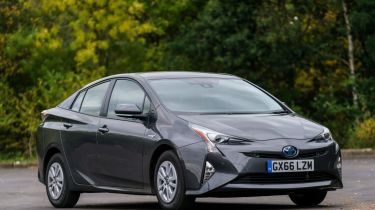
The Mk4 Prius was well-received as soon as it launched; it scooped the Green Award at the Auto Express New Car Awards 2016 and followed this up with two consecutive golds (2016 and 2017) in our sister site Carbuyer’s New Car Awards for Most Economical Car and Best Hybrid Small Car. It takes a very special car to claim so many titles in such a short space of time, and there’s no doubt that the Prius is just that, with its impressive ease of use, dependability, efficiency and distinctive design.
In addition, Toyota’s new 10-year retrospective warranty means that all cars under 100,000 miles can still be covered. Having a service at a Toyota main dealer gives you a year’s top-up warranty cover, which offers added peace of mind, not that you’re likely to need such reassurance.
If one car is synonymous with hybrid tech, it’s the Toyota Prius. Many people assume this was the UK’s first petrol-electric model, even though the original two-seater Honda Insight beat it to market by a few weeks. The Insight is long forgotten, though, and even the more practical second-generation version of the Honda has come and gone.

Models covered
- • Toyota Prius Mk4 (2015-2022) - Award-winning hybrid is dependable and efficient, but not cheap to buy used.
Toyota Prius Mk4
History
The original Toyota Prius hit UK showrooms in 2000 (having been launched in Japan in 1997). Its successor followed in 2003 and the third-generation model came in 2009.
Used - available now

2020 Toyota
Prius
52,915 milesAutomaticPetrol1.8L
Cash £17,475
2020 Toyota
Prius
42,384 milesAutomaticPetrol1.8L
Cash £17,000
2020 Toyota
Prius
76,219 milesAutomaticPetrol1.8L
Cash £17,295
2018 Toyota
Prius
84,750 milesAutomaticPetrol1.8L
Cash £11,499Toyota opened the order books for the Prius Mk4 in November 2015, with the first cars being delivered to owners in March 2016; a Plug-in model arrived a year later.
All versions featured a 1.8-litre petrol engine that was boosted by an electric motor fed by its own battery pack; power was sent to the front wheels via a continuously variable (automatic) transmission. The battery is bigger in the plug-in hybrid model, and can be recharged from the mains to give an all-electric range of 34 miles.
A revised Prius was shown in late 2018, and the first cars reached dealers in spring 2019. For the first time ever there is a four-wheel-drive option (largely unnecessary for UK buyers), as well as better smartphone connectivity and a light exterior refresh with a cleaner front end. The Mk4 Prius was replaced by the sleeker Mk5 in 2022.
Toyota Prius Mk4 reviews
Which one should I buy?
There aren’t too many decisions to make when working out which Prius is right for you, because you’ve got just two powertrains to choose from (the Plug-in and the regular hybrid) and four trim levels – or just two for the Plug-in model (Business Edition Plus and Excel), which now carries less of a premium over the regular Prius. The difference is minimal on the used market, as the hybrid models seem to have kept their value better than the plug-in hybrids.
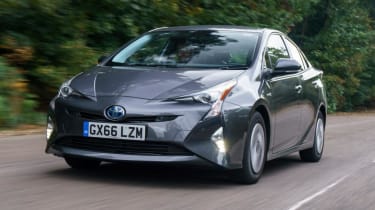
The entry-level Active trim on the regular Prius offers 15-inch alloys, LED headlights, a reversing camera, dual-zone climate control and electrically folding door mirrors.
Business Edition adds wireless phone charging, a blind spot monitor, heated front seats, upgraded trim and a colour head-up display. Business Edition Plus features self-parking and 17-inch rims, while Excel brings leather trim and an upgraded JBL stereo.
Alternatives to the Toyota Prius Mk4
If you want a hybrid that isn’t a plug-in, two worth considering are from within the Toyota fold: the C-HR and the Lexus CT 200h, both of which use a powertrain similar to the Prius’s. The CT is getting on, but the C-HR looks hi-tech and is a great car that’s let down by a lacklustre transmission. The latest Toyota Corolla also uses this hybrid engine, and both it and the C-HR are also available with a more powerful 2.0-litre hybrid powertrain.
Don’t fancy a Toyota? The Hyundai Ioniq looks more conventional than the Prius and is a little cheaper, although its hybrid drivetrain isn’t quite as sleekly integrated. There are plenty of hybrid SUVs, too, such as the Ford Kuga and Honda CR-V, plus a wide range of plug-in hybrid family-size SUVs.
What to look for
Safety kit
Blind spot monitor and rear cross-traffic alert are standard on all models, with the exception of the entry-level Active.
Spare wheel
Every Prius has a space-saver spare tyre as standard, but a full-size wheel can be made to fit if you would like the added peace of mind.
Tech
Useful features such as auto high beam, pedestrian detection, lane departure warning and adaptive cruise control are standard across the range. The infotainment system could be more intuitive to use, but models from 2020 get Apple CarPlay and Android Auto so you can use your phone’s apps if you prefer.
Safety rating
When Euro NCAP crash-tested the Toyota back in 2016, it declared it the safest large family car available to buy.
Interior
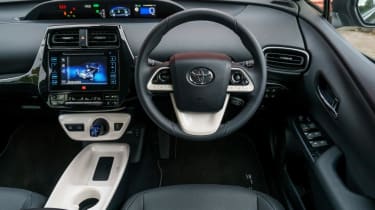
The dash design is certainly interesting, but is somewhat confusing initially. The quality is good rather than excellent, although it must be said that refinement levels are superb.
Cabin space is good overall, but the Plug-in model has just two rear seats, and headroom comes at a premium because of the sloping roof. Boot capacity is pegged at 297 litres with the seats up, or a tiny 191 litres for Plug-in models (both measured to the parcel shelf). That’s some way off a petrol-powered family hatchback like the Ford Focus or Volkswagen Golf, which both offer around 380 litres.
Running costs
Whether your Prius is a Plug-in or a regular hybrid, it’ll require maintenance every 12 months or 10,000 miles. The initial sequence is Intermediate (at £185) then Full (£335), but at 60,000 miles and then again at 100,000 miles the car needs a Full Plus service, which costs £395.
At five years old, a Prius qualifies for Silver (£120) and Gold (£200) services, under Toyota’s Essential Care discounted maintenance programme for older models.
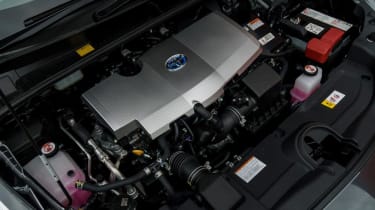
There’s no cambelt fitted, but at 100,000 miles or 10 years the coolant needs renewing, with fresh brake fluid required every two years or after 20,000 miles. The cost of these is included in the relevant service.
Recalls
The Prius Mk4 has been recalled six times; the first in November 2016 was for a potential parking brake failure on 4,617 cars. A week later, 691 models were called back over a front passenger airbag issue - and a similar recall happened again in September 2019 for many different Toyota models. In December 2017, three cars were recalled over a faulty hybrid powertrain capacitor. A campaign in September 2018 addressed a potential fire risk in 32,000 UK examples of the Prius and Prius Plug-in, as well as the C-HR hybrid. December 2019 saw a recall for cars produced in a two-week window in the July of that year, and the latest was in June 2020 for inspection of the ECU.
Driver Power owner satisfaction
An impressive fourth place in our Driver Power 2018 new car survey shows how supremely accomplished the Prius is. It notched up quite a few top-five places – including for its engine and transmission, safety, running costs and reliability – while ride and comfort were also highly rated by owners. The lowest score the car received in the poll was for practicality. Toyota, meanwhile, continued its strong performance in our 2020 manufacturer’s list, coming sixth out of 30.
Toyota Prius (2016-2022) review: what we said
Extracts from our 2022 in-depth review of the Toyota Prius...
Toyota is on good form with the Mk4 Prius. The manufacturer has added more versatility to a car that was already a low emissions champion, and the issues that affected its predecessor have been addressed to the point where the Prius is one of our favourite ‘green’ cars. It’s seen off challenges from other eco models including the hybrid Kia Niro SUV and Hyundai Ioniq, as well as being a genuine alternative to a conventional family hatchback.
About the Toyota Prius
Hybrids have to deliver impressive efficiency, and the Toyota Prius has 25 years of development behind it to perfect the formula. It’s pricier than some newcomers, but it has a generous spec, plus its cabin is spacious and there's plenty of boot space, which makes it a viable family car.
The latest Prius also serves up decent performance, while the ride is also more refined than ever. Four generations of development mean this is the most complete hybrid yet, but that bold exterior styling won’t be to everyone’s taste.
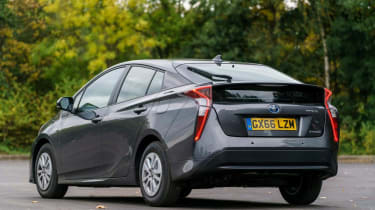
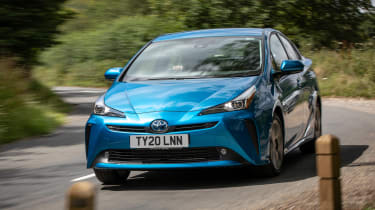
Toyota knows this, and smartened up the Prius’ styling in a 2019 facelift. The new car gets slightly more conventional-looking headlights, while the tail-lights now stretch horizontally across the bootlid rather than scything downwards towards the bumper. Most Prius styling cues, like the sloping roof and split rear windscreen, are still present and correct.
Inside it’s similarly unusual, although previous Prius owners will feel right at home. With the speedometer and driving information places nearer the windscreen, there’s a big expanse of dashboard right behind the steering wheel. This helps the car feel quite spacious. Toyota’s infotainment system is still far from the best around, but happily it now includes Android Auto and Apple CarPlay so you can use your phone’s operating system and apps rather than Toyota’s.
All cars come with a lot of equipment, like LED headlights, multi-zone climate control and a reversing camera. Toyota’s Safety Sense 2 driver assistance package is standard, too, and this includes lane-departure warning, high-beam assist and adaptive cruise control.
While the looks of the current Prius will be a little too out-there for some buyers, the running gear underneath is good enough that the Prius could be considered as a rival to a number of compact family cars. The main Prius rivals that use a similar petrol-electric hybrid set-up are the Kia Niro and Hyundai Ioniq, while a hybrid version of the Ford Mondeo only demonstrates how much further down the line Toyota is with its hybrid tech than other mainstream makers.
But as fuel economy is favourable, the Toyota Prius can also be considered when compared to conventional diesel hatchbacks. Because the Prius has been designed around its hybrid running gear, there's no compromise on interior space, and you could consider a Prius alongside cars such as the VW Golf, Ford Focus and Vauxhall Astra, as well as the rest of the compact hatchback fraternity.
Over time, the Toyota Prius has become the definitive hybrid car for sale in the UK today. With more than 20 years of development to its name, plus a look and image that means it's instantly recognisable, it's one of those cars that is known by a single name if you tell people outside the world of cars that you 'drive a Prius'.
Its ubiquity has been accelerated by its use by private hire and ride hailing companies across the world, where its reliability and quiet running on battery and petrol power have stood it in good stead. The range has expanded to include the range-extending Prius Plug-in, while the petrol-electric tech has found its way into other Toyota and Lexus models, so much so that diesel power has pretty much been entirely replaced.
The Toyota Prius Mk4 is based on Toyota's mid-size car platform that's also used on the C-HR crossover and latest Corolla. This gives the Prius surprisingly engaging handling, even on the narrow energy-saving tyres that are fitted as standard. The low-slung driving position and compact shape also add to this sporty feel.
Power comes from a 97bhp 1.8 VVT petrol engine combined with a 71bhp electric motor, while a 1.31kWh battery is stowed under the platform to store energy from braking and the electric motor. All cars get a CVT auto, but while past cars have been hindered by the slow responses of the gearbox, it's much better in the current Prius. Front-wheel drive is standard across the range, although a four-wheel drive Prius is now available from 2019 onwards.
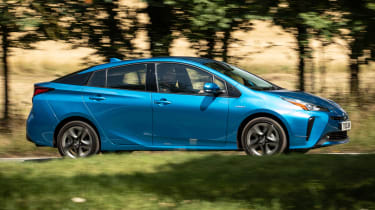
Engines, performance and drive
Fundamental to the Prius is Toyota's TNGA platform that has also been seen in the C-HR SUV and Corolla hatch. Due to cost savings in rolling out the same platform to various models, Toyota has been able to invest in making it extremely hi-tech from the outset.
One of the biggest benefits is that this platform is more dynamic, giving the Prius an agility on the road that previous models could only ever dream of. It’s backed up with light steering that gives more feedback and accuracy than previous Prius models, strong brakes and less body roll.
Don’t go thinking the Prius has become a sporting saloon or hatchback like the BMW 3 Series plug-in hybrid or Volkswagen Golf GTE overnight, though. It’s still noticeably lagging behind those cars, but it is a vast improvement on the soggy handling of previous Prius models. The Prius steers sweetly and rides with composure. Part of this is due to the smaller 15-inch wheels, but the chassis set-up also feels softer without compromising grip or dynamic ability.
The Prius Mk4 is also more refined to drive than before thanks to increased sound insulation, a new CVT (continuously variable transmission) gearbox that doesn’t ask the engine to rev as much as before, and the hybrid system spending more time running on silent electric power.
Around town the Prius often uses electric power alone to zip around the streets, but head outside of the city, and the petrol engine kicks in. The transition between electric and petrol power is near silent with only the real noise intrusion into the cabin being from the super-eco tyres.
Like the last model, the Prius has three distinct driving modes – ‘normal’ gives a suitable balance between fuel economy and throttle responsiveness; ‘eco’ optimises the powertrain and air conditioning to save fuel; while ‘Power’ mode gives more acceleration.
Like the standard Prius, the Plug-in is based on the brand’s TNGA architecture and has a transversely mounted 1.8-litre petrol engine hooked up to an electric motor, both of which drive the front wheels via a continuously variable transmission. Elsewhere, Toyota’s new Dual Motor Drive allows the car to use the hybrid system’s generator as a second motor when extra power is needed. The lithium-ion battery is under the boot floor and weighs a hefty 120kg.
The strut front suspension and double-wishbone rear axle are carried over, but the springs and dampers have been stiffened to cope with the extra weight, plus there’s a thicker front anti-roll bar. Despite the suspension changes, the Plug-in doesn’t handle as sweetly as its hybrid cousin, particularly during sudden direction changes, where the weight of the battery pack in the rear upsets the car’s composure. However, take things easier and the Prius feels more composed, with well weighted steering and decent grip from its eco tyres.
On the motorway the PHEV delivers a supple ride and low wind noise, but around town the stiffer suspension results in more bumps and jolts being felt.
0-60 acceleration and top speed
As in the old model, the Prius’s hybrid system features a 97bhp 1.8-litre VVT-i petrol engine. However, the unit has been re-engineered to deliver significantly better fuel economy.
The combined petrol engine and electric motor power output is 121bhp, allowing the Prius to cover the 0-62mph sprint in a reasonable 10.6 seconds. City driving is where the Prius is most at home as it can rely upon its electric motors adding zip to its performance, but it’s less comfortable at high speed. On the motorway, for instance, overtaking acceleration from 50 to 75mph takes a slow 8.3 seconds, while the top speed is only 112mph.
The Mk4 model is also the first Prius that can pull a trailer – it has a 725kg towing capacity (braked and unbraked).
Part of the problem with older versions of the Prius was that the CVT gearbox sent the engine revs sky-high when you tried to accelerate. With a bigger boost from the electric motor to help out in this current car, and a more advanced gearbox, the unit doesn’t give that ‘rubber band’ elastic feel as you work the accelerator.
A more refined engine also means that the Prius’s power delivery is smooth, and the lack of gears ensures there isn’t a noticeable step in the delivery, merely plenty of smooth torque. As a result, the powertrain always feels one step ahead of what you’re asking for.
The Plug-in Prius uses the same petrol engine but has a bigger battery capacity - and thus a little more weight. That means that while it can travel for longer on electric power alone (after being plugged into a socket), it is slightly slower off the line by half a second.
Thanks to the well integrated electric motors and CVT box, the Prius Plug-in has no trouble keeping up with traffic. Apply the throttle gently and it uses battery power to seamlessly assist the petrol motor; stamp on the pedal and the box sends the revs soaring.
We managed 28 miles on a full charge when we tested the Plug-in model, which is 11 miles short of Toyota’s claims. Crucially, you can use the driving modes to retain charge in the battery, which will be useful if you have a journey that involves some motorway miles followed by a drive across a city.
In pure electric mode the Prius pulls strongly and can cruise up to a maximum of 84mph. Better still, when the cells are depleted the transition to petrol power is smooth and quiet.
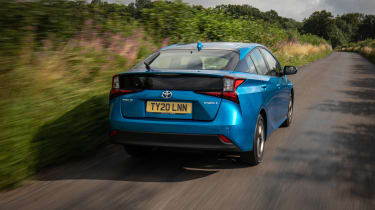
MPG, CO2 and Running Costs
The main reason you would buy a Prius is that it’s a hybrid and, in theory, a hybrid equals great running costs. The Prius certainly delivers impressive mpg and emissions figures, especially on the standard 15-inch wheels, which are available across all trim levels if you want the best economy. Most trims also give you the choice of 17-inch alloy wheels, with a slight efficiency penalty - you can expect almost 60mpg from models with the bigger wheels, and up to 67mpg for standard versions. Choosing the all-wheel-drive Prius AWD will reduce the maximum fuel economy to 58mpg.
These are figures that very few diesel cars can match, let alone petrol models. The Prius is also slightly more economical than its nearest hybrid rivals, the Kia Niro and Hyundai Ioniq.
Whether you’ll reach anywhere near those claimed economy figures will depend entirely on how and where you drive your Prius. The Prius is a common sight in big cities, and this is the best environment for the car.
For those who commute mostly in and around the city, you should be able to hit in excess of 70mpg if you are light with the throttle and use EV mode often. However, if you use a lot of motorways or fast A and B-roads, you’ll be looking at around 50mpg.
The Prius features an EV button, but there’s not much point in using it. Toyota admits this function is a hangover from the first hybrids, with the US market wanting an all-electric mode at the touch of a button. The Prius boosts efficiency by using electric power to support the petrol engine, rather than replace it, so it’s best to let the software intelligently manage the switch between the two modes.
Long-term running costs have been particularly good on older Prius models and the latest one should be no different. The Prius has earned itself a reputation – especially from fleets – for being cheaper to run than conventional cars in some cases.
Due to it being a hybrid, owners have reported replacing fewer consumable items like brake pads compared to normal petrol-engined cars, while the fringe benefit of Toyota's rock-solid reliability is also a major factor in these low running costs.
If you’re after the ultimate in fuel efficiency, though, the regular Prius can be trumped - and in some style - by the Prius Plug-in. It uses lithium-ion batteries to store more electricity for the car’s systems, and can therefore travel for up to 30 miles without firing up the combustion engine at all. That makes it a perfect tool for those who spend most of the week driving around town, but who need to make longer journeys from time to time. Unlike the Hyundai Ioniq, though, there’s no electric Prius version.
There’s no denying the benefits of that larger battery, too, because it plays right into the hands of the official fuel economy and CO2 tests. In the old tests, the Prius Plug-in returned 283mpg and 22g/km of CO2, but under WLTP tests these figures are now 235mpg and 28g/km. Whichever figures you use, it must be said that you’ll have to drive in a very specific, gentle fashion if you’re to get close to matching those fuel consumption numbers in the real world.
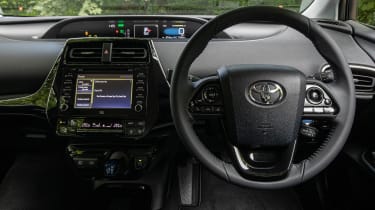
Interior, design and technology
The Prius’s sharp styling is in stark contrast to its predecessor, but many of the design flourishes also serve a purpose when it comes to aerodynamic efficiency.
At the front, the bonnet drops away, while the bumper features two defined creases at either side to give the Toyota a sharp leading edge. This helps the car cut through the air with the least resistance possible, and other details such as the squared-off tail and relatively low roofline ensure it has a low drag rating.
This hasn’t come at the expense of visual interest, though. While the Toyota’s looks won’t be to everyone’s tastes, and are potentially more divisive than rivals such as the Ioniq and Niro, there’s no denying they make an impression. Neat features such as the thin S-shaped LED tail-lamps, bright running lights plus striking slashes and vents mean the Prius makes a statement.
If you thought the outside of the Toyota Prius was wacky, the inside is just as mad. Toyota has continued the styling theme into the cabin with a shapely, futuristic design. Yet unlike the Mk3 Prius, it doesn’t feel forced, and neither does it ask you to compromise when it comes to practicality or equipment.
The Prius is not a sports car, so the dashboard doesn’t wrap itself around the driver; it doesn’t feel cosy for either front seat occupant. Instead it feels like you’re on the deck of a spaceship, with a 'floating' upper screen containing all sorts of driving information.
In the centre of the dash is a touchscreen infotainment system. It runs Toyota’s Touch 2 system which is very easy to use; the only real complaint is that there are touch-sensitive buttons around the screen for different menus and functions, but they need a firm prod to work and sometimes require you to take your eyes off the road to operate them. We’re glad Toyota has finally fitted Android Auto and Apple CarPlay as standard, so you can skip the outdated Toyota system and use your phone’s features instead - including navigation.
There are some clever touches inside too, such as the passenger air vent – this only blows air when it senses a passenger sitting there, otherwise it shuts off to help save fuel. The driving position is greatly improved over older Prius models – the seats are firm but supportive and thanks to plenty of adjustment in the seat and in the steering column, it’s easy to get comfortable.
Overall cabin quality is improved over previous Prius models. The upper part of the dashboard is covered in squidgy soft-touch plastic on ‘Business Edition’ models and above, but from the middle to low parts of the cabin, there are lots of the scratchy plastics.
It feels well screwed together, but we’d guess it wouldn’t take too long for some of the materials to mark. The low dash makes it feel spacious inside, while material quality is good. Most surfaces are covered in soft-touch plastic, while white inlays also brighten the interior.
There are four trim levels. ‘Active’ is the entry grade, but it’s well equipped and comes with dual-zone climate control, keyless entry (driver’s door) and start, Toyota Touch 2, DAB radio, driver’s seat electric lumbar adjustment, adaptive cruise control, road sign assist, lane departure alert, automatic high beam lights and forward collision warning with autonomous emergency braking. There are also 15-inch alloy wheels and LED headlights.
‘Business Edition’ is, unsurprisingly, aimed at business users and adds the plusher, soft-touch plastic interior, a wireless phone charger, a colour head-up display, blind spot monitor, rear cross traffic alert, heated front seats, a leather-covered steering wheel and auto-dimming rear view mirror.
‘Business Edition Plus’ comes with 17-inch alloys, Toyota Touch 2 with Go (sat-nav), park assist and front and rear parking sensors. Top-drawer ‘Excel’ is more designed for the private buyer, and has leather seats, an upgraded JBL stereo, rain-sensing wipers and an upgraded Touch 2 system with sat-nav and more internet connectivity functions.
The Plug-in Prius is largely the same as the standard hybrid, but all-new front and rear treatments mean it’s even more distinctive. And the revised design goes more than skin deep. For example, the tailgate is constructed of lightweight carbon fibre-reinforced plastic, plus you can add a £1,500 solar roof panel to help charge the batteries when the car is parked or on the move.
Inside, the Plug-in looks almost identical to the normal Prius. The quality of the materials isn’t up to the standard of a VW Golf’s, but the Toyota’s cabin is solidly built and the bold design helps it stand out from its conservative rivals.
Sat-nav, stereo and infotainment
There's a seven-inch touchscreen in the Prius, but it’s not as sharp or as clear as the display you'll find in a Hyundai Ioniq. The glossy screen also picks up fingerprints and is harder to view in bright conditions, because it shows more reflections.
The nav system is easy enough to use, but the menu layout is clunkier than the Hyundai’s app-like icons that mean it works more like a smartphone. The Prius’s unit also isn’t quite as responsive as the Ioniq’s, while the live traffic information isn’t as accurate, either.
There are plenty of driver coaching features to maximise efficiency, including a data logger that shows you how efficiently you've been driving in terms of a percentage score, which you'll soon be trying to improve on with every drive. Wireless phone charging is also a nice touch, yet the whole system lacks a little polish.
Only range-topping Business Edition Plus and Excel models come with the upgraded premium JBL sound system, and it’s not available on other models even as an option.
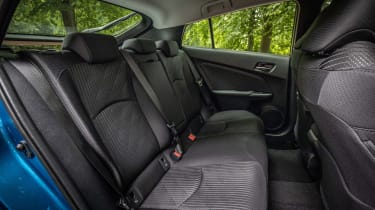
Practicality, comfort and boot space
Storage is decent in the Prius. The white tray in the centre console is a good place to store smartphones, and in ‘Business Edition’ models and above this tray adds an induction phone charger, so you can place a compatible device there to charge up without having to plug it in. The glovebox is large enough for a one-litre bottle of water, and under the armrest between the two front seats is a large cubby that can store all sorts of things like sweets and other paraphernalia.
Size
The Prius is 4,575mm in length, 1,760mm wide and stands 1,470mm tall, which means it's a little longer than a Hyundai Ioniq or a Volkswagen Golf, but not quite so wide as either of these hatchback rivals.
Leg room, head room & passenger space
It’s spacious up front thanks to plenty of headroom and a dashboard that sits away from the driver. In the back, however, while kneeroom is good and you can fit three people at a squeeze, headroom isn’t the best. This is due to Toyota relocating the Prius’s battery from the boot to under the rear seat. Consequently the rear seats sit high, and when combined with the sloping roofline, this means headroom is reduced. It’s a shame Toyota didn’t think more about this, especially given Prius’s popularity with private hire drivers.
Boot
Moving the battery now means the boot is larger, although it’s still less generous than a family hatchback like a Volkswagen Golf. There are 343 litres with the seats up (a Yaris-rivalling 297 litres with a space saver spare wheel) and this grows to around 1,400 litres with the seats down. The boot area is also wide and square with no awkward protrusions spoiling the space on offer.
With just 191 litres of boot space, the Prius Plug-in is way down on that offered by its standard hybrid sibling and the 341 litres in the Ioniq PHEV. That deficiency is due to the enlarged battery pack that takes up space under the boot floor, and although there’s a little flap to store the charging cables, this impact on practicality is disappointing for a family car.