Best Aston Martins - the legendary British brand’s all-time greats
The British sports car brand has given us some bonafide classics down the years and these are the best of the best

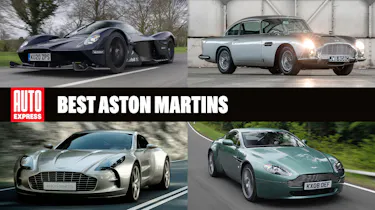
The Aston Martin brand has certainly had its fair share of ups and downs. In many ways, that makes the succession of hugely capable and desirable grand tourers and sports cars it has churned out over the decades all the more impressive.
The list of Aston Martin’s full output is too great to cover in detail in one place, but certain models have certainly stood out over the years, and the brand’s recent diversification into everything from SUVs to road-going Le Mans cars shows that iconic cars from the past like the DB5 and V8 Vantage are far from everything Aston Martin has to offer.
We’ve whittled things down to ten cars that (more or less) represent our favourite Aston Martins of all time here at Auto Express – though ask us on another day and we could be easily swayed by several others.
Aston Martin DB5 (1963)
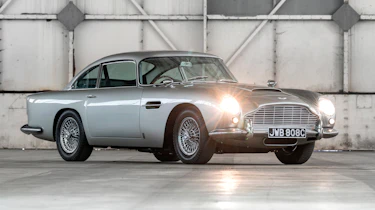
Despite the many brilliant cars Aston Martin has built since, it would be hard to argue that the DB5 isn’t still the most iconic of them all. But its fame isn’t built solely on the back of Hollywood starring roles (though that has undoubtedly been a significant contributor) – it was also a striking and talented GT, and a meaningful improvement over its visually similar DB4 predecessor.
In short, under the largely unchanged Carrozzeria Touring bodywork the DB5 gained a larger engine (4.0 litres up from 3.7), with triple SU carbs, a 282bhp output, and a new five-speed gearbox. Disc brakes from the high-performance DB4 GT ensured it stopped as well as it went, though in retaining a live rear axle, the DB5 still wasn’t as sophisticated as the Jaguar E-Type that had arrived a few years beforehand.
Like in the Jaguar, performance that was ample in the 1960s proves to still be enough to get along quite nicely in modern traffic – even early cars are making near-hot-hatch levels of power, although it’s not as easily deployed. You could still quite happily tour Europe in one – it’s no wonder later James Bonds played by Pierce Brosnan and Daniel Craig were, despite much more modern cars being available, still happy to hop behind the wheel of a DB5 now and then.
Aston Martin V8 Zagato (1986)
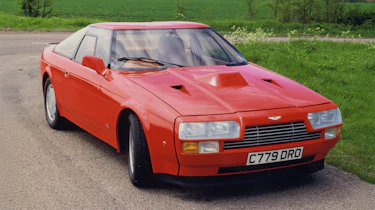
One of Aston Martin’s more controversial models when new, the V8 Zagato of 1986 is today much better appreciated – not least by collectors, whose interest in the car pushes prices well into the realms of £200,000 and beyond. That has something to do with its rarity, as only 52 coupes and 37 convertibles were ever made.
The V8 Zagato was based on the V8 Vantage that had debuted in the late 1970s. The Milanese coachbuilder’s sleek, modern, and surprisingly compact handiwork is perhaps one of its better efforts – high on presence, low on ornamentation, and topped by a glassy cabin that was distinctly more modern than any other Aston of the period.
With a 432bhp variant of Aston Martin’s 5.3-litre V8 (responsible for that power bulge in the bonnet) it wasn’t short on performance. A 186mph maximum speed was beaten only by cars like the Porsche 959 and Ferrari 288 GTO at the time, while magazines recorded 0-60mph times of under five seconds. Yet it handled too, being more agile than the base car without any nasty habits.
Aston Martin Vantage (1992)
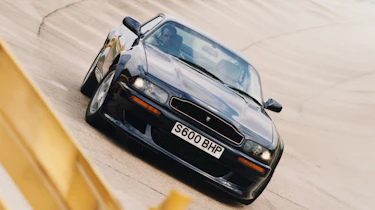
1992’s Aston Martin Vantage was the product of rapid evolution, starting with 1989’s Virage. Following on from the V8 Vantage of the 1970s, the Virage had a more rounded, sleek look than its predecessor but retained the company’s own V8, in 5.3 litre form. That made it a brisk performer for the time, with 330bhp and 364lb ft of torque.
Follow-ups came in quick succession. First was the drop-top Volante in 1990, then the brutally powerful Virage 6.3 in early 1992 that was built by Aston Martin Works Service and put out the best part of 500bhp. But 1992’s Vantage was the real refinement, with a more muscular yet also cleaner appearance and, not insignificantly, a pair of superchargers strapped to the V8, for 550bhp.
It was a monster, capable of 186mph despite the bluff styling, and you needed to work hard to make it dance in the corners. But as a powerful touring machine it had all the right ingredients, and anyone still not satisfied could hand their cars back to Works Service for the V600 upgrade. You can probably guess how much power (and torque) that one produced.
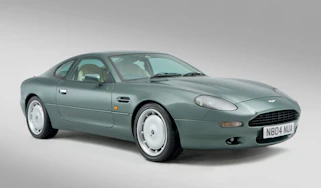
Aston Martin DB7 (1994)
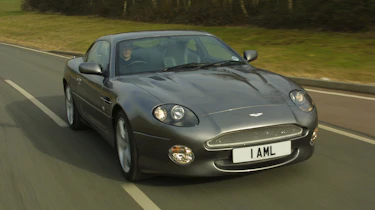
In retrospect the Aston Martin DB7 doesn’t seem like quite the renaissance for the brand that it did in the mid 1990s - instead, that came at the turn of the new millennium with first the Vanquish and then the subsequent ‘VH’ platform cars. But the DB7 still became a new best-seller for the brand. It was arguably the most beautiful car Aston Martin had built in decades, and that counts for a lot.
The balanced, delicate lines were the work of Ian Callum, and the car was originally envisaged as a Jaguar – a replacement for the XJS, which itself had followed on from the E-Type. Cost concerns at Jaguar saw Aston Martin pick up the project instead, and while not exactly rolling in money itself, clever parts-sharing (rear lights and interior door handles were Mazda, a lot of switchgear was Ford-sourced) and a supercharged version of Jaguar’s AJ inline-six kept costs down. The car was presented at the 1993 Geneva show, and put into production following a positive reception.
Driving one today is a pleasure. It’s very much a grand tourer rather than a sports car, but whether powered by six or twelve cylinders (the latter arriving with the V12 Vantage in 1999) the DB7 is a luxurious yet surprisingly interactive cruiser. And while Aston Martins today look a lot different, not many since have been as easy on the eye.
Aston Martin Vanquish (2001)
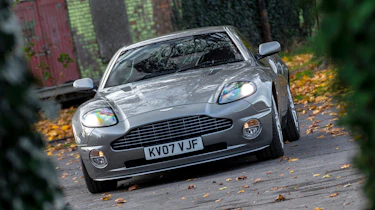
This was the point at which the story of the modern Aston Martin started. Powerplant aside (a development of the V12 used in the V12 Vantage a few years earlier) the Vanquish was a completely clean sheet: Styling once again by Ian Callum, a brand new aluminium structure, an automated manual transmission, and performance and handling that made it more of a front-engined supercar than a lazy GT.
The Vanquish had been previewed by a concept known as Project Vantage as far back as 1998, and when the production car debuted in 2001, little had changed visually – this was a far more pumped-up shape than the svelte DB7, indicating its higher standing in the range (technically, it was a replacement for the brutal old Virage).
The 5.9-litre V12 made 460bhp, up from 420bhp in the V12 Vanquish, and it delivered an angrier engine note to go with it - in fact, it was significantly more vocal than the contemporary Ferrari 550 Maranello, and could give the Ferrari a hard time in the corners too. The ‘waterfall’ dash and slightly patchy interior quality were less successful but Aston did improve them over time. The Vanquish went on to influence the look and feel of 15 years of Astons to follow.
Aston Martin V8 Vantage (2005)
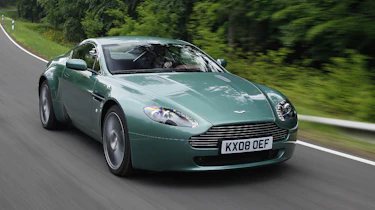
In Aston Martin’s timeline the V12-powered, DB7-replacing DB9 followed the Vanquish, but the V8 Vantage of 2005 was arguably the more significant car, with no real predecessor – despite its revival of the Vantage name. It was Aston’s smallest model at the time, more of a sports car than a GT, and priced to tread on the toes of cars like the Porsche 911.
It was probably the best Aston Martin yet. For a start, it looked (and still looks) spectacular. It cribbed details from the Vanquish and DB9, but the more compact dimensions, scalloped sides and slim glasshouse gave it real attitude. The brand continued to make quality improvements too: the DB9 had been a big step on from the Vanquish, but the V8 Vantage was better still.
And what a V8. We now know that the later 4.5-litre unit offered a welcome extra dose of torque, but the 380bhp 4.3 sounded glorious, with a racer’s bellow and the angry edge of something American from the 1960s. It really handled too, the shorter, stiffer, lighter platform compared to the DB9 and Vanquish giving it a nimbleness alien to most Aston Martins.
Aston Martin One-77 (2009)
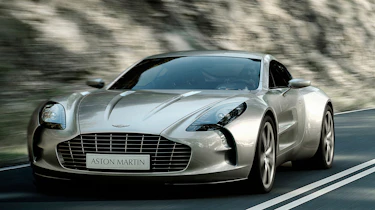
This was, famously, the £1.2million car launched on the back of one of the worst global recessions in history. It seemed like a case of unfortunate timing, but as the past few decades have shown, never underestimate the buying power of the super-rich, who seem effectively immune to the issues faced by the rest of us. Aston Martin did not struggle to sell all 77 examples, setting the scene for several special Astons to follow.
It was no cynical cash-grab though. There might have been visual similarities to other Astons but the One-77 used a custom carbonfibre monocoque structure rather than the aluminium VH platform (though the bodywork was indeed aluminium), and its engine wasn’t the now-familiar 5.9-litre V12, but a bespoke 7.3-litre unit developed by Cosworth.
A power output of 750bhp (meaning more than 100bhp/litre) still looks impressive today, and made it an absolute rocketship in 2009 – really, this was hypercar territory, with an estimated top speed around the 220mph mark. Like others of its ilk, it could be temperamental (the clutch wasn’t keen on low-speed manoeuvring) but as a driver’s car, or even just as a piece of art, it could certainly hold its own.
Aston Martin Valkyrie (2021)
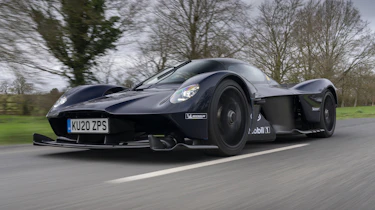
The term “race car for the road” has been overused to the point of deep mistrust over the years; most are nothing of the sort. If any recent model can claim it though, the Aston Martin Valkyrie is that car, given something really not far removed from the road car has competed at Le Mans and in the World Endurance Championship for the last few years.
Really, it’s the other way around. This is as much a racer converted for road use as it is a supercar given slicks and stickers for the track. That much is apparent when driving one on the road, as it’s quite an exhausting experience: excessively noisy and very temperamental. Do too much creeping in traffic on electric power, and it won’t have enough juice to restart itself, for example.
But the 11,100rpm Cosworth V12, aerodynamic components that stretch the entire length of the body, and the staggering performance when you’re really on it, all mark it out as very much a converted racing car. Take it on a track day, and regardless of what else was there, you won’t be overtaken much. For £2.3 million, you’d hope not.
Aston Martin DB12 (2023)
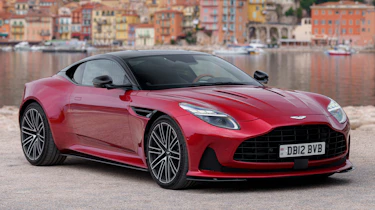
Aston Martin took some time to find its feet with the follow-up to the much-loved DB9. 2016’s DB11 was a bit of a shock to the system thanks to its all-new look, and while it was certainly competent and capable, it didn’t move the game on as much as everyone expected, and as much as some rivals had done. It did mark an interesting departure for the lineage though, when in 2017 it adopted a V8 engine.
When the DB12 arrived in 2023 it carried on with AMG-sourced twin-turbo V8 power, leaving twelve cylinders for the third-generation Vanquish. Some might see it as a step down but there’s no doubting the performance of the V8 (671bhp at launch, 690bhp with 2025’s DB12 S) and it’s not like the V8 doesn’t make fantastic noises, either.
More importantly, the DB12 is a bit more comfortable in its own skin, both in its styling and in the measured, enjoyable way it drives. The DB12 S goes even further, with improvements to its body control and steering for a more composed feel, while the cabin has only got better over the years as well. It has a balance between sporty handling and relaxed long-distance touring abilities that few companies beyond Aston Martin seem to truly understand.
Aston Martin Valhalla (2025)
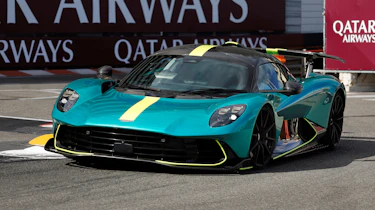
The Valkyrie was only ever designed as a limited-production and very specialised vehicle. The Valhalla meanwhile is, while not exactly mainstream, more Aston’s interpretation of a volume mid-engined supercar - an alternative to the likes typically offered by Ferrari, Lamborghini, and McLaren. And for what’s effectively a first effort, it’s very impressive indeed.
It had a somewhat tortured development, proposed in concept form as far back as 2019 but, thanks to Aston Martin’s ongoing struggles, the Valhalla seemed a little off-and-on for a while. It’s been worth the wait though. It looks spectacular for a start, very clearly related to the Valkyrie albeit less extreme, but it’s also simply great to drive.
The hybrid-assisted AMG V8 puts well over 1,000bhp to the road, though it has all four wheel-drive to help it, a rarity for Aston Martin outside of the DBX SUV. Performance is mighty but the handling is beautifully balanced and exploitable – you’d need a track to fully appreciate it, but it works great on the road too. If there’s one major flaw, it’s that despite this being a supercar you’d happily drive to far-flung locations, there’s no luggage space. You’ll need to send a DBX on ahead with your bags…
Get even more from Auto Express, follow our channels...
• Google
• Reddit
• Whatsapp