New BMW 3 Series 2026 review: too good for Audi and Mercedes
The new BMW 3 Series is everything we hoped it would be, with superb driving dynamics and a premium feel throughout


Verdict
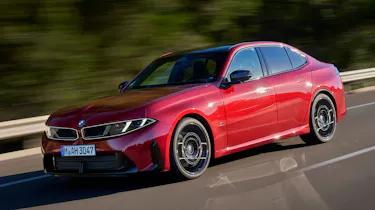
It’s no surprise that the BMW 3 Series retains its status as the best driving compact executive car, given the model’s history. However, this new M350 version has managed to improve the formula of the sports saloon to such an extent that some might wonder where the next M3 can go from here. The news is positive for the cheaper and potentially more rounded 320 too, and with more practical Touring versions en route, the 3 Series looks to be the car to beat in this segment of the market once again.
BMW has created such a fuss about the all-new, all-electric i3 that it’s easy to forget there’s a new generation of petrol-powered 3 Series to sit alongside it. The two cars share the same Neue Klasse looks and the same radical Panoramic iDrive interior set-up, but underneath they’re almost completely different.
Sitting on an updated version of the CLAR platform that the previous 3 Series came on, the new car is offered with mild-hybrid power, with the ever-popular 320 petrol kicking off the range at £44,975, followed by, for now, the hot M350 from £66,785. A plug-in hybrid version is coming to succeed the 330e and take on the Mercedes C 300 e PHEV in the process and, of course, at the top of the 3 Series tree will be a new generation of the iconic M3.
Used - available now

2026 BMW
3 Series
32,934 milesAutomaticPetrol2.0L
Cash £26,000
2022 BMW
3 Series
37,481 milesAutomaticPetrol2.0L
Cash £22,099
2020 BMW
3 Series
49,770 milesAutomaticPetrol2.0L
Cash £17,499
2020 BMW
3 Series
32,515 milesAutomaticPetrol2.0L
Cash £17,153The car we’re driving here is the M350, which replaces the old M340i. If you’re wondering where the ‘i’ designation has gone, BMW started to phase it out a few years ago (along with ‘d’ for diesel) in pursuit of a simpler naming strategy.
While the M350 looks identical to the i3 at first glance, it does have a slightly shorter wheelbase (as it doesn’t have to cater to a big battery within its chassis) and a longer bonnet. The latter can mainly be attributed to the M350 utilising that most typical of BMW engines, a straight-six.
It’s a familiar turbocharged 3.0-litre unit mated to a 48V mild-hybrid system. The generator for the hybrid power is crankshaft-driven, though, as opposed to the mild-hybrid in the 320, which is connected to the transmission. This is done to create quicker response to throttle inputs.
437bhp is the result (a touch more than the V8-powered E92-generation M3) and there’s a healthy 580Nm of torque, too. The M350 comes exclusively with BMW’s xDrive all-wheel-drive system, which helps it demolish the 0-62mph sprint in just 4.1 seconds and go on to a 155mph top speed. The M350 is 75bhp up on its main rival, the Audi S5, so unsurprisingly it hits the 62mph benchmark 0.4 seconds quicker. It’s also half a second quicker than the outgoing Mercedes-AMG C 43.
At 1,860kg, the M350 weighs 100kg more than the old M340i. We were told that the majority of the weight gain comes via the mild-hybrid system, plus the inclusion of an expansive panoramic glass roof as standard. However, it still beats the old car to 62mph by 0.3 seconds. As the ‘dynamic pinnacle’ of the 3 Series line-up, according to BMW, the M350 has to be much more than simply the fastest in a straight line.
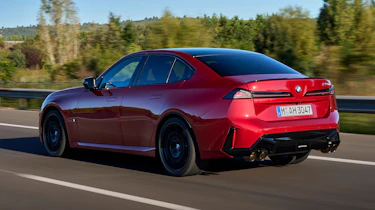
Before jumping into the range-topper of the combustion-engined 3 Series line-up, you notice the usual array of M-specific detailing. There’s a set of aggressive-looking quad-exhausts to the rear, a unique bodykit design, M-branded wheels in either 19-inch or 20-inch sizes and distinctive yellow signatures within the headlights.
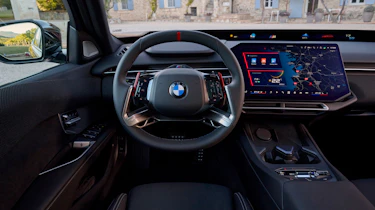
Inside, there’s more exclusive detailing for the M Sport model – a 320 M Sport is also available – including leather M Sport seats and back-lit ambient lighting in the M tricolor, cleverly integrated within the dash. The most important is the two-spoke M steering wheel, which replaces the overly fussy and awkwardly shaped standard one. There are also red paddle shifters behind the wheel, and a red 12 o’clock marker, just to remind you that this is no ordinary 3 Series.
The rest of the interior is almost identical to other Neue Klasse BMWs, such as the iX3, iX5 and the recently launched fifth-generation X5. Despite the smaller size of the 3 Series compared to those models, BMW has seamlessly integrated the same Panoramic iDrive display that sits at the base of the windscreen. The widescreen display is highly configurable, with the central section and passenger side providing space for customisable widgets, ranging from weather, driving data, calendar, throttle input, steering angle, rev counter and much more besides.
In front of the driver there’s no separate display; instead the Panoramic iDrive displays driver-oriented information such as speed, revs, range and the gear. In the M350, there’s a head-up display as standard, while on the 320 it comes as part of a £2,000 Technology Pack that also adds three-zone automatic air-conditioning and a Harmon Kardon sound system. We’d think twice about having the head-up display in the lesser models, however. It’s fine in terms of its layout and doesn’t distract like other head-up displays, but the information it shows is often replicated on the Panoramic iDrive and the huge 17.9-inch touchscreen, to the extent that many will consider it unnecessary.
The touchscreen controls almost all the 3 Series’ functionality and BMW says it’s taken care to ensure the most frequently used features are always readily available on ‘level one’ of the menu system. At the base, you’ll find a row of static climate controls, either side of the shortcut toggles for things like music, navigation, phone, driving modes and car settings. The responsiveness to inputs on the screen is fantastic; we never experienced a need to double tap, and loading times between the menus is instant, too.
It’s not perfect, though. There’s nothing to rest your hand on underneath the screen, so you’re reliant on the car’s ride to ensure you’re accurate with the touchscreen. Also the screen varies between left-hand drive and right-hand drive cars, angled to the driver in either one. Strangely, we’d prefer it if the left-hand-drive screen was fitted to right-hand-drive cars, because shortcut toggles for the likes of the speed limit warning and lane keep assist features are otherwise obstructed by the steering wheel.
The operating system for the latest iDrive does take a while to get your head around, though. It would take an extremely tech-savvy driver to simply hop in the 3 Series for the first time, and adjust the settings to their liking on the move. Despite the odd shape of the screen, Apple CarPlay and Android Auto – which are designed for rectangular displays – are incorporated well, with those climate controls and driver assist shortcuts still on show.
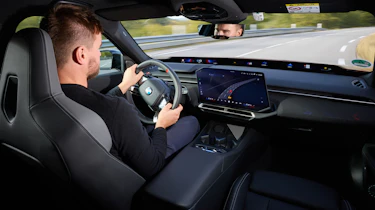
As for the rest of the cabin, the overall quality is as expected of a 3 Series. It’s not overly luxurious, but pretty much every surface has a premium touch with plenty of design flourishes to mark it out from its compact executive rivals. There are some elements we’re not sure about – for example, the seat adjustment buttons on the door should be on the side of the seats themselves for the sake of ergonomics. And compared to the classic steering wheel designs of BMWs of the past, the new options are a little fussy. But the crystal start button and volume knob clearly influenced by the iX, the aerated fabric upholstery and the frameless rear view mirror are all classy touches.
The 3 Series feels like a compact car from the driver’s seat, thanks to the wide centre console, angled displays and perfectly positioned steering wheel and pedal layout. There’s an extra 50mm of total body length and a wheelbase that is 10mm longer compared to the old 3 Series, but despite that, rear space isn’t great. The central tunnel obstructs middle seat legroom, while passengers in the outer seats don’t fare especially well in this regard, either. However, headroom, thanks to the panoramic glass roof, is perfectly fine for tall adults, plus the low window line creates a brighter environment than you might expect.
Over the previous two generations of 3 Series, boot space remained at 480 litres, which was better than the Audi A5 (445 litres) and Mercedes C-Class (455 litres). The new model sees a reduction to 450 litres and as the BMW is a proper saloon, the boot opening is narrower than you get on a hatch like the A5 Sportback.
With the previous 3 Series, BMW attempted to integrate some additional refinement and comfort to rival the C-Class, while retaining the excellent driving dynamics that the brand’s compact executive has become famed for. BMW purists will be pleased to hear that this ethos has been continued on the new model, with the promise of an ‘unmistakable driving experience’.
Setting off in the M350, we immediately headed into the tight and rather hectic streets of Marseille to see if the 3 Series was still at home in an urban setting, despite its slight increase in size. In the Personal driving mode – the others are M Sport, M Sport Plus and Efficient – and the steering is in its lightest Comfort setting, the BMW is pretty easy to place on the road and thread through traffic. The 5 Series, in certain guises, comes with rear-wheel steer, but you certainly don’t feel the need for that tech in the 3 Series. The Panoramic iDrive might take up a few inches of windscreen space, but it’s easy enough to see over the bonnet and rear visibility is pretty good, too.
At slow speeds, the mild-hybrid system is happy to take over from the engine for car park manoeuvres and during stop-start traffic, but the likes of the latest Audi A5’s MHEV tech is more keen to run in electric-only modes. Still, the straight-six is very smooth when it needs to cut in to provide that extra bit of power around town, as is the eight-speed automatic.
Our only slight gripe in town was the ride. Our car was fitted with the optional M adaptive suspension, which soaked up a decent amount of potholes and speed bumps, but the largest 20-inch wheels proved a limiting factor on rougher roads. You’d never say the 3 Series was noticeably uncomfortable, though.
Getting on to the motorway, the 3 Series has the immediate feeling of a car that’s ready to complete a cross-country excursion without any hassle. Despite the M350’s focus on performance with its own bespoke tweaks – which we’ll get to shortly – it’s a refined thing, with the gearbox keen to kick up a few gears (to mainly save fuel, but also reduce revs). At 70mph, it’ll be cruising along well below 2,000rpm.
The adaptive suspension is well calibrated. It doesn’t waft along like a 5 Series, and you can certainly feel the road surface, but it’s not draining. The steering stiffens up, too, so you’re not constantly making adjustments to your line. Although not the most fuel efficient at speed – you can coax out 40mpg if you’re careful – overall the new 3 Series, even in this harder-edged M350, is at the top of its class for long-distance driving.
As ever it’s the twisty stuff, particularly in this M350 form, where the 3 Series needs to impress. So rather than overhaul the 3 Series’ already very polished handling characteristics, BMW has tweaked various elements, introducing thicker anti-roll bars, a wider track, increased caster in the steering geometry and stiffer wishbone mounts.
Even around town, you get to grips with the 3 Series’ fundamentals very quickly, with perfectly weighted brakes and throttle calibration giving a fluid, natural feel. This means that within a few corners, you’re perfectly in tune with what the M350 is doing, giving you the confidence to really lean on the car’s grip levels, which are excellent thanks to its xDrive tech.
In M Sport mode, the steering wants to self centre a little more eagerly and there’s a touch more weight, but it’s still a doddle to use in normal driving and actually feels more aligned to the 3 Series’ size and mass. In our customisable Personal mode, we’d definitely have the steering in this setting all the time.
There’s tremendous responsiveness from the M350’s front end and you’ll have to really push on for any understeer to appear. That said, boot the throttle mid-corner and while the majority of the grunt is sent to the rear, it rarely unsettles the balance of the car. The anti-roll bars, which feature a pre-load function to counter body roll, keep the M350 remarkably flat, too.
If you really want to experience some tail-out hooliganism, the M350 will come with a Drift mode that decouples the front axle, just like the outgoing M3. Perhaps to the relief of residents on the rural fringes of Marseille, our 3 Series didn’t have this fitted, but customer cars due in spring next year are expected to have Drift mode.
The engine, which offers a tremendous breadth of flexibility from town driving to the motorway, is just at home on a thrilling backroad. The sound can be a little synthetic at times, although that’s an issue that arguably affects almost every turbocharged performance car right now. Those aforementioned paddle shifters produce quick enough gear changes that prioritise smoothness over any agitated, jerky shifts, although the paddles themselves are a little too plasticky and nowhere near the quality of the aluminium units that an Alfa Romeo Giulia offers.
Did you know you can sell your car through Auto Express? We’ll help you get a great price and find a great deal on a new car, too.
| Model: | BMW M350 xDrive |
| Price: | £66,785 (est) |
| Powertrain: | 3.0-litre 6cyl turbo petrol MHEV |
| Power/torque: | 437bhp/580Nm |
| Transmission: | Eight-speed automatic, four-wheel drive |
| 0-62mph: | 4.1 seconds |
| Top speed: | 155mph |
| Economy/CO2: | 37.2mpg/171g/km |
| Size (L/W/H): | 4,765/1,850/1,455mm |
| On sale: | Now |