Used Citroen C3 (Mk3, 2017-2024) review and buyer's guide
There's more to the Citroen C3 Mk3 than funky styling, the French supermini offers practicality, comfort and a decent amount of technology

Verdict
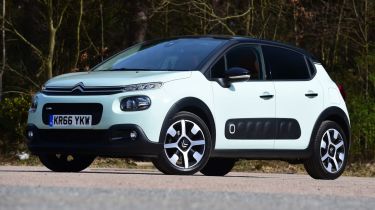
The C3 is Citroen's best-selling model across Europe, so it's a very important car for the brand, and the good news is that this third iteration is a much more compelling used option than its predecessors.
Although in our groups tests the Volkswagen Polo and Suzuki Swift came out as better buys than the C3, we found the Citroen more appealing than the Hyundai i20 and Nissan Micra, and you can hardly call those also-rans.
If there's one problem that Citroen has suffered from time and time again over the years, it's a reputation for poor reliability creeping in as its models age. However, while previous C3s could be worryingly fragile, the third take on the formula seems to be holding up much better, so while you still need to check any potential buy very carefully, the third-generation C3 is much more likely to be an easy car to live with and to own.
Citroen's history stretches back for more than a century, and when you look at which models stand out the most, you'll see that they have often been the smaller cars, such as the 2CV, Ami and Visa.

By the time the original C3 arrived in 2002, Citroen had lost its mojo and while this supermini looked distinctive it didn't really have what was needed to compete with key rivals.
Used - available now


The C3 Mk2 represented a step in the right direction, but it was third time lucky for Citroen's supermini, because it was with the Mk3 that things really came good.
Indeed, when we ran a C3 on our long-term fleet in 2017 we really warmed to it, with its roomy cabin, excellent comfort, distinctive design and high-tech interior. At last, here was a Citroen C3 that we could genuinely recommend.
History
The Citroen C3 Mk3 went on sale in the UK in January 2017, with buyers able to choose between 1.2-litre Puretech three-cylinder petrol engines in 67, 81 or 109bhp forms, or a 1.6-litre BlueHDi four-cylinder diesel with either 74bhp or 99bhp.
At first all engines came only with a manual gearbox, but within a month the Puretech 110 engine came with a six-speed automatic transmission option; this was the only engine offered in auto form.
The three trim levels were Touch, Feel and Flair, but from January 2018 there was also a Feel-based Elle edition, with a few cosmetic changes.
From August 2019 the line-up was switched to Feel, Origins and Flair Plus, then in June 2020 a facelifted C3 arrived with a refreshed nose, redesigned seats and extra driver-assistance systems.
The trim levels were rejigged once more in February 2021, to become Sense, Shine, C-Series and Shine Plus, with Shine being replaced by Saint James in October 2021.
The Mk4 Citroen C3 arrived in 2024 but the Mk3 car continued to be sold for a while alongside the newcomer, badged as the C3 Origin.
Which one should I buy?
Entry-level models (in terms of both engine and trim) are rare and best avoided. The Puretech 68 and even the Puretech 82 don't feel all that lively, while the Touch is rather spartan; it doesn't even have air-con. The automatic transmission blunts performance and you pay a big premium for one, so we'd stick with a manual gearbox.
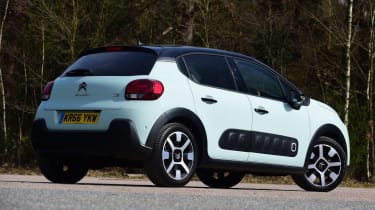
The C3 Touch comes with 15-inch steel wheels, Bluetooth, a DAB radio and cruise control. Move up to a C3 Feel and it'll have 16in alloy wheels, an extra pair of speakers (six instead of four), Apple CarPlay, climate control, powered windows front and rear, a 7in touchscreen and electrically adjustable door mirrors.
The range-topping C3 Flair brings automatic headlights and wipers, privacy glass, rear parking sensors and a camera, an integral dashcam, plus Airbumps on the doors for bodywork protection.
Alternatives
Perhaps the C3's biggest adversary is the Ford Fiesta, which is the consummate supermini with its roomy cabin, ready availability, excellent value and brilliant dynamics.
The Vauxhall Corsa is another big seller that's spacious and great value, while the Kia Rio and its cousin the Hyundai i20 play the value card heavily too, plus they come with long warranties.
The SEAT ibiza and Skoda Fabia are related to each other and they look smart, are good to drive and easy to live with. They're also related to the VW Polo, which costs more and it doesn't have the flair of the Citroen, but it's very safe and user-friendly.
Other contenders worth a look include the Nissan Micra, Peugeot 208, Renault Clio and Toyota Yaris – along with Citroen's own C3 Aircross.
What to look for
Spare wheel
Whereas the original entry-level model, the Touch, didn't come with a spare wheel (it had a mobility kit instead), the more expensive Feel and Flair came with a spacesaver spare wheel.
Dashcam files
Some owners have had problems transferring files from the integral dashcam, or updating the built-in navigation. Simply switching to high-quality USB cables can make all the difference.
Codename
The original C3 (unveiled in 2002) was codenamed FC/FN by Citroen, with its successor (launched in 2009) known as the SC. The third-generation C3 covered here, was codenamed SX/SY.
Airbumps
The C3 was renowned for its Airbumps on the doors, to protect the bodywork, but they were standard only on range-topping models. They were optional on cheaper editions; 55% of buyers chose them.
Interior
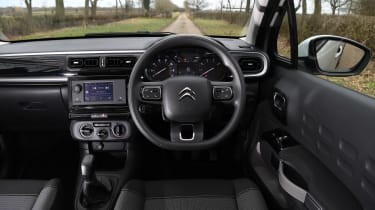
Gone is the generic design of a few years ago, replaced by a unique ambience.
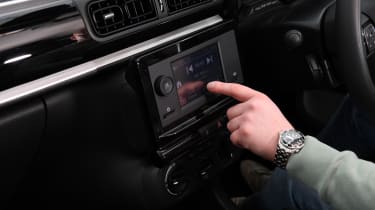
Even better, the C3's cabin looks different but it's also user-friendly, although having to adjust the climate control from within the infotainment menus isn't ideal.
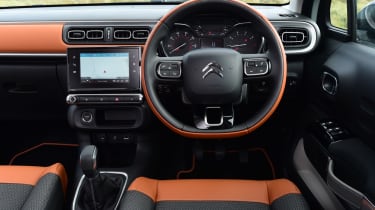
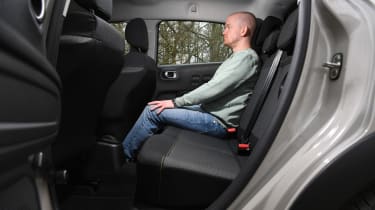
Cabin space is impressive for a supermini, with decent head and leg room in the back and lots of cubby hole space, but the seats are flat and less supportive than in most rivals.
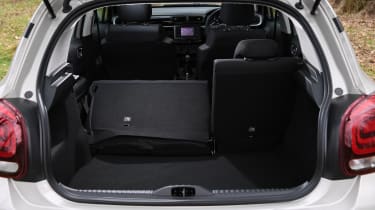
Boot space is impressive at 300 litres though, or 922 litres with the rear seats folded down.
Running costs
All C3s have to be serviced annually. There's a 16,000-mile limit between services for Puretech models built up to November 2019; after this the cap was dropped to 12,500 miles. Meanwhile, the 1.6-litre diesel has a 16,000-mile limit, but the 1.5 BlueHDi takes this up to 20,000 miles.
The schedule runs Interim (an oil and filter change), Main, Interim, Major.
Owners can choose between genuine or pattern parts which is why there are two prices for each service. A cambelt replacement on the petrol engines is required every six years or 64,000 miles. The diesel engine is chain driven.
Fresh brake fluid is also required every two years, while the coolant should be renewed after four years or 80,000 miles, then every year or 16,000 miles.
Recalls
Citroen has recalled the C3 Mk3 six times so far.
Two separate recalls were issued in June 2017 because of faulty airbags, one because of the driver's side curtain airbag not working properly, and the other because of the same glitch on the passenger side. The dozen or so cars affected, were all built in January or February 2017.
The third recall came in December 2017, because some C3s made in October and November 2017 featured a sub-standard component that could lead to engine failure.
Incorrectly fitted steering column joints were behind the fourth recall, in January 2019; in October 2019 there was another campaign because of excessive exhaust emissions.
The most recent recall came in May 2020, because of incorrect steering geometry; just 10 C3s built between September 2019 and March 2020 were affected.
Driver Power ownership satisfaction
There wasn't a single Citroen in the 2021 Driver Power new car survey, but there were four of them in the previous year's poll – although the C3 wasn't one of them.
In fact the C3 Mk3 has never made it into in any of our Driver Power surveys, although the first-generation C3 Aircross made regular appearances.
In our most recent Brands survey, run in 2020, Citroen came 18th out of 30 manufacturers. It managed just one top 5 score (fuel economy) and one top 10 (exterior design). Everything else was mid-table or worse.
Click here to tell us about your car in the Driver Power survey...
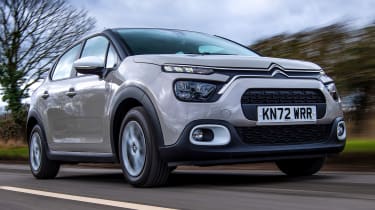
Citroen C3 (2017-2024) review: what we said
Extracts from our 2024 in-depth review of the Citroen C3 Origin...
The latest Citroen C3 Origin stands out from the rest of the small car crowd thanks to its funky styling and plethora of personalisation options. It’s frugal, and the ride is one of the softest in the supermini class, which makes the C3 Origin a relaxing car to spend time in, but not the most fun to drive.
The technology onboard could be better, but the C3 Origin offers a decent amount of equipment for the money, and boot space is more generous than most rivals. Citroen's supermini is a solid choice for buyers who want to avoid following the crowd.
The third-generation Citroen C3 arrived in 2017, and its cheeky charm helped erase the memories of its disappointing predecessors. A mid-life refresh in 2020 saw the C3 adopt the sharper front-end design of its siblings, while a rebranding in 2024 to C3 Origin helps to avoid conflicting with the fourth-generation Citroen C3 and electric Citroen e-C3.
The Citroen C3 Origin competes in one of the most hotly contested areas of the car market: superminis. So it’s going up against the likes of the Dacia Sandero, and cheaper versions of the Peugeot 208, Vauxhall Corsa and Volkswagen Polo.
In truth, the Citroen C3 Origin isn’t as agile as the 208 or the Corsa, or as refined as the Polo. However, the C3 Origin is good value, with prices starting from a little over £14,000, making it one of the cheapest cars on sale right now and even able to undercut the Dacia Sandero. Its obvious value and unique style mean the C3 offers something distinctly different to its class competitors.
Other rivals for the Citroen C3 Origin include the Hyundai i20 and Kia Rio, along with the Skoda Fabia and SEAT Ibiza from the Volkswagen Group family. The Renault Clio is one of the standout choices in the class, while the Mazda 2 and Toyota Yaris are both in the mix, too.
Running gear includes a platform that is a development of the old C3 Mk2. That's no bad thing as it provides a comfortable ride, while the more important running gear, such as the engines and gearboxes, are a lot fresher and offer good everyday running costs.
Petrol power comes from Citroen's versatile 1.2 PureTech three-cylinder engine, in 83 and 110 guises. The latter gives the C3 Origin great performance, while economy is on a par with the less powerful engines courtesy of a standard-fit stop-start system.
All C3 Origins are front-wheel drive and come with either a five or six-speed gearbox as standard. If you want an auto, your need to pick the PureTech 110 petrol in either Plus or top-spec Max trim, where an EAT6 auto is offered.
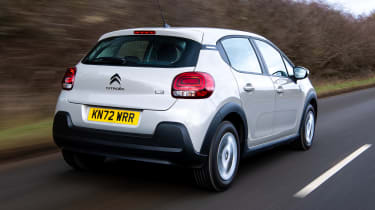
Engines, performance and drive
The French manufacturer has made great play out of the fact that the Citroen C3 Origin is not focused on handling agility or out-and-out performance. As part of the brand’s ‘Advanced Comfort’ mantra, the C3 Origin is trying to be an accomplished, refined companion that gets you from A to B with little fuss and no nasty interruptions from pock-marked road surfaces.
For the most part, it succeeds. In the majority of conditions, the C3 Origin’s suspension has enough compliance to soak up undulations and bumps, and while the trade-off for this is some body roll in corners, it never really becomes tiresome. The package can’t quite shake off its relatively elderly underpinnings, though; occasionally, you’ll notice that sharp imperfections – particularly bad potholes or expansion joints, mainly – will thump through to the cabin.
Nor, it must be said, is there any real involvement to enjoy here. The steering is typically light and there’s a bit too much play around the straight ahead, so at no point do you get a really good line of communication through from the front wheels.
The three-cylinder petrol engines, badged PureTech 83 and PureTech 110, are decent enough, with the PureTech 110 offering relatively potent performance. But while they are quiet and smooth enough when they’re cruising along, they can’t escape a bit of three-cylinder thrum when they’re being revved hard.
At their heart, the standard five- and six-speed manual gearboxes are slick enough, but they're not helped by a typical Peugeot-Citroen linkage: an extremely long throw and a gear stick with lots of play. At least the automatic option is an improvement; instead of the previous automated manual that was jerky and slow, there’s a reasonably smooth six-speed torque converter EAT6 automatic.
0-62mph acceleration and top speed
The core petrol engine in the Citroen C3 Origin is a 1.2-litre three-cylinder unit, and in entry-level 82bhp/118Nm PureTech 83 form, it does the 0-62mph sprint in 12.5 seconds, while the PureTech 110 is a turbocharged unit producing 109bhp and 205Nm of torque; enough for 0-62mph in around 10 seconds.
Of the two petrol engines, the PureTech 110 would be our choice. Its extra grunt makes it a more accomplished performer that’ll be happy maintaining swift progress in most situations. However, the 82bhp motor does have enough pep for those predominantly driving in town. It can also hack the odd motorway jaunt, but just be prepared to sacrifice a little refinement when getting up to cruising speed because you’ll encounter a three-cylinder thrum as you work the engine hard.
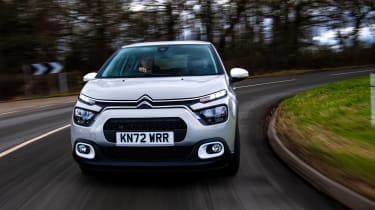
MPG, CO2 and running costs
The diminutive Citroen C3 Origin has a decent record on fuel efficiency, now featuring a 1.2-litre, three-cylinder PureTech petrol engine that’s available in two states of tune.
Citroen claims the base PureTech 83 can return up to 53.4mpg, with CO2 emissions from 123g/km, while the range-topping turbocharged PureTech 110 emits 123g/km of CO2 and is capable of up to 53.3mpg in manual form, or 49.8mpg and emissions of 134g/km when equipped with an automatic gearbox.
When we tested the entry-level Citroen C3 You! (before it was rebranded as Citroen C3 Origin) head-to-head against the similarly priced Dacia Sandero, the PureTech 83 petrol engine paired with a five-speed gearbox returned a respectable 48.5mpg, but the Dacia’s 49.3mpg pipped it.
To get an accurate valuation on a specific model check out our free car valuation tool...
Interior, design and technology
The exterior of the Citroen C3 Origin combines lots of the brand’s recent design traits into a funky-looking package. The modern and stylish look of the C3 Origin helps set it apart from the somewhat conservatively styled Hyundai i20, Skoda Fabia, and VW Polo. One of the features that makes the C3 Origin look so distinctive next to its fellow superminis is its paint-protecting ‘air bumps’ on the doors of mid-range Plus trim and above, which also have the additional benefit of shrugging off impacts with supermarket trolleys and other car doors. If you’re not a fan of them, then go for the most basic You! trim level because it doesn’t include them.
Don’t climb into the C3 Origin expecting it to be the last word in luxury. Citroen has tried to mimic the exterior styling by creating a welcoming cabin that offers something different in the class. For example, top-of-the-line cars have “Techwood” interior trim with faux-wood strips on the dashboard and some tasteful seat upholstery.
The Advanced Comfort seats (standard on top-spec Max versions) are similar to those found in the Citroen C3 Aircross SUV, and they’re designed to be quite soft instead of offering supreme lateral support during cornering. The dashboard is very simple, fitted with a small, black & white five-inch touchscreen on the base You model, and a seven-inch colour touchscreen display in all other trim levels.
Citroen also reckons the C3 Origin is the ‘mainstream’ supermini with the greatest scope for personalisation – and there’s no denying that the extensive range of colours and options is impressive. Seven paint finishes are available (although not all of those colours are available with all trim levels), a black exterior colour pack and two contrasting roof colours.
Entry-level You! cars come with 15-inch steel wheels, lane-departure warning, cruise control, LED headlights, electric front windows, and a white contrast finish for the fog lamp surrounds and door mirror caps.
The Plus trim adds 16-inch Matrix alloy wheels, air bumps on the doors, a black onyx roof, automatic air con, electric windows in the rear, a reversing camera and a seven-inch touchscreen with Apple CarPlay and Android Auto smartphone connectivity.
Top-of-the-range Max cars get 17-inch alloys, Techwood interior trim, a spare spacesaver wheel, built-in sat-nav and extra safety systems like driver attention alert, autonomous emergency braking and Intelligent Beam headlights – auto dipping headlights, to you and me.
Sat-nav, stereo and infotainment
Aside from the entry-level You trim, which still uses physical dials for its manual air-con controls, the rest of the C3 Origin range features a fully integrated touchscreen infotainment system that controls not only music and radio but also key vehicle functions, including heating and air-conditioning.
The dated-looking black & white central display used in You trim has either Bluetooth or USB connectivity, and we wish Citroen had taken a leaf out Dacia’s book and provided a phone holder like you’ll find in the Sadero, because then you could have used your phone’s screen as a navigation aid. Pairing a Bluetooth device is easy, although the USB socket’s position on the dash means a cable might get in the way of the gear lever, depending on where you keep your phone.
Upgrade to Plus trim or above for the seven-inch touchscreen and you can utilise Apple CarPlay or Android Auto smartphone mirroring in order to use apps from your phone. Max trim cars get sat-nav built-in, along with an enhanced infotainment system that includes connected services, including TomTom Traffic, information on petrol prices nearby and weather forecasts, and real-time info on traffic incidents.
There’s plenty of functionality, but the touchscreen interface can be a little laggy. It’s the latest generation unit from Peugeot-Citroen, so the graphics are nice and sharp. However, the touch-sensitive shortcut keys on either side of the screen aren’t as easy to use as the shortcuts you'll find in a Fabia or Polo.
Practicality, comfort and boot space
The Citroen C3 Origin is touted to follow the ‘Advanced Comfort’ mantra of the rest of the range, so it’s a little disappointing that it doesn’t offer many stand-out tricks on the practicality front.
That’s not to say the C3 Origin isn’t capable; there’s room in the cabin for four adults (just about), and the 300-litre boot is bordering on generous for the class. However, the C3 Origin’s relatively old underpinnings mean that Citroen hasn’t been able to incorporate any really neat tricks, such as a sliding rear seat that would allow you to prioritise either rear passenger legroom or boot space.
On Plus trim and above with the larger seven-inch touchscreen, you may find it a little awkward to use the air-con controls while on the move because they’re buried within a menu in the touchscreen, making a quick adjustment to the cabin temperature is more fiddly than it should be. Base cars feature a set of physical chunky dials for the cabin temperature that are more intuitive to use.
What else do you get? Well, there’s a slightly random ‘storage slot’ below the touchscreen in the dashboard, and a bigger bin below it that could be handy for storing a phone when it’s hooked up to the USB socket nearby. The door bins are a good size, and their linings are painted white to help brighten the mood – and make it easier to find bits of clutter you’ve dumped there.
The rear seat has a 60:40 split on all editions, but the boot opening isn’t the largest, thanks to the C3 Origin’s funky tail lights, and there’s quite a lip to lift heavy items over. At least there are a couple of lashing eyes to help you tie them down once they’re in there.
The C3 Origin has quite an elevated feel, although it’s still a supermini more than a baby SUV. This does give you quite a good view out, though, and the rear screen is deep enough to make reversing manoeuvres relatively straightforward. Plus trim adds a reversing camera and rear parking sensors to help when slotting into a space.
Dimensions and size
The days when a supermini had to be no more than four metres in length have long gone, but the C3 Origin sticks close to this brief (another result, probably, of its older chassis components). Its 3,996mm length and 1,829mm width are shorter and wider than the Vauxhall Corsa or the Hyundai i20. The wheelbase is par for the course too, at 2,539mm – or slightly longer than a Volkswagen Polo.
Seats, leg room, head room & passenger space
It’s possible for four adults to be reasonably comfortable in the Citroen C3 Origin, although the individuals who end up in the rear seats aren’t going to be particularly happy if their companions up front are on the taller side. The biggest issue is knee and legroom, although the soft seatbacks create a bit of leeway.
Getting in and out is relatively straightforward, and the door aperture is just about big enough to allow a bulky child seat to be fitted in the back without too much of a struggle. There’s a pair of ISOFIX points in the outermost rear seats, and the driver gets height adjustment on their seat on every edition of the C3.
Boot space
In raw terms, the C3’s boot capacity is 300 litres, which is actually pretty decent when compared with the likes of the Peugeot 208 and Corsa. It’s enough for a decent-sized suitcase, and the shape is usefully square, although you’ll have to contend with a big lip at the rear bumper. This means you’ll have to lift heavy items over the lip before you can set them down into the load space.
A split rear seat (60:40) is standard across the range and you operate it using buttons near the headrests. With the seats folded right down the C3’s capacity grows to 992 litres, which is good, but somewhat shy of the 1,190 litres you’ll find in a Skoda Fabia.
Check any car's MoT history in a few easy clicks with our MoT checker tool...