Hyundai Ioniq 3 review
Hyundai’s smallest Ioniq is a great all-rounder, and could be good enough to go to the top of the class

Our opinion on the Hyundai Ioniq 3
So, you want to go electric? But you want a spacious supermini hatchback rather than a small SUV. Well, the small electric car market has exploded over the last couple of years, and the Hyundai Ioniq 3 is the latest entrant, and with its striking styling, it could be the pick of small EVs. The Ioniq 3 is generally well equipped (although the entry-level Advance lacks some kit), as well as affordable to buy and good to drive. With its decent range and efficiency, this Hyundai should be cheap to run, too. We were hoping for keener performance, but maybe that’s the job of a faster version in the future?
About the Hyundai Ioniq 3
With the Ioniq 5, Ioniq 6 and Ioniq 9, Hyundai has proved it can make excellent electric cars. Now it’s turning its attention to an Ioniq-sized gap in the supermini sector, demonstrating its proven EV knowledge with the Ioniq 3.
Just launched in the UK, the newcomer offers supermini customers a decent range (especially with the bigger battery) and distinctive looks, with a spacious interior and a focus on driver satisfaction with a tidy driving experience.
Performance & driving experience
Pros |
|
Cons |
|
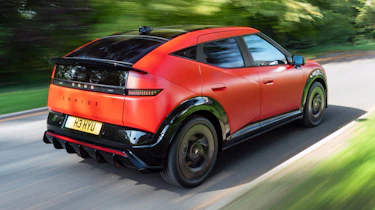
The Ioniq 3 shares the Electric Global Modular Platform (E-GMP) with its sister car, the Kia EV2. However, where the Kia can feel floaty on the move, the Hyundai is comfortable and controlled. Combine that with the precise steering and the Ioniq 3 is an enjoyable drive. In fact, with more power it could be an excellent electric hot hatch, but a high-performance ’N’ version is not confirmed.
| Model | Power | 0-62mph | Top speed |
| Hyundai Ioniq 3 42kWh Advance | 144bhp | 8.7sec | 106mph |
| Hyundai Ioniq 3 61kWh N Line Evo | 133bhp | 9.5sec | 106mph |
| Hyundai Ioniq 3 61kWh Premium | 133bhp | 9.5sec | 106mph |
Performance, 0-60mph acceleration and top speed
Like the Kia EV2, the Ioniq 3 is front-wheel drive, with a single electric motor, and is offered with a choice of 42kWh Standard Range and 61kWh Long Range batteries.
The former is only available with the entry-level Advance trim. With 10bhp more than the Long Range battery, it seemed noticeably quicker to accelerate than the bigger 61kWh Long Range version. However, in reality, it is just 0.8 seconds faster from 0-62mph, at 8.7 seconds.
The Long Range 61kWh battery is also available in Advance trim, as well as Premium and the expected best-sellers, the Ultimate and range-topping N Line trim. Weighing more than one-and-a-half tonnes, and with a 9.5-second 0-62mph acceleration time, this Ioniq 3 sounds sluggish on paper. Yet thanks to its 250Nm of torque, the Hyundai feels swifter than its numbers would suggest. Both versions have the same 106mph top speed.
Town driving, visibility and parking
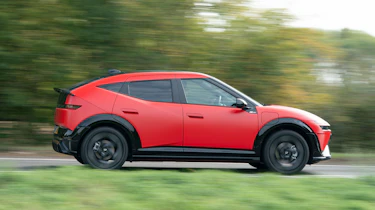
With its compact dimensions, good all-round visibility and an agile feel to the drive no matter which battery is chosen, the Hyundai Ioniq 3 is well suited to shorter, urban journeys.
All models come with the Rear View Monitor, which includes parking sensors and a rear-view camera. Cleverer still is the Dynamic Parking Guidance, which is standard on the range-topping N-Line Evo and maps out your steering path into a space. Exit the same spot, and a set of colour-coded guidelines is overlaid on the camera feed on the central touchscreen. These lines can curve, ultimately showing a safe and precise way out.
Country road driving and handling
The ride on all Ioniq 3s is generally well judged, but there’s some stiffness at low speed. Things get better at speed - the smallest 16-inch wheels on the entry-level Standard Range give the most comfortable drive - but there’s not a lot in it.
Body control is excellent, so there’s not much roll, and this translates to confidence in corners. Flick the drive mode into ‘Sport’, and this adds welcome extra weight to the steering, and brings a sharper throttle response. Road noise does increase at higher speed, though.
Motorway driving and long-distance comfort
Hyundai has done loads of work on the Noise, Vibration and Harshness (NVH) of the Ioniq 3. Its Sound Insulation package includes an acoustic windscreen and side windows, and models with 19-inch wheels have acoustic tyres. As a result, the interior is impressively hushed, although there’s more wind noise and tyre roar at higher speeds. To help with the long-distance refinement, there are three levels of brake regeneration, and a one-pedal driving mode.
"The Ioniq 3’s steering might lack feel, but it’s precise. This along with the excellent body control, adds up to a fun-to-drive package. Hyundai please give us an ’N’ performance version!" - Martyn Collins, Freelance Writer, drove the Ioniq 3 in the UK.
MPG & running costs
Pros |
|
Cons |
|
With the Ioniq 3’s best-in-class aerodynamics and a good range, the smallest member of Hyundai’s Ioniq range should rank highly for its low running costs. Plus, all models are well equipped with features including keyless go, auto headlights and the expected standard safety features, and prices start from just £18,495.
Electric range, battery life and charge time
As a result of the car’s slippery styling and impressive efficiency, even if you choose the smaller 42kWh Standard Range battery, it’s still capable of 213 miles of range. Go for the entry-level Advance trim with the bigger 61kWh Long Range battery, and this is the version of the Ioniq 3 that is capable of going the furthest at 308 miles.
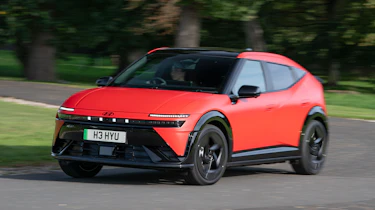
Yet, choose Premium or Ultimate trim for your Ioniq 3, and the range drops to 303 and 300 miles respectively. This is because of the weight added by the extra standard equipment and the larger 18-inch alloy wheels. However, the biggest drop comes in the range-topping N-Line Evo, with an official claimed range of 265 miles. In part, the reasons for this drop are the same as on its sister cars, but in addition, while its racier front bumper, deeper side skirts, rear diffuser and that prominent rear wing look the part, they disrupt the airflow over the aero shape. This results in the further 35-mile loss.
All Ioniq 3 versions are efficient, though; we managed an impressive 3.8 miles per kWh from an N-Line Evo Long Range on a cool autumn day over a mix of roads. We worked the Hyundai quite hard, but this efficiency figure still translates to roughly 232 miles per charge in the real world.
The entry-level Standard Range Advance model is lighter, and as a result, we saw 4.4 miles per kWh. Due to its smaller battery, that gives a range of 186 miles per charge, but that's not that far away from the official WLTP figure of 213 miles.
The Ioniq 3's maximum charging speed is 115kW, meaning a 10 to 80 per cent rapid charge will take around 29 minutes. Choose the Long Range battery, and this time increases to 50 minutes. Still, it’s a higher peak charging speed than in the multi-award-winning Renault 5, which only manages 100kW, although the Volkswagen ID. Polo edges ahead of both with 130kW.
| Model | Battery size | Range | Insurance group |
| Hyundai Ioniq 3 Standard Range Advance | 42kWh | 213 miles | Group 22 |
| Hyundai Ioniq 3 Long Range Advance | 61kWh | 308 miles | Group 25 |
| Hyundai Ioniq 3 Long Range N-Line Eco | 61kWh | 265 miles | Group 28 |
Insurance groups
All Ioniq 3 versions share the same 25A insurance group, which is two groups higher than its sister car, the Kia EV2. The Hyundai’s group is also higher than the Renault 5, which starts at group 24.
Tax
The Ioniq 3 is an EV, and as such makes the most sense to company-car drivers. It’s currently in the four per cent Benefit-in-Kind (BiK) tax band, but this will rise to five per cent from the 2027-28 year.
VED (road tax) for EVs isn’t free any more, but affordable pricing means this Hyundai thankfully isn’t subject to the luxury car tax surcharge, which applies to EVs that cost more than £50,000.
Depreciation
According to our resale valuation data from CDL, the Hyundai Ioniq 3 will maintain between 49 and 56 per cent of its original value after three years or 36,000 miles.
That compares well with the Renault 5, which is predicted to maintain between 46 and 47 per cent of its original value, and is better than the Peugeot E-208, which is only predicted to maintain between 35 and 43 per cent over the same period.
Interior, design & technology
Pros |
|
Cons |
|
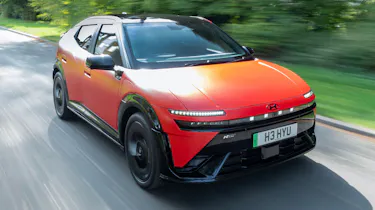
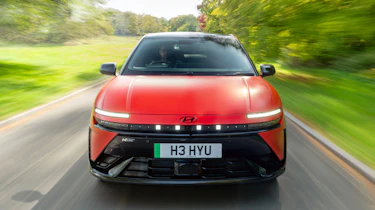
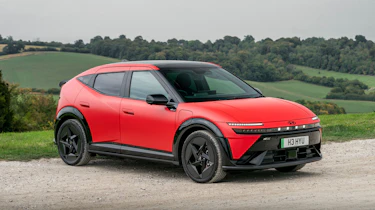
Think you’ve seen the Ioniq 3’s design before? Well, you’d be right, because its “Art of Steel” aero shape was previewed with the Concept THREE car, that was shown in 2025. The production car is close to the concept, with design highlights including the Aero Hatch shape, flat surfacing, dramatic creasing around the upswept rear windows, split rear screen and the Parametric Pixel lightbars with their four light dots. The styling is certainly distinctive, but you’ll either love or hate some of the design details, such as the Pixel lightbar at the front.
On the flip side, with the Aero hatch design, the Ioniq 3 is impressively aerodynamic; a 0.263 drag coefficient is a key reason for its impressive efficiency figures.
As standard, the Ioniq 3 Advance gets:
- 16-inch alloy wheels
- LED headlights
- Park Distance Warning (forward and reverse)
- Blind Spot Collision Avoidance Assist
- Cloth seat upholstery
- Manual driver’s seat height adjustment
- Six-speaker audio system
Then there’s Premium, which adds 17-inch alloys, power folding mirrors, rear privacy glass, and automatic rain-sensing wipers. Ultimate includes heated seats and steering wheel, matrix LED headlights, posher trim and 18-inch alloy wheels. The range-topping N-Line Evo range-topper features an N-Line bodykit, 19-inch alloy wheels, a 14.6-inch central touchscreen, driver's seat memory settings, and a digital key.
There are plenty of paint options available for the Ioniq 3, including metallic, or matte finishes. Advance has solid Fierce Red as the standard, no-cost option. Special Solid White is available on all Ioniq 3 trims for £350. There is also a variety of metallic/pearl paint choices priced at £795: Phantom Black, Lumen Grey, Aurora Grey, Vibrant Blue, and Ice Blue. You can also specify Fierce Red Matte Paint (£1,295) with N-Line Evo trim.
Interior and dashboard design
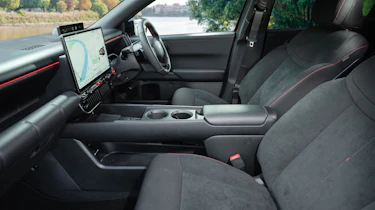
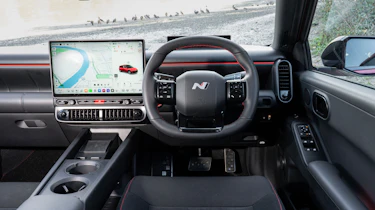
The Ioniq 3’s dash has a central infotainment display in either 12.9 or 14.9-inch sizes. It is the first model to be fitted with Hyundai’s new Pleos infotainment platform, which will eventually be rolled out to the rest of the range.
Choose any trim other than Advance, and there’s a useful customisable 9.9-inch driver’s display on the top of the dashboard, giving speed and range information right in your line of sight. There are also physical controls under the screen for key functions, such as the fan speed and temperature, which are much easier to adjust on the move than through a screen.
Materials and build quality
With the Ioniq 3’s affordable pricing, you might expect Hyundai to have cut corners with the materials and build quality, but this isn’t the case. In general, the interior finish is impressive, feeling as good as in some premium alternatives. The only disappointments are the harder than expected dashboard plastics and the firmer and shinier plastics on the top of the Advance trim’s doors.
Infotainment, sat-nav and stereo
All Ioniq 3s benefit from Hyundai’s new Pleos Connect infotainment system. It operates through either 12.6 or 14.6-inch touchscreens according to the version, along with the slim 9.9-inch customisable driver’s display, which is fitted to all models except the Advance. The new operating system is designed to work like a smartphone, and is pleasingly user-friendly once you know where all its features are. The built-in mapping is from Google Maps, but wireless Apple CarPlay and Android Auto are also well integrated.
“The Pleos Connect infotainment system is simple to operate. However, without the Driver display, key information such as the speed, are squashed into the right-hand corner of the screen, making it hard to read at a glance.” - Martyn Collins, Freelance Writer, drove the Ioniq 3 in the UK.
Boot space & practicality
Pros |
|
Cons |
|
The 3 might be the smallest model in Hyundai’s Ioniq electric range, but one of its key attributes is offering C-segment space in a B-Segment sized car.
Cabin stowage also impresses, with an open compartment along the bottom of the dashboard, and neat removable inserts in the cup-holders, so that you can fit a variety of bottle sizes. As in the Kia EV2, further stowage space is in the double-level centre console, thanks to the gear selector being on the steering column.
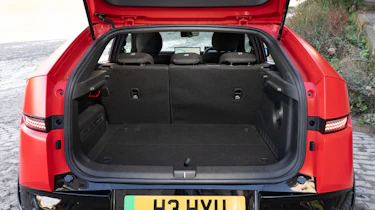
Hyundai claims a boot capacity of 441 litres which, at first glance, makes the Ioniq 3 seem about as practical as a bigger family hatchback. In reality, a significant amount of this space is accounted for by the ‘Megabox’ storage underneath the adjustable boot floor. Nevertheless, the boot space is impressive, which is more than you can say for the rear visibility, thanks to the split screen, especially with the N-Line Evo’s rear spoiler!
Dimensions comparison | |||
| Model | Hyundai Ioniq 3 | Renault 5 | Peugeot E-208 |
| Length | 4,155 mm | 3,922 mm | 4,055 mm |
| Width | 1,800 mm | 1,774 mm | 1,745 mm |
| Height | 1,505 mm | 1,498 mm | 1,430 mm |
| Wheelbase | 2,680 mm | 2,540 mm | 2,540 mm |
| Boot space | 441 litres | 326 litres | 309 litres |
Seats & passenger space
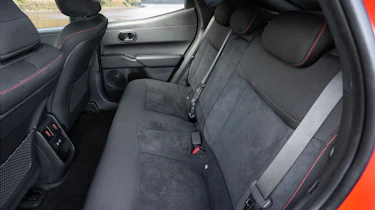
Despite the curvy roofline of the Ionic 3’s Aero hatchback shape, this Hyundai is a tall car compared with its rivals. As a result, headroom is generally good. The driving position is high set, because you’re sitting on the battery, as in an SUV, but it’s still comfortable. Ultimate and N-Line Eco versions with their standard electric adjustment, plus power lumbar support for driver and passenger seats, improve things further.
There is enough room in the back for two tall adults on longer trips, with plenty of foot space under the front seats. However, the tallest passengers may find their heads brushing the roof lining, plus it can feel claustrophobic back there, thanks to the upswept rear window line and dark interior trim. The rear bench is also designed for two, with a raised part in the centre, so it’s uncomfortable for a third passenger. There is a pair of Isofix seat mounts on the outer positions of the second row, for child seats.
Boot space
The Ioniq 3 might have a spacious interior, but we’re pleased to report that this hasn’t come at the expense of boot capacity. At 441 litres, it’s almost as big as cars from the class above. However, much of this is because there’s a 119-litre ‘Megabox’ space underneath the adjustable boot floor. Still, the remaining 322-litre boot is a practical space, and the opening is low, which makes loading easy. Unlike its sister car, the Kia EV2, the Ioniq 3 doesn’t benefit from any under bonnet storage - so all the charging cables must stay in the boot.
Towing
This might be the smallest Ioniq EV, but it’s still possible to tow with it. In fact, this Hyundai is rated for up to 750kg, which will be fine for a small trailer, or a mount could be attached to the optional towbar to transport a couple of bikes.
“We don’t think you’ll miss the Ioniq 3’s lack of a frunk, because the charging cable can be hidden under the adjustable boot floor.” - Martyn Collins, Freelance Writer, drove the Ioniq 3 in the UK.
Reliability & safety
Pros |
|
Cons |
|
The Ioniq 3 is too new to have received a safety rating from Euro NCAP. However, the fact that every model comes with plenty of standard safety kit should give confidence. This includes driver-assistance features including forward collision avoidance, blind-spot assist, lane-keeping assistance, and rear cross-traffic alert included.
Reverse Smart Park Assist, Reverse Memory Assist, and 360-degree rear camera are only fitted to the range-topping N-Line Evo.
Then there’s the comprehensive warranty to consider. Like the rest of the Hyundai range, the Ioniq 3 comes with a five-year unlimited-mileage warranty - where three years is the norm. Plus, as with many other EVs, this Hyundai’s battery is covered by an eight-year, 100,00-mile warranty.
The Ioniq 3 is too new to have appeared in the current 2026 Driver Power customer satisfaction survey. However, Hyundai did finish in a credible 13th place in the brands’ survey with an 85.3 per cent satisfaction score from owners. Although this is outside the top ten, it’s better than sister brand Kia, as well as Volvo, Honda and Toyota.
| Euro NCAP safety ratings | |
| Euro NCAP safety rating | N/A |
| Safe driving | N/A |
| Crash avoidance | N/A |
| Crash protection | N/A |
| Post crash safety | N/A |
Buying, prices and deals
- Best buy: Hyundai Ioniq 3 Premium Long Range
Much like its sister car, the Kia EV2, every version of the Ioniq 3 qualifies for the Government’s Electric Car Grant (ECG), but only the base Standard Range model in Advance trim earns the maximum discount of £3,750.
As a result, the entry price for the line-up is £18,495 and this version offers a range of up to 213 miles; the Long Range version with Advance trim costs £21,995 after the ECG is applied. The Premium and Ultimate trims with more standard equipment start from £23,695 and £26,195 after their respective discounts. The range-topping N-Line Evo is priced at £28,195, while the top three trims are the only ones available with an optional EV Pack, including a heat pump, which pushes the total price up by £1,250.
The Long Range car is our pick of the range, and we recommend Premium trim. That’s because with its standard 17-inch alloy wheels, it has the best range of the bigger-battery versions at 303 miles, as well as including the Driver display. It also has plenty of other desirable features, such as the wireless phone charger, powered and heated door mirrors, and privacy rear glass, yet it’s still significantly cheaper than the range-topping N-Line Evo.
If you're looking for a great deal on a Hyundai Ioniq 3, we can help. There are plenty of discounts to be had using our Auto Express Buy A Car service, along with numerous Ioniq 3 leasing deals. We can even help to sell your old car via our Sell My Car page.
Hyundai Ioniq 3 alternatives
Key alternatives to the Hyundai Ioniq 3 include our supermini of the year, the Cupra Raval, along with our previous Affordable Electric Car of The Year in 2025, the Renault 5, and the also recently launched Volkswagen ID. Polo. The Cupra is fun to drive, the Renault has retro style, and the Volkswagen’s comfortable ride is a highlight, but the Hyundai beats them for efficiency and, in big battery form, range too.
Hyundai Ioniq 3 pictures
Frequently Asked Questions
The Hyundai Ioniq 3 has a five-year, unlimited-mileage manufacturer warranty. In addition, the battery is covered by a separate warranty, which says that the pack’s state of health must remain above 70 per cent capacity after eight years or 100,000 miles. Two years of roadside assistance is included as well, and this can be extended to five years by following the service schedule at a Hyundai dealer.