Isuzu D-Max pick-up review
Constant updates have helped the Isuzu D-Max to keep pace with the pick-up pack

Our opinion on the Isuzu D-Max
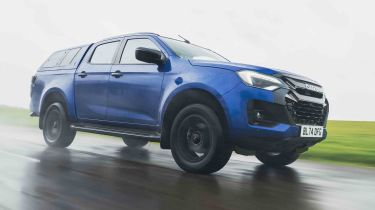
A long warranty and generous levels of standard kit make the Isuzu D-Max an appealing proposition, and there’s a range of models on offer to suit different purposes. The Utility variant is a workhorse through and through, while at the top of the range, the V-Cross makes a strong case for itself as a work vehicle that also offers family car versatility. Constant revisions have helped the D-Max keep pace with rivals, and its off-road ability is good, but the solitary 1.9-litre diesel on offer lacks power when compared with the class leaders. It’s not quite as well mannered as its rivals on the road, either.
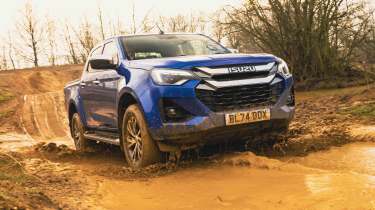
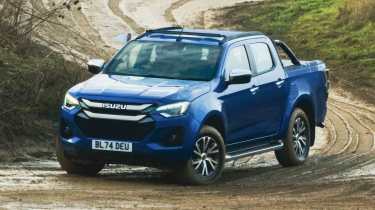
The most recent round of updates in 2025 added a subtly revised front end with new air intakes that help airflow around the front wheels, a tweaked bonnet line and new lights. At the back are new tail-lights and a redesigned tailgate, while inside there’s a more user-friendly infotainment system measuring eight inches across (or nine inches in the V-Cross). The twin-camera ADAS system has been upgraded with wider viewing angles to improve the response of the safety systems, while a Rough Terrain switch optimises the truck’s electronics for slippery conditions.
About the Isuzu D-Max
The Isuzu D-Max first arrived in 2012 with a 3.0-litre diesel and was pitched to tradespeople and farmers as a workhorse. A smaller, more efficient, but just as powerful 1.9-litre diesel arrived in 2017, while the current D-Max arrived in 2021. There have been updates in 2023 and 2025, while an electric Isuzu D-Max EV is due to arrive in 2026.
Used - available now

2024 Volkswagen
Tiguan
29,847 milesAutomaticDiesel2.0L
Cash £20,110
2023 Tesla
Model 3
25,146 milesAutomaticElectric
Cash £22,500
2026 Audi
A1 Sportback
29,740 milesAutomaticPetrol1.0L
Cash £16,870
2022 Volkswagen
e-Up
22,210 milesAutomaticElectric
Cash £10,660A broad range of models kicks off with the Single Cab Isuzu D-Max Utility starting from around £27,500 excluding VAT. This is two-wheel drive as standard, with an extra £2,500 adding four-wheel drive and a diff lock. The Double Cab Utility sits closer to £32,000.
The DL20 is available as either an Extended Cab or Double Cab for around £33,500 ex.VAT, while an auto gearbox is offered on the latter for roughly £2,000 extra. Add around £3,000 to move from DL20 to DL40 trim (as a Double Cab only), while the V-Cross starts at just over £38,000, with the auto version adding £2,000. The high-riding Arctic Trucks variant is by far the priciest D-Max, at more than £57,000.
Whichever model you choose, the same 162bhp four-cylinder turbodiesel is fitted under the bonnet, while six-speed manual or automatic transmissions are fitted.
MPG and running costs
Pros |
|
Cons |
|
At 360Nm, the 1.9-litre turbodiesel has a lack of torque when compared with rivals, so it needs to be given a workout if you’re going to be using the D-Max to carry heavy loads or for towing. The Toyota Hilux churns out between 400Nm and 500Nm, depending on spec.
Stop-start is fitted to the D-Max to help save diesel when stationary, but its overall efficiency isn’t quite a match for rivals.
With the six-speed manual gearbox, the entry-level D-Max Single Cab with 2WD returns 33.6mpg, with CO2 emissions of 220g/km, while adding four-wheel drive has a slight impact on those figures. Move up to a high-spec model with an automatic gearbox and that drops to 31.4mpg and 235g/km of CO2.
In order for Isuzu to be able to meet tightening emissions regulations, the D-Max now comes with an AdBlue tank. It’s 14 litres in capacity, and the filler is next to the one for the fuel tank, while the car’s on-board trip computer will count down to when it needs topping up.
Load space and practicality
Pros |
|
Cons |
|
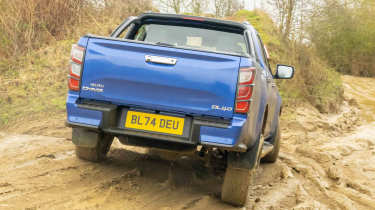
The availability of Single Cab and Extended Cab bodies gives the D-Max an advantage over some rivals. However, the slight caveat with the Single Cab model is that it sits 20mm lower to the ground than the Extended and Double Cab variants, so isn’t geared towards extreme off-road use.
The Single Cab has a 2,290mm long load bay and a maximum payload of 1,205kg in 4WD guise (the 2WD version can carry 1,190kg). Next is the Extended Cab, which has a 1,785mm load bay and a 1,140kg payload capacity, and then the Double Cab has a bed that measures 1,520mm long and a payload of up to 1,110kg, depending on trim level. All versions can carry more than a tonne in the back, though.
If you want to tow, then the D-Max offers 3.5 tonnes of capacity (except for the Single Cab 2WD, which can still pull a healthy 2.5 tonnes). There are plenty of accessories to choose from to help with towing and cargo carrying in general, including load covers and hard-top backs in various styles. Plus there are roof bars, frames and cargo rails to hold loads in place in the bed.
There are simply too many accessories to list here, but it’s safe to say that if you have a specific need for a D-Max, there is likely to be something in the catalogue that can help you.
Reliability, safety and security
Pros |
|
Cons |
|
Safety is a strong point for the D-Max as it boasts a five star Euro NCAP safety rating. The standard model was tested in 2020, and the Crew Cab received its own test in 2022, but Isuzu’s 2025 update upgraded the safety systems, meaning it’s likely that this truck would still earn a five-star rating if it were retested today.
The twin forward cameras now have a wider field of view and can detect pedestrians, cyclists and motorcycles, while traffic sign recognition can detect speed limits, stop and give way signs and more. Other kit includes lane-departure warning, attention assist, rear cross-traffic alert and a blind-spot monitor (Double Cab only).
Isuzu sells too few models to appear on the annual Driver Power customer satisfaction survey, so it’s tough to get feedback from owners. The D-Max has an enviable reputation for reliability, though, and the brand offers a five-year/125,000-mile warranty on all models.
Driving and performance
Pros |
|
Cons |
|
The only engine option in the D-Max is a 162bhp 1.9-litre four-cylinder turbodiesel, but it can be had with a six-speed manual or automatic gearbox. We prefer the latter, because the vague shift action of the manual isn’t very pleasant to use.
There’s a very short first gear, which is helpful when towing, but a bit of a frustration at other times, because you have to change up as soon as you pull away – it’s entirely possible to treat second gear as first if you’re unladen. The auto manages gearshifts better and is smooth overall, but it can be a bit slow to react when pulling out at junctions.
The engine itself isn’t very strong by pick-up truck standards, due to a torque figure of only 360Nm. Several rivals offer more pulling power. The engine is quite noisy, too, and since it delivers its power higher in the rev range than some other diesels, you end up having to push it harder than normal – which means you notice the rattly sound and vibrations more, too.
The gearbox has an “on-the-fly” 4WD switch, so you don’t need to stop before swapping from two to four-wheel drive, although you do have to come to a halt and put the gearbox into neutral to use the same rotary controller to select low-range gears. The rear diff lock is different, as this only engages in low-range mode at speeds below 5mph, while the latest update added a Rough Terrain mode that’s selected via a button on the dashboard. This optimises the electronics to cope with off-road conditions, and can even be used when in 2WD mode.
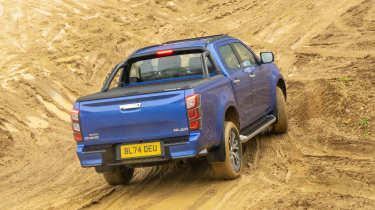
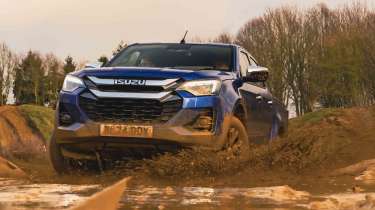
As a result of all these mechanical and electronic systems, the D-Max is an impressive performer off-road. We tried the truck on an off-road course consisting of wet, slippery clay, and even with the limitations of cross-climate tyres (Isuzu will offer all-terrain tyres as an accessory) we struggled to get stuck. The electronic systems work smoothly, while the steering, throttle and brakes boosted confidence when traction was at a premium.
Town driving, visibility and parking
The Isuzu D-Max is big and rugged pick-up, so it’s predictably challenging to drive in narrower urban settings. The high driving position means forward visibility isn’t a problem, and the chunky door mirrors will help in keeping an eye out for cheeky overtakers. However, the standard fit reversing camera often proved to be a blessing when we attempted to park.
Motorway driving and long-distance comfort
On the open road, the D-Max is a step behind the class leaders in terms of comfort. The latest updates haven’t changed the powertrain, and that means that while the higher-spec variants are the most comfortable in the line-up, there’s more bounce and noise than you’ll find in a Ford Ranger or Volkswagen Amarok. The D-Max’s safety systems work well, though, and aren’t too intrusive.
Cab interior and technology
Pros |
|
Cons |
|
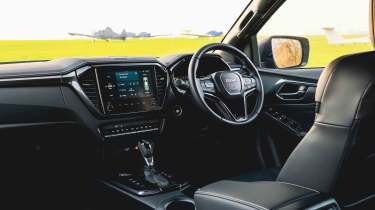
Standard kit on the Isuzu D-Max ranges from practical to SUV-like, depending on the model you choose. The Utility does what it says on the tin, with a functional cab full of hard plastics and durable fabrics. An eight-inch touchscreen is included, with Bluetooth smartphone connectivity.
The DL20 adds kit such as heated seats and a leather trimmed steering wheel, alloy wheels and carpets, and moving to the DL40 adds LED headlights, front and rear parking sensors, leather, keyless entry and starting, dual-zone climate control and a seven-inch digital dashboard. The V-Cross has the larger touchscreen, heated door mirrors, an eight-speaker stereo, extra USB-C ports and dark grey exterior trim.
While the D-Max can be smartened up by opting for a higher trim level, we still feel that the Ford Ranger and Volkswagen Amarok are generally more upmarket inside, regardless of specification.
Cabin storage is particularly good on the double-cab D-Max: there are two gloveboxes, plus a storage cubby on top of the dash and pop-out cup-holders. There’s a central cubby under the armrest and more cup-holders in the centre console.
Infotainment, sat-nav and stereo
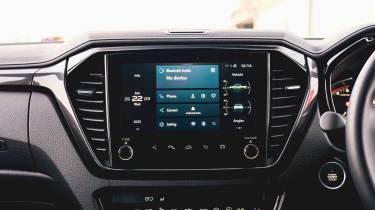
As part of the 2025 facelift, the majority of the Isuzu D-Max line-up received a revised infotainment screen measuring eight inches, although the V-Cross has a larger nine-inch display. This is better laid out than before – where DAB radio and AM/FM were separate on the old system, they are all in the same place now. It has Android Auto and Apple CarPlay compatibility – which is handy because sat-nav isn’t included – while there’s a range of screens that can show you the D-Max’s off-road performance, including pitch, yaw and steering angles.
Buying and owning
If you’re primarily using the D-Max as a work vehicle, we’d recommend opting for the DL20 or DL40, as these strike a blend of affordable price and car-like luxuries. However, if you need to perform more of a balancing act between commercial and family vehicle, forking out for the fancier V-Cross will help to reduce this truck’s utilitarian feel.
Alternatives
While there are fewer models available in the pick-up truck class, there is still variety within the trucks that are available. The big seller in the class is the Ford Ranger, which comes in a wide range of styles from utilitarian to luxury and performance, while V6 and plug-in hybrid power is available. The Volkswagen Amarok is related to the Ranger, and offers an even more plush experience.
Elsewhere, the Toyota Hilux is a perennial favourite that offers dependability, while the KGM Musso has a strong warranty to make up for its limited line-up and smaller cargo bed. If efficiency is key, the Maxus T90 electric pick-up is an option, but this is 2WD only, so it won’t get very far off road.
Frequently Asked Questions
There’s a long five-year warranty with a mileage limit of 125,000 miles that should cover most work needs. On top of that, the D-Max comes with five years of UK and European roadside assistance.
Pick-up truck dimensions | |||
| Body style | Height | Width | Length |
| Extended Cab | 1,790mm | 1,870mm | 5,280mm |
| Double Cab | 1,790mm | 1,870mm | 5,280mm |
Load area dimensions | |||
| Body style | Height | Width | Length |
| Extended Cab | 500mm | 1,530mm | 1,785mm |
| Double Cab | 500mm | 1,530mm | 1,520mm |