KGM Musso review
The KGM Musso is a simple and solid pick-up truck, but it’s let down by an awful ride and dull interior
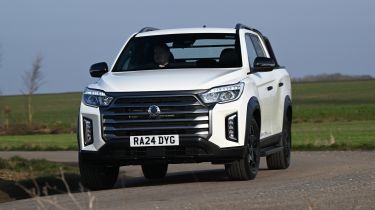

Our opinion on the KGM Musso
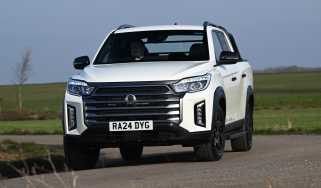
At a time when pick-up trucks are becoming more premium to offer tradespeople a genuine alternative to SUVs, the KGM Musso – formerly known as the SsangYong Musso – is appealingly simple with a strong focus on value and load-lugging capabilities. The downside of that simplicity is that it feels very agricultural, with an incredibly firm, bouncy ride and a dull interior featuring outdated technology.
About the KGM Musso
Since SsangYong was rebranded as KGM in 2023, the company has introduced some models with new nameplates to its line-up, and we’re expecting a few more still to come. However, the Musso name has stuck around, having originally been used on an SUV in the nineties before being applied to a pick-up truck in the late 2000s.
The second-generation Musso pick-up arrived in 2018, received a mid-life facelift in 2022 and was then given another series of updates for its interior. Underneath, it’s based on the same hardware as the Rexton SUV, featuring body-on-chassis construction, which is commonplace in this sector because it gives good off-road ability and high load-carrying capacity.
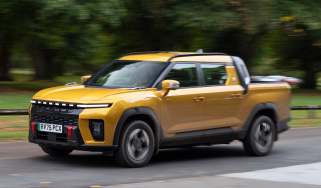
The current Musso’s days are now numbered because a replacement is in the works. This incoming model will share much of its DNA with the new electric Musso that’s also coming to the UK, which in turn is based on the KGM Torres SUV. We’ve already driven the new electric model, so be sure to also check out our dedicated KGM Musso EV road test.
Used - available now

2026 Volkswagen
Touran
38,250 milesAutomaticPetrol1.5L
Cash £24,490
2018 BMW
X5
102,819 milesAutomaticPetrol2.0L
Cash £17,989
2017 BMW
2 Series Convertible
80,176 milesAutomaticDiesel2.0L
Cash £10,699
2020 Volkswagen
Polo
40,500 milesManualPetrol1.0L
Cash £11,150For now, though, the existing Musso is available exclusively with a 2.2-litre four-cylinder turbocharged diesel engine that is shared with the Rexton. It delivers 203bhp and up to 441Nm of torque, and can be specified with either a six-speed manual or six-speed automatic transmission. All versions are fitted with a part-time four-wheel-drive system that sends drive to the front wheels only when it is needed, with high and low-range 4WD modes selectable by the driver.
The Musso is available in three trims: Rebel, Saracen, and top-of-the-range Saracen+. These models are geared towards private buyers as well as businesses, with larger alloy wheels and a smattering of smarter cabin materials, along with optional leather seats and upgraded infotainment systems.
Other pick-up trucks, such as the Ford Ranger, offer the added flexibility of a single-cab variant, but the Musso only comes in the double-cab form – although there is a choice of standard and long-wheelbase, with the LWB only available with an automatic transmission and Saracen+ trim.
When the Musso was launched with its mid-life facelift in 2022, it represented excellent value against its rivals, with prices starting from under £24,000 (excluding VAT). Since then, the starting price has risen to over £27,000 (excluding VAT) – severely reducing the cost advantage the Musso once boasted – the range-topping version costs more than £35k.
MPG and running costs
Pros |
|
Cons |
|
Anyone looking to purchase a pick-up truck will expect relatively high fuel bills, even when powered by a diesel engine, and the Musso is typical of the breed. Despite it being one of the lightest in its class, an official combined figure of 34mpg for the manual (32mpg for the automatic) puts it behind key rivals, and translates to consumption in the high 20s during everyday use.
The Musso doesn’t feature an engine stop-start system, either as standard or as an option, which is quite baffling. All of the KGM’s key rivals get this basic, fuel-saving feature, and this puts it at a further disadvantage for everyday running costs.
The Musso is fitted with a large, 75-litre fuel tank, which helps to mitigate the low economy, and could potentially provide a range of just under 500 miles. As with most pick-ups, aerodynamics play a key part in reducing fuel economy, and the Musso has a large frontal area, tall body and tyres designed for grip rather than low rolling resistance, all of which harm efficiency.
Similarly, an official CO2 figure of 255g/km is high by general pick-up class standards. This figure increases to 308g/km when the automatic gearbox option is ticked.
Depending on the exact model, the Musso falls into either insurance group 48 or 50 (out of 50). That’s significantly higher than the more expensive Ford Ranger and Volkswagen Amarok, neither of which fall into group 50, nor do the Toyota Hilux or Isuzu D-Max.
Load space and practicality
Pros |
|
Cons |
|
The Musso is available in just one double-cab body style, frequently the most popular choice among pick-up buyers, as it adds the flexibility of taking rear-seat passengers. Five seats are available, with four full-size and a slightly narrower centre seat on the rear bench.
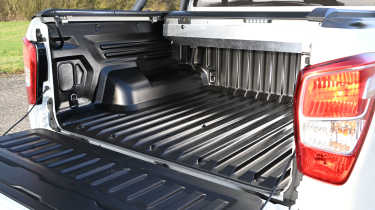
The Musso isn’t the largest pick-up truck on the market, with the standard-wheelbase model measuring 5,095mm long, compared to the Ford Ranger, which is a whopping 275mm longer at 5,370mm from nose to tail. This size difference is reflected in the maximum load length of the bed, the KGM’s 1,300mm is unable to match the Ford’s 1,564mm.
The long-wheelbase Musso measures 5,450mm long, which increases the maximum load length to 1,610mm. The Ford is much wider than both Musso variants though, and provides more cargo and passenger space.
Admittedly, the Musso has impressive ground clearance, which is particularly useful for owners who regularly go off-road.
Space is a crucial factor for working vehicles like pick-ups, especially double cab models that you would expect to easily accommodate five adults. The Musso definitely offers a generous amount of head and legroom up front. Unfortunately, legroom is tight in the back, and the cabin doesn’t feel wide enough to comfortably squeeze three across the bench.
Rear passengers don’t get any charging ports, either – just two air vents and some pockets in front of them. There are some useful storage areas within the cabin, though, in particular a generous cubby underneath the central armrest.
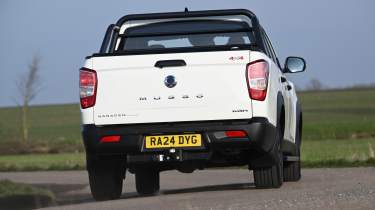
The flatbed features rotating hooks to secure cargo and a 12V power outlet to allow auxiliary equipment to be plugged in. Its size allows a standard Euro pallet to be carried, with a 1,105kg payload maximum for manual and 1,095kg for automatic models. The stretched version bumps this up to 1,205kg. Despite the extra practicality, the LWB only weighs 40kg more than the regular automatic Musso.
For anyone planning to use a pick-up for towing, the Musso deserves serious consideration thanks to its impressive performance. It is one of the few pick-up trucks that can tow 3,500kg and carry over 1,000kg payload at the same time, and is backed up by the security of selectable four-wheel drive.
Reliability, safety and security
Pros |
|
Cons |
|
Historically, pick-ups have performed less well in crash safety tests compared to conventional cars because of their separate chassis design, but this has improved in recent years with the addition of modern safety systems. All versions of the Musso are fitted with six airbags, ESP and Active Rollover Protection, although, at present, features such as autonomous emergency braking are not available.
Industry body Euro NCAP hasn’t tested the Musso, so there’s no official safety rating, but the lack of some safety features found on certain rivals makes us doubt whether it would receive the full five-star rating if tested.
As KGM is a relatively small player in the UK car and commercial vehicle market, we understandably haven’t had enough feedback from owners in our Driver Power satisfaction survey to rank it against other manufacturers, and reliability is relatively unknown as well.
There is reassurance in the fact that the Musso comes with a five-year/100,000-mile warranty, which trumps the three years/60,000 miles worth of coverage you get with a Ford Ranger. That being said, earlier Mussos got an even longer seven-year/150,000-mile warranty policy.
All KGM models follow a relatively strict 12-month/12,500-mile service interval compared to the variable service intervals available on some competitor vehicles.
Driving and performance
Pros |
|
Cons |
|
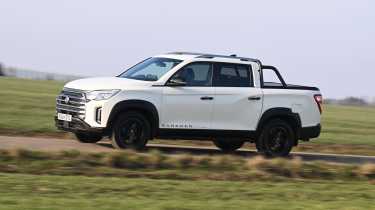
Earlier examples of the Musso came with a rather clattery 178bhp 2.2-litre diesel engine, but this was thankfully replaced by a somewhat smoother 2.2-litre motor that produces 203bhp and 400Nm of torque (or 441Nm for the models equipped with an automatic gearbox).
While the Musso isn’t fast, it has more than sufficient performance for a vehicle of this type. Torque is also offered up nice and low in the rev range, which is helpful for off-roading. The engine sounds raspy and starts to rattle when you push it hard. The six-speed automatic also has a tendency to kick down suddenly when you try to accelerate, but gear changes are otherwise smooth.
Less impressive is the steering, which is very light and doesn’t provide much in the way of feedback, making it somewhat difficult to place on the road and place accurately through corners. The brakes are surprisingly strong, although the truck can feel like it's squirming when you try to slow down, which isn’t exactly confidence-inspiring.
But the worst part of the driving experience is the Musso’s incredibly firm, bouncy ride when unlaiden that makes you feel every bump and crack. Even on smooth roads, it continues to fidget. We understand that the Musso’s suspension needs to be able to cope with having a tonne of stuff in the bed, but the Ford Ranger manages to do this while still being comfortable to drive unladen.
The Musso’s poor ride quality will put off any tradespeople who want something they can also use as family transportation when they’re off the clock, not just something to drive from one job site to the next.
KGM doesn’t say exactly how long it takes for the Musso to get from 0-62mph, but an estimated time of around 12 seconds seems about right. The top speed is 116mph (114mph for the automatic).
Town driving, visibility and parking
From the driver’s seat, the Musso offers a typically panoramic view of the road ahead thanks to the high ride height and driving position, while the electric seat controls and steering column rake and reach adjustment make it easy for drivers of all sizes to get comfortable. Even rear vision is relatively good considering the limited size of the rear window. However, some models get a roll hoop on the load bed with bars that run across the rear windscreen, obstructing your view out.
All but the base EX model also come with a reversing camera, but it’s angled almost directly at the ground. It’s the ideal view when hitching up a trailer, and if you need to see street curbs or obstacles near your rear bumper, but it’s hard to see anything coming towards you down the road.
Motorway driving and long-distance comfort
The bouncy ride quality and boxy ergonomics of the Musso mean it’s far from being the most refined motorway cruiser, even by truck standards. There’s no avoiding the roar of its chunky tyres, and the diesel engine becomes very vocal when pushed.
Cab interior and technology
Pros |
|
Cons |
|
There isn’t a lot to say about the design of the KGM Musso because it’s a ‘simple as you like’ kind of a pick-up truck. The Ford Ranger and Volkswagen Amarok have much more SUV-inspired styling, and generally look more classy (by pick-up standards, anyway).
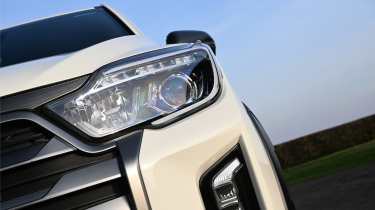
The Musso does have a rather distinctive face, with its towering front grille, and every version rides on 18-inch alloy wheels, although the design differs depending on the exact trim you go for.
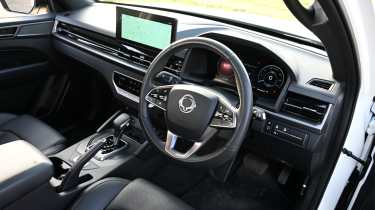
The interiors of the Ranger and Amarok also look like they were taken from SUVs, with enormous touchscreens, slick infotainment systems and high-quality materials. The Musso, on the other hand, borrows much of its cabin from the Rexton SUV, yet feels more like a utilitarian workhorse.
The dashboard design is very simple, and the interior in general feels solid. There are some soft-touch materials dotted around, but they feature alongside some hard, cheap-feeling plastics.
The steering wheel has physical buttons, while there’s an enormous gear lever, manual handbrake – even in the automatic versions – and a small rotary dial for the four-wheel-drive system on the centre console.
Saracen and Saracen+ models are fitted with more luxuries such as Nappa leather seats that are heated and cooled, electrically operated and supplemented by a heated leather steering wheel. Range-topping trucks come with heated rear seats as well, and blind spot detection.
Infotainment, sat-nav and stereo
Rebel trim trucks include analogue dials with a 3.5-inch TFT screen between, while the Saracen and Saracen+ models feature a fully digital 12.3-inch driver’s instrument panel. Aside from the base version, every Musso has a 12.3-inch central touchscreen that’s far from the sharpest or most responsive we’ve ever tested, and can’t match what its Ford and VW rivals offer, but it gets the job done.
Apple CarPlay and Android Auto come as standard with the touchscreen, so you can bypass the basic infotainment system, but they’re not wireless; you’ll need to plug your smartphone into the USB-C ports on the centre console to connect.
Buying and owning
Given its almost agricultural characteristics, we wouldn’t recommend the KGM Musso for someone who wants their truck to double as a daily car and a work vehicle. Therefore, sticking towards the lower end of the line-up makes the most sense, so we’d opt for the Rebel trim. There’s still enough kit included for most day-to-day essentials, but you won’t be quite as upset if the upholstery is tarnished.
Alternatives
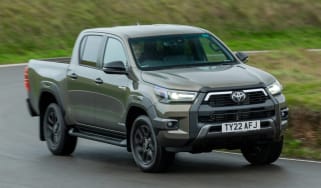
The Ford Ranger is undeniably our favourite pick-up in this class, having won our Pick-up Truck of the Year award seven times on the trot from 2019 to 2025. Other rivals to the Musso include the even more upmarket Volkswagen Amarok, plus the long-serving Isuzu D-Max and Toyota Hilux.
Frequently Asked Questions
Compared to the Ford Ranger or Volkswagen Amarok, the KGM Musso feels positively agricultural due to an extraordinarily bouncy ride and solid but dull interior with outdated tech.
Pick-up dimensions | |||
| Body style | Height | Width | Length |
| Double Cab SWB | 1,885mm | 1,950mm | 5,095mm |
| Double Cab LWB | 1,885mm | 1,950mm | 5,405mm |
Load area dimensions | |||
| Body style | Height | Width | Length |
| Double Cab SWB | 570mm | 1,570mm | 1,300mm |
| Double Cab LWB | 570mm | 1,570mm | 1,610mm |
More reviews
In-depth reviews