Volkswagen Tayron review
The Volkswagen Tayron takes the Tiguan’s best bits and mixes them with added practicality. We think it’s a solid, if unoriginal, family car

Our opinion on the Volkswagen Tayron
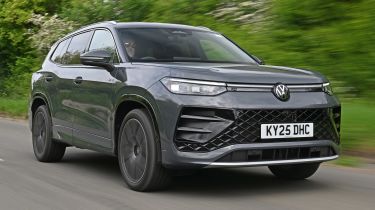
The Volkswagen Tayron provides seating for up to seven passengers, an excellent kit list, a strong variety of engines and a solid interior standing out as key selling points. Despite only having five seats, the plug-in hybrid version still makes for an appealing choice, largely thanks to its impressive electric-only range. On the whole, the Tayron is satisfying to drive rather than fun, but that’s fine given the primary focus of this SUV is on how many people you can fit in it rather than setting good lap times.
About the Volkswagen Tayron
The Volkswagen Tayron is the replacement for the VW Tiguan Allspace - the seven-seat version of the Volkswagen Tiguan. It borrows plenty of its design and technology from the Tiguan, but the Tayron is larger and available with up to seven seats, a unique feature in Volkswagen’s range of SUVs.
We’ve tested the Tayron on a wide range of UK roads and driving scenarios. Part of our testing included a head-to-head against the Hyundai Santa Fe, where the VW nabbed a victory due to how easy it is to live with.
Performance & driving experience
Pros |
|
Cons |
|
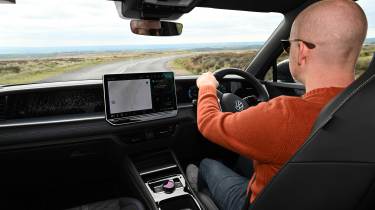
Few cars in this class offer quite as much choice as the Volkswagen Tayron. Short of a fully electric option, it’s got pretty much every base covered; pure petrol or diesel, mild-hybrid and plug-in hybrid options are all on the table. Most Tayron models are front-wheel drive, but 4Motion 4x4 is available at the top of the range with the 2.0-litre petrol engine.
The Tayron is also available with optional DDC dual-valve adaptive dampers that let you adjust the ride to your tastes across different driving modes, plus the latest generation of VW’s progressive power steering and the XDS virtual limited-slip differential to help distribute power.
Volkswagen has tweaked the Tayron’s suspension to be softer than its ‘all-rounder’ Tiguan counterpart, because the larger SUV, with its seven-seat layout, is designed to be a more practical, less sporty, family-focused model.
| Model | Power | 0-62mph | Top speed |
| Tayron 1.5 eTSI Life | 148bhp | 9.4 seconds | 129mph |
| Tayron 1.5 TSI eHybrid Style | 201bhp | 8.6 seconds | 130mph |
| Tayron 2.0 TDI Match [7 Seat] | 148bhp | 9.7 seconds | 130mph |
Performance, 0-60mph acceleration and top speed
The range kicks off with the 1.5 eTSI: a four-cylinder petrol engine backed up by a 48V lithium-ion battery and 48V belt-starter generator that replaces a traditional alternator and starter motor. While this engine is smooth enough and remains hushed under load, it doesn’t feel particularly lively for its 148bhp output and 9.4-second 0-62mph time. That’s with just one person on board, too; fully loaded with seven people and their cargo, it’ll need to be worked fairly hard to make much progress.
Some buyers will still prefer a big, torquey diesel engine, and the 2.0-litre diesel suits the Tayron well. It offers the same power as the 1.5 eTSI but, crucially, it has a significant 110Nm more torque than the petrol. Its 9.7-second 0-62mph time is also swift enough for most situations.
If you and your six passengers are in a little more of a hurry, then there’s always the range-topping 2.0-litre turbo petrol unit. Essentially, it’s in the same state of tune as the EA888 engine fitted to the Volkswagen Golf GTI – producing 262bhp – but here it powers all four wheels, delivering a 0-62mph time of 6.1 seconds.
There are also a couple of plug-in hybrid models, which combine a 1.5-litre petrol engine with an electric motor. These models have 201bhp and 268bhp respectively, with the more powerful version covering the 0-62mph sprint in a lively 7.3 seconds.
The plug-in models have a six-speed automatic gearbox rather than the seven-speed unit in the other Tayrons. On the move, both gearboxes are responsive enough but can be a little too slow to swap cogs in response to throttle inputs.
Town driving, visibility and parking
At low speeds, the body bobs around with sharp steering inputs that you’d probably expect of a jacked-up SUV with a high centre of gravity, but speed bumps and large potholes are dealt with easily – even on the larger rims found on the high-spec trim levels.
The steering is light and the Tayron’s longer wheelbase means its turning circle is 40cm greater than the Tiguan’s 11.7-metre radius. Meanwhile, the electric auto-hold handbrake feels jerky and can allow the Tayron to roll by an alarming amount between forward and reverse gears.
Country road driving and handling
The fidgeting you get at low speeds disappears as the speed increases, so the Tayron is enjoyable to drive along a twisty road. Despite the relative softness, it’s composed and capable through corners, and feels lighter on its feet than the Hyundai Santa Fe or the Kia Sorento.
There’s a reasonable degree of chassis control in flowing corners, and the optional DCC adaptive damping system with its 15 different modes offers a broad range of adjustability, although you will have to go for an Elegance, R-Line, or R-Line Edition trim to unlock this option. Grip levels are generally good, but get too vigorous with your steering inputs, and the Tayron will lose its composure.
The plug-in hybrid drivetrain prefers to use electric power at higher cruising speeds, but Volkswagen has generally done a great job of hiding the extra weight of the battery in these Tayron models. They feel a lot like the petrol and diesel versions to drive.
Motorway driving and long-distance comfort
Once you’re up to motorway speeds, the VW settles down well, smothering most road imperfections and generally quelling the din of road noise. Match trim and above come with acoustic laminated side glass, which does a good job of keeping wind noise pretty hushed.
Mechanical refinement is fairly dependent on what engine you choose as well, because the 1.5-litre eTSI mild-hybrid doesn’t feel too stressed and grumbly, whereas the diesel is a little noisy. Although silent in EV-only mode, the plug-in hybrid’s petrol unit doesn’t always cut in and out smoothly, either.
“The adaptive dampers are well worth investing in; at their firmest, they add a healthy dose of body control, and at their softest they deliver a superb ride quality.” - Alex Ingram, special contributor.
MPG & running costs
Pros |
|
Cons |
|
Being larger and heavier than the Volkswagen Tiguan, the Tayron unsurprisingly fares slightly worse on fuel efficiency and emissions.
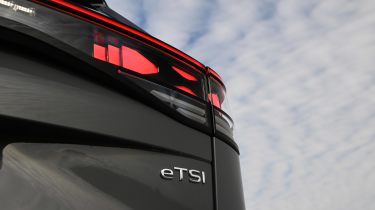
Thanks to its mild-hybrid system kicking in at low speeds, the Tayron 1.5-litre eTSI manages a respectable 45.2mpg on the WLTP combined cycle, which means it’s pretty competitive against other seven-seaters such as the Skoda Kodiaq, Hyundai Santa Fe and Kia Sorento.
The 2.0-litre TSI with 204bhp claims up to 36.0mpg, and the 262bhp unit gets 32.7mpg – not bad considering their use of all-wheel drive and lack of hybridisation. The 2.0-litre diesel provides a respectable 50.9mpg, although that’s slightly less than you’ll get in both the diesel Skoda Kodiaq and VW Tiguan.
| Model | MPG | CO2 | Insurance group |
| Tayron 1.5 eTSI Life | 42.8mpg | 142g/km | 24 |
| Tayron 1.5 TSI eHybrid Style | 176.6mpg | 36g/km | 29 |
| Tayron 2.0 TDI Match [7 Seat] | 50.4mpg | 146g/km | 25 |
Electric range, battery life and charge time
Available on every trim level, the Tayron PHEV in its lower-powered 201bhp guise can serve up to 185.7mpg according to Volkswagen. In the real world, we achieved close to 100mpg on our tests after a mix of petrol and electric running, and 44.9mpg using just petrol power.
On our test, we were able to get 58 miles of electric-only driving on a fully-charged battery driving a test loop including a mix of urban, country B-road, and motorway driving. That's against an official figure of 72 miles for an R-Line trim car like the one we tested.
The more powerful PHEV scores a little worse according to VW, at just shy of 167mpg, although we suspect there won’t be much between them in daily driving. You’ll want to keep the plug-in hybrid Tayron charged up regularly, not just to maintain decent fuel efficiency, but also because the 45-litre fuel tank is pretty small. Non-PHEV Tayrons get a 55-litre fuel tank instead.
Just like in the Tiguan eHybrid, if you run the battery down to below 15 per cent capacity in the Tayron, the PHEV’s electronics will favour petrol power to save the charge. Handily, there’s a high (for a plug-in hybrid) 40kW recharge rate, allowing for a 10 to 80 per cent top-up in 26 minutes. Utilise a typical 7.4kW wallbox charger and it'll take around four hours to fully recharge.
| Model | Battery size | Range | Insurance group |
| Tayron 1.5 TSI eHybrid Match | 25.7kWh | 74 miles | 29 |
| Tayron 1.5 TSI eHybrid Style | 25.7kWh | 73 miles | 29 |
| Tayron 1.5 TSI eHybrid 272 R-Line | 25.7kWh | 72 miles | 33 |
Insurance groups
The Tayron falls between insurance groups 25 and 35 out of 50, depending on your chosen trim and powertrain. That’s a fair bit higher than you’ll face with a Skoda Kodiaq, because it falls into groups 18 to 26. The Hyundai Santa Fe could be even more expensive to cover, in groups 33 to 36.
Tax
All Tayron models exceed the £40,000 threshold, meaning each version is subject to the luxury car tax surcharge. This will add £440 to your annual VED road tax bill, and it’ll apply from the second to sixth year after registration.
Business buyers considering the Tayron will be better served by the plug-in hybrid models as these attract the lowest Benefit-in-Kind rates of the line-up. However, for the greatest company car tax savings, a fully electric car is the best option.
The only electric seven-seater that VW currently offers is the Volkswagen ID. Buzz LWB. However, this is a very different car to the Tayron as it’s a boldly designed MPV rather than a somewhat understated SUV. If you’d prefer to stick with an SUV, you’ll need to look towards models from other brands like the Hyundai Ioniq 9, Kia EV9, and Peugeot E-5008.
Depreciation
Our market data shows that the Volkswagen Tayron should retain between 48 and 55 per cent of its original value after three years or 36,000 miles, which is on par with the Skoda Kodiaq, which holds on to 49 to 55 per cent. The Hyundai Santa Fe also puts on a similar performance at 49 to 52 per cent.
Interior, design & technology
Pros |
|
Cons |
|
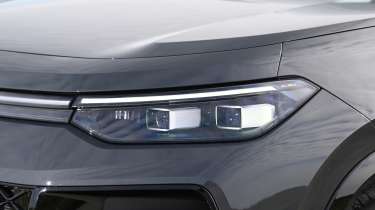
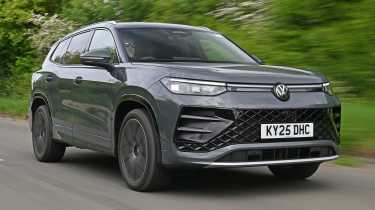
The Tayron may be essentially a stretched Tiguan underneath, but Volkswagen has gone to the trouble of ensuring that none of the larger SUV’s body panels is carried over. The result is a car that’s almost indistinguishable from the Tiguan visually.
Like that model, the Tayron comes with its ‘standard’ body kit or with the sportier stylings of R-Line trim, but there’s no getting away from the fact that this is a big, bulky SUV with interior space at the top of its brief.
Paint colours for the Tayron range from a black and white ‘solid paint’ to a white ‘premium paint’ and six metallic paint finishes. Ultraviolet is the most eye-catching, a deep purple.
As with many other VWs, the Tayron’s range starts with Life trim and includes a good level of kit as standard, including 18-inch alloy wheels, a 12.9-inch touchscreen, a 10.25-inch digital driver’s display, wireless smartphone charging, adaptive cruise control, ambient lighting, and front and rear parking sensors with a rear-view camera.
Our preferred Match trim adds:
- An electric tailgate
- Sound-insulating laminated side windows
- A 360-degree surround view camera system
- Heated front seats and steering wheel
- Auto-dimming side mirrors
Pay a bit more, and Style trim comes with larger 19-inch alloy wheels, massaging front seats, a 30-colour ambient interior lighting system, ArtVelours seat trim, and some wood ash dashboard trim. For a bit more, Elegance features Park Assist Pro with a memory function for the auto parking system that remembers the manoeuvre if you park in the same place regularly.
As usual, R-Line focuses on a sportier design, adding 20-inch wheels, more aggressive-looking R-Line bumpers, and sport seats. The R-Line Edition is the top-spec trim and comes with a unique set of 20-inch rims and a panoramic roof.
Interior and dashboard design
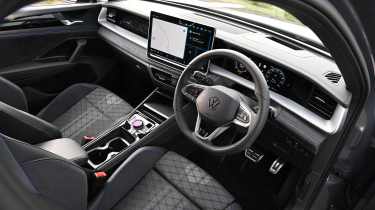
The Tayron’s neat cabin design is similar to that of the current Tiguan. It isn’t quite a class leader in terms of ergonomics or quality, but VW has ironed out some of the ergonomic flaws that have plagued its recent cars.
While climate controls and driver-assist settings are mostly adjusted through the touchscreen, they are fairly easy to alter, but the physical dials used by the Skoda Kodiaq are better still. The backlit dash and door trim panels look smart, and the steering wheel buttons are less fiddly to use than the haptic controls on some Volkswagen models.
Materials and build quality
While the cabin finish isn’t quite at the level of the Peugeot 5008, everything feels solidly screwed together, and any scratchy plastics tend to be in areas where hard-wearing materials are needed. Trimmed door pockets suggest that VW has put plenty of thought into offering an impression of expense.
There are some small gripes. One of the cars we tested (Style) had wood trim on the dash that looked good from afar but felt a little flimsy to the touch. The base Life trim also gets a rather dull silver and black colourway inside. Other than that, the Tiguan comes with plenty of solid surfaces, premium-feeling materials and a decent level of build quality.
Infotainment, sat-nav and stereo
Whatever size screen you get in your Tayron (12.9 inches as standard or optional 15 inches), you’ll find a crystal-clear resolution with a neat overall design to the infotainment system. As we’ve said in the Volkswagen Tiguan and Volkswagen Passat, where this screen also appears, the menu layout could be better, with a greater emphasis on the features you’ll use more often. Slider panels beneath for the climate and volume controls remain an annoyance.
The central screen and the customisable driver’s display work well together, but with wireless Apple CarPlay and Android Auto phone connectivity as standard, we’d recommend using these over the VW’s set-up.
“The Tayron has a ‘driving experience’ switch in the middle of the centre console. This rotary dial can toggle between presets from ambient lighting to driving modes. I found it worked well, although it works best as a simple volume knob.” - Alastair Crooks, senior news reporter.
Boot space & practicality
Pros |
|
Cons |
|
If you’re in the market for a roomy SUV that can occasionally seat seven, then the Tayron is ideally designed for the job. If you plan to carry six or more regularly, then the Hyundai Santa Fe or Kia Sorento are likely to be a better bet as they have more space in the rear row.
Dimensions and size
The Tayron is longer than a Volkswagen Tiguan by 250mm, which is where it gains the capacity for a third row of seats. The Hyundai Santa Fe is longer and wider, while the Skoda Kodiaq is a bit smaller.
| Dimensions comparison | |||
| Model | Volkswagen Tayron | Hyundai Santa Fe | Skoda Kodiaq |
| Length | 4,792mm | 4,830mm | 4,785mm |
| Width | 1,853mm | 1,900mm | 1,864mm |
| Height | 1,668mm | 1,780mm | 1,656mm |
| Wheelbase | 2,789mm | 2,815mm | 2,791mm |
| Boot space |
345/850/1,905 litres (7st/5st/2st) 705-1,915 litres (eHybrid PHEV) | 628-1,959 litres | 640-2,035 litres |
Seats & passenger space
As is typical of most modern Volkswagens, the Tayron’s driver’s seat and steering wheel offer a very wide range of adjustment, which means drivers of differing shapes and sizes can make the most of its fairly lofty driving position. But if the front seat is jacked up high for shorter drivers, the angle of the accelerator pedal is a touch acute, which could cause a little strain on the right foot on long motorway drives.
That minor gripe aside, there’s plenty of storage up front, with a cubby wide enough to hold two smartphones side by side (with the potential for twin wireless charging), plus a deep central bin and spacious door pockets.
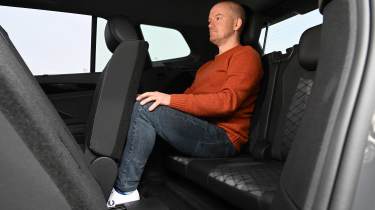
The second row has loads of space for three people. The cabin feels fairly wide, the seats are supportive, and knee- and head room are excellent. Some rivals offer more space, but you’re unlikely to hear many complaints from lanky occupants in the VW. A neat feature for middle-row occupants is the central armrest, which has two cupholders and a tablet holder.
Where fitted, the third row is tighter. As with most cars in this class, the second row can slide forward to better accommodate those in the back, but even so, any adult taller than average will find their knees pressed up against the seatbacks in front. The seat base is also very close to the floor, which forces the occupants’ knees up and reduces under-thigh support.
A lack of Isofix points in the third row is a shame, but a fixing point on the front passenger seat (plus two in the second row) gives families flexibility for fitting child seats.
Boot space
Where fitted, the Tayron still offers 345 litres of boot space with all seven seats up, roughly the same volume as a typical supermini, albeit with a much more generous boot opening. The third-row seats drop nearly into the boot floor (at which point a parcel shelf, which is otherwise stored in the boot floor, can be installed) to free up 850 litres of space.
Drop the second row of seats, too, and there’s a whopping 1,905 litres on offer. These figures improve on those of the Skoda Kodiaq, which has between 640 and 725 litres of space in five-seat mode, or 340 with all three rows up. Due to the Kodiaq's larger exterior dimensions, the Skoda has more capacity with all seats down at 2,035 litres.
In order to package the 25.7kWh battery in the plug-in hybrid models, there’s no space for the third-row seats. It does lose a little capacity compared with a regular petrol or diesel model in five-seat mode due to the battery pack, but 705 litres of capacity is still an impressive amount, and this grows to 1,915 litres when all seats are down.
Towing
For those needing to tow caravans and trailers, the 2.0 TSI 4MOTION (in either 201- and 261bhp forms) is the best choice thanks to its 2,400kg braked towing capacity, while its four-wheel drive system provides added traction on wet grassy campsites. Both the 262bhp eHybrid and diesel are almost as good, with a pulling capacity of 2,000kg. The entry-level 1.5 eTSI and 201bhp eHybrid can manage up to 1,800kg.
“Passengers in the second row will have few complaints, but space is tighter in the third row for adults, who will also find that the distance between the seat base and floor reduces under-thigh support” - Alex Ingram, special contributor.
Reliability & safety
Pros |
|
Cons |
|
The Tayron achieved a maximum five-star rating when it was assessed by Euro NCAP in 2025. Autonomous emergency braking, cross-traffic control, lane-keep assist, nine airbags and traffic-sign recognition come as standard, with more advanced driver-assist tech such as adaptive cruise control, lane-keeping assist and an area-view camera available either as optional extras or as standard on higher trim variants.
Although the Tayron didn’t appear in the latest Driver Power survey, Volkswagen’s 26th place finish out of 30 brands in the best manufacturer rankings is disappointing. Higher than expected running costs, infotainment system issues, and poor value for money were the three most common gripes for current owners, so there’s plenty of room for improvement.
| Euro NCAP safety ratings | |
| Euro NCAP safety rating | 5 stars (2025) |
| Adult occupant protection | 87% |
| Child occupant protection | 85% |
| Vulnerable road user protection | 83% |
| Safety assist | 80% |
Buying, prices and deals
- Best buy: Volkswagen Tayron 2.0 TDI Match
The entry-level Life trim is well-equipped and priced from around £41,600, but you can't have our preferred engine with it. Therefore, our vote goes to the slightly pricier Match trim, which features even more kit from around £41,800. This small additional outlay adds in useful extras like heated front seats, a surround view camera, and noise-reducing laminated side glass to make things quieter on longer trips.
Unless you are a company car driver, we'd go for the diesel instead of the plug-in hybrid in order to have seven seats. The entry-level 1.5 eTSI is a bit weedy when unladen, and will be much worse fully-loaded, so we think the extra muscle of the diesel will be worthwhile. And the diesel will be a lot more economical than the 2.0 TSI petrol.
The winter pack might be a worthwhile investment because it'll add a heated windscreen to help with defrosting the car in the winter, plus it also includes heated outer rear seats to keep those in the back happy. The panoramic glass roof is expensive at over £1,200, but it does flood the interior with natural light.
Whichever variant takes your fancy, you can save on the list price by building your new Volkswagen Tayron with the Auto Express Buy a Car service. We also have a range of Tayron leasing deals and new Tayron models to choose from. You can even sell your car with us.
Volkswagen Tayron alternatives
Volkswagen needed a replacement for the Tiguan Allspace because the seven-seat SUV game is too big to ignore. The Skoda Kodiaq is extremely similar to the VW under the skin, and comes with a related range of internal-combustion and hybrid powertrains. It’s also spacious inside, but the range’s base model dips just below £40k, and its rotary controls for the heating and ventilation make a big difference to the ease of use. The Cupra Terramar is another similar VW Group option that, in effect, is a Tayron in a sharper and more distinctive suit.
There are plenty more rivals in this segment, with the likes of the Kia Sorento and Hyundai Santa Fe, plus the Peugeot 5008 and the Nissan X-Trail all being worth a look.
Volkswagen Tayron pictures
Key updates of the Volkswagen Tayron review
19 August 2026: Latest driving impressions and data from our head-to-head PHEV test.
Frequently Asked Questions
All Volkswagen products come with a three-year, 60,000-mile warranty as standard, plus 12 months of roadside assistance cover. Rivals from Hyundai and Kia offer more generous packages in both areas.
Deals on the Volkswagen Tayron and alternatives
More reviews
Which Is Best
Most Economical
- Name1.5 TSI eHybrid Match 5dr DSG6 [Area View]
- Gearbox typeSemi-auto
- RRP£45,275