Aion V review
We get behind the wheel of the new Aion V to see if the latest arrival from China can stand out from the crowd

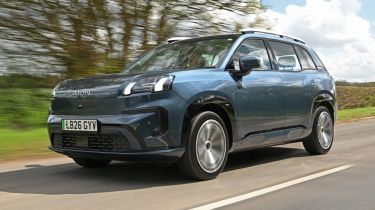

Our opinion on the Aion V
As the first car to bring the Aion brand to the UK, the V (pronounced ‘vee’ rather than ‘five’) really needs to impress, especially considering the rapidly growing market that it’s aiming for. We really like the amount of kit you get as standard and while the Premium Pack is fun, its use-case for families seems limited. The EV numbers from the Aion V are in the right ballpark and it will drive well enough for most people, although the screen-orientated approach and poor safety assist spoil the experience somewhat. Yet the aftersales support from Aion should give plenty of confidence.
About the Aion V
Before we dive into the V, let's first take a look at Aion, because this is a name that will be new to most people. Aion is the electrified sub-brand of GAC – or Guangzhou Automobile Company – which is the fifth-largest car manufacturer in China. Here in the UK, Aion will be established as part of a joint venture with Saudi-owned auto company Jameel Motors – the people distributing the Farizon SV electric van.
Being a 4.6-metre long electric SUV sitting around the £35k mark, the Aion V isn’t short of competition. There’s our 2026 Best Mid-Size SUV of the Year, the Skoda Elroq, the excellent Kia EV3 and fellow Chinese offerings, such as the recently facelifted BYD Atto 3 Evo, Geely EX5 and the Stellantis-backed Leapmotor B10.
As part of Aion’s parent company GAC and its joint ventures with Toyota in China, the Chinese-market Toyota bZ3X uses the same AEP 3.0 platform as the Aion V and the firm’s upcoming second model, the UT electric hatchback. There’s also just one powertrain with a 75.3kWh battery providing 317 miles of range.
The Aion V’s line up is super-simple, too, because there’s really just one unnamed trim with a £1,495 ‘Premium Pack’ above it.
If the Aion brand is a little too new for you, why not check out the Auto Express Buy a Car service where you can enjoy great discounts on big-name electric rivals, such as the Volkswagen ID.4, Nissan Ariya and Renault Scenic.
Performance & driving experience
Pros |
|
Cons |
|
Early criticisms of the driving experience in the Australian market have included a crashy ride with ‘bottoming out’ on bump stops, under-damped rear suspension and lifeless steering. Before arriving in the UK, Aion has fettled the chassis and the steering and the results have been positive, although it’s worth pointing out early on that this is no sports SUV.
Performance, 0-60mph acceleration and top speed
The Aion V’s sole powertrain features a 204bhp unit mounted on the front axle with 240Nm of torque – which is relatively low for an EV. However, on the move the Aion never feels underpowered and actually feels pretty nippy. You get the quickest throttle response in Sport mode, but the pedal itself still feels nice and firm, too. Changing to the Comfort or Power Save settings introduces a bit more of a delay, with the latter providing some additional brake-regeneration force – a little more than you’d get from a traditional combustion engine.
| Model | Power | 0-62mph | Top speed |
| Aion V | 204bhp | 7.9 seconds | 99mph |
Town driving, visibility and parking
On the standard-fit 19-inch wheels the Aion feels mostly composed at low speeds, however, big bumps and potholes will still deliver a thud into the cabin, which is surprising given the tall stance and expected depth of compression in the suspension.
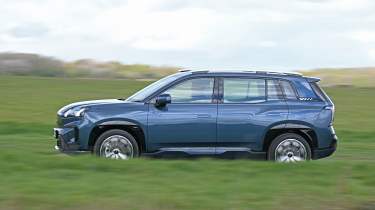
Country road driving and handling
You can artificially change the weight of the steering, but in Sport the calibration felt bang on to us. There’s not much in terms of feedback and if you’re too eager with your inputs it’s very easy to overload the front wheels, but overall it feels well judged. The slightly firm suspension doesn’t really equate to any cornering engagement, although the Aion certainly doesn’t roll as much as you’d think. This is possibly as a result of its 1,880kg kerbweight, which is far from what we’d call light, but is less than most rivals of a similar size.
Motorway driving and long-distance comfort
At higher speeds we experienced a very slight but constant vibration akin to a wheel being out of balance in the Aion V, we suspect this could’ve been down to fairly high tyre pressures (well above 40psi). In the future Aion is considering larger wheels for the V, but all we can say is smaller wheels with more tyre profile would be welcome.
“We’re quite used to family EVs coming with sportscar levels of performance and acceleration, but the Aion V, somewhat refreshingly, has not been designed to juggle masses of power.” - Alastair Crooks, senior news reporter
Range, charging & running costs
Pros |
|
Cons |
|
We’ve said the Aion V comes with just one battery offering, but we know the upcoming Aion UT hatchback will have smaller batteries. While Aion is focused on offering the V with all the bells and whistles from launch, the company said it’s looking into bringing a small-battery (and supposedly cheaper) variant to the UK.
Right now there’s a 75.3kWh pack that provides up to 317 miles of range under the WLTP testing regime. That places the newcomer almost exactly in between the ranges of the small and large-battery versions of the Elroq and EV3. It’s also comfortably more than the Leapmotor B10’s 270 miles, although it’s just one more mile than the Atto 3 Evo. After a few hours of driving on a mix of roads, our car (which started with the battery charged to 95 per cent and showing 303 miles of range), returned an average efficiency of 3.6 miles per kWh – which would’ve resulted in a range of 270 miles.
Charging for the V is at the upper end of the spectrum compared with its rivals, with 180kW ensuring a 10 to 80 per cent charge takes 24 minutes. Aion has only released 11kW AC recharging speeds (around 8.5 hours to fully recharge the battery), but we expect that a far more common 7.4kW home wallbox charger will be able to fully recharge an Aion V in around 12 hours.
| Model | Battery size | Range | Insurance group |
| Aion V | 75.3kWh | 317 miles | 32 |
Insurance groups
The Aion V starts in insurance group 32, while the Premium Pack version is in group 33. That's on par with a Renault Scenic, but several groups higher than the Ford Explorer, which starts in group 21 for the smallest battery version and goes up to group 27 for the larger-capacity 79kWh Style model.
Tax
As with all EVs, the Aion V is subject to the standard annual rate of vehicle excise duty (VED) of £200. Thanks to affordable pricing, this car's list price isn't even close to troubling the raised £50,000 luxury car tax limit, so there's no surcharge to pay.
However, EVs are going to be subject to the Government's pay-per-mile road tax scheme launching in April 2028, and it is likely to start at three pence per mile, before going up from April 2029 onwards. To read more about it, please follow the link provided here.
Depreciation
Our residual values experts predict that the Aion V will retain 47 per cent of its original price after three years and 36,000 miles. That’s pretty competitive and comparable with lower-rung versions of the Skoda Elroq, with the Kia EV3 only holding on to two per cent more during the same period. It doesn't hold its value as well as a Renault Scenic, though, because the Scenic is expected to maintain 54 per cent of its original value over the same period.
Interior, design & technology
Pros |
|
Cons |
|
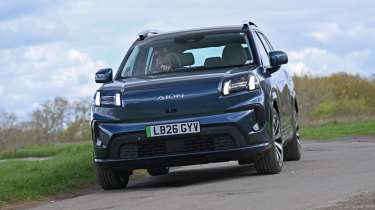
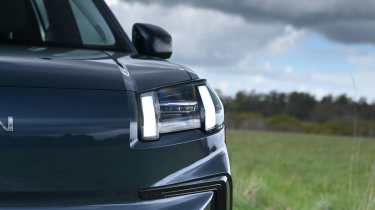
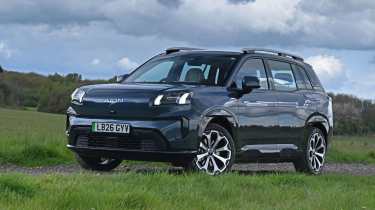
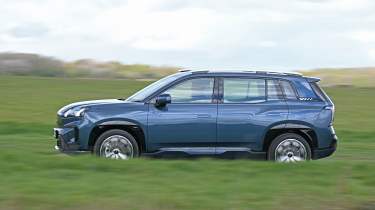
The Aion V’s exterior is pretty plain-looking, the boxy and upright profile and contrasting roof rails give the Aion V something of an off-road character, which makes the chequered flag motif on the rear pillar all the more odd, but in terms of interesting details you’re left a bit short-changed.
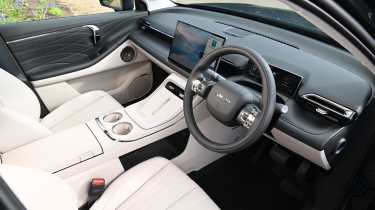
Open the flush-fitting door handles (Aion is keen to point out these are mechanical rather than electrical, presumably as a consequence of the bad press electric door handles have received in China) and you’ll find a cabin clearly targeting a premium experience.
It largely pulls it off, too. There are heated and cooled front seats, a powered bootlid, wireless smartphone charger, 360-degree camera and a panoramic glass roof with built-in sunshade all fitted.
For £1,495, the Premium Pack adds massaging front seats, real leather, a 6.6-litre fridge in the centre console and one tray table in the rear – on the back of the front passenger's seat. The table is leather-topped, too, and the damping of the hinges was benchmarked against the table in the back of a Bentley Mulsanne, apparently. While the fridge is a nice addition, as a family-oriented SUV, we’re not sure of the day-to-day use case of the Premium Pack, although it certainly adds some grandeur.
Materials and build quality
As part of our introduction to the brand, Aion’s managing director, Jon Wakefield, told us that GAC’s Toyota and Honda joint ventures in China have helped ensure the V will be “imbued with the same quality”. On first inspection, it appears the Aion V can hold its own with established brands here for quality.
The materials are all soft to the touch but feel durable, too, and there were no trim pieces rattling around, either.
The mirrored metal trim extends to the interior door handles, which are superbly damped – another nice touch. As a whole, despite the manual air vent controls being a little flimsy, we think most people getting into the Aion V will be pretty impressed by overall quality levels.
Infotainment, sat-nav and stereo
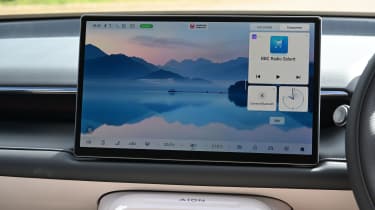
The Aion also gets a 14.6-inch touchscreen that dominates the dashboard. Aside from the Tesla-inspired toggles on the steering wheel (which don’t respond particularly well to inputs and are awkward to use while driving), there are very few physical buttons inside. This puts you at the mercy of the infotainment, which is confusing and distracting to use on the move. For instance, the positioning of the main sub-menu list is on the passenger side, meaning you have to frequently reach over to make selections.
Elsewhere, there’s a nine-speaker sound system which doesn’t sound particularly excellent, although it's no worse than Sony’s set-up in the Geely EX5.
“The Aion V aims for a more upmarket ambience inside and it largely nails it, although things unravel slightly with the fiddly infotainment system.” - Alastair Crooks, senior news reporter.
Boot space & practicality
Pros |
|
Cons |
|
The Aion V is larger than most of its rivals on the outside – which means it’s big on the inside too, particularly in terms of cabin space. The standard-fit panoramic roof makes it feel bright and airy – along with the optional £195 two-tone black-and-cream interior. There’s also a £195 black-and-tan interior option which is pretty bold.
Dimensions and size
| Dimensions comparison | |||
| Model | Aion V | Skoda Elroq | Kia EV3 |
| Length | 4,605mm | 4,488mm | 4,300mm |
| Width | 1,854mm | 1,884mm | 1,850mm |
| Height | 1,876mm | 1,625mm | 1,560mm |
| Wheelbase | 2,775mm | 2,765mm | 2,680mm |
| Boot space | 427 - 978 litres | 470 - 1,332 litres | 460-1,250 litres |
Seats & passenger space
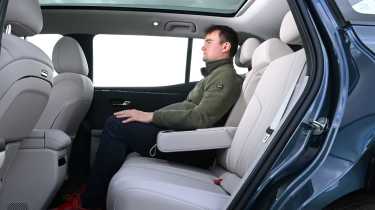
There’s loads of room inside the Aion V’s cabin. Space is perfectly fine up front, and tall adults in the back can stretch out easily – there’s even a tilt function for the rear-seat backrests. Plus there’s a completely flat floor, too.
Unusually, there’s no glovebox – with some meagre curry hooks in the passenger footwell instead. But at least there is a large storage compartment under the armrest where you can stow items.
Boot space
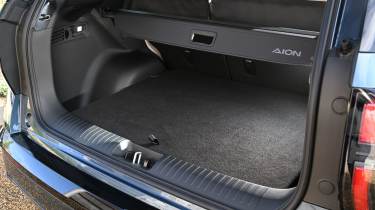
Boot space stands at 427 litres, which is more than the Geely EX5’s but less than both the Skoda and Kia, despite the Aion being longer than both of those cars. There are several levels of adjustment for the boot floor, but something we didn’t like was the parcel shelf. This is difficult to remove and has a few exposed screwheads, which brings the otherwise decent air of quality down a touch.
Reliability & safety
Pros |
|
Cons |
|
Despite its size, the touchscreen’s fonts are small, so until you’ve memorised the many sub-menus, the display takes your attention away from the road far too much. At that point, the overzealous driver-monitoring camera will start beeping at you. On the subject of safety assists, the speed-limit sign recognition defaults to also beeping when you enter a new speed zone. There’s also no way to turn off many of the safety systems, and like all new cars, they turn back on when you restart the Aion, too.
The Aion V achieved a five-star Euro NCAP safety rating when it was tested in 2025. That matches a safety pack equipped Kia EV3 and the Skoda Elroq, both of which were also tested in 2025.
As Aion has only just arrived in the UK, the V hasn’t appeared in any of our Driver Power surveys yet. However, Aion is hoping to reassure new customers and turn them into ‘brand advocates’ with its ‘Great 8’ strategy. Referencing Kia’s seven-year warranty, which helped secure the Korean company’s popularity in the UK, Aion’s ‘Great 8’ will provide a warranty, servicing, MOT and roadside-assistance package lasting eight years. The cover carries over to used buyers, too.
| Euro NCAP safety ratings | |
| Euro NCAP safety rating | Five stars (out of five) |
| Adult occupant protection | 88% |
| Child occupant protection | 85% |
| Vulnerable road user protection | 79% |
| Safety assist | 78% |
Buying and owning
Best buy: Aion V (standard trim)
You can get into the Aion V for £36,450, with the ‘Aion V Premium Pack’ costing £37,945. Upgrading to the Premium Pack is something more than 50 per cent of V buyers will do, according to Aion, and we can see that it elevates the cabin’s vibe to something trying to be more upmarket. We’d probably just stick with the standard car and make sure we get our preferred interior trim, whether it’s the standard all-black, black and tan or black and cream colourway.
Aion V Alternatives
The Aion V’s biggest issue isn’t really its own fault; it’s the vast array of similarly sized, similarly specified electric SUVs The Kia EV3, Skoda Elroq and Volkswagen ID.4 all drive better and all come with a choice of battery or motors, so they’ll appeal to wider audiences.
There’s also the relative leap into the unknown you’ll have to make with Aion, although the impressive ‘Great 8’ package will surely convince a few buyers.
Aion V pictures
Key updates on the Aion V review
15 July 2026: Included the latest VED, insurance, and maintenance information
Frequently Asked Questions
According to the maintenance schedule, the Aion V will require trips to the dealer every two years or 18,000 miles, whichever comes first.
Deals on the Aion V and alternatives