Best seven-seat hybrid cars 2026
Families typically need a big car with low running costs – and the best seven-seat hybrids fit the bill

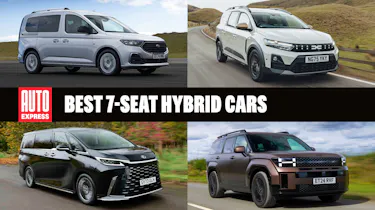
Until quite recently, the default choice for a large family car was diesel power. With torque to deal with associated weight, and greater fuel economy on long runs, there’s still a lot to recommend that approach.
Today though, hybrid power makes more sense for those who spend a lot of their time driving around towns or cities and want reduced fuel bills. Simply put, the best seven-seat hybrid cars have the qualities to make anyone think twice about buying another diesel and they also remove range and charging issues that come with a big EV.
Types of hybrid SUV
Broadly speaking, there are three types of hybrid on the market: mild, full and plug-in. Mild hybrids are fitted with a small generator instead of a traditional starter motor to improve efficiency, but they can’t travel on pure-electric power.
Meanwhile, full or ‘self-charging’ hybrids usually combine at least one electric motor and a battery alongside their internal-combustion engine. This combination is used to supplement the power of the engine, which itself also charges the hybrid-system’s battery. The result is greater efficiency and the ability to travel on electric power over very short distances.
Plug-in hybrids work in much the same way as full hybrids, but add the ability to charge the (much larger) battery with an external cable. The result is a much higher pure-electric range, supplemented by an internal-combustion engine – which can also help charge the battery.
Compare the best seven-seat hybrid cars on sale
Below we’ve picked out the top ten new hybrid cars with a seven-seat option for large families that are currently on sale.
We’ll be ignoring mild hybrids here for the most part, and instead focusing on more efficient self-charging and plug-in variants. These are the powertrains that work particularly well in large family cars and most cars of this type now have some form of mild hybrid assistance.
| Best 7-seat hybrid cars ranking | Name | Hybrid prices from |
| 1 | Dacia Jogger | £23,330 |
| 2 | Hyundai Santa Fe | £49,090 |
| 3 | Kia Sorento | £44,705 |
| 4 | Volvo XC90 | £73,765 |
| 5 | Peugeot 5008 | £37,045 |
| 6 | Ford Tourneo Connect | £35,280 |
| 7 | Ford Tourneo Custom | £64,392 |
| 8 | Lexus LM | £97,645 |
| 9 | Chery Tiggo 8 | £33,545 |
| 10 | Mazda CX-80 | £50,085 |
Keep scrolling to learn more about the best seven-seat hybrid cars currently on sale, or click the link in the table above to jump to a specific make and model..
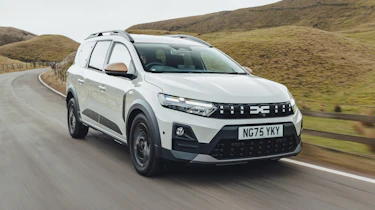
1. Dacia Jogger
If you’re after value for money and low running costs, look no further than the Dacia Jogger.
- Prices from £23,330
- Best for value
Pros |
Cons |
|
|
We named the Dacia Jogger our Family Car of the Year in 2022 and 2023 because of its MPV-like practicality, impressive flexibility, decent driving manners and incredible value. It comes with seven seats as standard and the choice of two engines: a 1.0-litre three-cylinder petrol or a 1.6-litre four-cylinder self-charging petrol-electric hybrid.
The hybrid is great for urban driving, running mainly in electric mode at low speeds and when pulling away; on the open road, the engine gets welcome electric assistance and feels punchier than its 1.0-litre non-electrified sibling. It’s for these reasons that the hybrid would be our powertrain of choice.
The Jogger is much lighter than just about every other seven-seat car, and this translates to a great driving experience, too. It feels grown-up on twisty roads and it’s reasonably refined considering its low price.
Crucially for a seven-seater the rearmost seats are easy to access, and there’s also decent space back there for adults. The trade-off is a very small boot with all seats in place – 160 litres – but fold down the third row and this increases to 565 litres. However, fold both rear rows and you’ll have a van-like 1,807 litres to play with.
“There’s plenty of room in the third row – only taller adults will have a reason to grumble about limited kneeroom, but we expect these seats to be mainly used by children anyway.” - Dean Gibson, senior test editor
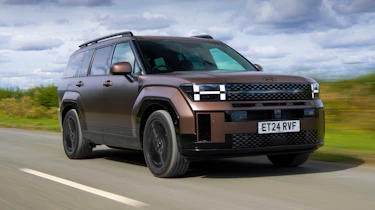
2. Hyundai Santa Fe
Seven-seat SUVs don’t need to be bland and boring, just look at the Hyundai Santa Fe.
- Prices from £49,090
Pros |
Cons |
|
|
The latest generation of Hyundai’s largest SUV, the Santa Fe, follows recent trends for squared-off designs, and is sure to attract fans on looks alone.
The new car is available only with hybrid powertrains, either self-charging or plug-in, and whichever you pick there’s a decent trade-off between performance and efficiency for such a large vehicle. It’s also comfortable to drive, and is surprisingly easy to handle around town thanks to good visibility.
The plug-in hybrid version makes good use of its battery, favouring electric drive at lower speeds and offering a pure-electric range of 33.6 miles, while the hybrid system in the non-plug-in does a good job of helping the petrol engine get up to speed. Efficiency is good across the board considering the Santa Fe’s appreciable size and weight.
Inside, the Santa Fe offers a plush cabin with loads of space; seven seats come as standard, but a more luxurious six-seat option is also offered, with two captain’s chairs for the middle-row passengers.
The Santa Fe is ideal for larger families, especially in its seven-seat configuration. Unlike rivals, the rearmost third row of seats are spacious enough to accommodate taller passengers on more than a temporary basis. The boot is also suitably large with 628-litres of space when five seats are in place, dwarfing the Peugeot 5008 by almost 300 litres.
“If you’ve got young children and need a family car that can handle multiple child car seats, the Santa Fe features four sets of Isofix mounting points – two on the middle bench, and another two on the rearmost seats.” - Dean Gibson, senior test editor
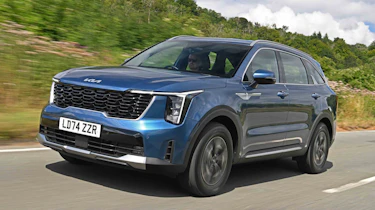
3. Kia Sorento
If the bold looks of the Hyundai Santa Fe don’t take your fancy, the more understated Kia Sorento just might.
- Prices from £44,705
Pros |
Cons |
|
|
Closely related to the Santa Fe above, the Kia Sorento has less aggressive styling but is similarly capable as a large seven-seater family car.
While previously pitched as a value proposition, the latest incarnation of the Sorento is plusher and much more desirable – but it still boasts the brand’s famous seven-year, 100,000-mile warranty.
Power comes from a 2.2-litre diesel (unlike the Hyundai Santa Fe) or the choice of a pair of hybrids – self-charging or plug-in. The former combines a 1.6-litre petrol engine with an electric motor, while the latter adds a bigger battery to the same basic recipe for 35 miles of pure-electric range.
We enjoyed the self-charging hybrid, which remains refined unless pushed hard and can return a claimed 42.2mpg – although we managed only 38.7mpg in our tests, it’s still pretty reasonable for such a large car in the real world.
Perhaps most importantly, the Sorento has a large, spacious cabin with a flat floor. We tested it against a Nissan X-Trail, and found the Kia was much better at carrying seven people, none of whom felt particularly cramped or squeezed in. The boot is also much larger, boasting 608-litres worth of space, 178 litres more than the X-Trail, when five seats are in place.
“The Sorento is a hugely spacious family car that’ll happily seat seven people – or accommodate five with a huge boot. What sweetens the deal further is the Santa Fe’s low starting price.” - Alastair Crooks, senior news reporter
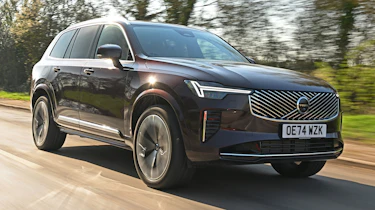
4. Volvo XC90
The Volvo XC90 might be getting a little long in the tooth, but it’s still an imperious luxury seven-seater.
- Prices from £73,765
Pros |
Cons |
|
|
A stalwart of the seven-seat family SUV category since the long-serving original launched in 2002, the Volvo XC90 has managed to retain its appeal thanks to a considerable overhaul in 2015 and subsequent facelifts in 2019 and 2024.
We recently tested the XC90 against the much more up-to-date all-electric Kia EV9, and found that it was still more than up to the task, proving itself as a great all-round family car despite its age, and majoring on practicality and comfort.
While mild hybrid engines are offered and probably make the most sense for most buyers, we suggest you should opt for the T8 plug-in hybrid variant but only if you can regularly charge the battery to make use of its official 44 mile electric range. Here you’ll be able to reduce your running costs while benefiting from its impressive performance, thanks to its 448bhp of combined power.
In typical Volvo style, the XC90’s cabin is both stylish and functional. Everything feels solid and sturdy so it should easily withstand day-to-day family life. The Android Automotive infotainment system is slick and we like the fact Volvo has kept large on-screen buttons and shortcuts to key vehicle controls you’re likely to use frequently.
Space is abundant, with 302 litres worth of boot capacity, even when all seven seats are in place. We did find that getting into the rearmost third row can be tricky as there’s not a lot of floor space to put your feet when clambering in. Once in place though, passengers shouldn’t feel too cramped.
“I like the way the XC90 is a little less ostentatious than some of its large SUV rivals. It certainly doesn’t have the imposing road presence of big SUVs from Land Rover or BMW and many people will prefer it that way.” - Steve Walker, head of digital content
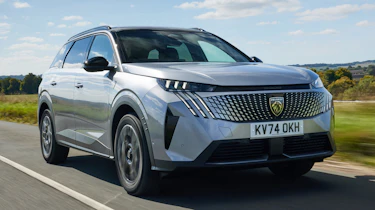
5. Peugeot 5008
The Peugeot 5008 looks pretty sharp, is spacious and is a great seven-seat family car overall.
- Prices from £37,045
Pros |
Cons |
|
|
The Peugeot 5008 recently benefited from a thorough reworking, with the French company adding more space and practicality to its largest SUV. There’s also now the option of a pure-electric version, along with self-charging and plug-in hybrids.
The latter is particularly useful thanks to its pure-electric range of up to 48 miles, but the non-plug-in is still good for up to 52.5mpg – a respectable figure for a big seven-seat SUV.
On the road, the Peugeot 5008 is very comfortable and rides very smoothly compared to its rivals. You do have to work the Peugeot a little harder than most to get up to speed, but it never feels out of its depth.
When it comes to space, Peugeot has enlarged the outer two seats on the middle bench to improve comfort, while legroom and headroom remain excellent.
When it comes to the 5008’s rearmost seats, there is enough head and shoulder room for most adults, but the kneeroom is a little on the tight side. We think it’s perfectly adequate for occasional use, though.
The boot is nice and square in shape, and there’s 258-litres worth of space with all seven seats in place. This is more than the 179 litres you’ll find in the Kia Sorento.
“The electrical part of the hybrid system covers most areas where the small petrol engine struggles. However, it’s not the fastest when pulling away from junctions.” - Pete Gibson, senior photographer
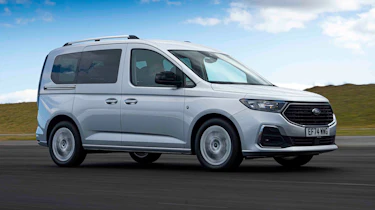
6. Ford Tourneo Connect
If you regularly carry more than five people, van-based MPVs like the Ford Tourneo Connect are affordable and hugely versatile.
- Prices from £35,280
Pros |
Cons |
|
|
The van-based Ford Tourneo Connect MPV has long been a solid choice for those carrying more than five people, and while the genre is less well represented in 2026, some have survived and added a hybrid powertrain for good measure.
Just as with the all-electric Ford Explorer, the Tourneo Connect is the product of the firm’s partnership with Volkswagen. Based heavily on that brand’s Caddy model, Ford’s offering takes all the best bits of its counterpart and increases the value proposition with more standard equipment and safety kit.
What’s more, the new plug-in hybrid variant offers a seriously impressive pure-electric range of 68 miles, while there’s even the choice of two body lengths and five- or seven-seat layouts. To get the most out of the plug-in hybrid powertrain, you’ll want to charge it up regularly.
When we tested the Tourneo Connect against the Dacia Jogger and Toyota Proace City Verso, we liked the sheer size of the Ford over the Toyota, plus its sliding doors make getting in and out of the rear that much easier compared to the Jogger. Its van roots mean the boot and cargo space is also very generous at 1,213 litres.
“As well as having a longer body, the Grand Tourneo Connect has an extended wheelbase, too. That makes room for a longer door, which boosts access to the cabin.” - Dean Gibson, senior test editor
Latest Ford Tourneo Connect deals
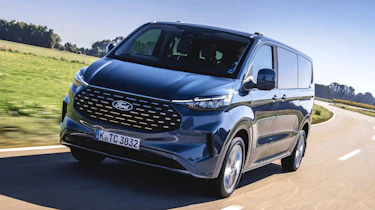
7. Ford Tourneo Custom
If you like the sound of the Ford Tourneo Connect but wish it had more space, the Ford Tourneo Custom would like a word.
- Prices from £64,392
Pros |
Cons |
|
|
The Ford Tourneo Custom is another ‘van with windows’ from the blue oval, this time based on the tried-and-tested Transit but so much more sophisticated than you might expect. Designed to take on the likes of the Mercedes V-Class and other executive people-movers, the Ford majors on space and comfort, while electric and plug-in hybrid versions have been added to the range for silent running around town with no local emissions.
Various configurations are available, with space for up to nine people; the seats sit on tracks in the floor that allow for easy adjustment and trade-off between luggage and passenger space.
We’ve yet to get behind the wheel of the hybrid version, but if the standard diesel-powered iteration is anything to go by, the Tourneo Custom’s van connections really shouldn’t put you off heading for a test drive.
With removable seats on sliding rails, there’s a wide range of configurations on offer which makes it ideal for very large families or for executive people-movers.
“We like the fact all the chairs are removable, with four out of six being individual seats. This makes it much easier to configure the cabin as you please.” - Dean Gibson, senior test editor
Latest Ford Tourneo Custom deals
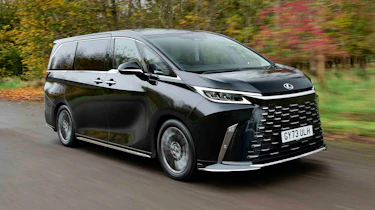
8. Lexus LM
If you want to carry seven people around in real luxury, the Lexus LM could be just the ticket.
- Prices from £97,645
- Best for luxury
Pros |
Cons |
|
|
Those familiar with car culture in Japan and other south-east asian countries will be familiar with cars such as the Lexus LM, but this luxurious cab-forward minivan is among the first of its kind to be officially imported to these shores.
Based on the same architecture as the Toyota Alphard, the LM is a more luxurious proposition than its Japanese domestic market counterpart.
In its base spec the LM comes with seven seats, while an optional four-seater makes the most of that van-like shape to offer near private-jet levels of luxury – in fact, the LM was outselling the long-standing LS saloon before it went off-sale.
Despite its boxy appearance, it drives as you’d expect a Lexus to: smooth, effortless and quiet, with a great powertrain thanks to parent firm Toyota’s expertise in self-charging hybrid technology.
Though the starting price of near £100,000 is high, running costs and efficiency should be on the opposite end of the spectrum. During our time with the LM, we managed to see a fuel efficiency figure of 36.4mpg, even with most of our driving taking place on high speed roads.
Spend more time at lower speeds and you should get closer to Lexus’ claimed efficiency figure of 42mpg with the powertrain favouring electric running.
“At urban speeds, the hybrid drivetrain is hushed if you take things easy. There’s virtual silence when coasting or on light throttle openings as the electric motor does the work. Even when the engine kicks in, there’s only a distant hum”. - Dean Gibson, senior test editor
9. Chery Tiggo 8
The Chery Tiggo 8 might be a newcomer to the UK, but this seven-seat SUV has all the right ingredients to become a popular option.
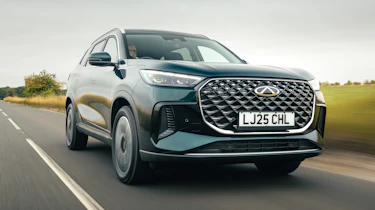
- Price from: £33,545
Pros |
Cons |
|
|
You are forgiven if you’ve not heard of the Chery Tiggo 8 before, but this SUV comes from a Chinese brand which you should really be paying attention to. Let us explain.
The Chery Tiggo 8 has one of the lowest starting prices of any car on this list. While the Dacia Jogger has the Tiggo 8 beat when it comes to overall cost, its Chinese rival features impressive levels of build quality, more space, and even a plug-in hybrid powertrain.
Speaking of powertrains, while you can get the Tiggo 8 with a pure-petrol engine, we think it's best avoided. Spending the extra cash on the Tiggo 8 plug-in hybrid means you’ll benefit from up to 56 miles of all-electric range, reduced running costs, and a much smoother and more comfortable driving experience.
Practicality is an area where the Tiggo 8 shines. There are lots of places to store items around the cabin. Passenger space is generous up front and in the second row, but six-foot adults might want to avoid using the rearmost third row for anything more than short journeys.
Thankfully, getting in and out of the third row isn’t too difficult thanks to the wide door openings and the split folding second row rear seats. With five seats in place, boot space is rated at 494 litres which is respectable when you consider rivals with more boot space are much more expensive.
“The Tiggo 8 has huge door bins that can hold large water bottles, a split-opening cubby that can store one-litre bottles upright, and cup-holders for every occupant. There are also three Isofix child-seat mounting points.” - Alastair Crooks, senior news reporter
10. Mazda CX-80
The Mazda CX-80 might be a left-field option, but with great levels of build quality, efficiency and practicality, it’s pretty appealing.
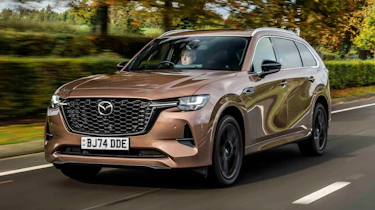
- Prices from £50,085
Pros |
Cons |
|
|
Mazda’s CX-80 is the firm’s largest offering with great space, good build quality, efficient powertrains and a decent driving experience.
Two engine options are offered: a 3.3-litre mild-hybrid diesel, and a plug-in hybrid with a 2.5-litre petrol and electric motor with a combined 323bhp and 500Nm of torque – which is pretty useful in a big car such as this and would be our powertrain of choice.
While the plug-in’s pure-electric range of 37 miles lags behind that of some rivals, the system works well overall and is very efficient, with claimed combined economy of up to 176.6mpg. You will have to charge very regularly in the real world to achieve this and with the battery flat something closer to 35mpg is more realistic. The PHEV system is somewhat jerky so we would recommend the diesel for anyone regularly taking longer trips.
Inside, the slickly designed cabin feels great and is very spacious, with seven seats as standard, or the option of six with a pair of captain’s chairs in the middle row. Crucially, even those in the rearmost row have plenty of space, but access can be a challenge for adults.
“I achieved 169mpg over a couple of weeks where the CX-80 hardly exceeded its 25 to 30-mile EV range. It’s a good example of how efficient a big car with a PHEV powertrain can be if you charge it. When the battery is flat, 35mpg is more realistic.” - Steve Walker, head of digital content.
How to choose the best seven-seat hybrid car
It probably goes without saying that picking the right seven-seater should involve in-person visits to a dealership to try out cabin size, boot space and other essentials. If you plan to carry plenty of passengers regularly, it might even be a good idea to bring a gang of seat-testers with you to see how the car handles it.
Beyond practical considerations, it’s worth comparing self-charging and plug-in hybrids to see which best suits your budget or circumstances. The former offers fuss-free improvements in efficiency in running costs, but you won’t be able to use electric power alone for very long.
Also, pure-hybrid power doesn’t drastically affect road tax and doesn’t bring the same savings to company car users as plug-in variants.
PHEVs make a lot of sense as company cars, but also can slot perfectly into many average-use cases. If you do most of your driving over short distances, but supplement this with a long motorway trip every so often, it should be possible to reduce your fuel bill by sticking to electric power only most of the time.
You’ll have to factor in charging, of course, but this takes less time than for a pure-electric car in most cases. Avoid charging a plug-in hybrid using the public network as it’s quite expensive and will eat into any of your fuel savings. If you have access to a driveway, charging via a home wallbox will be considerably cheaper, as you can take advantage of lower costs EV specific tariffs.
Don't need this many seats? These are the best hybrid cars on sale...