Used BMW Z4 (Mk2, 2009-2016) review and buyers' guide
A full used buyer’s guide on the BMW Z4 covering the Z4 Mk2 (2009-2016)

Verdict
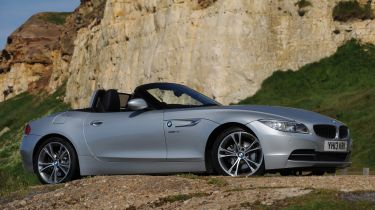
This wasn’t BMW’s first coupé-cabriolet, but the company has since shifted back towards soft tops for its convertibles. Nevertheless, BMW did a pretty good job with the Z4. Admittedly the coupé-cabrio configuration brought compromises in terms of the driving experience, as well as reduced roof-down carrying capacity, but on the plus side, year-round usability and security were improved. There are plenty of Z4s for sale, from economy-focused entry-level models to tarmac-tearing hot-rods that are sure to become collectors’ items. As car makers rush to electrification, cars such as the Z4 are a dying breed. So it’s worth seeking out a good one, even if it’s only for the occasional weekend drive.
Of the mass-market premium brands, BMW has been close to the front of the pack of car makers producing drivers’ cars. Despite this, its focus has been more on ‘sporting’ cars rather than sports cars. If you’ve wanted a brilliant family estate or SUV that’s also fun to drive, BMW has delivered, but if you fancied a two-seater roadster with an emphasis on dynamics over practicality, not so much.
Then in 1996, the company launched the Z3, which offered a blend of style, usability, affordability and fun. The Z4 that replaced it built on this, with the Z4 Mk2 bringing everything nicely up to date. Now the Z4 Mk2 is a modern classic.
History
The second-generation Z4, code named E89 by BMW, hit UK showrooms in August 2009. Initially there were 204bhp 2.5-litre sDrive23i, 258bhp 3.0-litre sDrive30i, or 306bhp 3.0-litre sDrive35i options (all with six cylinders), but by March 2010 there was also the ultra-quick 340bhp sDrive35is too.
Used - available now

2020 BMW
2 Series Gran Tourer
59,121 milesAutomaticPetrol1.5L
Cash £12,880
2022 MG
HS
42,916 milesManualPetrol1.5L
Cash £12,880
2020 Volkswagen
Golf
61,778 milesManualDiesel1.6L
Cash £12,490
2022 Mercedes
GLA
32,179 milesAutomaticPetrol1.3L
Cash £24,490By spring 2012, the sDrive23i and sDrive30i had been superseded by the 184bhp sDrive20i and 245bhp sDrive28i respectively, both powered by a turbocharged 2.0-litre four-cylinder engine.
A facelifted Z4 reached showrooms in March 2013, with new headlamps, extra standard equipment, fresh colour options and a new entry-level model, the sDrive18i, with a detuned 154bhp turbocharged four-cylinder 2.0-litre engine.
The second-generation Z4 went out of production in August 2016, but from a year before that BMW added standard sat- nav.
Which one should I buy?
If running costs are important, your best bet is to buy a four-cylinder Z4, but the six-cylinder cars have a far more exciting soundtrack, with performance to match.
While the range-topping models are seriously fast, they’re also costly to run. Indeed, the sDrive30i is all you need.
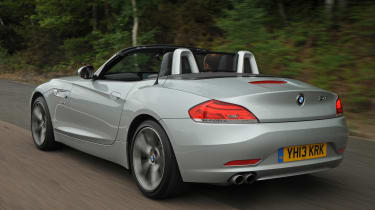
Both manual and DCT dual-clutch transmissions are excellent, so which you go for is down to personal preference. There were two trim levels: standard and M Sport. The standard equipment with the former varied according to the engine, but all Z4s came with dual-zone climate control, electric windows, xenon headlights and 17-inch alloy wheels. Entry-level cars had cloth trim, but posher ones had leather. M Sport added 18-inch alloys, a black headlining, a bodykit and sports seats, along with stiffer suspension.
Alternatives to the BMW Z4
If you’re set on buying a coupé-cabriolet, the Mercedes SLK/SLC is a great alternative, with its impressive build quality and smooth engines, and it’s also better to drive than you might expect. If an engaging driving experience is key, the Porsche Boxster and its sibling the Cayman coupé should be on your shopping list; both are fabulous to drive and superbly built.
The Audi TT is also constructed to a high standard and good to drive, and uniquely here, it came with four-wheel drive. As with the Mercedes, the Audi also had the option of a diesel engine. The Nissan 370Z is quick and fun to drive, but it can’t match the BMW’s build quality or refinement. The Mazda MX-5 is light and more entertaining to drive as a result, but less sophisticated than the BMW.
What to look for
Hydraulics
The roof is generally reliable, but hydraulic fluid leaks can lead to stained interior trim and the roof getting stuck up or down.
Tyres
The Z4 came with run-flat tyres as standard, which spoils the ride comfort. Some owners have resorted to fitting standard tyres instead.
Cracked wheels
The 10-spoke 19-inch alloy wheels are prone to cracking on potholes, leading to air escaping from the tyres.
Injectors
Take an extended test drive and check for faulty injectors betrayed by the engine cutting out or running unevenly. Engine remaps are common.
Common faults
All Mk2 Z4s are getting on a bit, so you’ll have to put up with a few creaks and rattles. High-mileage examples may face pricey problems with fuel injectors, while other issues include rear light clusters filling with water and needing to be replaced, and side windows that don’t always drop when the hood operates.
Interior
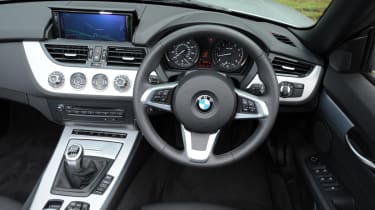
Compared with BMW’s current models, the Z4 has a rather old-school dash with proper buttons and no digital instrumentation, and it’s all the easier to use as a result.
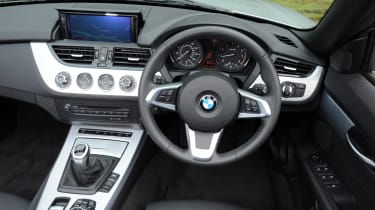
As you’d expect, there are plenty of high-quality materials, the seats are supportive, and because there’s room for only two, even relatively tall adults can get comfortable.
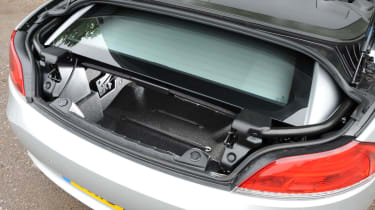
Boot space isn’t great, though, as you might expect; it runs to just 310 litres with the roof up, or only 180 litres with it stowed. For context, a Kia Picanto can hold 255 litres.
Prices
Early 2.0-litre examples are the most common engine, followed by sDrive23is, which make up a quarter of used Z4s. There’s a 55:45 per cent split in favour of manual transmissions. For exact prices on specific models, use our car valuation service...
Running costs
The Z4 comes with Condition-Based Servicing, which is a variable-servicing programme that tells the driver when maintenance is required, based on oil levels, wear rates of components and how hard the vehicle is driven.
With normal driving, an oil service is due every 16,000 miles or so. Because parts are replaced when necessary rather than according to a set schedule, there are no fixed prices for the services.
Fresh brake fluid is required after three years and then every other year. All Z4 engines are chain-driven, so there are no cambelts to replace.
Recalls
The Z4 Mk2 has been recalled seven times over the course of its life. In July 2012, some Z4s were recalled due to faulty power steering. A few Z4s were recalled in April 2013 because an electrical fault could lead to the engine cutting out; the same problem led to a second campaign in April 2017. Loose bolts could lead to clutch failure of some Z4s built between February and June 2013, while brake-servo glitches of Z4s made between June 2012 and August 2013 resulted in a recall in January 2014.
Engine problems leading to limp-home mode forced an action in July 2017, for some Z4s made up to October 2011, while the most recent recall came in April 2017 because of driveshaft failures on some Z4s produced between December 2010 and April 2011.
Driver Power owner satisfaction
The Z4 didn’t sell in big enough numbers to appear in any of our Driver Power surveys when the model was in production. Looking at current brand survey results for BMW would be misleading, but the 47 owner reviews on CarBuyer.co.uk provide a good indication of Z4 ownership. With an average score of 4.4 out of five, owners clearly love the Z4s’ dynamics, well-made cabin, reliability and refinement.
Looking to sell your current car quickly and for a good price? Try our Free Car Valuation tool today!
BMW Z4 (2009-2016) review: What we said
Extracts from our 2016 in-depth review of the BMW Z4...
It looked sporty and had a range of powerful engines, but the BMW Z4 was more of a comfortable cruiser than a sharp sports car. The rear-wheel drive layout delivered balanced and engaging handling, but a soft suspension set-up meant it never felt as responsive as a Porsche Boxster or Audi TT. M Sport models featured a stiffer suspension set-up, but the trade-off was an extremely firm ride.
Unlike the Audi TT or Mercedes SLC, there was no super-frugal diesel version, but the BMW’s petrol units were powerful, smooth and respectably efficient. The last round of design tweaks kept the Z4 looking fresh, but nothing was done to fix the compromise of the roadster’s metal top, which took up far too much boot space when stowed. Overall, it was an open-top sports car that promised plenty, but delivered too little to make an impact in the class.
The BMW Z4 was a competitor to popular roadsters like the Audi TT Roadster, Mercedes SLC and Porsche Boxster. The second-generation car was originally launched in 2009, and it was given a subtle facelift in 2013 to try and keep up with newer rivals.
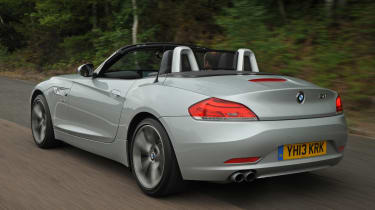
The original Z4 was in production from 2002-2008 (it was a replacement for the Z3 roadster), but unlike that car, the second-generation featured a complex folding metal roof that helped make the BMW more refined and secure than fabric-roofed rivals. However, the electrically powered mechanism added weight and reduced luggage space when the top was stowed.
In-keeping with BMW tradition, the Z4 had a traditional front-engine, rear-wheel drive layout, and power came from a choice of turbocharged four and six-cylinder petrol engines. The range comprised the entry-level 154bhp 2.0-litre in the sDrive18i, the 181bhp version in the sDrive20i and a 241bhp sDrive28i, while a 3.0-litre straight-six was used in the 302bhp sDrive35i and 336bhp sDrive35iS.
The Z4's two-seater cabin featured a suitably upmarket finish. Top quality materials were used throughout, although it was beginning to look dated towards the end of the car's like, but the snug two-seater cabin had real premium appeal.
All cars bar the sDrive35iS were offered in two trim levels, standard and M Sport, but even the most basic model wasn't short on kit. Climate control, 17-inch alloy wheels, DAB radio, Bluetooth connection and xenon headlamps all featured.
Go for an M Sport model, and extra kit included larger 18-inch wheels, a muscular bodykit and leather trim for the seats, while the flagship 35iS added adaptive damping and a seven-speed DCT twin-clutch gearbox. All models got a six-speed manual or an optional eight-speed automatic. The exception was the 35i, which was available with the same DCT unit as the 35iS.
Engines, performance and drive
The rear-wheel-drive Z4 wasn’t as engaging as a Porsche Boxster or Audi TT, but it was a surprisingly good cruiser, thanks to its supple ride and high level of refinement – the latter due in part to that complex and relatively weighty metal folding roof.
Still, the naturally weighted steering, fine balance and decent grip meant the BMW still felt agile and composed through a series of corners so it was a lot of fun to drive. M Sport versions featured a stiffer suspension set-up that harmed ride comfort, while the range-topping 35is got adaptive dampers, which were very stiff in their sportiest setting.
Engines
Unlike the Mercedes SLK and Audi TT Roadster, the Z4’s engine line-up was exclusively petrol. The range kicked off with the sDrive18i, which used a detuned version of the four-cylinder 2.0-litre turbo engine from the 20i and 28i. According to BMW, it could complete the 0-62mph sprint in 8.1 seconds and hit a top speed of 137mph, but it needed to be worked hard to keep up with traffic. The sDrive20i was a much better bet in terms of performance, despite its modest 181bhp power output.
It still accelerated strongly even from low revs and responded quickly to the throttle, particularly when the standard Performance Drive Control was in Sport mode - you could also choose from efficient ECO PRO and relaxing Comfort settings. At the top of the range, were the six-cylinder sDrive35i and sDrive35iS – the latter went head-to-head with the Boxster S and SLK 55 AMG, with a 0-62mph time of 4.8 seconds.
It came with a seven-speed twin clutch M DCT transmission, which delivered smooth and quick shifts using the paddles on the steering wheel. Every other model came with a six-speed manual gearbox as standard, while an eight-speed auto gearbox was available as an option, and the 35i could be had with the DCT transmission, too.
MPG, CO2 and Running Costs
No matter which version of the 2.0-litre four-cylinder turbocharged engine you chose, whether it’s the sDrive18i, 20i or 28i, BMW claimed average fuel economy figures of 41.5mpg and CO2 emissions of 159g/km across the board. These numbers were pretty good for a sports car, although the newer, more efficient Audi TT Roadster 2.0 TFSI had the BMW Z4 beaten, with figures of 47.1mpg and 140g/km.
Of course all the official figures are generated during a computer controlled test cycle, so if you use all the Z4’s performance potential on the road then fuel consumption and emissions have the potential to rise considerably. The larger capacity engines, driven hard, are likely to consume more.
It’s worth noting too, that opting for the eight-speed automatic gearbox on the Z4 had no impact on the numbers. Unlike Audi with its TT, BMW didn't offer a diesel version of the Z4, so don’t go looking for a super-frugal option.
The range-topping sDrive35iS with its six cylinder engine will naturally be much more expensive to run than the four cylinder cars, as it can only manage to return 31mpg and emits 211g/km of CO2. Newer rivals like the SLK 55 AMG and Boxster S PDK both do better in this area, with emissions of 195g/km and 188g/km respectively – making the BMW marginally more expensive to tax, and increasing its Benefit-In-Kind rating a touch for company drivers.
Interior, design and technology
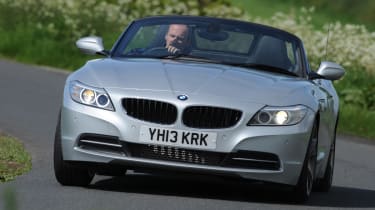
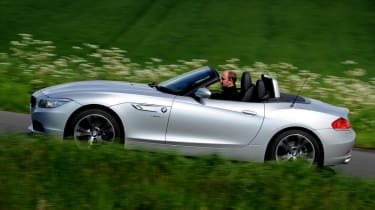
While the original 'flame surfaced' BMW Z4 divided opinion, the last model has a much sleeker shape. The long bonnet and stubby boot gave it classic sports car proportions, while the metal folding roof ensured it looked just as smart with the top up or down. You could even specify it in a contrasting colour, if you wanted to make sure everyone knows you're driving a convertible.
The Z4 was facelifted for the second time in 2013, with new circular LED running lights, subtle chrome trim for the grilles and side indicators, plus a slim white ‘eyebrow’ line that was added to the top of the main headlight cluster. The changes were subtle but did just enough to keep the Z4 looking fresh. It’s just a shame, then, that BMW didn't do more to the interior.
The snug wraparound dash design was stylish and made using high-quality materials, but some dated looking switchgear meant it felt older than rivals such as the hi-tech Audi TT and Porsche Boxster.
Standard equipment depended on the engine you went for, but all versions got climate control, alloy wheels, a DAB radio, Bluetooth and xenon headlamps. Leather seat trim was standard on 20i models and above, while the M Sport versions got bigger 18-inch alloys, sport seats, M Sport chassis and suspension settings and an aerodynamic bodykit.
The options list included a Comfort Pack, which came with cruise control, parking sensors, extra storage and a wind deflector, while the Media package added Internet connectivity and a Design Pure Traction styling pack added black and orange contrasting trim to the interior.
Sat-nav, stereo and infotainment
The Z4’s sat-nav and infotainment system is operated by the familiar iDrive wheel on the console between the seats – existing BMW owners will feel comfortable with it straight away, and newcomers to the system soon will.
The audio package comprised a BMW Professional radio with single CD player and MP3 playback, and you could beef up the output with two levels of speaker upgrades, or even add a TV tuner.
Practicality, comfort and boot space
Two-seater sports cars aren’t bought for their practicality, but even by class standards, the BMW Z4 didn’t fare well in this area. The complex hood system takes 21 seconds to fold down and 20 seconds to erect, which is considerably longer than the Audi TT Roadster’s fabric top.
The BMW does claw back some advantages thanks to its elaborate roof though, as it improves driving refinement with the roof up, as well as increasing security. The car’s comfortable ride – excluding M Sport spec – helps make long distances bearable too, and while boot space was compromised, there are handy luggage nets and a couple of big central cupholders in the cabin itself.
As the Z4 is strictly a two-seater, there’s no option of slinging bags behind the seats either.
Size
The BMW Z4 measures 4,244mm bumper-to-bumper, and is 1,790mm wide. This compares to 4,177mm x 1,842mm for the Audi TT and 4,374mm x 1,801mm for the Porsche Boxster.
Leg room, head room & passenger space
Even tall occupants should have no problems fitting into the BMW Z4’s comfortable seats – there’s plenty of leg room, and elbow and shoulder room isn’t bad either. With the roof up the car’s headroom is decent, and roof down the sky is the limit!
Boot
Lowering the roof on the BMW Z4 unfortunately has a big impact on available luggage space, with boot capacity shrinking from 310 litres to 180 litres with the hood stowed. It’s still big enough for a couple of large holdalls, but getting them in and out is one of the biggest problems, as the roof mechanism leaves you with a narrow opening when you raise the bootlid.
Such compromises are part and parcel of living with a convertible, but if you load the boot with the hood up and try to unpack with it stowed, the chances are you’ll have to raise it again before you can get your luggage out. An optional ski-hatch allows you to carry longer items, though.
By way of comparison, the Porsche Boxster offers 280 litres of luggage space, the Audi TT offers 250 litres, while the Mercedes SLK has 310 litres reducing to 225 litres with the roof folded.