BYD Seal 6 review
Plug-in hybrid family car offers saloon or estate options and good value for money


Our opinion on the BYD Seal 6
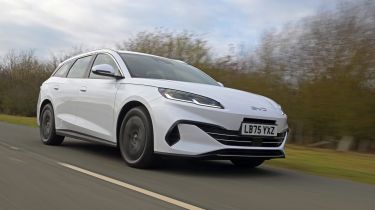
If you want a family car that’s neither electric nor an SUV, then the BYD Seal 6 is worth checking out. It has a plug-in hybrid petrol powertrain that offers commendable efficiency when the battery is flat, while the two variants that are offered come with plenty of kit for a reasonable price. Even better is the option of four-door saloon or practical estate bodies, the latter providing strong versatility thanks to its extra luggage space. On the downside, while the powertrain is efficient, it lacks finesse, and the lumbering chassis is neither comfortable nor sporty. In addition, the touchscreen takes some learning and the hyperactive safety systems are frustrating.
About the BYD Seal 6
The BYD line-up has expanded rapidly, and the Seal 6 is a plug-in hybrid family car that’s an alternative to the all-electric Seal. It is available as a saloon and an estate, with this Touring version carrying a £1,000 premium over the four-door model.
The Seal 6 comes exclusively with a plug-in hybrid powertrain that’s shared with the Seal U family SUV. Boost and Comfort trims are offered, with more power and a larger battery for a longer all-electric driving range for the higher-spec model. Both variants are front-wheel drive, while the powertrain uses a CVT gearbox to send power from either the petrol engine or electric motor to the wheels.
Used - available now

2025 BYD
Seal 6
3,889 milesAutomaticPetrol1.5L
Cash £22,995
2025 BYD
Seal 6
5,000 milesAutomaticPetrol1.5L
Cash £22,497
2025 BYD
Seal 6
9,685 milesAutomaticPetrol1.5L
Cash £22,500We've tested both the saloon and Touring versions of the Seal 6 during the UK launch, and we've pitched the Seal 6 Touring 1.5 DM-i Boost against the VW Passat eHybrid in a twin test. While we found the Seal 6 Touring to be more efficient when the hybrid battery was flat, and its larger petrol tank gave it better overall range, we thought that the BYD didn't do quite enough to beat the more well-rounded Passat – even with its more affordable pricing. The driving experience was disappointing; it didn't have as comfortable a ride, and its safety assistance systems were annoyingly intrusive.
BYD Seal 6 prices and latest deals
The saloon starts from around £34,000, with the Touring adding £1,000 to the list price, while upgrading from Boost to Comfort trim costs £3,000 extra. The Seal 6 is still a little too new to make waves on the Auto Express Buy a Car portal, although the deals we do have include discounts of around £3,000 for potential buyers.
Performance & driving experience
Pros |
|
Cons |
|
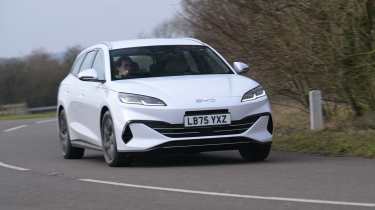
The Seal 6 has a plug-in hybrid powertrain that delivers strong performance, albeit with a few rough edges. Overall it’s not much fun to drive, and it doesn’t compensate for this with good comfort.
| Model | Power | 0-62mph | Top speed |
| Seal 6 DM-i Boost | 181bhp | 8.9 seconds | 112mph |
| Seal 6 DM-i Comfort | 209bhp | 8.5 seconds | 112mph |
Performance, 0-60mph acceleration and top speed
BYD’s DM-i plug-in hybrid powertrain consists of a 1.5-litre petrol engine, an electric motor and a drive battery, while a CVT transmission transfers power to the front wheels. Battery size depends on which trim you choose, with the Boost featuring a 10kWh pack and the Comfort offering one that’s nearly twice the size, at 19kWh. The latter also has more power, with a system output of 209bhp, compared with 181bhp for the Boost model.
Intriguingly, it’s the electric motor that provides the majority of the power, with the petrol engine acting as a back-up generator when the battery is flat. On the whole, the system is pretty smooth when there’s charge in the battery, and it’s punchy, too. The lower-powered car accelerates from 0-62mph in 8.9 seconds, while the 209bhp model, which has an extra 95kg of battery weight to carry, manages the same sprint in 8.5 seconds.
Once the drive battery is flat, the 1.5-litre engine remains running most of the time, but it’s rather unrefined, especially when accelerating. As with any CVT-equipped car, the revs rise independently of vehicle speed, so it can become thrashy with even the smallest of throttle inputs.
Town driving, visibility and parking
At lower speeds, the light steering helps with manoeuvrability, while a relatively tall ride height boosts the view out, helping to position a car that measures around 4.9 metres in Touring estate guise. Rear parking sensors and a reversing camera are standard on the Boost model, while the Comfort version adds front sensors and BYD’s 360-degree camera system to help with visibility.
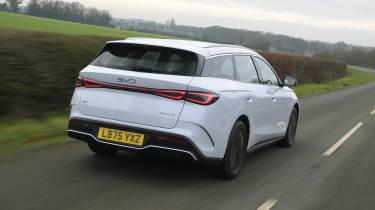
One major issue for the Seal 6 is its fidgety ride. It never really settles except on the smoothest tarmac, so that could cause problems on UK roads. Sharper, car park-style speed humps also cause the car to bounce as the suspension fails to control body movement over them, while a resounding thud goes through the car.
Country road driving and handling
The fidgety ride doesn’t improve with higher speeds, while the suspension also induces side-to-side movement in the car over undulations. Combine this with light steering that lacks feedback, and the Seal 6 isn’t at home on country roads. BYD has added a Sport mode for the steering – accessible via one of the numerous sub-menus – but while it adds weight to the wheel, there’s still no sense of what the front wheels are doing.
Motorway driving and long-distance comfort
With a long range from its petrol-electric powertrain, the Seal 6 should be well suited to motorway driving, but refinement is lacking. There’s constant road noise, which is accompanied by the drone of the petrol engine when the battery has run down. The ride remains unsettled at the motorway limit, too, with a patter from the suspension that is amplified on rougher concrete surfaces.
"At night, the auto main beam system worked erratically, going from dipped to main beam even on well-lit urban roads. These functions can be deactivated, but hunting for them in the multiple infotainment sub-menus is another minus point." - Dean Gibson, senior test editor
MPG & running costs
Pros |
|
Cons |
|
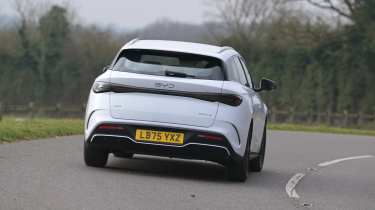
While the Seal 6 is disappointing to drive, there are good financial reasons to investigate it further. These start with list prices, which kick off at around £34,000 for the Boost model, and are £3,000 higher for Comfort trim, while the Touring estate adds another £1,000 to both. In comparison, the plug-in version of the Volkswagen Passat Estate is around £10,000 more expensive, although it does feel like a higher-quality product.
The Seal 6’s plug-in hybrid powertrain has official fuel economy figures of 108.6mpg for the Boost model with the smaller battery, and 166.2mpg for the Comfort version. When we tested the Seal 6 Touring in Boost trim, we saw an average of 53.3mpg from the car once the battery was flat. That was on a route that included plenty of faster dual carriageway driving, so lower-speed driving could achieve even better figures than that. That is the kind of economy we’d see from Toyota’s hybrid models on a similar route. A VW Passat on the same roads delivered poorer economy when running on the engine alone.
Match our economy figure, and the generous 65-litre fuel tank (larger than the 45-litre tank in the Passat eHybrid) should help to deliver a range of more than 750 miles.
| Model | MPG | CO2 | Insurance group |
| Seal 6 DM-i Boost | 108.6mpg | 60g/km | 33 |
| Seal 6 DM-i Comfort | 166.2mpg | 38g/km | 36 |
Electric range, battery life and charge time
The 10kWh battery in the Seal 6 Boost has an official range of 31 miles, while the 19kWh version doubles that to 62 miles. There’s a maximum charging rate of 26kW on offer with the larger battery, and it takes 23 minutes to go from 30-80 per cent capacity. There’s slower charging for the 10kWh pack, and a 15-100 per cent charge from a 3.3kW source takes three hours.
| Model | Battery size | Range | Insurance group |
| Seal 6 DM-i Boost | 10kWh | 31 miles | 33 |
| Seal 6 DM-i Comfort | 19kWh | 62 miles | 36 |
Insurance groups
Group ratings of 33 and 36 are high, when you consider that the top-spec VW Passat Black Edition eHybrid is in group 32. You might struggle to find a competitive quote, too, because not all providers will have the latest BYD models on their systems.
Tax
Thanks to the quirks of Benefit-in-Kind company car tax, it’s the higher-spec Comfort model that will be the wiser choice for business users. Its longer all-electric range means it’s in a lower nine per cent banding for the 2025/26 tax year, compared with 18 per cent for the Boost model. It means taxpayers can almost halve their contributions by plumping for the higher-spec model.
Depreciation
The Seal 6 is one of the best performers in the BYD line-up when it comes to residual values. The saloon is in the 48.5-50 per cent range, while the Tourer is even better, retaining 51 per cent of its value in Comfort guise. The cheaper Boost model is currently the best BYD of all, retaining 52 per cent of its value after three years.
To get an accurate valuation on a specific model check out our free car valuation tool...
Interior, design & technology
Pros |
|
Cons |
|
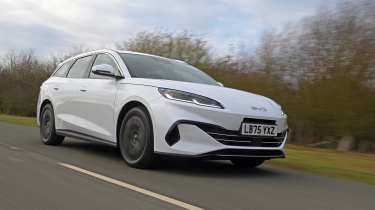
The exterior of the Seal 6 carries the same styling cues as other larger BYD models, so it has a smooth pebble-like shape that doesn’t feature many prominent design touches. White is the standard exterior colour, with black, blue and beige metallics offered as options, although at £1,000 this is a relatively pricey upgrade.
Interior and dashboard design
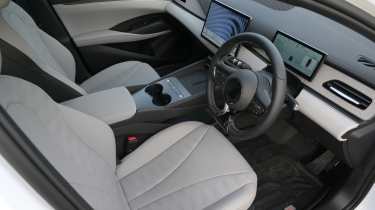
The simple shape of the exterior is carried over inside, where the large touchscreen stands proud on a dashboard that has a smooth line and an uncomplicated layout. We like the no-cost option of light upholstery for the seats, because it gives a lift to what would otherwise be a relentlessly grey cabin.
The Seal 6 has a column gear shift to the right of the steering wheel, so lighting and wiper functions are both allocated to the left-hand stalk. On the Touring there are two rocker switches for the front and rear wipers, although it takes practice to flick them in the right direction for the wipers or screenwash.
Materials and build quality
The quality of the trim on board feels fine, with soft-touch materials where you expect to find them, such as the armrests and dashtop, while harder plastics are used lower down, around the centre console and doors. The dashboard adds a fabric-looking insert that stretches across the width of the car, although this is actually harder plastic – it’s not something you’ll be touching too often, and is probably easier to keep clean than a fabric section.
Infotainment, sat-nav and stereo
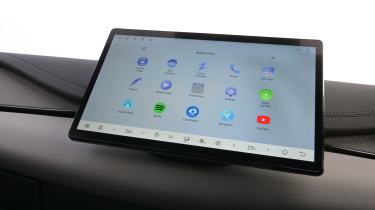
You get a large 12.8-inch touchscreen in the Boost model, while the Comfort car upgrades this to a substantial 15.6 inches. The smaller screen offers shortcuts across the bottom of the display, with the temperature controls and heated windscreen settings on offer, but you have to jump into the main climate menu to adjust anything else, including the heated rear screen, which seems to be a particular oversight on the Touring model. Other shortcuts take you to the home screen, lighting, app menu and the split-screen set-up, but the latter offers limited use.
All cars come with an 8.8-inch digital dashboard, but as with other BYD models, it seems overloaded with information about energy use and safety system status, when a simplified layout would be more useful.
The response of the touchscreen is quick and the screen resolution is good, but there are far too many menus to negotiate for even the simplest functions. There are two separate menus for the driver assistance systems, for example, so if you want to deactivate the speed limit warning, you need to find the ADAS menu and then select a secondary menu within it and scroll down to the required setting. However, the driver monitor is in another section called Cabin Perception that’s within the separate Vehicle menu.
At least the trip computer is comprehensive, with various displays showing your energy use on every trip and over longer periods.
"The large touchscreens offer a lot of real estate to show the car’s assorted functions, but the software doesn’t make the best use of it. The home screen offers pretty wallpaper options, but all functions are in secondary menus that are selected via the widgets across its lower section. There’s a split-screen function available, but it only works with compatible apps, so you can’t have the car’s native sat-nav and audio functions on the screen at the same time, for example." - Dean Gibson, senior test editor.
Boot space & practicality
Pros |
|
Cons |
|
Dimensions inside and out are competitive with rivals, so the Seal 6 should be a versatile family car, especially in Touring estate guise.
Dimensions and size
The Seal 6 has fairly typical proportions for a family car, with a long body and lower overall height than an SUV. The saloon and estate are the same length.
Dimensions comparison | |||
| Model | BYD Seal 6 | Volkswagen Passat | Skoda Superb |
| Length | 4,840mm | 4,916mm | 4,902mm |
| Width | 1,875mm | 1,849mm | 1,849mm |
| Height | 1,505mm | 1,521mm | 1,482mm |
| Wheelbase | 2,790mm | 2,839mm | 2,841mm |
| Boot space | 500-1,535 litres | 510-1,920 litres | 510-1,770 litres |
Seats & passenger space
There’s a good range of wheel and seat adjustment on offer, while the Seal 6 sits a bit taller than other family cars, so the driving position offers a good view of your surroundings. However, if you have large feet, you might find the pedal box to be a little cramped – your right toes can brush the underside of the dashboard when using the pedals. The seats are reasonably comfortable and are trimmed in artificial leather, although heated seats and a heated steering wheel are only offered on the higher spec Comfort car.
Storage is fair, with a big glovebox and a shelf beneath the centre console for smaller items. This is also the location of two USB-C sockets, although they are fiddly to access from the driver’s seat because of the shape of the console and the fact the steering wheel gets in the way if you’re looking to connect a cable.
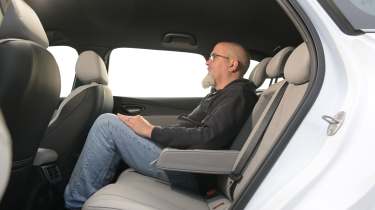
A flat floor means foot space in the back is good, while shoulder room and headroom are acceptable, too. There are two air vents and two USB-C sockets in the rear, but the high floor and low seat mean under-thigh support could be better. Isofix child seat mounts are located behind plastic covers for ease of access – the front seat also has Isofix behind slots in the upholstery.
Boot space
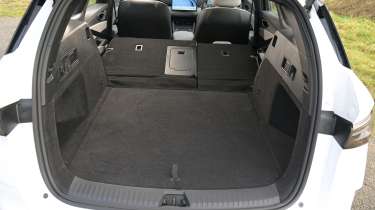
The Seal 6 Touring has a powered tailgate that opens to reveal a relatively square 500-litre cargo area in five-seat mode, which is almost the same capacity as the 510-litre load area provided in plug-in hybrid versions of the Passat. Indeed, during our twin test, we found that both the Seal 6 Touring and the Passat have identical boot widths of 1,010mm, although the VW has the edge in boot length, at 1,130mm versus 990mm for the BYD. If you have bulky items to transport, the Passat also has the lowest boot opening height at 625mm, compared with the 675mm we measured for the Seal 6 Touring.
The back seats in the Seal 6 Touring fold via levers in the boot or on their shoulders, leaving a slight rise in the floor, which will be helpful when pulling longer items out. There’s also a ski hatch, so you can keep four seats in use if you need them. There’s a rolling load cover, while recesses on either side of the wheelarches provide enough room to store the load cover when not in use, although there’s no dedicated storage slot for it. You'll find a 12-volt socket in the boot and some bag hooks to stop things flying around, while the boot floor lifts to reveal a shallow area beneath with room for the tyre repair kit, but not a lot else.
If you plump for the saloon, then you'll get a narrower opening and miss out on the underfloor storage of the Touring. You'll also miss out on the handy remote levers to lower the split-folding rear seats; you'll have to wander around to pull the latch at the top of the rear seats. You shouldn't need to do that often, though, because the total boot volume for the saloon is only nine litres shy of the Touring at 491 litres.
"The Seal 6 Touring has a powered tailgate that can be opened and closed remotely via the keyfob. It’s not the fastest opening, but this is a handy function to have. You can also set the opening height, but as with everything else on the car, it’s adjusted via the car’s central touchscreen." - Dean Gibson, senior test editor
Reliability & safety
Pros |
|
Cons |
|
With a five-star Euro NCAP rating under its belt, there shouldn’t be any question marks over how safe the Seal 6 will be in the event of an accident. However, the big caveat we’d add to that is that the safety systems do seem rather over-zealous with their reactions, which is frustrating. During our twin test with a Seal 6 Touring, we found the driver monitoring system to be particularly annoying. There's a small camera on the A-pillar that monitors you at all times, but in our car, it was over-sensitive to the point of frustration – even warning of inattention when we were looking straight ahead. We suggest you make sure to turn it off before setting off to save your sanity.
BYD came 30th (out of 31) in the most recent Driver Power ownership survey, but since it’s a relative newcomer to the UK market, we expect that position to improve as more cars hit the roads and the dealer network expands.
There’s a six-year warranty on the Seal 6 and the mileage limit is nearly 100,000 miles, so if there are any issues, there is cover on offer that should help. On top of that, the battery has an eight-year or more than 150,000-mile warranty.
Servicing costs are still to be confirmed, but with a rapid expansion of BYD franchises, getting the Seal 6 serviced every 12 months shouldn’t need a long trip out of your way.
| Euro NCAP safety ratings | |
| Euro NCAP safety rating | Five stars (2025) |
| Adult occupant protection | 92 per cent |
| Child occupant protection | 90 per cent |
| Vulnerable road user protection | 84 per cent |
| Safety assist | 85 per cent |
Buying and owning
Best buy: BYD Seal 6 Boost
Private buyers will have all the car they’ll need with the Boost model, but if you’re a company car driver, the lower tax benefits of the higher-spec Comfort model make it the smarter choice.
BYD Seal 6 alternatives
Plug-in hybrid family cars are few and far between these days. The obvious option is the Skoda Superb iV, which comes as either a hatchback or estate, or there’s the platform-sharing VW Passat, which is estate only. Both cars are pricier than the Seal 6, but are better to drive and have more space inside, while they are offered with non-PHEV powertrains, too. Beyond that, you’re looking at plug-in SUVs, such as BYD’s own Seal U.
Key updates of the BYD Seal 6 review
6 February 2026: Include observations of the boot for the saloon version and some of our measurements from the BYD Seal 6 Touring versus VW Passat twin test in the review.
BYD Seal 6 pictures
Deals on the BYD Seal 6 and alternatives
Frequently Asked Questions
It depends on what you want from your family model. If low running costs are the priority, then it offers good value and mid-fifties fuel economy without really trying. But if you want comfort or an involving drive, we’d look elsewhere.