Skoda Octavia Estate review
The Skoda Octavia Estate is an excellent alternative to a family SUV


Our opinion on the Skoda Octavia Estate
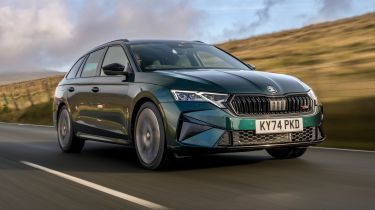
The Skoda Octavia Estate is a shining example of why families shouldn’t be so quick to order an SUV. It takes everything that’s great about the Octavia hatchback and expands on that with an even larger boot for an extra dollop of practicality, creating one of the best-value family cars on sale today.
This is especially true following its mid-life update, which included a subtle facelift, a new fuel-efficient engine and more kit as standard. It’s even more upmarket than before, although pricing has crept upwards in order to reflect this.
About the Skoda Octavia Estate
The Skoda Octavia has always offered a superb blend of space, practicality and value for money, especially if you choose the estate version. Across continental Europe, it’s actually a bigger seller than the hatchback, so there’s a lot resting on the latest version.
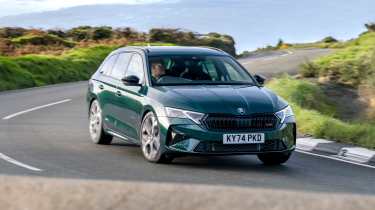
The facelifted model carries the same updates that were applied to the hatchback version; mainly a mildly tweaked design and some additions to the standard equipment list. On the outside, the restyling extended to new daytime running lights, a revised front bumper, fresh tail lights with an animated ‘welcome’ functionality, and some new alloy wheels and colour options.
We’ve tested both the Skoda Octavia Estate and hatchback in a variety of different ways over the years. For example, this family-friendly load lugger saw off the Peugeot 308 SW in our real-world twin test. If you’re more tempted by the hatchback than the estate, we also have a dedicated in-depth Skoda Octavia hatchback review.
Skoda Octavia Estate prices and latest deals
Prices start from around £29,500, which means the Octavia Estate is about £1,000 more than the equivalent Octavia hatchback. That price is based on an SE Technology model with a 1.5-litre petrol and a manual gearbox. Moving up to SE L trim increases the price to around £34,300, while the sportier looking SportLine starts from £35,100. At the top of the line-up sits the performance-focused Skoda Octavia vRS, and that’ll set you back at least £42,000.
Used - available now

2023 Skoda
Octavia
52,537 milesAutomaticPetrol1.4L
Cash £15,445
2021 Skoda
Octavia
54,147 milesManualDiesel2.0L
Cash £13,589
2024 Skoda
Octavia
24,096 milesManualPetrol1.0L
Cash £15,176
2013 Skoda
Octavia
137,600 milesAutomaticDiesel2.0L
Cash £2,795You can save an average of up to £2,900 if you build your perfect Skoda Octavia Estate through the Auto Express Buy a Car service, though. We also have a number of new Octavia Estates in-stock ready to hit the road, as well as some top used Skoda Octavia Estate deals.
Performance & driving experience
Pros |
|
Cons |
|
Just like the hatchback, the Octavia Estate’s engine line-up mirrors that of it’s less expensive sibling. It features petrol, mild-hybrid and diesel offerings with either a six-speed manual with the least powerful petrol and diesel engines, while both outputs of the mild-hybrid equipped 1.5 e-Tec, the 148bhp 2.0-litre diesel, and the high-performance vRS come with a seven-speed DSG automatic as standard.
The plug-in hybrid of pre-facelift Octavia models is no more, with the larger Skoda Superb and Skoda Kodiaq carrying on in iV PHEV forms. Alternatively, the all-electric Skoda Elroq and Skoda Enyaq will fulfil your zero tailpipe emission needs. Four-wheel drive is also no longer offered as it was in previous editions of the Octavia.
| Model | Power | 0-62mph | Top speed |
| Octavia Estate 1.5 TSI SE Technology | 114bhp | 10.5 seconds | 126mph |
| Octavia Estate 1.5 TSI e-TEC Sportline DSG | 148bhp | 8.6 seconds | 139mph |
| Octavia Estate 2.0 TDI 150 Sportline DSG | 150bhp | 8.6 seconds | 139mph |
Performance, 0-60mph acceleration and top speed
In its least powerful 114bhp form, the 1.5-litre TSI petrol will launch the Estate from 0-62mph in 10.5 seconds, although this does increase to 10.7 seconds if you opt for the automatic with mild-hybrid tech.
The more powerful 148bhp 1.5-litre petrol reduces the 0-62mph acceleration time to 8.6 seconds in both manual and mild-hybrid e-Tec automatic forms. The more powerful 148bhp 2.0-litre TDI diesel matches this time, while the less powerful 114bhp lump manages 10.5 seconds. It’s worth noting that every Octavia Estate is slightly slower than the equivalent Hatchback due to the added weight, but the difference is minimal.
For those in the biggest hurry, the Skoda Octavia Estate vRS is the obvious (and most expensive) choice. This model’s 2.0 TSI petrol engine will fire it from 0-62mph in only 6.5 seconds.
On the road, the 2.0 TDI does a terrific job of reminding you how effective a diesel powertrain can still be. There’s more than 120Nm of additional torque here compared with the 1.5-litre 148bhp petrol, and even with the load bay relatively empty, you can certainly feel it. There’s more than enough shove from less than 1,500rpm, and in general, you’re done and dusted and up to the next gear before 2,700rpm, with a minimum of fuss.
This, in turn, means that the gearbox is hopping around all over the place, but most of the time, it manages to perform the necessary manoeuvres smoothly and slickly. It’s best at a cruise, though if you decide to ramp up the pace and use the (cheap-feeling) shift paddles at the rear of the steering wheel, it’ll perform snappily. It’s at low speeds, as usual, where DSG can be exposed, with the occasional jerky shift or flare-up of driveline shunt – but these are relatively rare.
Town driving, visibility and parking
In order to provide so much interior and luggage space, the Skoda Octavia Estate is a considerably more bulky car than a more traditional hatchback like a Hyundai i30. This means you’ll need to take a bit of extra care when navigating through narrow streets, but it’s no more difficult to figure out than most small to mid-size SUVs.
Parking can also be a bit of a challenge, and you’ll need to double check the size of any potential space. However, standard-fit front and rear sensors, along with light steering make the whole process a lot easier.
Country road driving and handling
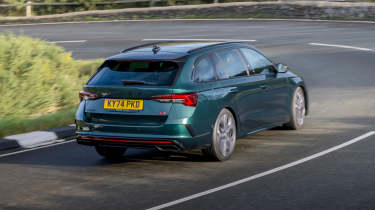
If you’re looking at the standard Octavia Estate range, we doubt you’re in the market for a sporting machine. It’s a good job, too, because this car errs on the side of comfort rather than excitement. The soft suspension keeps most road surface imperfections at bay, although the price for this is a lack of driving enjoyment. However, body roll is kept well in check through the corners.
If you simply cannot bear to give up on proper road-going thrills, the vRS gets a unique chassis tune which is firmer and ups the overall level of driver engagement.
Motorway driving and long-distance comfort
Another upside of the Octavia’s soft suspension is that it settles down nicely at motorway cruising speeds. Both the petrol and diesel engines provide their power in a pleasingly smooth way, with plenty of shove available from low down in the rev range.
“The Skoda’s quick steering rack helps it to feel rather agile, and while the suspension is soft, body roll is well controlled.” - Alex Ingram, chief reviewer.
MPG & running costs
Pros |
|
Cons |
|
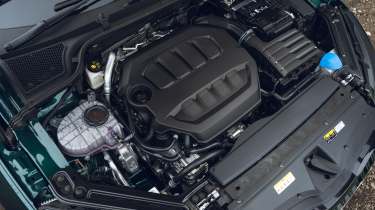
Perhaps surprisingly, the most efficient petrol engine isn’t the smaller of the two, but the larger 148bhp unit. This is thanks to the combination of a dual-clutch transmission and mild-hybrid technology (badged e-Tec), which helps deliver as much as 58.2mpg on the WLTP combined cycle, depending on your chosen trim level and wheel size. This setup’s 48-volt starter generator helps save fuel by stopping the engine in traffic or when coasting, and delivers a small power boost when accelerating to reduce the amount of work the engine has to do.
If you spend a lot of time driving in towns and cities, the 1.5-litre engines with mild-hybrid assistance makes a lot of sense, with official figures between 55.7 and 55.6mpg for the 148bhp motor, and 52 to 58.2mpg for the 114bhp version. Be aware, though, that the less powerful engine is only available with the SE Technology trim.
In models without mild-hybrid tech, the 1.5-litre petrol engines manage a claimed maximum of 52.5mpg in 114bhp form, and this increases slightly to 53.2mpg for the 148bhp variant.
Predictably, the 2.0-litre diesel engine is even more economical, delivering between 59.7mpg and 65.8mpg, depending on the transmission, power output and trim level.
| Model | MPG | CO2 | Insurance group |
| Octavia Estate 1.5 TSI 150 SE L | 51mpg | 126g/km | 20 |
| Octavia Estate 1.5 TSI e-TEC Sportline DSG | 54.6mpg | 118g/km | 21 |
| Octavia Estate 2.0 TDI 150 Sportline DSG | 59.7mpg | 124g/km | 22 |
Insurance groups
The Skoda Octavia Estate should have pretty unalarming premiums, as the standard line-up sits between insurance groups 14 and 22. The vRS resides in a higher group 27 out of 50.
Tax
With the plug-in hybrid Octavia no longer available (and no plans for Skoda to re-introduce it), company car drivers won’t find any Benefit-in-Kind (BiK) tax relief here. Instead, they’ll be better served by a fully electric estate car like the Peugeot E-308 SW or Vauxhall Astra Sports Tourer Electric.
The high-performance vRS version sneaks over the £40,000 VED luxury car tax threshold in standard form, and being too liberal with the options list can also push the SportLine into this territory. Do this, and you’ll be looking at a £620 annual surcharge between years two and six after the car’s first registration.
Depreciation
According to our expert data, the Skoda Octavia Estate feels the depreciation pinch after three years or 36,000 miles, with the whole range expected to retain only 41 to 45 per cent of its initial value. It’s the same situation with the Octavia Hatchback, too.
In comparison, the Peugeot 308 SW manages a similar 43 to 45 per cent after the same period, while the Vauxhall Astra Sports Tourer retains merely 36 to 41 per cent.
Interior, design & technology
Pros |
|
Cons |
|
With its revamped front bumper, daytime running lights, tail lights and colour selection, the Octavia Estate looks even better than before thanks to its mid-life facelift. However, it was already a handsome enough machine as it was.
Interior and dashboard design
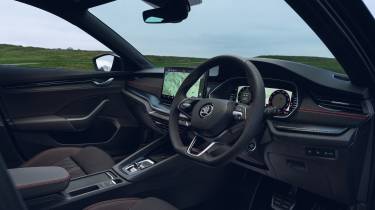
The Octavia has always been a conservative car, and the interior of the latest model continues the tradition of prioritising function over flair. It’s still a smart place to sit, though, with a twin-screen layout taking the place of more traditional dials in the older cars. We only wish there were more buttons, or at least the same smart dials that you’ll find in the Skoda Superb and Skoda Kodiaq.
Materials and build quality
Similar to the hatchback version, the Octavia Estate feels suitably premium inside with plenty of soft touch materials and flashes of chrome trim to help make it feel a cut above even its Volkswagen Golf sibling. The Peugeot 308 SW perhaps has the edge over it in terms of its design and materials, but the Octavia still feels very well screwed together and ready to endure whatever a family can throw at it.
Infotainment, sat-nav and stereo
All models have a 13-inch touchscreen mounted at the top of the dashboard next to the 10.25-inch driver’s display. In common with other touchscreens in the Volkswagen Group, there’s no volume knob on the dashboard, but a slider function is located beneath the screen for adjusting the level. There are also no physical controls for the heating and ventilation, with the driver and passenger controls integrated into the bottom of the screen. The same is true of the controls for the heated seats, which are standard across the range.
Indeed, the spec is generous across the range, including sat-nav, wireless SmartLink for Apple CarPlay and Android Auto, voice control and wireless phone charging. There are also four USB-C ports (two in the front and two in the back), along with another one in the rearview mirror for charging a dashcam or aftermarket sat-nav.
“Inside, the Octavia is more restrained than the Peugeot 308 SW, but that’s no bad thing. Build quality is first class, while the black and white displays with Skoda’s subtle green highlights feel high-class, whereas the 308 SW’s graphics are quite showy.” - Alex Ingram, chief reviewer.
Boot space & practicality
Pros |
|
Cons |
|
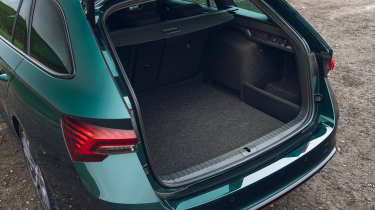
The sheer amount of cabin and boot space on offer has always been key to the Skoda Octavia Estate, and it remains so here. This is such a practical car that we named the Octavia our 2025 Family Car of the Year.
Dimensions and size
| Dimensions comparison | |||
| Model | Skoda Octavia Estate | Peugeot 308 SW | Vauxhall Astra Sports Tourer |
| Length | 4,698mm | 4,635mm | 4,642mm |
| Width | 2,003mm | 2,062mm | 2,062mm |
| Height | 1,468mm | 1,475mm | 1,443mm |
| Wheelbase | 2,686mm | 2,735mm | 2,732mm |
| Boot space | 640 to 1,700litres | 548 to 1,634 litres | 516 to 1,634 litres |
Seats & passenger space
There’s enough room up front for a six-foot adult to get comfortable, plus the driver has plenty of adjustment in the seat and steering wheel to get comfortable.
Much like the regular Octavia, the estate version offers more rear leg room than the equivalent Volkswagen Golf, and it has greater head room in the back, thus addressing the slight issue taller rear passengers may have with the Octavia hatchback due to its sloping roof design.
Boot space
The Estate’s boot comes in at a whopping 640 litres with the rear seats in place, and you can boost this to 1,700 litres by folding down the second row; either way, you have a capacity that trumps those of the Octavia’s obvious Stellantis competitors, the Vauxhall Astra Sports Tourer and the Peugeot 308 SW.
Towing
The Octavia Estate can tow a braked trailer or caravan of between 1,300kg and 1,600kg, depending on your chosen spec and powertrain. The best performer is the more powerful 148bhp 2.0 TDI diesel. In comparison, the Peugeot 308 SW only manages a maximum of 750kg in plug-in hybrid form.
“One area where the Octavia could be better is front cabin storage. There’s an armrest cubby and twin cup-holders that feature Skoda’s clever grip system, which means you can open bottles one-handed, but none of it is as generously proportioned as the Peugeot 308 SW’s centre console storage.” - Alex Ingram, chief reviewer.
Reliability & safety
Pros |
|
Cons |
|
The Skoda Octavia didn’t appear in the most recent Driver Power customer satisfaction survey. The brand managed a 12th place ranking out of 31 in the best manufacturer rankings, which isn’t incredible, but it did at least beat its own parent company, Volkswagen (27th).
Safety experts Euro NCAP retested the hatchback version of the Octavia in 2025 after an initial test that took place in 2022. After this more rigorous test the Skoda maintained its five-star crash safety rating with strong category scores across the board.
Although the entry-level SE Technology trim features multiple airbags and a decent level of driver assistance systems, you’ll need to add the optional Assisted Drive Package for the likes of adaptive cruise control and lane-keeping assistance. An Assisted Drive Package Plus pack is available on some models, adding blind spot monitoring and parking assistance.
| Euro NCAP safety ratings | |
| Euro NCAP safety rating | Five stars (2025) |
| Adult occupant protection | 85% |
| Child occupant protection | 82% |
| Vulnerable road user protection | 81% |
| Safety assist | 80% |
Buying and owning
- Best buy: Skoda Octavia Estate 2.0 TDI SE Technology
If you’re in need of a large estate, you probably have a lot of people and luggage to carry. It’s because of this that we recommend opting for a diesel-powered model, as this will bring a welcome power boost, along with strong efficiency and towing capability. Sticking with SE Technology trim will help to keep the price down, but you’ll still get a good amount of useful kit thrown in.
Skoda Octavia Estate alternatives
The most obvious alternative to the Octavia Estate is the Skoda Octavia hatchback, which still has a massive 600-litre boot. Other estate car alternatives include the stylish Peugeot 308 SW, the highly-efficient Toyota Corolla Touring Sports or, if you need something larger, the Skoda Superb Estate and Volkswagen Passat - the latter now only comes in estate form.
There are also an increasing number of electric estates to choose from, such as the Peugeot E-308 SW, Vauxhall Astra Sports Tourer Electric and Volkswagen ID.7 Tourer.
Frequently Asked Questions
The Skoda Octavia Estate is covered by a three-year/60,000-mile warranty, although this can be extended to five years/100,000 miles for an additional cost. Rivals such as Hyundai and Kia offer coverage for five years and seven years, respectively.
Deals on the Octavia Estate and alternatives
More reviews
Car group tests
In-depth reviews
Road tests
Which Is Best