Used Subaru Forester (Mk4, 2013-2018) review and buyer's guide
A full used buyer’s guide on the Subaru Forester covering the Forester Mk4 (2013-2018)

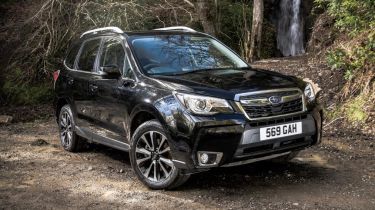
There’s a lot to like about the Forester, but its talents aren’t as wide-ranging as rivals’. Many of the alternatives above are fine all-rounders, but the Subaru only really stands out for its reliability, safety and practicality – plus its off-road ability, if you need this. Admittedly many of these things are extremely important to buyers, but the Forester is outclassed dynamically, while its styling is awkward and the interior is dated. That means the Forester is worth considering if you can buy one at the right price, but you should try some of its rivals before parting with your cash.
Subaru started making cars in the fifties, but it wasn’t until 1977 that its models were officially sold in the UK. Since then the brand has gained a reputation for producing tough cars, invariably with four-wheel drive, and occasionally a hefty dose of sportiness thanks to the success of turbocharged versions of the Impreza in rallying.
For those wanting something spacious, durable and decently swift there has also been the Forester, available since 1997. The fourth generation that arrived in 2013 was Subaru’s most popular model in the UK, but with the brand taking just 0.1 per cent of the market, it was still very much a niche product.
Models covered
- • Subaru Forester Mk4 (2013-2018) – The Subaru Forester is worth a look – at the right price.
Subaru Forester Mk4
History
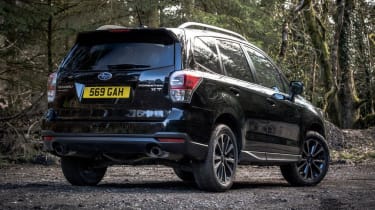
The fourth-generation Subaru Forester went on sale in the UK in May 2013, priced from £24,995. Buyers could choose between 2.0-litre petrol or diesel engines, the former coming in 148bhp naturally aspirated and 237bhp turbocharged forms.
Used - available now

2018 Subaru
Forester
20,500 milesAutomaticPetrol2.0L
Cash £19,600The non-turbo petrol and 145bhp diesel came with a six-speed manual gearbox as standard, but the naturally aspirated petrol unit could be specified with a CVT auto marketed as the Lineartronic, which came as standard with the 2.0-litre turbo engine.
By April 2015 the diesel could also be specified with a Lineartronic transmission, but these cars are rare on the used market. At the same time an upgraded interior was introduced, with a touchscreen infotainment system and higher-quality trim. There were further interior upgrades in May 2016, along with recalibrated suspension. The 5th generation Forester arrived in 2019 to replace this car.
Which one should I buy?
When it comes to running costs, diesels make the most sense; the petrol units are refined and the turbocharged XT is great fun, but fuel and insurance costs will be steep. We’d stick with a manual gearbox because the CVT isn’t as nice to use in automatic mode. It’s better if you use the paddle shifts and treat the transmission as a manual, but that rather defeats the object.
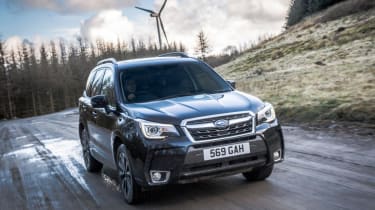
All Foresters come with climate control (dual-zone on all but the entry-level X trim), 17-inch alloys, Bluetooth and roof rails. XE and XE Premium add automatic headlights and wipers, power-fold door mirrors, a power-sliding and tilt-adjustable sunroof, an eight-way power-adjustable driver’s seat, rear camera, and cruise control. Lineartronic XE adds 18-inch wheels, privacy glass, keyless go and a powered tailgate.
Alternatives to the Subaru Forester
The Forester is up against some keen rivals, including the Nissan Qashqai, which is an excellent all-rounder. Plentiful, decent value and practical, this is a desirable car, but its reliability can be less than impressive.
If you want to enjoy driving your SUV, the Ford Kuga is worth a look; there are plenty of them around, they’re good value, and they handle well. Dynamics are one of the main attractions of the Mazda CX-5, too, which looks smart and is very well made.
The Volkswagen Tiguan offers a user-friendly cabin, good looks and strong engines, much like the (higher-quality, but more expensive) Audi Q3. But also consider the Toyota RAV4 and Honda CR-V; the latter is available as a seven-seater as well.
What to look for
CVT
Foresters fitted with the Lineartronic transmission come with paddle shifters for changing gear, and hill descent control.
Stop/start
Fuel-saving stop/start systems come only on non-turbo petrol-engined versions of the Forester.
Safety
The EyeSight suite of safety features was introduced in autumn 2017. This is worth having, because it increases accident prevention/mitigation.
Four-wheel drive
Unlike some rivals, the Forester has permanent four-wheel drive, which is great for traction, but not so good for economy.
Interior
The good news is that the Forester has plenty of head and legroom for five adults, while the boot is spacious, although the back seats don’t fold flat. The bad news is that the car trails behind its rivals inside: the Forester doesn’t feel very premium; the materials aren’t plush, and the design is tired. Early examples feel even more dated, because Subaru improved the car along the way.
Prices
Running costs
Foresters had a five-year or 100,000-mile warranty, which is well above average. Service intervals are every 12 months or 12,000 miles, apart from on the XT, which cuts the mileage limit to 10,000 miles. The schedule runs through minor, intermediate then major, regardless of fuel type.
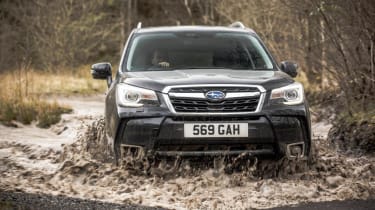
There are no cambelts to replace, but the coolant has to be renewed every 100,000 miles. New brake fluid is needed every two years. The cost is built into the service, but you’ll pay to have it done separately.
Recalls
The Forester has been recalled five times. In August 2016, cracks in the air intake could lead to poor idling or stalling engines. Faulty passenger airbags caused a July 2018 action. There have been three recalls in 2019: a hydraulic pipe could rub against the wiring, causing short circuits; some engines had sub-standard valve springs; and a faulty brake-light switch was behind the third.
Driver Power owner satisfaction
Owners rate their Foresters more highly than we do: in the 2017 Driver Power new car survey the Subaru was 10th out of 75 cars, and in 2016 it finished in an even more impressive eighth. In the more recent survey the car was first for safety and ride and handling, while it took fourth place for its interior/comfort and engine/gearbox. The lowest score was for the car’s exterior.
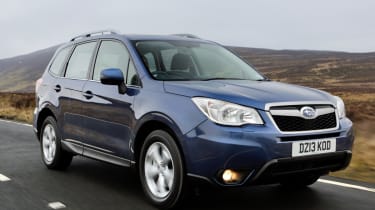
Subaru Forester (2012-2018) review
Below are extracts from our 2018 in-depth review of the Mk4 Subaru Forester...
Gone are the days when Subaru was associated with countless World Rally Championship victories. The Impreza was an icon in the early to mid 1990s, but today the brand is better known for its rugged and capable – if slightly old fashioned – 4x4s. Models like the Forester make up the bulk of Subaru's UK sales, with owners praising the no-frills practicality and bulletproof reliability.
The Forester wraps all those characteristics up into a family-friendly SUV, with decent if unadventurous styling, excellent equipment levels and reasonable pricing. Even the official fuel economy figures look reasonable – though the real-world numbers are likely to be more challenging. The Forester’s drive is also let down by a jittery ride and numb steering.
But for folk who want to trundle around the farther-flung parts of the British countryside – often with a trailer or horsebox in tow – the dependability of Subaru’s rugged 4x4 engineering outweighs such niceties.
The Subaru Forester is a rugged SUV aimed at high-riding machines such as the Mazda CX-5, VW Tiguan and Ford Kuga. Now in its fourth generation, the original Forester helped set the current trend for crossover models when it made its debut in 1997. Combining four-wheel drive, a raised ride height and practical estate body, the Subaru didn’t fit in an established car niche back then. However, these days the Forester has matured into more of a traditional SUV, as fashion has swung the other way.
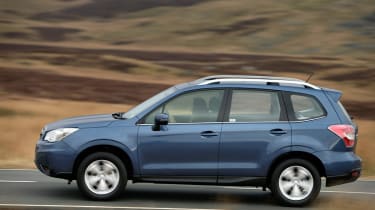
You’d struggle to call the Subaru handsome, but its boxy proportions and rugged styling cues give it a certain no-nonsense appeal. It got a light update in 2016, bringing new bumpers and lights, as well as some chrome trim details. It’s a similar story inside, where the Subaru benefits from tough build quality but dated looks. On the plus side there’s plenty of space for occupants, while the boot will swallow a generous 505-litres of luggage.
There’s a choice of three engines – two petrol and one diesel. Both have a 2.0-litre capacity and feature Subaru’s trademark flat-four ‘boxer’ layout, and the Forester is available with manual gears or - especially unusual in the SUV sector – a constantly variable transmission (CVT) auto called Lineartronic.
All models get Subaru’s symmetrical four-wheel drive system that provides confidence-inspiring all-weather grip. It also gives the Forester excellent off-road ability, and few rivals in this class are as accomplished in the rough stuff. There’s no cut-price two-wheel drive version either, perhaps because Subaru is honest about its chances of attracting aspirational lifestyle types to the Forester model.
The available trim levels are different according to fuel choice. Petrol versions are available in the XE and XE Premium guises, while flagship XT trim is reserved for the turbocharged petrol engine. Go for diesel and you can choose between X, XC and XC Premium models. All versions get air-conditioning, Bluetooth connectivity, cruise control and heated seats.
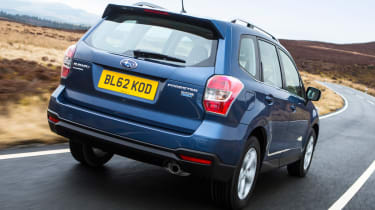
Engines, performance and drive
The Forester has never been as sharp to drive as rivals and that remains true for the updated model. Permanent four-wheel-drive system ensures the car has very high levels of grip but the steering is completely lifeless. The ride is firm and a little jittery on cars with 17-inch alloys, but body roll isn’t too pronounced.
The manual gearbox is sweet, but the CVT does blunt performance somewhat - even though Subaru has added ‘virtual’ stepped ratios you can select from steering-wheel-mounted paddles. This Lineartronic transmission also comes with Subaru’s X Mode system that aids traction off-road and adds a hill descent function. As a result the Forester is extremely capable on loose ground, and will leave many rivals trailing in its wake.
The standard 2.0-litre petrol is smooth but a little gutless, so buyers craving performance will be better off with the turbocharged version. It’s only available in flagship XT guise and mated to a Lineartronic gearbox, but it claims 0-62mph in just 7.5 seconds. While it looks quick on paper, it feels laboured and rather underpowered in reality.
For most buyers the 2.0-litre diesel will be the best bet. It’s surprisingly refined, plus with plenty of torque it’s a punchy performer. All engines get Subaru’s SI-Drive set-up that allows you to select from up to three different levels of throttle response.
Engines
Thanks to their ‘boxer’ configuration, all the Forester engines have a distinctive sound, and all are quite smooth, if a little noisy. The petrol is the quietest, especially with the CVT option.
It’s a 2.0-litre unit that makes 148bhp and 198Nm, which is enough to take the Forester from 0-62mph in 10.6 seconds, or 11.8 with the Lineartronic gearbox. Maximum speed is 118mph, or 119mph with CVT.
The turbocharged version takes power up to 237bhp and torque to 350Nm, so as well as the range-leading 0-62mph of 7.5 seconds time you get a 137mph top speed.
The 2.0-litre diesel engine gets 145bhp and 350Nm it provides 0 to 62mph acceleration in 9.9 seconds, in both manual and CVT forms. Maximum speeds are 117mph and 118mph respectively.
MPG, CO2 and Running Costs
All three engines in the Subaru Forester line-up come with stop-start technology, but it’s not enough to keep the mpg figures abreast of best-in-class rivals.
The 2.0-litre petrol can be had with manual or CVT gearboxes, the latter improving consumption marginally to 43.5mpg on the combined cycle – compared to the manual version’s 40.9mpg. The CVT will also save you money on road tax, or your company car tax bills. Hooked up to the normally aspirated 2.0 petrol it cuts CO2 emissions from 140g/km with manual gears to 129g/km.
The 2.0-litre turbo petrol is only available with a CVT and returns just 33.2mpg on the combined cycle, which isn’t a great trade-off for the extra power on offer. It's expensive to buy, too, and won’t look that attractive to company car buyers either, with a C02 figure of 161g/km.
The diesel predictably offers the best fuel economy of 49.6mpg, with CO2 emissions of 150g/km, and while it isn’t ultimately as fast, it develops the same 350Nm of torque as the petrol turbo. That makes it the best compromise between all-round driveability and running cost.
However, keep in mind that while fuel economy isn’t too bad when driven smoothly, we found an enthusiastic approach caused the Forester’s mpg to suffer markedly more than its rivals.
Interior, design and technology
Subaru prides itself on its engineering pedigree, which means that form often follows function. The Forester doesn’t stand out from its rivals, but it’s not a bad looking car. Its curvaceous bumpers, swept-back headlights and gently sloping roofline soften the bluff shape of its predecessor, and also help to cut aerodynamic drag.
Subaru gave the Forester a mid-life nip and tuck in 2016, to keep it looking fresh alongside more modern rivals. All cars got a redesigned grille, updated headlights and some chrome trim on the bumpers. A giant bonnet scoop used to mark out the Turbo model in the 1990s, but that is no more. Instead, all cars have a creased, aluminium bonnet, while top-spec cars have large but purely cosmetic gill vents in their front bumpers and 18-inch alloys.
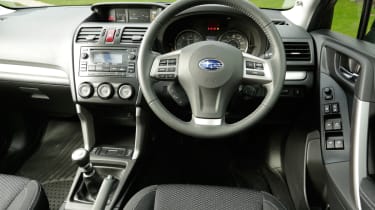
The interiors of all cars are very similar to the Subaru XV. That means build quality is good, but it can’t match premium rivals for upmarket appeal. Not only does the design look a little dated, there are very few soft touch materials to help lift the ambience.
Still, there are no complaints concerning the amount of standard kit, with all models getting air-conditioning, Bluetooth connectivity, heated seats and cruise control. XC and XE versions add climate control, a rear view camera, powered seats and xenon headlamps, while upgrading to Premium brings leather trim and sat-nav.
The X Mode is a useful bit of kit on automatic models, as it distributes torque evenly between all four wheels to prevent wheel-spin on loose or slippery surfaces. It only operates at low speeds as it disengages automatically above 25mph, but it could make all the difference on the wet grass car park at the pony club.
Sat-nav, stereo and infotainment
The updated Subaru Forester is fitted with a new 7.0-inch touchscreen, which is far more responsive than the old system.
The standard audio set-up is a six-speaker system with DAB radio and single CD player. There’s a voice command system on all models but the base 2.0 DX diesel, while all models feature steering wheel controls to supplement the touchscreen.
Practicality, comfort and boot space
The latest Forester is also the largest. The A-pillars are further forward than before, by 200mm, which gives extra space in the front.
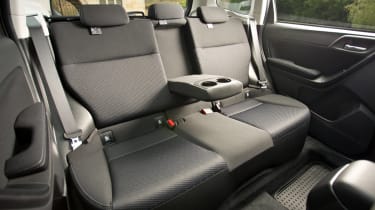
In the rear, the floor has been lowered to create more space for feet, while elbow and shoulder room is good in the front and back.
All cars feature three power points and a narrow but deep centre cubbyhole, plus two good-sized cup-holders between the front seats.
From a driver’s point of view it’s easy to get comfortable thanks to a rake and reach adjustable wheel, and very adjustable seats. A high driving position means the forward visibility is excellent, and the mirrors are now mounted on the doors, which reduces the front blind spot. As most models come with a reversing camera you’ll have no qualms about backing up either.
There’s only the one five-door bodystyle in the Forester line-up, and just the five seats on offer.
Size
The Forester measures up at 4,595mm long x 1,795mm wide x 1,735mm high. That compares to the 4,524mm x 1,838mm x 1,689mm Ford Kuga and the 4,426mm x 1,809mm x 1,703mm Volkswagen Tiguan.
Leg room, head room & passenger space
With a slightly lengthened wheelbase compared to the last model, and that high boxy roof, there’s plenty of room for grown-ups in the back of the Forester. That said, the rear bench is designed to seat three adults, but in truth, they’ll be a little cramped.
Isofix child seat mountings are standard, as you would expect, and a nice feature is the one-touch seat folding mechanism for the 60:40 split rear seat. The seats don’t lie totally flat, but there’s a carpet flap to cover the gap between the boot floor and the folded seatbacks.
Boot
The boot has a low, flat lip, making it easy to load, and its 505-litre capacity is similar to the Mazda CX-5 and quite a lot bigger than the Ford Kuga’s 406 litres. Top-spec XT models get a powered tailgate, while folding the rear seats down liberates a healthy 1,564-litres of space. There’s a space-saver spare wheel under the boot floor.
Towing
All versions of the Forester should make pretty good tow cars, with a braked trailer weight limit of 2,000kgs for everything except the manual 2.0-litre non-turbo, which can pull 1,800kgs.
Check any car's MoT history in a few easy clicks with our MoT checker tool...
More reviews
Car group tests
In-depth reviews
Road tests