New Toyota Yaris Cross facelift review: hybrid makes a good case for EVs
Toyota’s mini hybrid SUV will cost pennies to run, but the purchase price is thousands of pounds more than several rivals


Verdict
The Yaris Cross is now half a decade old, but exorbitant petrol prices mean it should, on paper, be an ideal choice at this moment in time. The problem is that while the updated version of Toyota’s hybrid SUV offers low running costs and a pleasant drive, this isn’t enough to offset the relatively high purchase price. With EV alternatives in this segment offering posher and more practical interiors for the same money (or even less), it’s hard to justify the Yaris Cross, unless you’d otherwise have to rely heavily on pricey public charging infrastructure.
If you’re after a small family car with rock-bottom running costs, your first point of call these days should generally be an EV. Yet those without a driveway can be stung by the high cost of public charging, meaning a fuel-sipping full hybrid like the Toyota Yaris Cross can often be a shrewder choice – for now, at least.
Since arriving five years ago, the Yaris Cross has promised class-leading fuel economy thanks to the Japanese brand’s unrivalled expertise when it comes to hybrid powertrains. But with newer electric rivals now offering more for less, is a nip-and-tuck for 2026 enough to keep the small SUV competitive?
Used - available now

2026 Toyota
Yaris Cross
30,376 milesAutomaticPetrol1.5L
Cash £17,513
2026 Toyota
Yaris Cross
12,546 milesAutomaticPetrol1.5L
Cash £19,469
2024 Toyota
Yaris Cross
15,106 milesAutomaticPetrol1.5L
Cash £21,988
2026 Toyota
Yaris Cross
28,836 milesAutomaticPetrol1.5L
Cash £18,712Well, to get the most important bit out of the way: the Yaris Cross remains as economical as ever, despite the fact that only the larger 1.5-litre hybrid petrol-electric powertrain is now offered. Using all three of the Yaris SUV’s drive modes – Normal, Eco and Sport – as intended, we returned 55.3mpg on our drive across towns, country roads and motorways, which is almost bang-on Toyota’s claimed figure.
With a (very) light right foot and leaving the car exclusively in its Eco setting, we were even able to push this as high as 77.5mpg. At current petrol prices, this equates to just seven pence per mile, which is almost as cheap as an electric equivalent.
Unlike EVs in this segment, which tend to offer performance similar to petrol-powered hot hatchbacks, the Yaris Cross’ 129bhp output appears comparatively weedy. In practice, though, a somewhat feather-like 1,200kg kerbweight and 185Nm of torque mean the baby Toyota SUV has no problem keeping up with traffic. The benchmark 0-62mph sprint takes just under 11 seconds, but the instant acceleration provided by the electric motor makes the Yaris Cross feel nippier at low speeds.
Get up to 70mph, however, and the CVT gearbox tends to hang onto revs, resulting in a rather unpleasant groan from the three-cylinder motor. That said, the Yaris SUV does otherwise feel composed on faster roads; wind, tyre and road noise are all present, but far from obtrusive. The firmer suspension also trades a bit of overall comfort – your spine becomes more acquainted with the effects of potholes than in a Citroen C3 Aircross – for stability at high speeds, giving you extra confidence on motorways or twisty B-roads.
Speaking of which, the Yaris Cross is unexpectedly good to drive. Toyota has struck the ideal steering balance between weight and accuracy to make the Yaris Cross more engaging – albeit not quite to the level of a Ford Puma – but also easier to place on a tight city street or car park. The wheel itself is perfectly sized and comes studded with an array of buttons and switches, too.
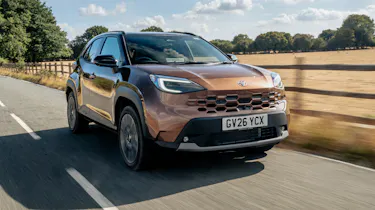
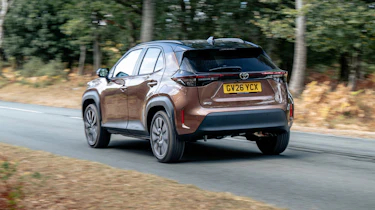
All of this is stuff you might have heard before, because, truthfully, there isn’t all that much new here for 2026. Toyota has tweaked the Yaris Cross’ front-end design to help tie it in with the rest of its line-up; C-shaped signatures in the headlights are a nod to the Yaris’ EV counterpart, the Toyota Urban Cruiser, while the hexagonal grille design mimics that of the larger Toyota RAV4. There are also two new colour options – including our test car’s rather striking Precious Bronze, which costs £580 extra – as well as revised alloy wheel designs.
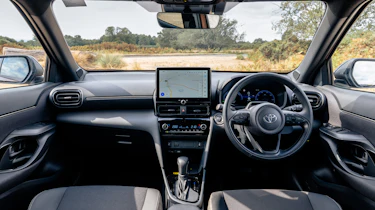
Inside, you’ll need to squint even more to tell what’s new. Toyota says it’s freshened up the interior materials, but it remains the same infotainment set-up as before. This comprises a 12.3-inch digital instrument cluster alongside a 10.5-inch touchscreen; lower-end Icon and Design models get smaller displays without wireless smartphone connectivity, although we don’t think having to use a cable for Apple CarPlay or Android Auto is a dealbreaker.
The Excel model, which we drove, is expected to be the biggest seller. It gets heated part-leather seats, dual-zone climate control, a 360-degree camera system and even a powered bootlid. However, we’d probably save £4,000 and pick the aforementioned Design, although you will have to suffer closing the boot yourself and driving without toasty haunches.
The Design model will set you back over £30,000, with entry-spec Icon models in touching distance of £27,500 – over £7,000 more than a Chery Tiggo 4. Granted, that car’s hybrid powertrain is far thirstier than the Toyota’s, but China’s offering feels markedly more premium inside; the Yaris Cross’ cabin oozes longevity and robustness, but lacks the plush materials you might expect at this price point. It also feels a bit dated, having more than a whiff of half a decade ago, although this does come with the ergonomic benefit of physical buttons and switches that are crucially absent in newer models.
The focus on durability is perhaps intentional given that Toyota will want the Yaris Cross to last for the course of its 10-year warranty. Individuals and couples – unequivocally the target audience for this car – might not keep the Yaris SUV for that long, though, as the small boot, tight rear legroom and narrow door opening mean that it’s less than ideal for anyone planning to have a family.
| Model: | Toyota Yaris Cross Excel |
| Price: | £34,280 |
| On sale: | Now |
| Powertrain: | 1.5-litre full-hybrid petrol |
| Power/torque: | 129bhp/185Nm |
| Transmission: | CVT auto, front-wheel drive |
| 0-62mph/top speed: | 10.7 seconds/109mph |
| Economy/CO2: | 56.8mpg/102g/km |
| Size (L/W/H): | 4,172/1,765/1,595mm |
Our dealer network has 1,000s of great value new cars in stock and available now right across the UK. Find your new car…
Don't miss the best of Auto Express on Google! Make us a preferred source. Click here...