Audi RS 3 review
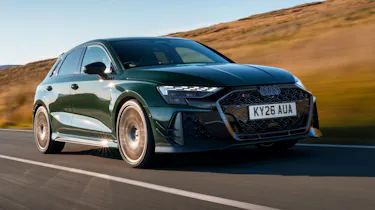
The Audi RS 3 is a sensational hot hatch with a powertrain to match, but the interior should be more premium at this price point

Our opinion on the Audi RS 3
Throw an Audi RS 3 up against a modern high-performance electric car and it’ll feel sluggish and a bit compromised, but this is to take it at face value and ignore its charm. Audi built its reputation on turbocharged five-cylinder engines, grippy all-wheel-drive systems and the ability to cover rough roads at ferocious speed.
When considered against those metrics, the RS 3 remains in a class of one. It’s not slick, but the RS 3 offers character and true engagement.
About the Audi RS 3
The Audi RS 3 has been one of the most successful and desirable hot hatches of the past decade or so, and that’s because there’s many key things that help it stand out from the crowd. It’s one of the few, alongside the Mercedes-AMG A 45 S, that is produced by
a premium brand rather than a mainstream maker, which instantly gives it a kick of badge appeal that alternatives can’t match.
Then there’s the lure of the quattro nameplate, instantly tying the RS 3 to the brand’s rallying heritage. But standing out among all these USPs, it’s what’s under the bonnet that really sets Audi’s hottest hatch apart. That five-cylinder engine offers up not only huge power, but also a distinct soundtrack – one that has become even more important given that many rivals have converged on rather soulless four-cylinder turbocharged engines.
Used - available now


We tested the RS 3 head-to-head against the Honda Civic Type R in 2025. The Civic - which is no longer available to buy new - won, thanks to its sparkling chassis and superb manual gearbox but the RS 3 ran it very close with its charismatic five-cylinder engine.
Performance & driving experience
Pros |
|
Cons |
|
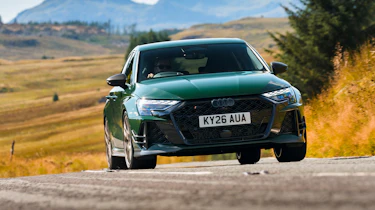
The RS 3 always feels on it, allowing the driver to hold a higher gear and enjoy the wonderful sound of that unique, complex engine note as it climbs through the revs. The strong, consistent torque can play tricks on you as a driver, though, because the engine pulls so strongly right up to the red line that it feels like the unit could easily handle a higher rev limit, so if you take over with the manual shifters, it’s quite easy to misjudge the change-up point.
The chassis has its own strengths, with Audi’s engineers paying close attention to a few key elements. These include widening the front track, changing the suspension geometry and fitting wider wheels and tyres to give the car more front-end grip.
In general, the suspension set-up feels quite performance biased at low speeds with a broadly firm ride, but as you speed up and put some load into the chassis, things smooth out to give it an impressively fluid and supple feel. The wheels are resistant to being thrown off by rough roads or off cambers, helped by steering that’s accurate and direct. Dampers are passive on the lower two RS 3 models, but our top-spec car swaps these for an adaptive set that helps further smooth off the ride on poor surfaces.
Traction is good, but the all-wheel-drive system does allow some slip from both front and rear axles. As a Haldex-style system, the maximum torque able to be sent to the rear wheels is only 50 per cent, but the RS 3’s trick torque-vectoring rear differential can then also send drive across the rear wheels under acceleration. When putting power down under boost you can feel it being shifted around.
There’s even a mode that will have the outside rear wheel over-rotate on purpose to elicit oversteer. This was in place in the previous generation, but further calibration work has improved its consistency. As selected, it can gently coax the rear end into slip before quickly gathering it all up and firing you down the road. The RS 3 used to be something of a blunt instrument, but this generation has taken considerable steps towards offering a more engaging driving experience, something this mid-life update has only improved upon.
| Model | Power | 0-62mph | Top speed |
| Audi RS 3 Sportback TFSI quattro S Tronic | 394bhp | 3.8 seconds | 155mph |
| Audi RS 3 Sportback TFSI quattro Carbon Vorsprung | 394bhp | 3.8 seconds | 155mph |
| Audi RS 3 Saloon TFSI quattro S Tronic | 394bhp | 3.8 seconds | 155mph |
Performance, 0-60mph acceleration and top speed
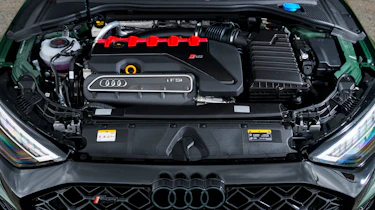
The RS 3 is one of Audi’s few models that has retained the same powertrain layout across all of its generations, which in this case is both its best and most compromised elements. Its unusual 2.5-litre five-cylinder engine is full of character, with a deep and resonant exhaust note reminiscent of those iconic Quattro rally cars from the eighties. Peak power is rated at 394bhp, and it’s generated with the help of a large single turbocharger.
Yet the forced-induction layout is quite simple and does without any clever tech, so turbo-lag is noticeable. Combined with the often sluggish dual-clutch transmission, the RS 3’s peak performance can take time to access. You need to plot your heavy throttle applications carefully, anticipate the delay and then hold on for the rush. Owners of a modern EV would be aghast at this notion, but it can be tempered.
This slow-witted response can be minimised in the most aggressive driver modes, including two RS settings that can be personalised and accessed directly from the steering wheel. It’s now that the performance isn’t just objectively fast, but feels like an event due to the evocative engine note. The RS 3’s 0-62mph time is rated at 3.8 seconds on paper – a figure that feels accurate so long as launch mode is activated – with a top speed of 155mph, or 174mph for the top-spec Carbon Vorsprung model we’re driving here.
But the Audi’s engine has a completely different character to many other hot hatches, including the Mercedes-AMG A 45 S. While that car needs lots of revs to extract its best, the RS 3’s bigger-capacity engine combines that top-end grunt with a huge dose of torque – its 500Nm maximum is available from just 2,250rpm and continues to 5,600rpm.
Town driving, visibility and parking
At low speeds, the RS 3 is no trickier to drive than any other A3 – except you get the benefits of a lovely warble from that engine up front to accompany you on each journey. The ride is firm enough to hint at the car’s performance potential, but is certainly on the more comfortable side of the hot-hatch spectrum.
A surprising element are the wonderfully supportive Recaro wing-back bucket seats. You sit much higher in them than expected, though there’s still plenty of headroom and it helps with visibility, too.
Country road driving and handling
The RS 3 might be a fully-fledged ‘hyper hatch’ with phenomenal straight-line performance, but it’s still a playful thing with a chassis that offers just as much sparkle as its engine.
In 2024 the RS 3 received software tweaks to its brake torque splitter and the torque-vectoring tech. In helping these systems to communicate with each other quicker and in more precise detail, Audi’s RS division tuned the car to feel more responsive in bends. The front end became more resistant to understeer on turn-in, which allows more corner speed to be carried and for the driver to get on the power sooner.
There’s a wider band of driveability as a result. The more positive front end means that on certain roads the RS 3 can be chucked around like a traditional front-wheel drive hot hatch. In lower-grip conditions, the four-wheel drive doesn’t mute the RS 3’s fun, it amplifies it. Power sent to the rear is predictable enough that you can play with its balance on the throttle, as well as the steering.
In terms of steering it’s very well calibrated. Naturally weighted and precise, there’s plenty of communication from the front tyres. Our one small criticism is that we found the brakes struggled a little sooner than we expected under sustained use on track, but on the road they offer up incredible stopping power.
Motorway driving and long-distance comfort
Much like the driving experience in town, a long motorway trip in the RS 3 feels no more stressful than it would in a regular A3. Indeed, thanks to all of that extra power, the engine makes much lighter work of getting up to motorway speeds in the first place - though you want to be in Normal mode and not one of the sportier settings, otherwise the revs take a while to settle. Unflappable stability and a firm, controlled ride make it great at devouring long distances.
“I’ve driven various RS 3s on track, both before and after the sport differential was added. It really makes a huge difference, both in terms of how sharply the nose points into a corner, and how early you can jump on the accelerator at the exit.” - Alex Ingram, contributor.
MPG & running costs
Pros |
|
Cons |
|
Audi has worked hard to keep the 2.5-litre five-cylinder engine compliant with ever-tightening emissions regulations, and given its huge character and power, we can’t grumble too much about fuel usage.
Officially, Audi quotes a fuel-efficiency figure of 31.0mpg for the RS 3, with a corresponding 207g/km of CO2. Our most recent time behind the wheel of the RS 3 saw a real-world return of just over 28mpg, although gentle motorway runs will see that creep up to around 33mpg. Naturally, plenty of enthusiastic driving (or revving it loudly in your local town centre) will see that figure drop.
The kickback comes in towns and cities, because despite a decent stop-start system the RS 3 does get through fuel when pottering at low speeds. We also found that the dual-clutch transmission has particularly conservative mapping, meaning that it can feel quite sluggish and slow to respond. Other running costs will be higher than average, thanks to the wide, high-spec tyres and the aggressive suspension geometry run, particularly on the front axle.
The RS 3 is the only new car on sale to have a wider front rubber than rear, with a 265-section width up front and just 235-section tyres on the rear. The standard Pirelli P Zero set-up is good, but for those wanting to extract the ultimate performance from their RS 3, Audi UK now offers the option of track-focused Trofeo R rubber. When fitted, the car’s dry-road performance is lifted up to another level, but the softer compound will require replacing more often, and they’re more expensive as well. The big brakes also need to be looked after, and while the optional ceramics make short work of track days, pad replacements can be even more expensive.
| Model | MPG | CO2 | Insurance group |
| Audi RS 3 Sportback TFSI quattro S Tronic | 30.1mpg | 214g/km | 37 |
| Audi RS 3 Sportback TFSI quattro Carbon Vorsprung | 29.7mpg | 215g/km | 38 |
| Audi RS 3 Saloon TFSI quattro S Tronic | 30.4mpg | 211g/km | 37 |
Insurance groups
Depending on the trim level you choose, insurance groups for the RS 3 range from 36 to 39 out of 50. Insurance for a car like this is never going to be cheap but you could still save a few pennies compared to owning a Mercedes-AMG A45 S, as that sits in group 40.
Tax
Every RS 3 is way above the £40,000 luxury car tax threshold, so you’ll need to add an extra £440 onto your annual VED road tax bill between the second and sixth year of ownership.
Depreciation
There’s only one thing about the Audi RS 3 that we can call slow, and that’s depreciation. Our market data shows that both the Sportback and Saloon will retain between 53 and 57 per cent of their initial value after three years or 36,000 miles. This makes the Audi a stronger investment than the Mercedes-AMG A 45 S, as that only manages 48 per cent.
Interior, design & technology
Pros |
|
Cons |
|
The RS 3’s build quality inside is fine, but many of the plastics aren’t up to the standard of typical Audis, let alone one costing the thick end of £60,000. There have been a few improvements in quality in certain areas compared with the previous version – we’re talking about small elements inside the air vents and door cards – but in general too many of the hard-finish plastics are still there and feel cheap.
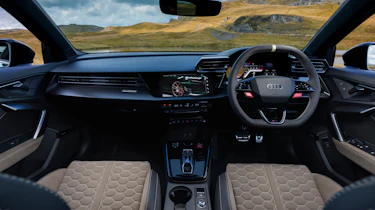
The standard seats are also up to standard, but you can now opt for a much more serious set of carbon-backed buckets. Together with the new steering wheel, they give the interior a welcome lift, although the fresh touch-sensitive buttons are a backwards step.
Interior and dashboard design
The standard A3’s cabin has been lifted by a couple of key details. The main feature is a hexagonal-shaped steering wheel; it’s a slightly odd shape, but it’s nice to hold, while it’s furnished with a couple of small red buttons. These can be programmed in the infotainment menu to preselect drive modes tailored to the driver’s tastes. However, we prefer the design of the RS 3’s wheel, not only for its more regular shape, but because it still has physical buttons to adjust the audio settings and digital driver’s display controls.
Materials and build quality
Little details like those touch-sensitive keys on the wheel take the shine off the overall feeling of expense, but the general finish feels fairly solid. Physical climate control keys aren’t just great for ergonomics, but each button operates with a pleasing click, too. That aside, the cabin doesn’t quite feel either as smart as we’d hope from a car at this price point, or an Audi in general.
Infotainment, sat-nav and stereo
Audi’s Virtual Cockpit – the 12.3-inch digital instrument panel – looks sharp and presents all of its information clearly, even if those touch-sensitive steering wheel keys make it a little awkward to switch between screens. Here there are three display layouts exclusive to the RS 3. RS Sport places one large, round dials in the centre of the screen; RS Performance reshapes the rev counter to a hockey stick shape, mimicking the layout of a typical race car dash; and RS Runway arranges the layout into two bars that sit vertically on the dash and appear to disappear into the distance.
We reckon it’d make more sense if the revs started from the bottom and worked their way up, but they’re the opposite way around. You can display the likes of power, torque, a
G-force meter, and oil temperatures to either side of the central dial.
Regardless of the mode, the red line on the dash drops lower when the engine is warming up, in order to prevent the five-cylinder being thrashed too harshly from cold.
“Whether you like the look of the new steering wheel more than the old one will come down to personal taste, but the previous design was less fiddly to use.” - Alex Ingram, contributor.
Boot space & practicality
Pros |
|
Cons |
|
Hot hatches combine sports car performance with everyday practicality, and there are few cars that blend the RS 3’s speed and usability.
Dimensions and size
The RS is fundamentally no more or less practical than a standard A3 of the same generation.
Dimensions comparison | |||
| Model | Audi RS 3 | Mercedes-AMG A 45 S | BMW M2 |
| Length | 4,381mm | 4,453mm | 4,580mm |
| Width | 1,984mm | 1,850mm | 1,887mm |
| Height | 1,430mm | 1,414mm | 1,403mm |
| Wheelbase | 2,630mm | 2,730mm | 2,747mm |
| Boot space | 282 litres (321 litres in saloon) | 370 litres | 390 litres |
Seats & passenger space
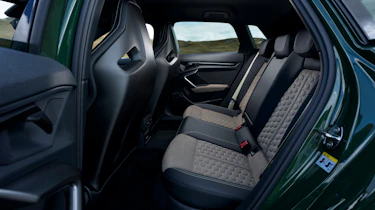
UK buyers can add a pair of optional carbon-fibre-shelled sports seats to the RS 3. While the standard seats are pleasant enough, the sports ones are superb upgrades; they look brilliant, and offer superb support during hard driving, yet are comfortable enough on longer trips. They’re pricey at over £2,000 but they’re worth it.
Space for back-seat passengers is the same as in any other Audi A3 – which is to say that it’s absolutely fine, if not outstanding. Knee room is adequate, and headroom is just above average for the family-hatchback class.
Boot space
The 4WD tech joining the rear axle, plus a relocated 12V battery, compromise the RS 3’s boot space. At 282 litres, the overall volume is 98 litres less than you’d find in a standard front-wheel-drive A3 Sportback. It’s also far less than you’ll find in the Mercedes-AMG A 45 S (370 litres) or BMW M2 (390 litres).
If you fancy a different look, the RS 3 is also available in a saloon bodystyle. For around £1,000 more than the Sportback, the saloon gains a 321-litre boot, but with a smaller opening, it’s not quite as practical as the hatchback.
Reliability & safety
Pros |
|
Cons |
|
Audi quotes a full five-star Euro NCAP safety rating for the A3, of which the high-performance RS 3 is merely an extension of the range. The latest regulations do mean active lane-keep and speed warning systems are in place, but despite the RS 3’s relatively old interior design, there is a dedicated switch that’ll take you to a menu to easily disable the system if you wish.
The five-cylinder engine is a well known entity, so reliability issues have not been flagged. But the dual-clutch transmission has been a weak point for many Volkswagen Group cars, with clutch replacements not uncommon – especially on high-performance models such as this.
While the RS 3 didn’t make an appearance, its mainstream sibling, the Audi A3, landed in a pretty unremarkable 42nd place out of 50 on the most recent Driver Power leaderboard. High running costs and questionable build quality were two areas which caused owners to vote it into such a low position. It’s a similar story with the Audi brand, too, as it only managed 23rd out of 30 in the best manufacturer results. This is especially disappointing when considering that Mercedes achieved first place.
| Euro NCAP safety ratings | |
| Euro NCAP safety rating | Five stars (A3, 2025) |
| Adult occupant protection | 86% |
| Child occupant protection | 81% |
| Vulnerable road user protection | 76% |
| Safety assist | 74% |
Buying, prices and deals
The Audi RS 3 Sportback starts from around £63,700 in its entry-level form, rising to just under £64,500 for the Saloon. At these sorts of prices, though, we reckon it’s worth going all-in and opting for the range-topping Carbon Vorsprung. Naturally, this the most expensive RS 3 you can buy from around £72,500, but it does bring an extensive list of additional kit. Slow depreciation means you shouldn’t wind up regretting your investment, either.
Of course, you can also save on these list prices by building your dream Audi RS 3 with the Auto Express Buy A Car service. We also have a range of used RS 3 models in stock and ready to hit the road. Plus we can even help you to sell your car.
Audi RS 3 alternatives
The Mercedes-AMG A 45 S remains the RS 3’s key rival, with a similar price point and level of performance. The Merc produces more power, with 416bhp, but this comes from a more highly strung four-cylinder engine that’s effective but ultimately has less character. The chassis has a similarly fluid quality and the all-wheel-drive system has its own torque-vectoring differential, but there’s something a little less engaging about the overall driving experience.
The BMW M2 is priced slightly higher, but this comes with more power, technology and prestige. Its rear-wheel-drive chassis is more entertaining, and the option of a manual transmission is a definite boon to enthusiasts. However, those looking for ultimate all-weather capability will miss the Audi’s all-wheel-drive system. Then there’s the Tesla Model 3 Performance, which is significantly quicker in a straight line but lacks any real sense of engagement.
Audi RS 3 pictures
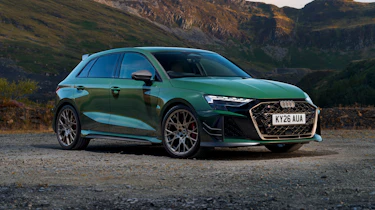
Key updates of the Audi RS 3 review
11 November 2026: Driving impressions from RS 3 Competition Limited.
Frequently Asked Questions
All Audis come with a three-year warranty as standard with a 60,000-mile limit, plus three years’ breakdown cover.
Deals on the RS 3 and alternatives