Used BMW 5 Series (Mk7, 2017-2024) review and buyer's guide
A full used buyer’s guide on the BMW 5 Series Mk7 that was on sale between 2017 and 2024

Verdict
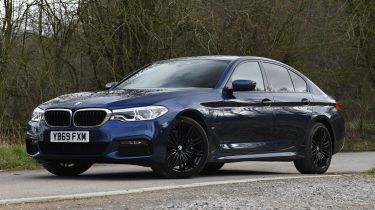
Some cars may excel in one way or another, but occasionally a consummate all-rounder shows just how good the modern family car can be. The BMW 5 Series is just such a vehicle, and while you pay for such talent, the best things in life are never cheap. Since the seventh-generation 5 Series was launched we’ve pitted it against the Audi A6, Mercedes E-Class, Volvo S90 and V90, plus the Lexus ES and Jaguar XF. In every case the BMW has come out on top, so it’s no wonder that it was our Executive Car of the Year in our 2017 New Car Awards – and then again in both subsequent years. Since then the Mercedes E-Class has stolen the BMW’s thunder, but don’t let that put you off, because the 5 Series is every bit as desirable as it has always been.
The 5 Series celebrates its 50th birthday this year. It was way back in 1972 that BMW launched its family saloon, and it would go on to become the enthusiast driver’s executive car of choice, with its engaging dynamics, efficient and sonorous engines, and driver-focused cabin.
Back in 1972 the idea of a plug-in hybrid would have been fanciful; the original 5 Series wasn’t even offered as an estate. But in the intervening half a century BMW’s mid-size family car would adopt diesel engines, four-wheel drive, hybrid tech and more.
Used - available now

2019 BMW
5 Series
67,484 milesAutomaticDiesel2.0L
Cash £18,697
2020 BMW
5 Series
24,000 milesAutomaticPetrol2.0L
Cash £19,300
2019 BMW
5 Series
82,146 milesAutomaticDiesel2.0L
Cash £12,749
2016 BMW
5 Series
169,897 milesAutomaticDiesel3.0L
Cash £6,499From the second-generation 5 Series there would also be an M5, just as there is with this Mk7. But that car deserves its own guide, so we stick with the more mainstream versions here, of which there are plenty.
History
The 5 Series Mk7 went on sale in February 2017 in saloon form, codenamed G30. At launch BMW offered 187bhp 520d and 261bhp 530d diesels (both with xDrive four-wheel drive as an option), a 181bhp 530e plug-in hybrid, and a 335bhp 540i xDrive with a 3.0-litre six-cylinder petrol engine.
Soon the firm added the 181bhp 520i and 228bhp 525d which, like the other models, came only with an eight-speed automatic transmission. The Touring (estate, codenamed G31) arrived in June 2017 and a 518d joined the range soon after.
A facelifted 5 Series arrived in July 2020, with refreshed styling, additional driver-assistance systems, new infotainment set-ups, and a 523bhp M550i xDrive option. By the end of the year a 545e xDrive plug-in hybrid had also been introduced.
Which one should I buy?
You can’t really go wrong, whichever engine, transmission, bodystyle or trim you pick. Buy a diesel or plug-in hybrid and you should be rewarded with excellent economy; the petrol engines are impressive, but far less frugal.
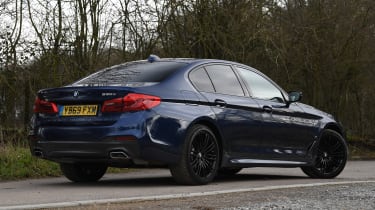
The xDrive four-wheel-drive transmission provides excellent traction in wintry conditions compared with the rear-wheel-drive alternative, but you pay a big penalty in fuel economy, so simply buying winter tyres instead might be the best option.
All 5 Series are generously equipped, with the entry-level SE having 17-inch or 18-inch alloy wheels, dual-zone climate control, adaptive cruise control, LED headlights, navigation, and front and rear parking sensors, plus heated front seats with part-electric adjustment. The M Sport trim is largely cosmetic, with a bodykit and sportier details, but upgraded brakes and bigger wheels (18/19-inch) are included.
Alternatives to the BMW 5 Series
The Mercedes E-Class gives the 5 Series the hardest time, with its wide model range, excellent engines, impressive build quality, roomy cabin and lots of hi-tech equipment. The Audi A6 offers these, too, and while it’s not as engaging to drive, it’s hugely desirable. The Jaguar XF is getting dated, but it looks great and is enjoyable to drive, plus there’s ample cabin space.
All three of these come in saloon and estate forms, which is also the case with Volvo’s well equipped and incredibly safe S90/V90. We’d consider the Lexus GS and its successor, the ES, too. They’re both well equipped, incredibly reliable and extremely refined, but not as rewarding to drive.
Use our valuation tool to check the price of a BMW 5 Series
What to look for
Fuel economy
A 520d Efficient Dynamics was offered, with an optimised transmission, reduced weight and emissions-control tech.
PHEV
The 530e had a 2.0-litre four-cylinder engine and a 9.2 or 12kWh battery pack. The 545e had a 3.0 six-cylinder unit and an 11.2kWh battery.
Spare wheel
The M Sport had run-flat tyres, but the SE had conventional tyres and a mobility kit. On all except the 530e, a space-saver spare was an option.
Engines
The 518d, 520d and 525d had a 2.0-litre four-cylinder diesel engine. The 530i had a 2.0 four-cylinder petrol, and the 530d had a 3.0 six-cylinder.
Common faults
Some owners have noticed rattles from the back seat, which can be caused by the seatbelt buckles or the seat-folding mechanism (if fitted). The problem seems to be worse when the car is cold. Having six recalls isn’t ideal, but it’s not bad, either.
Interior
Just about every aspect of the BMW 5 Series’ luxurious cabin impresses: the clear dash design, the supportive seats, the quality of the materials, the ample space for five people, and the infotainment systems, which are class-leading in terms of both their ease of use and their responsiveness.
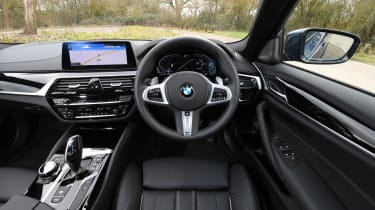
Boot space is excellent, at 530 litres in the saloon; a folding rear seat was an optional extra, so if you find a car with this fitted, versatility is improved significantly. As you would expect, the Touring’s carrying capacity is even better, at 570 litres with the rear seats up, or 1,700 litres with them folded.
Running costs
Like all BMWs, the 5 Series comes with Condition-Based Servicing, which tells the driver when maintenance is required, based on oil levels, wear rates of individual components and how the vehicle is driven. With normal driving, an oil service is due every 16,000 miles or so.
Because parts are replaced when necessary rather than according to a schedule, there are no fixed prices. Lifetime coolant is used and all engines are chain-driven, so there are no cambelts to replace.
Recalls
BMW has recalled the 5 Series G30 six times so far, the first time in September 2017 because three cars made in August 2017 had a faulty steering rack. A month later the next recall was issued, because 307 cars built in August 2017 left the factory with problematic seatbelts.
Two recalls came in 2020, one in October and the next in December, because some plug-in hybrids were fitted with battery packs that could short circuit. Both times the solution was to fit new battery packs or replacement cells; 530es made between May and September 2020 were affected. The two most recent recalls came in March 2021. The first was because some 5 Series made in January and February 2021 had faulty brake discs; the second was because sub-standard driveshafts were fitted to some cars made in June and July 2020.
Driver Power owner satisfaction
The seventh-generation 5 Series was superseded by an all-new model in early 2024, so last year was the Mk7’s last hurrah in the Driver Power new-car survey. But it went out on a high in 22nd place, thanks to top-10 results in the infotainment, quality and reliability categories – it was rated ninth in the latter two – while there were also further top-20 spots for its interior (12th) and the various powertrains (12th).
As you might expect, it was the high servicing costs (47th) as well as the onerous insurance bills (49th) that owners liked the least, while they were also not too enamoured with the exterior styling, which ranked in a relatively lowly 40th. At least a 23rd place for fuel economy ensured the BMW was above average here.
On a more positive note, the car’s excellent infotainment system ranked fifth across four sub-categories: the balance between touchscreen and physical controls, touchscreen functionality, audio systems, and smartphone connectivity. The BMW also managed a fifth place for interior quality, while seventh place for rear legroom was impressive.
What do owners think?
Here’s what owners of the BMW 5 Series Mk7 thought of the car in the 2024 Driver Power survey.
| What they like | What they don't like |
| “I love how it handles anything, regardless of weather, road surface condition or road type.” | “No thought has been given to disabled people using the car and needing suitable and accessible storage.” |
| “It puts a smile on my face whenever I drive it. It does everything well and makes a fantastic package.” | “The parking sensors aren’t sensitive. The collision- warning light is a waste of time and should be audible.” |
| “Everything you need as a driver is in the right place, so you are not distracted by having to look for it.” | “I get 40mpg from a 3.0-litre diesel, which isn’t awful, but I thought it would be more with the mild-hybrid tech.” |
| “The warning systems work well, with a good balance between being intrusive and warning you of danger.” | “The ride quality is poor. Without the adaptive suspension it can be very harsh around town.” |
| “A practical and very fast car that can take five adults, a dog and luggage, while also managing 42mpg.” | “I thought my BMW would be as nice as my Mercedes E-Class, but it just can’t compete in terms of quality.” |
| “The nav is very easy to use, backed up by the concierge service to help you find somewhere if necessary.” | |
| “Although my car has 20-inch run-flat low-profile tyres, the ride quality is good, especially with the adaptive suspension. Potholes send a shudder through the car, but overall I love driving it.” | |
| “There are no large blind spots, thanks to the big windows, along with the well proportioned and positioned door mirrors. It’s also super-quiet, especially at motorway speeds. I’ve never driven a car quieter than this one.” | |
| “There’s plenty of rear-seat legroom and the boot is impressive, even with the back seats in use. Folding them flat creates a gigantic space. There’s also a decent number of cubbyholes, with lots of space for bottles and cups throughout the cabin.” |
SEE OUR LATEST USED BMW 5 SERIES DEALS
Did you know you can sell your car with Auto Express? Get the highest bid from our network of over 5,500 dealers and we'll do the rest. Click here to try Auto Express Sell My Car now...
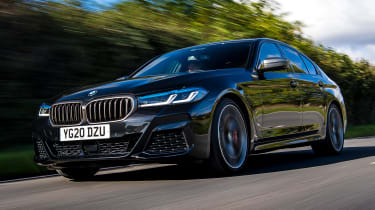
BMW 5 Series (2017-2024) review: What we said
Extracts from our 2023 review of the BMW 5 Series...
The BMW 5 Series is a hugely capable, beautifully built and spacious premium saloon that’s also great to drive. Arguably, it is still one of the most complete cars on sale today.
Few vehicles are as accomplished as the 5 Series. BMW's executive saloon has long been considered one of the best all-round cars you can buy, and the seventh-generation model delivers the talents of its predecessors with a healthy dose of hi-tech kit and construction in the mix.
About the BMW 5 Series
There’s been a 5 Series in BMW’s line-up for more than four decades now, and we’re well into the seventh generation which received a minor mid-life facelift in 2020. Although an all-new 5 Series model is expected to be revealed later in 2023, the current big executive saloon remains an exemplar of fine engineering and offers a superbly driver-focused approach.
As you’d expect, the seventh-generation car is packed with BMW’s most up-to-date technology and safety features, but it also offers more interior space than its predecessor thanks to the adoption of the larger platform from the bigger 7 Series. It’s lighter than previously too, thanks to extensive use of aluminium for the body panels and internal structures, while efficiency improvements including plug-in hybrid (PHEV) tech have extended the model’s appeal.
As such, the BMW 5 Series is a compelling choice in a sector that includes some very attractive rivals. The list includes the Audi A6, Genesis G80, Jaguar XF, Lexus GS, Mercedes E-Class and Volvo S90, while buyers may also be tempted by the 5 Series Touring estate version.
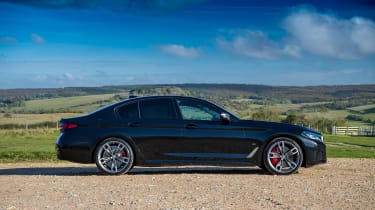
The 5 Series is luxurious, beautifully built and has always been one of the most engaging cars to drive in its segment. The current model doesn’t disappoint - it may be bigger, but as it’s 100kgs lighter than its predecessor it feels just as nimble. The styling is smart but conservative - an evolution of the last model, combined with cues taken from the larger 7 Series. But there's no doubt about who builds it, thanks to the synonymous kidney grilles, four-ring headlights and distinctive BMW window line.
We named the 5 Series our 2022 Large Company Car of the Year, as it's also extremely refined, with barely a hint of wind or engine nose, except on coarse tarmac when its big tyres can transmit a fair amount of rumble into the cabin. The standard suspension is compliant and comfortable too, although the sportier M Sport set-up feels firm at lower speeds - a trade-off for its improved agility.
The car’s top-notch refinement is backed up by one of the classiest cabins in the business. The quality of the materials and finish are first rate, while there’s plenty of standard kit, including sat-nav, online services and leather seat trim. There’s bags of space too, with occupants in the back getting nearly as much legroom as the larger 7 Series.
Business users are likely to be impressed by the car’s low running costs, with the 530e plug-in hybrid model emitting as little as 37g/km of CO2. With regular access to a plug socket and a short commute, you can run the car almost entirely on electricity, too.
The 5 Series line-up is simple, with only SE and M Sport trims on offer. The engine range is more extensive, however, with a selection of petrol, diesel and plug-in hybrid variants available. The diesel models are predictably most popular, with the excellent 187bhp 2.0-litre 520d accounting for the majority of sales. The 530d features a traditional BMW straight-six diesel with 282bhp, and is designed more for performance than efficiency.
Petrol power comes in the form of the 520i, which uses a 2.0-litre turbo petrol engine with 181bhp. There’s the M550i as well, which harnesses 523bhp from a 4.4-litre, turbocharged V8 petrol, reaching 62mph from a standstill in a frightening 3.8 seconds - still half a second less than the 5 Series-based M5 super-saloon.
Other than that, there are a pair of plug-in hybrids to consider in the form of the 530e and 545e. The former uses a 2.0-litre petrol engine and electric motor to make 288bhp, which delivers performance similar to the 530i but with far lower running costs and a potential 37-mile electric driving range. Meanwhile, the 545e develops 388bhp from a 3.0-litre straight-six petrol engine and electric motor, with an 11.6kWh battery contributing to an electric range of up to 33 miles depending on spec.
All cars feature an eight-speed automatic gearbox, while xDrive four-wheel drive is available as an option on 520d and 530e models - it's standard on the 530d and 545e.
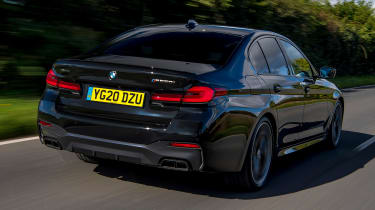
Engines, performance and drive
While the structure, bodyshell and interior were all-new in 2017, the BMW’s engine line-up features tried and tested petrol and diesel units. Two appealing plug-in variants are also on offer, with an electric range of up to 37 miles.
Whichever version you opt for, you’ll benefit from the same fine ride and handling balance. The 5 Series’s weight reduction has delivered improvements across the board, and despite exterior dimensions that are larger than the old car’s, the new version actually feels more agile on the move.
The steering isn’t as quick as the Jaguar XF’s, but it’s naturally weighted and delivers just the right amount of feedback. There’s also bags of grip, while even on the standard springs and dampers fitted to SE models the BMW delivers strong body control, coping very well over the bigger bumps.
Four-wheel drive is standard on the 530d and 545e, and optional on the 520d and 530e. The benefits in traction are obvious on the more powerful versions, but the 520d is best suited to the traditional rear-wheel drive layout, which feels a little lighter and more agile than the xDrive set-up.
The impression of luxury is enhanced by the low levels of noise in the cabin. Even the 520d’s four-cylinder diesel is hushed, while wind and road roar are barely perceptible.
For the first time ever in the UK, the 5 Series isn’t available with a manual gearbox – so if you want to shift ratios yourself you’ll need to look at an Audi A6 or Jaguar XF. However, the BMW’s standard eight-speed auto is so good that we'd have recommended spending extra on it even if it was an option.
We used to recommend forking out for adaptive dampers, which were an option on certain M Sport variants as part of BMW’s M Sport Pro Pack. In its sportiest setting, this set-up gives sharper responses and even greater composure, while selecting Comfort serves-up a soft ride that rivals luxurious limousines - presumably why BMW now reserves adaptive dampers for the M550i where they’re fitted as standard.
0-62mph acceleration and top speed
Forming the bulk of 5 Series sales in Britain will be the 520d, with its familiar 2.0-litre four-cylinder diesel. Producing 187bhp and 400Nm of torque, you might think it’d struggle in a car as big as the 5 Series. However, the new car is 100kg lighter than before, while the slick-shifting eight-speed automatic transmission means the 520d delivers as much performance as you’ll need.
BMW claims 0-62mph in just 7.2 seconds, which rivals warm hatchbacks for outright pace. Yet with a healthy 400Nm of torque you don’t need to work the 520d’s engine hard to make decent progress. The automatic gearbox delivers smooth changes when left to its own devices and crisp shifts when using the manual mode. The 2.0-litre unit is also smooth and refined, although this is partly down to excellent soundproofing.
In fact, for most of the time this engine is as unobtrusive as the bigger six-cylinder in the 530d. And while the 282bhp unit knocks nearly two seconds off the 520d’s 0-62mph claim with a time of 5.4 seconds, in the real world the differences aren’t as obvious as you’d think.
There’s more low-down muscle with the larger engine, while the deep growl under hard acceleration adds to the sporty appeal. Yet unless you want to have bragging rights when it comes to the Top Trumps performance statistics, the 520d’s more balanced mix of performance and efficiency makes it the more rounded choice.
The excellence of the diesels leave the petrol models firmly in the shade. The 530e and 545e are impressive alternatives, though, driving very nearly as well as the petrol and diesel cars, with the added boon of up to 37 miles of zero emissions range in the less potent car.
The M550i delivers scorching pace, with four-wheel drive traction and a healthy 523bhp delivering 0-62mph in just 3.8 seconds.
MPG, CO2 and running costs
Ever since launching its EfficientDynamics technology a decade or so ago, BMW has been leading the way for low running costs – and the new 5 Series is no exception.
If you're after a diesel model, it’s the 520d that makes the most financial sense. CO2 emissions from 126g/km place the BMW in the 30-31 per cent benefit-in-kind tax bracket. On top of that, the brand claims an impressive fuel return of 58.9mpg. Adding the xDrive four-wheel drive system increases emissions to at least 133g/km.
However, even the 530d delivers impressive low running costs, with claimed fuel efficiency of 51.4mpg and a CO2 figure of 143g/km provided you stick to SE trim.
As you’d expect, the petrol versions aren’t quite as efficient, but the 520i’s promises of 45.6mpg at the pumps and 142g/km of CO2 are good for such a big car powered by a four-cylinder engine. The M550i is the thirstiest model in the line-up, claiming to return just under 27mpg with emissions of 243g/km.
For company car users who do as much commuting as long trips, the 530e could be worth considering. The plug-in hybrid machine falls into the 12 per cent BiK tax bracket thanks to its ultra low CO2 output of just 31-35g/km. Obviously, to get anywhere near the claimed 188.3-201.8mpg you’ll have to plug the car into charge frequently and make plenty of short journeys in the electric-only mode.
Interior, design and technology
Apart from a brief spell of daring design in the early 2000s, BMW has always taken a cautionary and conservative approach to styling. And given the loyal customer base of the 5 Series, it’s no surprise the brand has played it safe with the latest model.
Its proportions are very similar to the old car, while the detailing around the headlamps and at the rear is pure 7 Series. The BMW isn’t as sleek as the Jaguar XF or quite as imposing as the Mercedes E-Class, but its handsome design oozes understated class.
If you opt for the M Sport trim level, then a subtle bodykit, bespoke front and rear bumpers and larger 19-inch alloys (18-inch alloys on the 530e) give the car some racy kerb appeal.
The interior of the old 5 Series was starting to feel a little dated compared to rivals such as the Mercedes E-Class. There was nothing wrong with the quality of the materials or construction, but the design and infotainment were starting to look old hat.
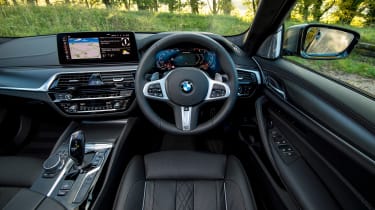
As a result, BMW has pulled out all the stops with this latest car, which takes its cues from the 7 Series flagship. In fact, from behind the wheel you could easily mistake the 5 Series for its larger brother.
The wrap-around dashboard is logically laid out, while the metal finished switchgear for the climate control is taken from the 7 Series. Also taken from the larger car is the large TFT display that replaces the traditional analogue dials.
As you’d expect, the fit and finish are first rate. Top-notch materials are used throughout, while the build quality is flawless. Few cars feel as thoroughly engineered from behind the wheel.
Like other models in the BMW range, it’s possible to customize the interior to suit you tastes. There are various leather trim options and different trim inserts, plus there’s the brand’s Individual programme, which provides a bespoke tailoring service – although you’ll need deep pockets for some of the options.
Technology plays a big part in the new BMW 5 Series, with features from the larger 7 Series trickling down to its smaller brother. For instance, the adaptive cruise control can be upgraded to include semi-autonomous driving with the Driving Assistant Professional option, part of the £4,995 Technology Plus Pack. This system allows the car to accelerate, brake and steer itself at speeds of up to 130mph. It will even change lanes to overtake on a motorway; simply flick the indicator on and sensors will identify a gap in the traffic, then pull smoothly out to pass the slower car.
This heavily priced upgrade also includes the latest parking aids, with the usual parking sensors and camera joined by a remote set-up. Parking Assistant Plus allows you to slot the car automatically into a tight space while you stand outside: you can get this feature for a standalone £650 if you prefer to do without the autonomous driving aids.
Other highlights include the full colour head-up display, which features speed and sat-nav information. This comes as part of the Technology Pack and costs £2,495, with gesture control and wireless charging also thrown in.
Sat-nav, stereo and infotainment
While BMW has been fairly restrained when it comes to styling updates, it has taken some big steps with the 5 Series’ infotainment. A larger screen, increased connectivity and gesture control all feature on the new system, while the familiar and intuitive iDrive controller is carried over.
Plenty of the tech operated by the 12.3-inch infotainment screen is carried over from the 7 Series, just as it has been with the new 5 Series’ chassis. But more of it is optional on the exec than it is on the luxury saloon.
BMW was the first manufacturer to integrate Apple CarPlay wirelessly, with Android Auto also supported. Meanwhile, the BMW Connected app can send images from the car’s 3D view cameras (if fitted) to your mobile device, and will link to Amazon’s Alexa service for those using this tech. Online services are standard.
All versions of the 5 Series get BMW’s ConnectedDrive Services, which adds a host of online services. Emergency Call will contact help in the event of an accident, while the Online Services give you access to various apps and information. Also included in this package is the Real Time Traffic Information (RTTI), which uses up-to-the-minute data to display traffic flow.
If you want to upgrade the sound system, you can select the Harman Kardon option for £820. There’s a Bowers & Wilkins Diamond Surround sound system, although this costs an eye-watering £4,220.
Practicality, comfort and boot space
Given that the BMW 5 Series has grown in nearly every external dimension, it’s no surprise to find its bigger inside. In fact, it now comfortably matches the Audi A6 and Mercedes E-Class for space, and edges ahead of the Jaguar XF.
Boot capacity has increased, too – although close class benchmarking means it offers no real advantage over its immediate rivals in this regard. Yet if buyers want more luggage space, then there’s always the 5 Series Touring estate version.
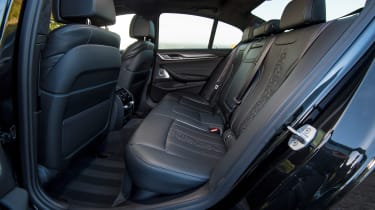
Access to the cabin is straightforward thanks to wide-opening doors, and once inside there’s bags of head and legroom for rear seat passengers. It’s a similar story up front, where the driver gets a wide range of seat and wheel adjustment.
Like all BMW models, the driver’s seat can be set low, placing you at the heart of the action. The standard seats also offer plenty of support, particularly over long distances. M Sport models get more heavily bolstered sports items, while if you want a heating function for both the front and rear seats you'll have to tick the optional Comfort Plus Pack.
Legroom, headroom and passenger space
You’d expect an executive saloon to be roomy and comfortable – and the 5 Series doesn’t disappoint. By stretching the whole car by 36mm, BMW engineers have liberated extra legroom, particularly for those sitting in the back. There’s enough space for even tall passengers to stretch out in comfort, while the rear bench is wide enough for three adults – although the large transmission tunnel means those sitting in the middle don’t have much room for their feet. Up front, the amount of space is equally generous. There’s also a wide range of seat adjustment, particularly for the driver.
Boot
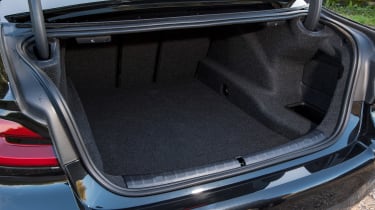
BMW has boosted the carrying capacity of the 5 Series, but the 10-litre increase to 530 litres isn’t much to write home about. What’s more, it trails the 540-litre figures claimed by the Mercedes E-Class and Jaguar XF.
Go for the 530e or 545e plug-in hybrids however, and you'll sacrifice 120 litres of space. That's a fair chunk, although the Mercedes E 350e suffers to a larger extent, losing 140 litres over its conventionally-powered petrol and diesel siblings.
Still, the load bay is reasonably well shaped in all versions, while the opening is wide. There is a pair of handy cubbies behind each wheel arch, plus some storage beneath the boot floor. The split/fold rear seat further aids versatility.
Did you know you can buy a used car with Auto Express? Choose from tens of thousands of cars with trusted dealers around the UK. Click here to buy used with Auto Express now...