Fiat Panda super test: the 45-year evolution of Italy’s small car icon
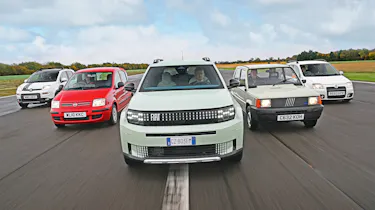
A lot has changed since the Fiat Panda first appeared in 1980. To mark the Italian hatchback’s 45th anniversary, we brought together examples from eighties petrol models to today’s electric Mk5 Grande Panda

The Fiat Panda celebrates its 45th birthday this year. That means it’s the same age as Kim Kardashian and 2009 Formula One world champ Jenson Button.
The Panda was never intended to be as racy as either of its fellow 45-year olds, but when it comes to deciding which has had the greatest success, that’s a much harder one to answer; since the original launched all that time ago, Fiat has shifted the best part of eight million units across the world.
To mark its birthday, an all-new generation has arrived: the Grande Panda moves the Panda’s game on when it comes to space, safety and tech, but it hasn’t turned its back on its humble roots, because simplicity and considered design are still key. And value is still at the heart of what the Panda offers.
To celebrate the milestone, we assembled examples of Panda past and present, and it’s clear that heart plays a big part in all of them. They may be small, but models of all ages are overflowing with personality.
Bringing the group together let us take a look at one of the most charming small car families around. We could see how the models compared, where improvements came over the years, and what, if any, traits persisted throughout the car’s 45-year life.
Used - available now

2023 Hyundai
Bayon
20,826 milesManualPetrol1.0L
Cash £12,299
2024 Volkswagen
Tiguan AllSpace
39,216 milesAutomaticPetrol1.5L
Cash £25,197
2024 Skoda
Kodiaq
22,592 milesAutomaticPetrol1.5L
Cash £24,697
2023 Tesla
Model 3 Performance
27,526 milesAutomaticElectric
Cash £23,997Did you know you can sell your car through Auto Express? We’ll help you get a great price and find a great deal on a new car, too.
Panda Mk1
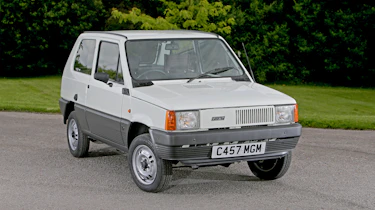
| Model: | Fiat Panda 30 Mk1 |
| Engine: | 0.65-litre 2cyl |
| Power/torque: | 30bhp/41Nm |
| Transmission: | Four-speed manual, front-wheel drive |
| 0-62mph: | 36 secs |
| Price new: | £2,860 (1980) |
| Value today: | from £4,000 |
Panda Mk2
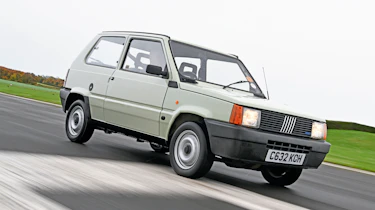
| Model: | Fiat Panda 1000 CL Mk2 |
| Engine: | 1.0-litre 4cyl |
| Power/torque: | 44bhp/80Nm |
| Transmission: | Four-speed manual, front-wheel drive |
| 0-62mph: | 16 secs |
| Price new: | £4,585 (1988) |
| Value today: | from £4,000 |
Few car brands have managed to nail the small car formula quite as consistently as Fiat. Ever since the original 500 was launched back in the late fifties, buyers have bought Turin’s smallest cars by the millions. The replacement for the 500, the 126, arrived in 1972, but towards the end of the mid-eighties, the rear-engined, air-cooled format had been improved upon by the front-engined, front wheel-drive format, which allowed for more efficient packaging.
So while the 126 soldiered on – and with great success – right up until the year 2000, Fiat wanted a new small car champion to usher in the eighties. It didn’t hold back, either; for the design of the Type 141, as it was internally codenamed, Fiat enlisted the help of Italdesign – co-founded by legendary designer Giorgetto Giugiaro. At this point, Giugiaro was already responsible for penning some truly stunning sports cars from the Alfa Romeo Giulia Sprint GT, BMW M1, Lotus Esprit and Maserati’s Ghibli and Bora, to Fiat’s own Dino Coupé and 850 Spider. But now it was time to turn to something more attainable, yet still desirable for the masses.
The intention, much like its predecessors, was to provide a car that was cheap to run and to maintain. Indeed, the aim was to deliver a car that didn’t cost any more to produce than the 126, yet managed to be both more practical and refined. It was revealed to the world at the 1980 Geneva Motor Show. Taking its name from the Roman goddess Empanda, there were plenty of divine details to enjoy.
The minimalist look was entirely deliberate; below the wheelarch line, the metalwork was finished with a plastic coating that was much more resistant to scuffs than regular paint. Each of the windows was made with flat glass, because it’s much cheaper than curved panels. Thin seats – including a hammock-style rear bench – maximised the cabin space; the Panda is much more roomy inside than that other small-car icon, the Mini, as well as the 126 that came before it. The dashboard essentially trimmed the metal panels with fabric, leaving a small pod in which the heating, ventilation and instruments were housed. In terms of its simplicity and ingenuity, it’s a fabulous piece of design.
Further cost-saving measures came under the bonnet, where the Panda kicked off with a twin-cylinder engine borrowed from the 126. With 30bhp on offer, it did the job of moving the Panda around at a gentle pace – the 127’s 903cc four-cylinder unit offered a little more poke, but not too much.
In 1986, Fiat overhauled the original design. The changes were so extensive that the new 141a model is considered a Mk2 in Panda circles. The exterior changes are obvious; a larger front grille holds the four-slash Fiat logo which the brand introduced in 1982, while the sides lost the original contrasting lower half in favour of bare metal panels.
The original engine line-up was ditched, too, with the new range going fully four-cylinder; things kicked off with a 769cc unit with 34bhp, while the range topped out with the new 999cc FIRE engine - one which, as we’ll see shortly, continued into the next chapter of the Panda’s history, too.
A new rear suspension design and a stronger bodyshell were also introduced. Adding to the Panda’s already rugged appeal, Fiat toughened things up further with the 4x4. This version gained higher ground clearance, a tougher bodyshell and a manually selectable four-wheel drive system. It also gained an extra gear ratio to the standard Panda’s four; an ultra-short first gear was slipped in beneath the existing quartet of gears, and was designed to help the plucky Panda scrabble up steep off-road inclines.
There were 4x4 versions of the generations that followed, too, and each is known for its plucky, giant-killing ability in the rough stuff. As such, the Panda is a popular choice for those who do trials and other off-roading events, with the aftermarket rife with modifications to make an already formidable mud-plugger into something even more rugged.
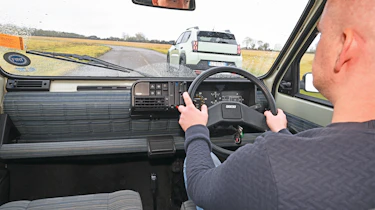
With Mk1 examples incredibly rare in the UK, we’re driving a Mk2 today. It’s in immaculate condition, transporting us right back to the mid-eighties with its pale green paint and its bare steel wheels. Hop inside, and the Mk2 maintains the wonderful simplicity of the original. Stripey fabric trims the dash, while a small pod houses the ventilation controls and switchgear such as the rear window heater and wash/wipe. Modern touchscreen-obsessed car designers, take note. The ventilation is gloriously simple: the side vents are just a flap in the windscreen frame, which the driver can open and shut to let fresh air in.
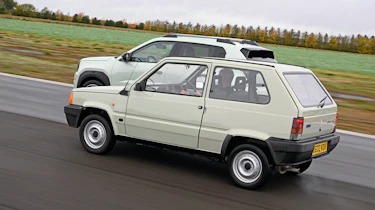
Much of the door skin is bare paint, but the panel is ribbed and has an embossed Fiat logo. Just above that panel, the door release is neatly integrated into the slim door pull/armrest.
The steering wheel and gearknob feel very slender, but on the move are so light to use – even though there’s no power steering to ease the former. That feeling of lightness is carried through to all of the controls, because with so little weight to move around, everything feels fairly effortless on the go. Don’t expect a huge amount of shove from the FIRE engine, but it moves the Panda along nicely, even if that bare- bones cabin makes it fairly audible from inside.
That modest power encourages you to keep up your momentum through turns, and you’re greeted with noticeable body roll – but less than in superminis such as the Mk1 VW Polo and Citroen AX that were available at a similar time. The soft seats are comfortable, too.
Finding examples today is very tricky, at least in the UK. With its huge popularity in Italy, and the country’s more favourable climate, they’re still a regular site in its home nation. But even then, the earliest first-generation examples are becoming rare now. We found just one example currently for sale, in Italy, for around 4,000 Euros (£3,500). The later facelifted Mk2s are easier to find in Britain, although most of those that remain are now lovingly cared for, and therefore are beginning to creep up in price. The UK-based examples we found currently for sale are priced from £4,000 and upwards.
Panda Mk3
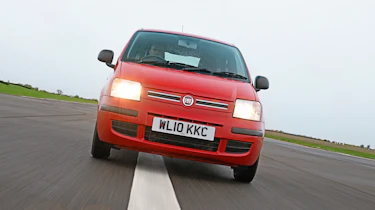
| Model: | Fiat Panda 1.2 Dynamic Mk3 |
| Engine: | 1.2-litre 4cyl |
| Power/torque: | 60bhp/102Nm |
| Transmission: | Five-speed manual, front-wheel drive |
| 0-62mph: | 14.0 secs |
| Price new: | £7,290 (2006) |
| Value today: | from £1,500 |
While UK sales of the Mk2 Panda ended in 1995, production soldiered on until 2003, when the Mk3 arrived. It didn’t take long to see that there had been more than two decades of progress between the two generations.
While the new model maintained some family ties with its predecessor, such as the square lights at the front and its boxy shape, the overall proportions had grown taller, for a near mini-MPV-type shape. With the addition of a pair of doors at the rear, the new Panda instantly became a more practical, usable small car – especially for families.
Creature comforts had drastically grown from one generation to the next, too. There was no fabric-trimmed bulkhead here. Now, Panda owners got the luxury of a full dashboard, and a really smartly designed one both in terms of its style compared with other city cars of its era, but also ergonomics. The main dash panel crams an awful lot of functionality into a space that’s very well laid out; four big, round dials control the air-conditioning, the electric window switches sit just beneath them, and because of the slightly raised seating position, Fiat figured that mounting the gear lever on the floor would be too much of a stretch, so it’s positioned at the base of the dash, instead.
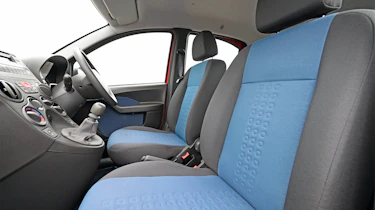
Even the stereo system had an inadvertently forward-thinking position; mounted high on the dash, its controls are easy to reach, and those wanting to add an aftermarket navigation system today will find it perfectly placed yet more neatly integrated than in many modern cars.
As with the previous Panda, buyers were given plenty of choice under the bonnet. For most buyers, it’s the standard 1.2 litre four-cylinder that’s the one to have. The example we have here today is absolutely immaculate, having covered barely 16,000 miles over its 15-year life. It’s everything you want to have in a city car: great visibility, light controls, a tight turning circle, and decent comfort. The engine isn’t overly powerful, but it enjoys to be revved to make the most of it.
But there was a version that thrived on revs even more. Back in 2006, Fiat launched what remains the hottest production example of the Panda yet, the 100HP.
Panda 100HP
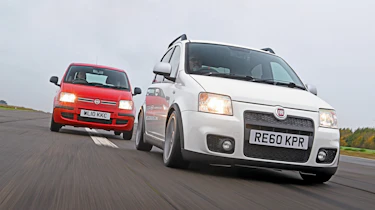
| Model: | Fiat Panda 100hp Mk3 |
| Engine: | 1.4-litre 4cyl |
| Power/torque: | 99bhp/132Nm |
| Transmission: | Six-speed manual, front-wheel drive |
| 0-62mph: | 9.5 secs |
| Price new: | £9,995 (2006) |
| Value today: | from £2,000 |
Under the bonnet sat a 1.4-litre version of the FIRE engine, making 99bhp (or 100 metric horsepower, hence the name). Lower suspension and chunky alloy wheels work together to lend a fantastic stance, and a tough-looking bodykit gave the 100hp a proper Scrappy Doo attitude. The optional Pandamonium pack added Abarth vibes, thanks to a red racing stripe and brake calipers, plus a satin finish for the wheels and door mirrors. When it was launched, it cost from just £9,995 – adjusted for inflation that’s just over 17 grand in today’s money – making it an absolute performance bargain.
It was hard to find something that offered so much fun for the money. Today, as performance cars have grown heavier and larger, the 100hp is as desirable as ever. Agile, tiny and eager, the pointy front axle loves to be thrown into corners with abandon, and responds with minimal body roll and a surprisingly docile feeling on the limit – even in damp conditions, it isn’t prone to dramatic lift-off oversteer.
The engine is a little star, too. It was never about outright speed even when it was new, with 0-60mph taking 9.5 seconds. But that level of performance put it on a par with older hot hatches, such as a Peugeot 205 GTI 1.6 – and we never had any complaints about how fast that was either. Much like the 205, it’s got an engine that just loves to be revved. It makes a cracking four-cylinder noise in a way that so many Italian cars from this era and earlier got so right; there’s a gargle and a throaty roar that means that you’re always going for the red line. It’s so nice, in fact, that we’d love to hear even more of that induction note inside the cabin.
Panda Mk4
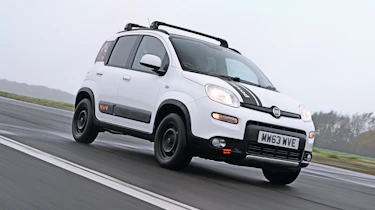
| Model: | Fiat Panda Mk4 4x4 |
| Engine: | 0.9-litre 2cyl turbo |
| Power/torque: | 85bhp/145Nm |
| Transmission: | Five-speed manual, four-wheel drive |
| 0-62mph: | 12.4 secs |
| Price new: | £13,950 (2013) |
| Value today: | from £3,000 |
The next decade saw buyers demand a little more from their small cars. They no longer needed to simply get from A to B, so brands needed to give drivers a more complete experience. More refinement, more safety and a little more tech, too.
By 2011, the Mk4 Panda arrived, and while its chunky proportions were familiar, the styling was more rounded. It saw Fiat coin the phrase for a new shape: the ‘squircle’. The theme of rounding off squares with softer edges runs throughout the design inside and out; the headlights, the window surrounds, even the reversing light.
Inside, the cabin carries over many fundamentals from the Mk3, most notably the arrangement of the four heating/ventilation switches surrounding the dash-mounted gearlever. There’s a noticeable step up in the level of the finish again; the climate controls, instrument dials and the steering wheel’s centre boss adopt the squircle theme. There’s plenty of space inside, too; at 1.5 metres tall, the Mk4 is roughly the same height as its predecessor, and at 3.6 metres long it’s only grown 10cm or so.
This Panda shows another example of the fact that Fiat has never been afraid to innovate, even at this traditionally budget and cautious end of the new-car market. Under the bonnet sits the brand’s TwinAir engine; for the first time since the Mk1 Panda, just two cylinders power the car. Unlike the original twin, there’s the benefit of the boost of a turbo, although a naturally aspirated version was available in other markets. The result was 84bhp and 145Nm, enough for a fairly sprightly 0-62mph time of 11.2 seconds – or 12.4 seconds in 4x4 form.
It’s that version we’re driving here. In an already characterful car, the TwinAir makes the Panda even more charming to drive. The engine wakes into life with a distinctive thrum. Release the quirky handbrake – which is more akin to an airliner’s throttle quadrant than what you’d normally expect to find (a more traditional lever was fitted to some models) – and the revs build in a strangely laid back way.
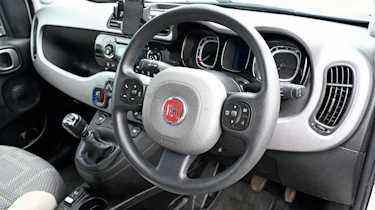
Yes, it is a little on the noisy side, but it never sounds harsh or thrashy; instead, you’re treated to a low-frequency rumble that has a sense of fun. It never feels like it’s revving that hard – even towards the red line it doesn’t sound like it’s straining. But there’s no need to rev it to its limit; instead use the surprisingly generous torque in the mid-range to rumble along at a very pleasing rate.
The Mk4 is a touch more substantial than its predecessor, but it still feels like a fundamentally light and simple car. The steering is fingertip light – more so in the ‘City’ mode, which increases the assistance to make parking manoeuvres a breeze – and while we didn’t have the opportunity to put this example through its paces off road, it’s clear that its big, chunky tyres and the car’s modest weight would no doubt see it show a clean pair of heels to many much pricier off-roaders along a rough track.
Later on, the Mk4 got a mild-hybrid powertrain. A 1.0-litre three-cylinder turbo engine (meaning that this Panda was available with two, three and four-cylinder units) is backed up by a small 12-volt motor through an integrated starter/generator system. The e-motor never fully drives the wheels, but adds a little boost under acceleration to take some strain (and therefore fuel usage) away from the engine.
It recovers a little energy under braking to keep its energy topped up, and saves a little more fuel by cutting out the engine when slowing down; simply knock the car into neutral below 18mph and the petrol unit shuts down. In common with all of the other Pandas, this engine has lots of character –there’s a raspy exhaust note when accelerating hard. The electrical assistance is mild, but the Panda loves to be driven in the typical Italian small-car way: flat out everywhere. Even driven in a flamboyant style, the Fiat still proves to be fairly frugal, too.
Grande Panda Mk5
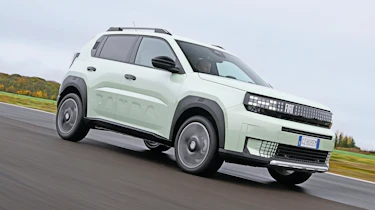
| Model: | Fiat Grande Panda La Prima Hybrid Mk5 |
| Engine: | 1.2-litre 3cyl mild hybrid |
| Power/torque: | 108bhp/205Nm |
| Transmission: | Six-speed auto, front-wheel drive |
| 0-62mph: | 11.2 secs |
| Price new: | £21,995 |
With a name like Grande Panda, it’s no surprise to see the latest car dwarf the original model in terms of size. However, at 3,999mm long, it’s still dinky by modern standards – and 75mm shorter than a Volkswagen Polo.
Much like the two examples that came before it, the Panda takes advantage of platform sharing to help maintain an affordable cost. Explore the wider Stellantis group, and the Grande Panda can find much in common with both the Citroen C3 and C3 Aircross, and the Vauxhall Frontera.
But out of those four cars, it feels like by far the most design effort has gone into the Fiat. Wherever you look, this small car is teeming with neat or sweet design details; the Panda lettering pressed into the doors, and Fiat logo embossed on the boot lid are subtle but stylish decisions that set the Panda apart from other, more conservative hatchbacks, including its Citroen sisters.
The pixel-like headlights and sharply finished cuboid tail-lamps all combine to provide a heavily modernised interpretation of the Giugiaro original. The funky exterior colour palette – Fiat is still sticking to its guns in its refusal to sell grey cars – sets it apart from the modern competition, too.
Step inside, and the Panda’s cabin feels like a breath of fresh air from much of the supermini norm. From the bamboo-effect storage bin to the translucent polycarbonate panel that surrounds the main portion of the dashboard, it looks like genuine time and effort have been invested in the Fiat’s interior in a segment where cars must be built down to a price. Even the embossed door panels have echoes of the original’s design, although here the indentations spell out the car’s name.
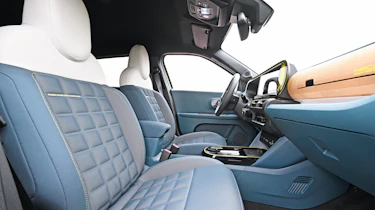
Yes, touch the plastics and they’re not the softest materials you’ll find in a modern car, but the blue finish, which complements the blue seat upholstery, makes the cabin more interesting to look at than so many rivals that are finished in a sea of grey. By extending its roofline slightly upwards, the Grande Panda manages to offer loads of space inside, considering that modest footprint, too.
To drive, it’s no surprise to find that the latest model is the most refined, the most secure and the most solid-feeling of the examples here. But even with all of its modern creature comforts, there’s a sense of fun and character that ties it into all of the previous generations. The model shown here is the Hybrid version; a 1.2-litre three-cylinder turbocharged petrol works alongside a 48-volt electric motor and a six-speed dual-clutch automatic gearbox.
The system allows for smooth low-speed driving, thanks to its ability to pull away from a standstill using the electric motor alone. Once up to speed, performance isn’t as lively as in the Mk3 100hp – even though the new model offers 9bhp more – but it’s still peppy enough for modern traffic, and is even fairly refined.
A fully electric version also sits neatly within the range, offering small-car buyers all the Grande Panda’s style but with a smooth, silent electric motor – and for much the same price as the rangemates with a hybrid powertrain.
While the Panda represents strong value for money in the current market, prices have gone up in real terms. Back in 1980, the Panda was launched in the UK for £2,860; adjusted for inflation, that’s £12,300 in today’s money. Prices for the new hybrid kick off at £18,995 – although inflation-adjusted, that makes it cheaper than a first-generation Volkswagen Golf that was on sale around the same time as the original Panda. But given the extra space, performance, refinement and especially safety kit on the Grande Panda, we think that step up is pretty reasonable.
The most important thing is that the character of all of those old Pandas remains, and there are few more charming superminis around in today’s market – especially at this price.
Fiat Panda special editions and market impact
Panda Italia ’90
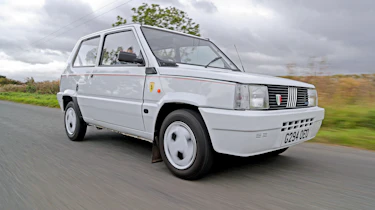
The Panda has become famous for its varied and often quirky special editions, including the Mk3 Alessi, which was tied into the Italian kitchenware brand, and the Rossignol whose roof bars were magnetic so owners could attach a pair of skis from the brand after which it was named.
But we reckon the most memorable of all was the Italia ’90 – a version of the Mk2 Panda designed to mark the Italians hosting the 1990 FIFA World Cup. It was finished almost entirely in white – colour-coded bumpers weren’t really a thing on the rest of the range at the time – with an Italian Tricolore pinstripe. But the football-motif wheel trims were arguably the most distinctive ever fitted to any car, and screamed louder than players around a referee after a poor offside call.
Panda Elettra
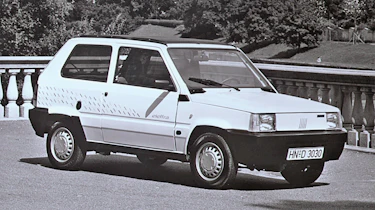
The latest Grande Panda went on sale in the UK with a fully electric powertrain, alongside a hybrid version – but this isn’t the first Panda to be a full EV. Back in 1990, Fiat produced the Panda Elettra - and in doing so, the firm became the first manufacturer to mass produce an electric vehicle.
It ditched the regular car’s back seats in order to accommodate 10 six-volt batteries (two more sat under the bonnet where the combustion engine would usually live). The Elettra had a range of about 62 miles, a total power output of 12.3bhp and a 43mph top speed. It did have regenerative braking to recover energy, though.
SEAT Marbella
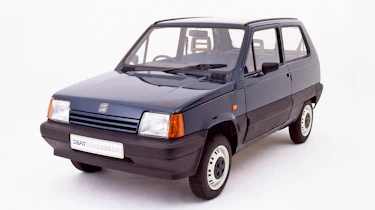
The Panda’s influence goes much beyond the scope of Fiat small cars – it can be credited for kickstarting another manufacturer entirely. SEAT started life by building the Panda under licence firstly in Pamplona, northern Spain, and then later at its Zona Franca plant in Barcelona, which it still uses to this day.
Following on from the first-generation model, which was also called the Panda, the Mk2 took on a little more of SEAT’s own personality. It was rebadged the Marbella and differentiated itself from its Italian twin by a unique front grille that was set at a slightly shallower angle than the Fiat Panda’s, plus different tail-lights and boot lid.
Our final verdict on Fiat’s city car
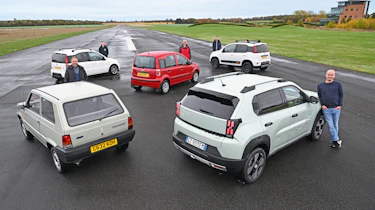
We assembled these Pandas for two purposes: to celebrate the 45th birthday of a city-car icon, and to find out how much character has prevailed throughout its five iterations. And we’re really pleased to say that the new model has definitely kept hold of a big chunk of the personality that made its predecessors so easy to like. Is it the most accomplished small car around? Not necessarily, because there are some models that are sharper to drive, and others that are a touch more efficient. But few alternatives on the new-car market today can make you smile quite so much.
Get the latest and best car news and reviews, first! Follow Auto Express on Google today