Vauxhall Frontera review
The Frontera misses the mark slightly on design and quality, but this budget-friendly Vauxhall still scores well in other areas

Our opinion on the Vauxhall Frontera
On paper, the Frontera looks astonishingly good value for money when you compare it with Vauxhall’s more expensive Vauxhall Mokka. The Frontera is much bigger, doesn’t skimp on equipment too much, looks the part and has the option of hybrid and pure-electric power with very little difference in cost between them. In the real world, it lives up to this promise, although the interior material quality and design do bring the tone down slightly.
The driving experience is also uninspiring and while the standard Frontera Electric’s claimed 188-mile range will put off some potential buyers, the Extended Range model’s 253-mile figure is much more appealing. The Frontera proves you can have a choice of powertrains, decent practicality and an attractive price tag too.
About the Vauxhall Frontera
The Frontera name might not be the most memorable in Vauxhall’s history, but the latest model to wear that badge is an SUV like its nineties forebear – and it sits in the company’s range between the Mokka and Grandland in size.
Vauxhall used parent company Stellantis’s Smart Car platform (which has no connection with the Smart brand) for the Frontera, which means it’s front-wheel drive only, in contrast to the four-wheel drive Frontera of old. Thanks to the flexibility of the platform, there are petrol-hybrid and pure-electric options, so in theory there should be a Frontera to suit most families. There’s also a seven-seat variant - something the Mokka and Grandland do not provide.
Vauxhall Frontera prices and latest deals
Perhaps surprisingly, the Frontera doesn’t split the Mokka and Grandland when it comes to price. The all-electric line-up starts at a Dacia Duster-rivalling level of around £22,500 after the £1,500 Electric Car Grant (ECG) is taken into account.. The above price is for the most basic Design trim level, while the higher-spec GS starts from around £2,500 more. At the very top sits the Frontera Ultimate, which starts from around £25,700. The Frontera Hybrid (without that ECG), starts from just over £24,800.
Used - available now

2025 Vauxhall
Frontera
3,260 milesAutomaticPetrol1.2L
Cash £18,999The full range comes with five seats as standard, but something that will help the Frontera stand out – not just from the rest of Vauxhall’s SUV line-up, but also against similarly priced C-segment SUVs – is the option of seven seats. This option is only available on the hybrid model in GS or Ultimate, and costs £550 extra.
You can save an average of £1.800 when you build your perfect Vauxhall Frontera through the Auto Express Buy a Car service. We also have plenty of tempting Frontera leasing deals to choose from.
Performance & driving experience
Pros |
|
Cons |
|
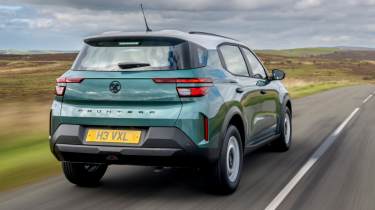
The Frontera’s platform is also used by the Citroen e-C3 – a previous Auto Express Car of the Year – so we had high hopes for the latest edition of the Frontera, and indeed its sibling model from Citroen, the C3 Aircross.
The Frontera Hybrid comes with a 1.2-litre three-cylinder turbocharged petrol engine, which is supplemented by a 28bhp electric motor that is built into the six-speed dual-clutch automatic transmission. Unlike the C3 Aircross, the Frontera doesn’t offer the option of a manual. Above the 100bhp Hybrid, there's a more powerful 136bhp version, but every EV comes with an 111bhp front-mounted electric motor.
We’ve driven both the electric and hybrid versions of the Frontera and the similarities between the two cars were immediately obvious, which is impressive given the different powertrains. There’s slightly more engagement and chassis control in the Vauxhall than in the Citroen C3 Aircross (which has Citroen’s Advanced Comfort Suspension with Progressive Hydraulic Cushions), but as you’d expect, the Frontera isn’t a car you’d take out to drive for the fun of it. It also doesn’t pretend to be a proper off-roader like the old all-wheel-drive model.
Regardless of which of the Vauxhall’s two powertrains you pick, you’ll get good ride quality; a decent amount of suspension travel means that speed bumps and potholes are dispatched well. However, at higher speeds you’ll notice the Frontera doesn’t quite settle – although it’s far from uncomfortable.
Noise levels are a little high, though, and you get the sense Vauxhall could have fitted a lot more sound deadening. But that would have made the car heavier when weight is a crucial concern in Vauxhall’s approach to the Frontera – and the Smart Car platform in general. The Hybrid weighs 1,344kg in five-seat form and the Hybrid seven-seater weighs just 32kg more. The Electric model sits at 1,514kg, but these are all incredibly impressive numbers from a car that is much larger than all of its nearest rivals.
| Model | Power | 0-62mph | Top speed |
| Vauxhall Frontera 1.2 Hybrid 110 Design | 110bhp | 11 seconds | 112mph |
| Vauxhall Frontera 1.2 Hybrid 145 Design | 145bhp | 9 seconds | 118mph |
| Vauxhall Frontera Electric Design Extended Range | 113bhp | 13 seconds | 88mph |
Performance, 0-60mph acceleration and top speed
The Frontera Hybrid’s turbocharged 1.2-litre three-cylinder engine and electric motor combine for either 99bhp and 205Nm of torque, or 134bhp and 230Nm. The lesser-powered version completes the 0-62mph sprint in 11 seconds before topping out at 112mph, while the more powerful version takes nine seconds and can reach 118mph.
With 111bhp and just 125Nm of torque, the Frontera Electric takes 12.8 seconds to reach 62mph before hitting its 87mph top speed. Weirdly, the Electric’s 111bhp motor doesn’t have the immediacy of an EV from standstill – you have to be up to speed for it to give you some punch – but it doesn’t feel overly slow at any point. With its larger, heavier battery, the 54kWh Extended Range model takes 13 seconds to reach 62mph.
Town driving, visibility and parking
Just like the C3 Aircross, the Frontera comes with a lofty driving position that enables great visibility. The boxy shape of the Vauxhall SUV also means it’s easy to place on the road, even in tight city streets. The 11.05-metre turning circle is handy too, although the Citroen’s is tighter still at 10.9 metres.
Country road driving and handling
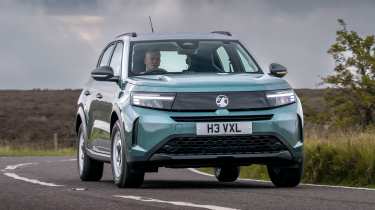
The Frontera will never be something to relish throwing at corners, but crucially it doesn’t go to pieces at the sight of a bend. In fact, the body roll is well contained and there’s decent grip from the front end. We found the Electric version more surefooted than the Hybrid in corners, possibly due to the positioning of the heavy battery low in the body. Although the steering is light, it requires a little more input than you might expect, while the brakes are a little on the spongy side and the six-speed automatic is sluggish to kick down.
Motorway driving and long-distance comfort
During our drive of the Frontera, we noticed that although it’s more than capable at motorway speeds, it can wander around, thanks to the light steering and relatively high centre of gravity. Compared with, say, a Vauxhall Astra Sports Tourer estate with its newer, more powerful Hybrid 145 engine, the Frontera Hybrid 136 can also feel a little slow to respond at high speeds - you’ll need to give yourself an extra second or two to judge overtaking manoeuvres for instance.
“Unsurprisingly, the Frontera drives much like its C3 Aircross sibling. In common with the Citroen, it’s not as refined as other Stellantis products that use the CMP architecture, but the Smart Car platform does give it some nimbleness despite the size.” - Alastair Crooks, senior news reporter
MPG & running costs
Pros |
|
Cons |
|
We’ve spoken about how the Frontera’s inherent lightness from its Smart Car platform affects the way it drives - but it also has a positive impact on the SUV’s efficiency too.
Despite it being a family-friendly, blocky-looking SUV, the Frontera returned some useful WLTP efficiency figures.
Vauxhall claims that both the Hybrid 110 and 145 will return a WLTP combined economy figure of 53.3mpg. This isn’t quite up to the Dacia Duster Hybrid 140, which will do 55.3mpg, nor the MG ZS Hybrid, which will return 55.4mpg. During our test we managed 39.7mpg, although this included a lot of keen driving; we expect high 40s will be easily achievable. The Vauxhall also emits a little bit more CO2 than its Dacia and MG counterparts, at 118 to 119g/km.
| Model | MPG | CO2 | Insurance group |
| Vauxhall Frontera 1.2 Hybrid 110 Design | 53.3mpg | 118g/km | 16 |
| Vauxhall Frontera 1.2 Hybrid 145 Design | 53.3mpg | 118g/km | 20 |
| Vauxhall Frontera 1.2 Hybrid 145 GS 5dr (7 Seat) | 53.3mpg | 119g/km | 20 |
Electric range, battery life and charge time
The Frontera Electric’s claimed 188-mile range might be rather difficult to match on a routine basis. There’s no heat pump for its 44kWh battery, so you’re at the mercy of the weather conditions. We saw a range figure of around 130 miles, although this was with plenty of spirited driving.
The Frontera Extended Range later in 2025, and this model comes with a larger 54kWh battery and a much more appealing 253-mile range, which is five miles more than the Citroen e-C3 Aircross with the same battery.
Given the Frontera Electric’s relatively small 44kWh battery, it’ll be able to top up from 20 to 80 per cent of its capacity in 26 minutes, despite having a fairly average recharge speed of 100kW. The same maximum charge rate will see a 20 to 80 per cent charge in the Extended Range model take 28 minutes.
An 11kW on-board charger is also fitted as standard - which would cost you £360 in the Citroen e-C3 Aircross - but most will likely charge at home, utilising a typical 7.4kW wallbox charger. It’ll take 7 hours to fully recharge the 44kWh version, while the 54kWh Extended Range Frontera will take 8.5 hours.
Vauxhall has rolled out its ‘Electric All In’ offer across its pure-electric models recently and the Frontera also benefits from this. The deal gives the customer £500 towards a home wallbox (an Ohme Pro unit), online credit with Octopus Electroverse or credit for a Tesco charger.
| Model | Battery size | Range | Insurance group |
| Vauxhall Frontera Electric Design | 44kWh | 186 miles | 15 |
| Vauxhall Frontera Electric Design Extended Range | 54kWh | 249 miles | 14 |
Insurance groups
The Frontera line-up sits between groups 14 and 20 in either hybrid or electric form, so premiums should be pretty reasonable. In comparison, the majority of the Dacia Duster line-up resides in group 24, while the MG ZS finds itself between groups 16 to 22.
Tax
Company car drivers paying Benefit-in-Kind (BiK) tax will find the Vauxhall Frontera Electric to be their best choice. The EV incurs three per cent BiK while both hybrids sit in the 29 per cent bracket. EVs no longer qualify for free VED road tax, though, and they will be subject to the planned eVED pay-per-mile tax that’s set to arrive in April 2028.
Depreciation
Unfortunately, our expert data suggests that the Frontera isn’t expected to hold its value particularly well, with the all-electric model retaining 34 to 37 per cent after three years and 36,000 miles. The hybrid fares slightly better with 42 to 44 per cent after the same period. The Vauxhall doesn’t come close to the Dacia Duster’s performance, though, as this car clings on to 54 to 61 per cent.
Interior, design & technology
Pros |
|
Cons |
|
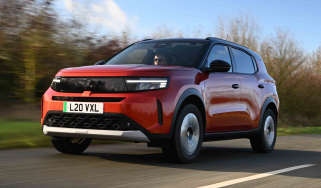
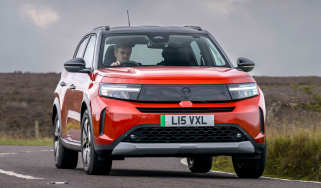
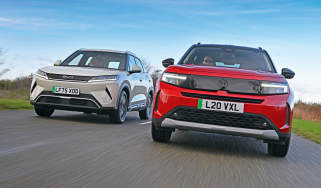
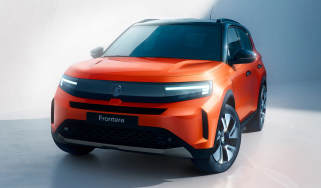
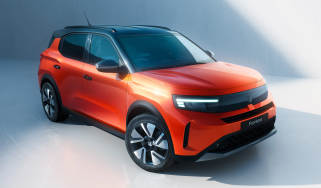
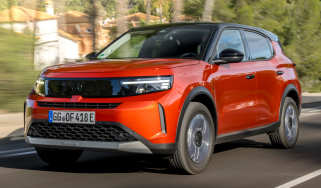
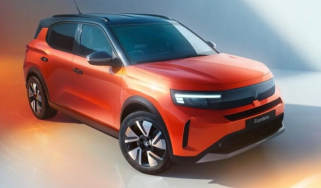
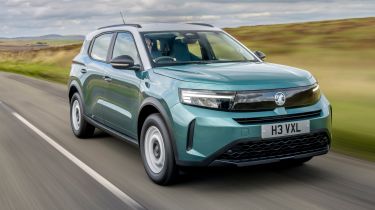
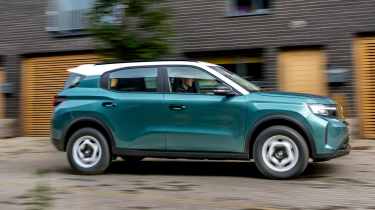
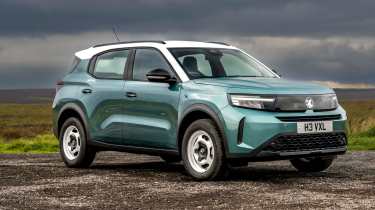
The Frontera might be an SUV like its namesake from the nineties, but that’s really where the similarities end. Up front the new Frontera has the same ‘Vizor’ headlights and grille arrangement seen across the brand’s entire line-up, giving a style that’s distinct not only from its competitors, but also from its Citroen e-C3 Aircross sister car. The Frontera’s blocky side profile and upright stance give it an almost MPV-like shape. Specifying the £400 white wheels and white roof has a dramatic effect on the model’s style, though, and from some angles it looks like it’s mimicking the Land Rover Defender, especially with Khaki Green metallic paint.
There’s quite a range of paint options with the Frontera. They start with a no-cost basic white, followed by metallic blue, black and silver at around £600, with the Khaki Green and Canyon Orange an extra £100.
Despite being a value-driven proposition, the Frontera still has a relatively decent level of kit, with entry-level cars including twin 10-inch displays with wireless Apple CarPlay and Android Auto, wireless smartphone charging, rain-sensing windscreen wipers and cruise control.
Interior and dashboard design
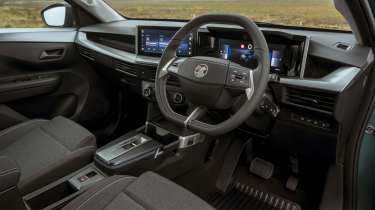
We often test cars that feel like they’ve been given technology and equipment for the sake of it, so the no-frills approach of the Vauxhall Frontera is deeply refreshing. Being a value-driven family car, the Frontera doesn’t scream luxury inside – in fact it’s a rather basic affair. However, it does look much more modern than its Vauxhall Crossland predecessor, thanks to those twin 10-inch displays and a fairly minimalist layout. There are physical controls for the climate control, heated seats and heated steering wheel. But one area where the Crossland is better are the radio controls – annoyingly, they are done either through the central touchscreen or via the steering wheel on the Frontera.
The infotainment system is more basic than the version you’d find in the Vauxhall Corsa. It’s incredibly simple, making it easy to navigate, but we suspect the vast majority of drivers will sync their smartphones to the car and make use of the standard-fit Apple CarPlay or Android Auto connectivity.
Materials and build quality
We poked around both the base-level Design and the higher-spec GS Frontera and at first we didn’t notice a huge amount of difference between the two. There’s some fabric material on the doors in the GS, which the Design trades for scratchy black plastic, but both cars get the same interior layout and Vauxhall’s ‘Intelli-seats’ in the front. The elastic band that wraps around the centre console is quite interesting and means you can fit bottles of all sizes in there. Overall, we found the Citroen C3 Aircross provided a more welcoming cabin and a more interesting dashboard layout.
Infotainment, sat-nav and stereo
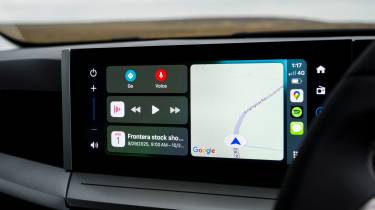
The twin 10-inch displays are nicely laid-out on the dash with a slight angle towards the driver. The central touchscreen is within easy reach and while the system took a little while to boot up for us once, it’s responsive to inputs and has a clear display. The menu interface is extremely easy to navigate, although that’s more to do with the fact it’s an incredibly basic set-up. The driver’s display is configurable, but only to a small extent, with efficiency figures and trip information available to view.
Four USB-C ports come as standard on the Frontera, along with a wireless smartphone charger – the latter is positioned in a way that doesn’t let your phone slide around or fall out either (take note, MG). Something we’ve come to find on certain Vauxhalls, even the Corsa supermini, is that the firm’s standard sound system is really quite good.
“The Vauxhall Frontera’s cabin is a neat and tidy affair, but one that some might find a little dull. That certainly applies in comparison to the Citroen C3 Aircross, which gets some quirky little French-themed touches.” - Alastair Crooks, senior news reporter.
Boot space & practicality
Pros |
|
Cons |
|
The Frontera is a C-segment SUV, priced at around B-segment SUV levels, so practicality is a strong point for the Vauxhall against its rivals. It’s offered in five-seat form as standard, with the seven-seat version available on the GS Hybrid model for around £550.
Dimensions and size
The Frontera provides a significantly different body shape to the old one, which came in three or five-door bodystyles. At 4,385mm long, the Vauxhall Frontera is 10mm shorter than its Citroen C3 Aircross cousin, and both cars are relatively compact considering their ability to seat seven. At 1,795mm wide, it’s also 65mm narrower than an Astra Sports Tourer Estate.
Dimensions comparison | |||
| Model | Vauxhall Frontera | Dacia Duster | Citroen e-C3 Aircross |
| Length | 4,385mm | 4,343mm | 4,395mm |
| Width | 1,795mm | 1,813mm | 1,850mm |
| Height | 1,627mm | 1,621mm | 1,660mm |
| Wheelbase | 2,670mm | 2,660mm | 2.670mm |
| Boot space | 370 to 460 litres | 472 litres | 460 litres |
Seats & passenger space
Up front, the Vauxhall feels like a traditional SUV, with a slightly more upright driving position than you get in the Mokka. Despite it being a relatively long car for its class, its narrowness is reflected inside by the small gap between the two front occupants. Good visibility means the Frontera doesn’t feel cramped at any point, however.
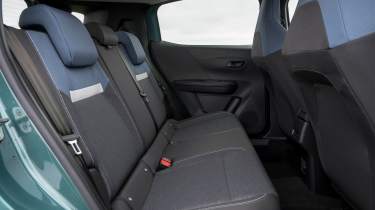
There’s a lot of headroom and legroom up front and in the rear, although you’ll find sitting three adults in the back might be slightly tight. The Frontera also features two ISOFIX fixings on the outer rear seats. There aren’t a lot of storage cubbies, but the door bins are quite wide.
The floor is also different between the Frontera Electric and Hybrid. The battery positioning in the Electric means the rear floor is slightly raised compared with the Hybrid. While that means the central ridge is mostly flattened out, your knees end up a little higher up. The back of the Frontera is still a perfectly pleasant environment, with a lot of natural light, squishy, comfortable seats and a lot of space.
As for the third row of seats we wouldn’t recommend adults using these for any long drives - with cramped leg and headroom they’re merely designed for ferrying children around on short journeys.
Boot space
The boot is big and it’s the same size for both the Electric and five-seat Hybrid models, too. At 460 litres, it’s enough to cater to most families, but it’s not quite as much as you get in a Dacia Duster Hybrid (496 litres). The rear row splits 60:40 and the moveable boot floor means you can set it level with the boot lip, too. Fold the rear seats and the load bay expands to a decent 1,600 litres.
In the seven-seat model you get a 1,400-litre maximum boot space with all seats removed - although this drops to 370 litres with just the third row down. With the third row in place, there’s almost no space in the boot for bags - indeed, Vauxhall doesn’t quote a boot capacity for this arrangement.
Towing
Vauxhall doesn’t quote a towing capacity for the all-electric Frontera, but both hybrids have a maximum 1,250kg capacity - the same as the C3 Aircross Hybrid.
“Rear passengers will be pleased with the amount of space on offer, as found legroom and headroom are more than adequate. The only complaint is a regular EV quibble of the high floor, necessary to house the batteries, meaning you sit in a slightly odd position where your legs aren’t resting on the seat cushion.” - Paul Barker, editor.
Reliability & safety
Pros |
|
Cons |
|
Neither the Citroen e-C3 Aircross nor the Vauxhall Frontera has been tested by Euro NCAP yet. Vauxhall has given the Frontera a sensible amount of safety equipment as standard, however, so it should score fairly well in the ‘safety assist’ category.
Safety kit on the entry-level Design includes:
- Rear parking sensors
- Cruise control
- Lane-keep assist
- Active safety braking
- Collision warning
- Speed-sign recognition
- Driver-attention alert
- Speed-limit indicator
It’s too soon to give an indication on the Frontera’s reliability, considering its new underpinnings. However, the Hybrid’s powertrain has been used in a bunch of other Stellantis products and we’ve heard no horror stories yet.
Given the Frontera’s price point, you’d expect the build quality to be a little questionable, and while the material quality isn’t the best, it mostly feels well screwed together. We couldn’t hear any rattles or feel any nasty vibrations during our test drives.
There’s a three-year or 60,000-mile warranty on the Frontera Hybrid with unlimited miles for the first 12 months. Matching the e-C3 Aircross, the Frontera Electric comes with an eight-year or 100,000-mile warranty on its battery, guaranteeing a minimum level of 70 per cent capacity during its life.
The Vauxhall Frontera placed 5th overall in the 2026 Driver Power survey with a score of 86.86%, a strong debut result for the model. Interior ranked 3rd and Practicality & Bootspace 5th, while Ride & Handling came in 9th and Economy & Running Costs 4th - suggesting owners are very happy with the everyday ownership experience. The weakest area was Quality & Reliability at 42nd, which is worth noting for prospective buyers given the model's limited track record. Vauxhall ranked 6th out of 30 brands in the manufacturer standings with a strong score of 85.94%.
| Vauxhall Frontera | Position | Score |
| Overall | 5 | 86.86% |
| Powertrain | 11 | 89.00% |
| Exterior | 33 | 87.02% |
| Interior | 3 | 87.91% |
| Practicality & Bootspace | 5 | 87.88% |
| Ride & Handling | 9 | 90.01% |
| Safety Features | 10 | 85.19% |
| Economy & Running Costs | 4 | 83.96% |
| Quality & Reliability | 42 | 84.21% |
| Infotainment | 11 | 85.66% |
| Value | 20 | 84.32% |
What owners said
- Lovely to drive, cheap to run. My only dislike is the terrible phone app
If you own a Vauxhall Frontera or any other car, let us know what you think of it: Take the Driver Power survey today
Buying and owning
- Best buy: Vauxhall Frontera Extended Range Design
The long-range version of the Citroen e-C3 Aircross is a favoured choice of the French car and it’s the same story with the Vauxhall. Decent range, lots of cabin space and a low price of around £26,000 make it a solid option for family car buyers needing a cheap, practical EV. It’s probably worth recouping the money spent on the larger-battery model by sticking with the still well-equipped Design trim, too.
Vauxhall Frontera alternatives
With price parity between the Electric and Hybrid models, Vauxhall has been aggressive with the Frontera’s pricing. The Hybrid has rivals in the shape of the Dacia Duster and, when the seven-seater arrives, the Dacia Jogger, too. The pure-electric version of the Frontera does have its Citroen e-C3 Aircross sister model to contend with, but not much else besides. While the Frontera definitely feels like a less premium offering than its Mokka cousin, those prioritising space and value will find it virtually impossible to look past Vauxhall’s newest model.
Deals on the Vauxhall Frontera and alternatives
Frequently Asked Questions
Despite being cheaper, the Frontera is over 234mm longer than the Mokka, and it has a much bigger boot - 460 litres compared to the Mokka's 350 litres. The Frontera can also be had with seven seats.