New Ford Kuga will arrive in 2029 with a little help from China
The new Kuga will feature rally-bred looks and a practical cabin, and it'll powered by electric and hybrid tech from partner Geely

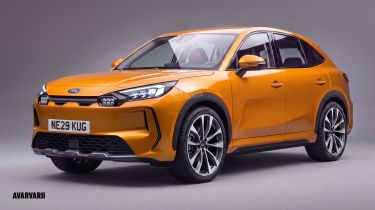
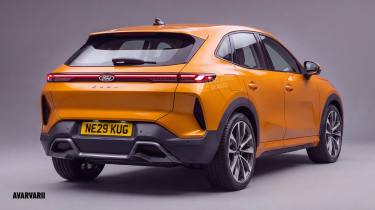
Ford will unleash a flagship family crossover – effectively the new Ford Kuga – in 2029, with an exciting design shaped by the firm’s rally car heritage and diverse powertrains to satisfy a broad range of customers.
The new crossover will be the culmination of a wholesale reinvention of the Blue Oval’s European range, in partnership with Renault for small electric cars and Chinese car maker Geely for the Kuga replacement.
The Chinese and American companies have forged a new joint-venture at Ford’s 50-year-old manufacturing hub in Valencia, Spain. Beginning operations in 2027, the JV will co-develop, jointly source and manufacture three vehicles on a shared vehicle architecture. The first of two Geely electric SUVs is set to roll off the line by the end of 2028, with Ford’s all-new Kuga following in 2029.
Future Ford cars will be defined by three strands of distinct DNA. The Ford Mustang muscle car or steroidal Raptor pick-up are ‘thrill’ cars, while ‘adventure’ shapes another Ford coming out of Valencia, a European-sized and homologated version of the rugged Bronco SUV, due in 2028.
Its classical, blocky 4x4 design intentionally creates space for the next-generation Kuga to build on its more rounded, crossover positioning. “We’re going on a product offensive with a rally-bred, thrilling, unmistakably Ford passenger vehicle portfolio,” said Jim Baumbick, president of Ford of Europe. The Kuga will be the king of that hill.
Expect a dramatic crossover SUV, with exaggerated wheelarches clad in plastic body protection and aggressive body vents, hinting at rally-bred capability. The headlamps are split, with smaller central LEDs reminiscent of the Alpine A110’s auxiliary spotlights for illuminating dimly lit forest tracks. The more Ford turns up the emotional dial, the more distinctive it will be from Geely’s typically functional designs.
Ford’s European design team has experience of taking a third-party architecture – Volkswagen’s MEB platform – and distinctively reskinning it to create the Explorer EV. With its blocky, almost Tonka truck vibes, Murat Güler and Jordan Demkiw’s design sits closer to the Bronco’s pure adventure pillar than the new Kuga will.
And the Explorer’s design freedom – a shorter rear overhang and more upright windscreen pillar, compared with the VW ID.4 donor car’s – will apply to Ford’s new crossover too. “Make no mistake, the Ford product will have a completely unique [body]. This is not a reskin,” Baumbick told Auto Express. “We don’t do boring cars. This is a uniquely engineered, truly unmistakably Ford product that will be differentiated from Geely’s and their target customers.”
Despite a more rakish look than the Bronco, Ford knows the Kuga must deliver on passenger space and cargo-carrying capability. It will sit in the heart of Europe’s most popular market, ‘C-segment’ mid-size SUVs, where rivals typically measure around 4.5m-long and include cars such as the Volkswagen Tiguan, Kia Sportage and slightly longer Toyota RAV4.
The new Kuga is set to tap into the latest update of Geely Holding’s Global Intelligent New Energy Architecture (GEA), which underpins the Geely brand’s launch vehicles for Europe, the Geely EX5 electric SUV and Geely Starray E-Mi plug-in hybrid electric vehicle. Both are front-wheel drive and have a 400-volt electrical system, with DC charging capability even for the plug-in hybrid. Motors can also be rear-mounted or paired for all-wheel drive – and it’s this flexibility that has caught Ford’s eye.
“[Valencia is] going to be launching vehicles that are multi-energy,” explained Baumbick. “We’ll start with EV first, but there are extended-range electric vehicles (EREVs) and plug-in hybrids. We think that a whole portfolio of solutions are absolutely critical to the goal of achieving net zero over time.”

Ford has had its fingers burnt by the Explorer and Capri launching strictly as EVs, with more than 70 per cent of the market still buying combustion-based drivetrains. The revamped Cologne factory is not running at full capacity as a result; the new Valencia set-up will give the Blue Oval flexibility to adjust powertrains to consumer demand.
“If you think about the adoption curve of new technology, even if the first 50 per cent is incentivised to quickly move to EVs, it’s the second 50 per cent that’s the Achilles’ heel,” said the European boss. “We need everybody to move towards that electric future, and for some customers it may take two steps: from a current internal combustion engine into a partial electric, next-generation hybrid or extended range EV, then they will see the benefits and move to EVs in the second step.”
The Geely Starray EM-i’s plug-in hybrid (PHEV) is supplied by Horse Powertrain, the joint-venture drivetrain supplier formed by Ford’s two newest partners, Geely and Renault. This combines a naturally aspirated 1.5-litre four-cylinder petrol engine with two electric motors, one on the crankshaft which acts as a starter/generator and adds torque to the driveline, the other at the end of the transmission to drive the wheels. Plugging in the batteries provides a decent electric range on start-up: around 86-miles for the bigger, 29.8kWh variant.
On the go, the Starray operates much like a range-extender hybrid, with the efficient petrol engine mainly charging the battery so the driving experience feels like an EV’s. But there’s one big difference: under heavy load the engine can help spin the wheels. Total system output is 258bhp, good for a 0-62mph run in eight seconds.

That’s hardly going to win any rallies, though the Starray’s sister EV, the EX5, is slightly quicker. While Ford’s engineers will overhaul the ride and handling and tune the PHEV’s drive modes to enhance its character, deviating from the fundamental hardware defeats the object of entering into the partnership: “to unlock ruthless speed and efficiency,” vowed Baumbick.
Pooling component sourcing and tapping into Geely’s battery supply chain will help Ford deliver new cars at a lower price for consumers. “The reason we're co-developing is to leverage scale,” explained Baumbick. “The environment in Europe has changed forever. The battle we’re in is at a new level of cost. What we’re trying to do is ensure that we can actually demonstrate the lowest possible cost while building products specifically in Europe for European customers.”
Production of the current Kuga, which hit the market in 2019, is set to continue, bridging the gap to the new models in 2028-29. And it’s highly likely the nameplate will continue on the new family crossover: Ford is sensitive to the power of bringing back beloved nameplates – think of how the Ford Puma coupe’s name was revived for the UK’s best-selling small SUV in 2019 – and the Kuga name has rights clearance and a strong following.
Can't wait? Our dealers have plenty of current Kuga models available right now! Search for the latest deals…