Used Kia Sorento (Mk3, 2014-2020) review and buyers' guide
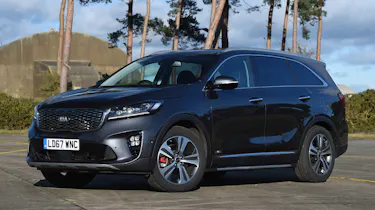
The Mk3 Kia Sorento is a seven-seat SUV that’s a great all-rounder as spacious, dependable family transport

Verdict
The Mk3 Kia Sorento is large and spacious, and is one of the roomiest seven-seater SUVs on the market. Every model has four-wheel drive, so it’s also capable off-road, great for towing and generally stands up well to utilitarian tasks.
Despite the car’s rugged abilities, the interior is classy, impressively quiet and refined. It also provides plenty of room and there’s no shortage of equipment as standard, even on the entry level models.
The Sorento isn’t as good to drive as more expensive SUVs of its era, but it’s comfortable and running costs should be manageable.
Which one should I buy?
- Best Kia Sorento for families: 2015 2.2 CRDI KX-3
- Best Kia Sorento for low costs: 2015 2.2 CRDI manual KX-1
- Best Kia Sorento for towing: 2019 2.2 CRDI auto GT-Line
The third-generation Sorento went on sale in March 2015. Priced between £28,795 and £40,995, all Sorentos had a 2.2-litre diesel engine and there was a choice of four trim levels, all of which came with four-wheel drive and seven seats, plus a choice of six-speed manual or automatic gearboxes.
A facelifted Sorento went on sale in September 2017 with the same 197bhp engine as before, but an eight-speed auto was added, while GT-Line and high-spec GT-Line S trims replaced the KX-4.
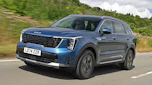
The Mk3 Sorento was replaced by the Mk4 car in 2020. This model came as another significant step forward from its predecessor in terms of technology and design, while also offering petrol hybrid and plug-in hybrid engines alongside an updated version of the 2.2-litre diesel. Prices increased to reflect the move upmarket.
Used - available now

2022 KIA
Sorento
20,267 milesAutomaticDiesel2.2L
Cash £30,665
2023 KIA
Sorento
15,273 milesAutomaticDiesel2.2L
Cash £35,599
2025 KIA
Sorento
34,729 milesAutomaticDiesel2.2L
Cash £33,180
2019 KIA
Sorento
31,353 milesAutomaticDiesel2.2L
Cash £19,000The only decisions to make when buying a Kia Sorento are which transmission and trim level to choose because there’s only one engine. The automatic gearbox suits the Sorento, but the manual is also decent. In terms of trim levels, no Sorento is poorly equipped so you aren’t going to feel short-changed with an entry level version, although the standard kit list was very generous further up the range.
As far as trims are concerned, even KX-1 trim has a DAB radio, Bluetooth, air-con, rear parking sensors, privacy glass and cruise control. KX-2 adds leather trim, heated second-row seats and steering wheel, dual-zone climate control, sat-nav, automatic lights and wipers plus heated door mirrors.
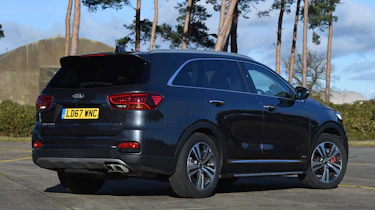
The KX-3 comes with xenon headlights, a panoramic sunroof, electric driver’s seat adjustment, an upgraded stereo and an electric tailgate. The KX-4 also has a self-parking system, bird’s-eye-view camera, heated and ventilated front seats, plus power adjustment for the front passenger seat.
The GT-Line and GT-Line S trim levels replaced the KX-4 in 2017, when the Sorento was facelifted. A raft of new driver-assistance systems, such as lane-keep assist, were introduced at this point, while auto-dipping, high-beam assist LED headlights were fitted as standard to the GT-Line S. The Mk4 Sorento arrived in 2020 to replace this car.
What are the alternatives?
Buyers considering a third-generation Kia Sorento will be looking at other family-sized SUVs of a similar age. The Hyundai Santa Fe is closely related to the Kia Sorento but was a bit cheaper when new, not quite so well equipped and came with a shorter warranty (five years versus the Kia’s seven). The interior design is fussier than the Kia’s, but it’s a great alternative.
So too is the Land Rover Discovery Sport, which feels very premium, but it’s more costly than the Kia, and some models are fitted with just five seats instead of seven. You also can’t take seven seats for granted with the Nissan X-Trail, but it has a well designed and spacious interior, plus it’s reasonable value.
The VW Group trio of the Volkswagen Tiguan Allspace, Skoda Kodiaq and SEAT Tarraco are great all-rounders, while the Peugeot 5008 is another impressive seven-seater that’s decent value.
If you’re willing to look beyond the SUV sector, seven-seat MPVs such as the Citroen Grand C4 Picasso (renamed as the Grand C4 Spacetourer in 2018), SEAT Alhambra or Ford S-MAX and Galaxy are worth looking at. They tend to offer better interior versatility and space, particularly in that third row, but lack the SUV style that many buyers find so attractive.
Kia Sorento vs VW Tiguan Allspace vs Skoda Kodiaq
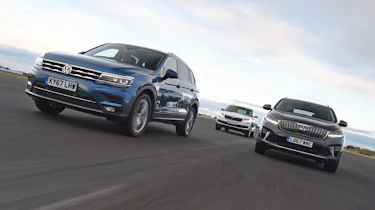
The Sorento finished second in our test of these three popular family SUVs in March 2018. The Kia beat the Tiguan by virtue of its superior interior space and high equipment levels. It wasn’t as good to drive as either rival but comfort and utility levels were high. The Kodiaq came out on top thanks to its low running costs, good performance and solid showings elsewhere. Read the full test...
How much will a used Kia Sorento cost?
The Kia Sorento was always considered a good value option as a new car and very little has changed on the used car market. Kia models still don’t retain their value quite as well as cars from more prestigious brands, although things are improving on that score, while running costs should be manageable thanks to that proven, economical diesel engine.
Prices
Large SUVs aren’t known for retaining their value well and neither are models from budget brands, so you wouldn’t expect market-leading resale values from the Mk3 Kia Sorento – and that plays into the hands of used buyers.
Things are looking up for Kia, however: the brand has put a lot of work into improving the proportionate residual values of its cars and more recent models have enjoyed very strong used prices helped by what is an outstanding warranty package. The classy interior and all-round updates mean the Mk3 Sorento is more likely to fetch stronger prices on the second-hand market than previous versions.
You can value a specific model using our free car valuation tool or check for great used deals with our Find a Car service.
Fuel economy and emissions
The Sorento’s fuel economy and CO2 emissions are decent for such a large car, and all models come with Kia’s fuel-saving ISG stop/start system as standard. Kia claims entry-level manual cars on 17-inch wheels are capable of 41.5mpg and 177g/km of CO2 under the WLTP test regime, while auto ’box-equipped cars return a less respectable 39mpg and 191g/km emissions.
These economy test results are poorer than those the earlier cars received under the less realistic NEDC test conditions, but that doesn't mean the Sorento will be any less economical in the real world.
Running costs
All Sorentos need a service every 12 months or 20,000 miles, alternating between minor and major. Brake fluid needs to be replaced every two years, regardless of mileage.
Coolant should be renewed every 10 years or 120,000 miles, while the engine is chain-driven, so there’s no cambelt to replace. All Sorentos came with a seven-year/100,000-mile warranty, which is transferable between owners.
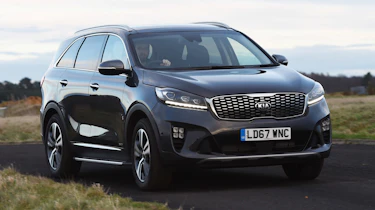
The Sorento is about midway up the table for insurance groups, and the beauty of having only one engine with one power output is that it doesn’t vary much. The entry-level KX-1 model sits in insurance group 24, and the KX-2 and KX-3 models rise consecutively through groups 25 and 26. The top-spec GT_line and GT-Line S are in groups 26 and 28 because of a higher price and long list of standard equipment.
Annual premiums are likely to be cheaper for the Sorento’s Nissan X-Trail rival, because it sits in groups 19 and 20.
What do owners think?
The fact that the Sorento Mk3 came top of the Driver Power new car survey in 2020 is impressive when you consider that its successor had already been unveiled. The victory came on the heels of third and fourth place in the 2019 Driver Power new and used surveys respectively. So-so gearboxes and fuel economy are the biggest bugbears with owners, but they seem to love everything else about this car.
Reliability
Kia finished second in the Driver Power 2020 manufacturer’s survey, with only 13.3% of owners reporting faults of any kind. The Sorento itself has also received good scores for reliability in Driver Power.
How practical is it?
This is a large seven-seat SUV so practicality should be an integral part of its make-up, and the Sorento certainly delivers. Kia kept things relatively simple with this Sorento’s design so it’s not obviously flashy or high tech but there’s plenty of size and space to cater for a large family.
Dimensions, cabin and boot space
The Mk3 Sorento is considerably bigger than the model it replaced in 2014: at 4,780mm long and 1,890mm wide, it’s 95mm longer and 5mm wider, plus it has an 80mm longer wheelbase. However, it’s 15mm lower than the Mk2 model, at 1,685mm tall. This Sorento is also longer than its Nissan X-Trail and Hyundai Santa Fe rivals.
There’s no shortage of space inside the Sorento, and as the seats are mounted lower than in the previous model, there’s more headroom than before despite the reduction in height, as well as more legroom. Taller passengers sitting in the back will have plenty of space to stretch out, while unlike in many rivals, the optional panoramic glass roof doesn’t particularly affect headroom. However, one drawback is that only the kerb-side seat folds to give access to the third row.
Accessing the rear-most seats is a bit tougher; the middle row doesn’t fold and slide as far forward as that of some rivals, and the door aperture also isn’t as big. There’s plenty of room once you’re sitting in the back row, though.
The Sorento’s seven seats can be configured in a variety of ways, and with the third row in place there’s 142 litres of boot space. That doesn’t sound like much on the face of it, but they fold flat into the boot floor at the tug of a cord.
With the rearmost seats out of the way, the Sorento has a more useful 660 litres of space behind the second row – which itself can slide back and forth and has a 60:40 split. Fold this middle row of seats down via two levers in the side of the boot and you can free up a massive 1,732 litres of space – 52 litres more than in the Hyundai Santa Fe sold at the same time, and easily enough for carrying most large objects.
Equipment, technology and safety
The entry-level KX-1 model is the only Sorento that doesn’t come with satellite navigation, but you do get a seven-inch touchscreen to control everything. KX-2 models and upwards feature an eight-inch touchscreen that includes sat-nav. However, all the later cars feature Apple CarPlay and Android Auto, so the lack of a nav in the KX-1 is no hardship if you use your phone instead. Bluetooth and a DAB radio are also included, as are USB and AUX sockets to charge and connect devices.
Unlike the touch-sensitive hot keys used on the Skoda Kodiaq's touchscreen, the Kia uses proper buttons which are clearly labelled and easy to use. So is the touchscreen, which offers features such as local search functions and traffic recognition for the sat-nav.
KX-1 trim is a little spartan compared to other specs, but you still get 17-inch wheels, roof rails, cornering lamps, privacy glass and cruise control, all-round electric windows and standard DAB audio with Bluetooth.
Higher up the range, KX-3 and KX-4 trim levels add luxuries such as a panoramic sunroof, powered leather seats and driving assistance systems such as lane departure warning, cross traffic alert and blind-spot detection. KX-4 cars also feature automatic emergency braking. At the very top of the range are GT-Line and GT-Line S cars
Safety
Euro NCAP awarded the car the full five stars in its crash tests in 2014, and the Mk3 Sorento achieved high scores in all four areas of the assessment: 90 per cent for adult occupant protection, 83 per cent for child occupant protection, 67 per cent for pedestrian protection and 71 per cent in the safety assist section.
This perhaps isn’t surprising when you consider that all models come with six airbags, as well as hill-start assist control to make it easier to pull away on inclines. There’s also trailer stability control to make towing safer.
Other safety systems include a road sign detection camera that displays the speed limit and other important signs in the instrument cluster. In addition, there’s a lane departure warning system, a self-parking function and adaptive cruise control, while all versions except the entry-level KX-1 model feature self-levelling suspension to help stabilise the car when it’s packed with people and luggage.
What’s it like to drive?
The Sorento is a comfortable and refined drive that lacks the composed handling that you find in some rivals. The engine is a solid unit that’s strong enough to cope with a fully loaded car.
Engines
Choosing which Sorento to go for couldn’t be easier because there is only one engine: a 197bhp 2.2-litre CRDi diesel. It’s quite smooth unless you rev it really hard, at which point it starts to sound coarse. But drive it normally and it just buzzes away in the background. There’s a good amount of mid-range pull, too.
It isn’t hard to find big SUVs with more powerful or smoother engines. Yet you’ll pay a lot more for the privilege; for the price, the Kia does very well indeed.
Go for a lower-spec model and you’ll get a six-speed manual gearbox, with an eight-speed auto offered as an option. Higher up in the range, the auto is standard, and the shorter gearing makes the Sorento feel faster than its 0-62mph time of 9.1 seconds suggests. But the manual ’box provides slick shifts – and also cuts the 0-62mph time to 8.7 seconds – so we’d save the cash and opt for one of the cheaper versions.
If you choose the eight-speed auto, it's not as sharp to shift as those in some rivals, and feels like it saps power. It slurs between gears, and although this means progress is smooth on the road, it’s no smoother or more refined than the transmissions in its rivals, plus the Sorento loses out when it comes to performance through the gears.
On the road
Comfort and refinement are the Kia Sorento’s strong suits. Thanks to extra insulation that Kia added in the engine bay and wheelarches – plus larger doors that stretch over the sills – engine and road noise is much better insulated. That means the interior is pretty quiet and the car is a good motorway cruiser. The suspension is soft, and although it can struggle to control the Kia’s near two-tonne kerbweight, the damping allows plenty of wheel travel and takes the edge off bumps.
The drawback is that on faster roads the Kia doesn’t feel as controlled or composed as a Skoda Kodiaq or Land Rover Discovery Sport of the same age. Whereas the latter gets better the faster you drive at the expense of some low-speed ride comfort, the Sorento’s chassis feels one-dimensional and less capable. Still, big seven-seat SUVs are about comfort, so at least the Kia offers a fairly refined ride where it counts.
Kia’s Flex Steer system is fitted as standard; this adjusts the weight of the steering wheel at different speeds, but the differences are marginal and the set-up doesn’t really make the Sorento any more involving to drive. Wind noise becomes a little intrusive at higher speeds, although this is mainly down to the big door mirrors.
In town, the standard parking sensors, reversing camera and light steering make the Kia easy to park for such a big car, but more advanced features including park assist and a 360-degree surround-view cameras are reserved for GT-Line models and above.
The Kia’s sure-footed feel disappears in the wet, although the selectable driving modes allow you to add extra weight to the steering in the Sport setting. Turn off the Tarmac, and the Sorento’s solidity returns; it features four-wheel drive and a locking differential, which means it’s capable when the going gets rough and there’s plenty of traction on loose, muddy surfaces.
What should you look out for?
The Kia has a decent reliability record and a lot of satisfied owners so there aren’t too many pitfalls to be wary of. It shouldn’t be an expensive car to run but there are some things to look out for.
Common used Kia Sorento problems
Navigation
The sat-nav in earlier cars is poor and has outdated maps; later cars are equipped with Android Auto and Apple CarPlay.
Spare wheel
Unlike many of its rivals, the Sorento comes with a full-size spare alloy wheel, rather than a repair kit or space-saver.
Suspension
If you’re buying a Sorento to use as a tow car, buy at least a KX-2 model because this comes with self-levelling suspension as standard.
Towing
Whereas the Sorento manual is rated at 2,500kg for towing, the automatic can pull just 2,000kg, so the former is a more suitable tow car.
Recalls
The third-generation Sorento has been recalled just once. Only the range-topping Sorento GT-Line S model was involved because the auto emergency braking function could fail to detect pedestrians. There were 579 Sorentos affected, built between January and November 2019, and the remedy was a software update.
Kia Sorento (2015-2020) review: what we said
Extracts from our 2019 review of the Kia Sorento Mk3...
The Kia Sorento is large and spacious, and is one of the roomiest seven-seater SUVs on sale. Every model comes with four-wheel drive as standard, so it’s also capable off-road, great for towing and generally stands up well to utilitarian tasks, despite its upmarket feel inside.
That simplicity continues under the bonnet, as the only engine option in the Sorento range is a 2.2-litre CRDi diesel – although buyers have a choice of manual and automatic gearboxes.
Despite the car’s rugged abilities, the interior is very classy and a real step up from Kias of old. It also provides plenty of room and there’s no shortage of equipment as standard, plus for a big, diesel 4x4, the cabin is impressively quiet and refined. The Sorento isn’t as good to drive as more expensive SUVs, but it’s comfortable and decent value for money, although running costs are on the high side when compared to newer rivals.
For many years, the Kia Sorento has been the biggest car the Korean firm has had for sale in the UK. It's now in its third generation, although a major update in 2018 means it's a lot more upmarket than it ever used to be.
One thing that has remained constant is the fact the Sorento is a full-size SUV with seven seats. All model come with four-wheel drive, too, which is signified by the KX trim naming structure used within the range. Because the Sorento is a large seven-seat SUV, it has a number of talented rivals to go up against. Chief among these are the Skoda Kodiaq and SEAT Tarraco (which share the same running gear), while the Hyundai Santa Fe shares running gear with the Sorento.
Also worth considering if you only need the third row of seats on occasion are cars such as the Nissan X-Trail, Honda CR-V and Land Rover Discovery Sport. And in some ways the Sorento is a budget alternative to cars such as the Land Rover Discovery, Volvo XC90 and Audi Q7, as it offers similar space and kit but for considerably less money, with the range starting from around £30,250.
Every version of the Sorento is powered by a 197bp 2.2 CRDi diesel. This comes with a six-speed manual gearbox or the option of an eight-speed auto, although higher spec cars get the auto as standard. Also standard on all cars is four-wheel drive, so fuel economy isn't as good as it could be, although the introduction of the 8-speed auto is designed to boost efficiency.
Thanks to the Sorento's size, there's lots of space inside, including a van-like load bay if you fold all of the back seats completely flat. With the seats in place, there's plenty of space for all passenger, while standard equipment is pretty good across the board. KX-1 is a little spartan compared to other specs, but you still get 17-inch wheels, roof rails, cornering lamps, privacy glass, and cruise control, all round electric windows and standard DAB audio with Bluetooth.
The KX-3 and KX-4 models that add luxuries like a panoramic sunroof, powered leather seats and driving assistance systems such as lane departure warning, cross traffic alert and blind-spot detection. KX-4 cars also feature automatic emergency braking. At the very top of the range are GT-Line and GT-Line S cars.
Engines, performance and drive
Comfort and refinement are the Kia Sorento’s strong suits. Thanks to extra insulation in the engine bay and wheelarches – plus larger doors that now stretch over the sills – engine and road noise is much better insulated. That means the interior is pretty quiet and the car is a good motorway cruiser. The suspension is soft, and although it can struggle to control the Kia’s near two-tonne kerbweight, the damping allows plenty of wheel travel and takes the edge off bumps.
The drawback is that on faster roads the Kia doesn’t feel as controlled or composed as a Skoda Kodiaq or Land Rover Discovery Sport. Whereas the latter gets better the faster you drive at the expense of some low-speed ride comfort, the Sorento’s chassis feels one-dimensional and less capable. Still, big seven-seat SUVs are about comfort, so at least the Kia offers a fairly refined ride where it counts.
Kia’s Flex Steer system is fitted as standard; this adjusts the weight of the steering wheel, but the differences are marginal and the set-up doesn’t really make the Sorento any more involving to drive. Wind noise becomes a little intrusive at higher speeds, although this is mainly down to the big wing mirrors.
Go for a lower-spec model and you’ll get a six-speed manual gearbox, with an 8-speed auto offered as an option. Higher up in the range, the auto is standard, and the shorter gearing makes the Sorento feel faster than its 0-62mph time of 9.1 seconds suggests. But the manual provides slick shifts – and also cuts the 0-62mph time to 8.7 seconds – so we’d save the cash and opt for one of the cheaper versions.
In town, the standard parking sensors, reversing camera and light steering make the Kia easy to park for such a big car, but more advanced features including park assist and a 360-degree surround-view cameras are reserved for GT-Line models and above.
In the wet, the Kia’s sure-footed feel disappears, although with selectable driving modes, you can add extra weight to the steering in the Sport setting. Turn off the tarmac, and the Sorento’s solidity returns. It features four-wheel drive and a locking differential, meaning it’s capable when the going gets rough, and there’s plenty of traction on loose, muddy surfaces.
Engines
Choosing which Sorento to go for couldn’t be easier because there is only one engine: a 197bhp 2.2-litre CRDi diesel. It’s quite smooth unless you rev it really hard, at which point it starts to sound coarse. But drive it normally and it just buzzes away in the background. There’s a good amount of mid-range pull, too.
It isn’t hard to find big SUVs with more powerful or smoother engines. Yet you’ll pay a lot more for the privilege, and for the price, the Kia does very well indeed.
If you choose the eight-speed auto, it's not as sharp to shift as some rivals, and feels like it saps power. It slurs between gears, and although this means progress is smooth on the road, it’s no smoother or more refined than the transmissions in its rivals, plus the car loses out when it comes to performance through the gears.
MPG, CO2 and Running Costs
The Sorento’s fuel economy and CO2 emissions are decent for such a large car, and all models come with Kia’s fuel-saving ISG stop/start system as standard. Kia claims entry-level manual cars on 17-inch wheels are capable of 41.5mpg and 177g/km of CO2 under the latest WLTP test regime, while auto-equipped cars return a less respectable 39mpg and 191g/km emissions. While these results are poorer than they were under NEDC test conditions, it doesn't mean the Sorento will be any less economical in the real world.
Interior, design and technology
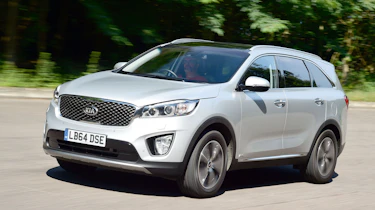
The exterior is relatively anonymous, but the Kia Sorento has just enough visual appeal to stand out from the SUV crowd. The overall shape is an evolution of the previous generation, although it’s longer and wider than before.
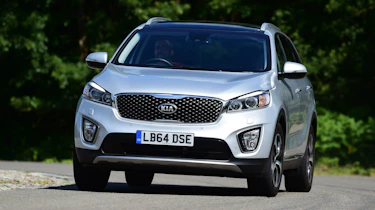
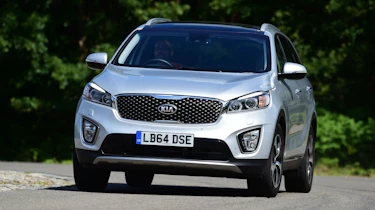
At the front, the big grille features Kia’s signature tiger nose chrome surround – a design trademark that the company has been rolling out across each updated model in its range – and it’s flanked by neat headlamps with LED daytime running lights. KX-3 models get more powerful and brighter xenon headlights with cornering foglamps (you have to upgrade to GT-Line spec for fully adaptive xenon headlamps), while the front bumper is finished off with a thin, silver skid plate.
There are silver roof rails, as well as chrome trim on the sills, while at the rear is a roof spoiler and LED tail-lights. The Sorento doesn’t really hide its larger dimensions, and it looks quite imposing on the road
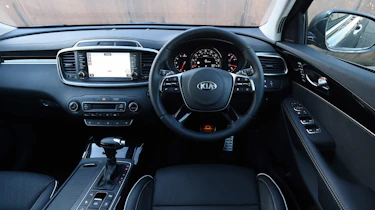
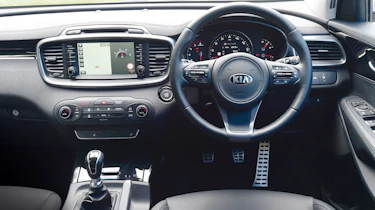
Inside, it’s very upmarket – much more so than you’d expect from a Kia. The infotainment screen is housed in a silver-trimmed binnacle, while a large central speedometer dominates the instrument dials. Next to this is another full colour display showing information such as the trip computer.
The Sorento is the first Kia to be passed for production by the brand’s new quality control centre in Korea, and it shows. The soft-touch dashboard, as well as the matt and gloss black plastic finishes, represent a marked improvement over the previous generation. There are still a few questionable bits of trim here and there, though, including some slightly cheap-looking materials around the gearstick, which appear prone to showing up scratches.
Sat-nav, stereo and infotainment
The entry-level KX-1 model is the only Sorento that doesn’t come with satellite navigation, but you do get a seven-inch touchscreen to control everything. KX-2 models and upwards feature an eight-inch touchscreen that includes sat-nav. However, all cars now feature Apple CarPlay and Android Auto, so the lack of anav in the KX-1 is no hardship if you use your phone instead. Bluetooth and a DAB radio are also included, as are USB and aux sockets to charge and connect devices.
Unlike the touch-sensitive hot keys used on the Skoda Kodiaq's touchscreen, the Kia uses proper buttons, but they’re clearly labelled and easy to use. So is the touchscreen, which offers features such as local search functions and traffic recognition for the sat-nav.
Practicality, comfort and boot space
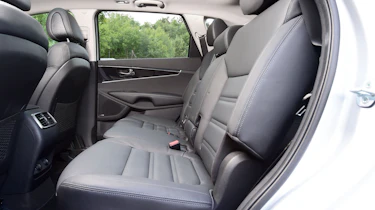
The Sorento is a big SUV with seven seats, and its large cabin is dotted with useful features: it boasts levers to fold the rear seats remotely, a pair of deep storage bins and two cup-holders in the front, some useful under-floor storage, plus a USB charging point for passengers in the second row and ventilation controls for third-row passengers.
As with most models in this class, you sit high and have a good view of the road, while the optional panoramic roof is well worth considering as it floods the cabin with light and adds to the sense of space.
Size
The current Sorento is considerably bigger than the model it replaced: at 4,780mm long and 1,890mm wide, it’s 95mm longer and 5mm wider, plus it has an 80mm longer wheelbase. However, it’s 15mm lower than before, at 1,685mm tall. The latest car is also longer than its Nissan X-Trail and Hyundai Santa Fe rivals.
Leg room, head room & passenger space
There’s no shortage of space inside the Sorento, and as the seats are mounted lower than in the previous model, there’s more headroom than before, as well as more legroom. Taller passengers sitting in the back will have plenty of space to stretch out in, while unlike in many rivals, the optional panoramic glass roof doesn’t particularly affect headroom. However, one drawback is that only the kerb-side seat folds to give access to the third row.
Accessing the rear seats is a bit tougher. The middle row of seats doesn’t fold and slide as far forward as some rivals, and the door aperture also isn’t as big. There’s plenty of room in the rear once you’re sat there, though.
Boot
The Sorento’s seven seats can be configured in a variety of ways, and with the third row in place there’s 142 litres of boot space. That doesn’t sound like much on the face of it, but they fold flat into the boot floor at the tug of a cord.
With the rearmost seats out of the way, the Sorento has a more useful 660 litres of space behind the second row – which itself can slide back and forth and has a 60:40 split. Fold this middle row of seats down via two levers in the side of the boot, and you can free up a massive 1,732 litres of space – 52 litres more than in the Hyundai Santa Fe, and easily enough for carrying most large objects.
Towing
Large SUVs are prime towing vehicles, and the Kia can pull a hefty 2,500kg behind it, which is a respectable towing capacity even for a big, diesel 4x4. That being said, if you are after an automatic Sorento, the maximum towing capacity falls to 2,000kg.
Check any car's MoT history in a few easy clicks with our MoT checker tool...