Lexus LBX review
The Lexus LBX is a compact SUV that blends luxury with excellent fuel efficiency. It is expensive to buy, though.

Our opinion on the Lexus LBX
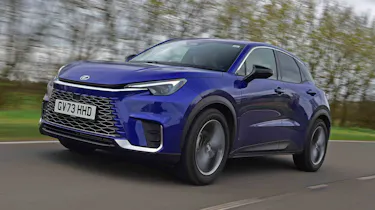
There is nothing else quite like the Lexus LBX currently on sale in the UK. It's as small as a Toyota Yaris Cross, yet offers the kind of premium appeal that is synonymous with larger Lexus models. However, while it feels well-appointed from behind the wheel and is reasonably comfortable to drive, there are some compromises. Rear passenger space is almost as cramped as it is in a Yaris Cross, while the LBX's list prices place it on a par with electric SUVs that offer lower running costs, or larger SUV models that match it for quality but deliver greater practicality.
About the Lexus LBX
After many years of offering a safe range of luxury SUVs and saloons, Lexus is going all-out to diversify its range. The Lexus LC grand touring coupe started the expansion, while the Lexus LM people carrier offers something unique in the large luxury car sector. At the smaller end of the market, Lexus is also downsizing with the LBX premium small SUV.
LBX stands for Lexus Breakthrough Crossover, and this is only the second car from the company to feature a three-letter name (the first being the Lexus LFA supercar). It's the ‘Breakthrough’ part that's important, because the LBX is the smallest car Lexus has ever built, but it comes with the premium quality and technology that has made the company's larger cars popular.
Used - available now


In order to determine whether Lexus’s foray into the compact SUV world is a successful one, our senior news reporter, Alastair Crooks, lived with an LBX in Takumi trim on a long-term test.
Performance & driving experience

Pros |
|
Cons |
|
Given its Yaris Cross underpinnings, it’ll come as no surprise that the Lexus LBX utilises the same three-cylinder ‘self-charging hybrid’ powertrain. It pairs a 1.5-litre three-cylinder petrol engine with an electric motor to produce a combined 134bhp, which is more than any Toyota Yaris Cross.
Performance, 0-60mph acceleration and top speed
The unsurprising result of it having more power is that the Lexus is slightly quicker than its Toyota twin. Officially, the 0-62mph time is 9.2 seconds for a front-wheel-drive model, increasing to 9.6 seconds for the four-wheel-drive version. The Yaris Cross, meanwhile, only covers the sprint in 10.7 seconds in its quickest form.
Both variants of the LBX have a 106mph top speed. You probably won’t be flooring the throttle all that often, though, because the continuously variable transmission (CVT) encourages a smooth driving style. Being overly eager with the accelerator results in more noise than forward momentum, which briefly spoils the overall refinement.
| Model | Power | 0-62mph | Top speed |
| LBX 1.5 Premium E-CVT | 136bhp | 9.2 seconds | 106mph |
| LBX 1.5 Premium Plus E-CVT | 136bhp | 9.2 seconds | 106mph |
| LBX 1.5 Takumi 5dr E-CVT AWD | 136bhp | 9.6 seconds | 106mph |
Town driving, visibility and parking
The LBX’s hybrid powertrain can run solely on electric power under 30mph, so things remain very quiet and refined at city speeds. Stop-start traffic doesn’t require much effort, either, as the power is pretty much instantaneous when you need it.
The lofty driving position and clear all-round visibility make the Lexus LBX an easy car to navigate through narrow streets and into parking spaces. Front and rear sensors are fitted to all variants, along with a reversing camera, but high-end Takumi gains a 360-degree camera system.
Country road driving and handling
While the Lexus LBX is an easy and quiet car to drive, there’s very little in the way of excitement to be found from behind the wheel. It does handle in a slightly more composed fashion than the Toyota, but this certainly isn’t anywhere near enough to inspire a driver’s inner hooligan to come out in the corners.
Motorway driving and long-distance comfort
While it could be easy to dismiss it as a Yaris Cross in fancy clothes, Lexus has put serious effort into delivering a more refined driving experience for the LBX. The hybrid system is far quieter here than it is in the Yaris or Yaris Cross, with enough sound deadening to make the three-cylinder petrol engine almost undetectable when it fires up. There's just a distant thrum when accelerating, while no obvious engine noise is present at a cruise.
The suspension has been overhauled, too, and the LBX offers a comfortable ride for such a small car, and it’s a marked improvement over the Yaris Cross. The dampers do a good job of soaking up bumps, and only the biggest thumps are felt in the cabin. It's much like Lexus's larger SUVs in this regard. The LBX isn't the most involving car to drive, but the steering is direct, and while body roll is noticeable, the car doesn't feel wallowy in the bends.
“When you set off, the LBX drives in EV-only mode. The illusion of electric running quickly dissipates though, because the throttle only needs the slightest nudge to awaken the three-cylinder petrol engine, even at very low speeds.” - Alastair Crooks, senior news reporter.
MPG & running costs
Pros |
|
Cons |
|
Officially, the LBX can return up to 62.7mpg on the WLTP combined cycle, depending on the size of the alloy wheels, although this drops to 58.8mpg for the four-wheel drive version. These are all strong figures compared with regular petrol rivals like the BMW X1, which fails to breach the 50mpg mark.
However, our long-term test car’s average has us wondering just how easy it is to replicate these numbers in the real world. After several thousand miles on mixed roads, our LBX Takumi only managed an average of 48.6mpg at best. This was especially surprising, given that we managed 64.7mpg from our long-term Yaris Cross under similar circumstances. The 35-litre fuel tank is fairly small, so fill-up stops were a tad more frequent than we initially assumed.
| Model | MPG | CO2 | Insurance group |
| LBX 1.5 Premium E-CVT | 62.7mpg | 102g/km | 23 |
| LBX 1.5 Premium Plus E-CVT | 61.4mpg | 103g/km | 24 |
| LBX 1.5 Takumi 5dr E-CVT AWD | 58.8mpg | 110g/km | 24 |
Insurance groups
Lexus is a premium brand, and when it comes to insurance, the LBX will attract suitably premium, erm… premiums. The line-up is in groups 23 to 25 (out of 50), depending on the trim level. The BMW X1 is costlier, residing in groups 25 to 35.
Tax
The four-wheel drive Takumi and both Takumi Design models surpass the £40,000 price barrier, so these cars are liable for the luxury car tax surcharge. Being a bit too trigger-happy with the options list can also drive some lower-spec cars into this territory. If you do find yourself on the wrong end of this particular fee, you’ll be looking at a combined annual VED road tax charge of £640 between years two and six after the car’s first registration.
There’s no plug-in hybrid or electric variant of the LBX, so there are no tax savings to be found here. As a general rule, company car drivers will be better served by zero-emission models like the BMW iX1, MINI Countryman Electric, and Volvo EX30.
Depreciation
According to our market data, the LBX will hold on to between 49 and 54 per cent of its original value over three years or 36,000 miles. This is a good performance, but it’s not much better than the cheaper Toyota Yaris Cross, which manages 46 to 51 per cent.
The BMW X1 puts on a similar show to the Lexus by retaining 46 to 52 per cent of its initial value after the same period. However, some premium small SUVs do even better, such as the MINI Countryman, which will retain between 51 and 58 per cent of its original value over the same period.
To get an accurate valuation of a specific model, check out our free car valuation tool...
Interior, design & technology
Pros |
|
Cons |
|
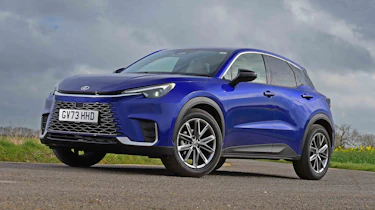
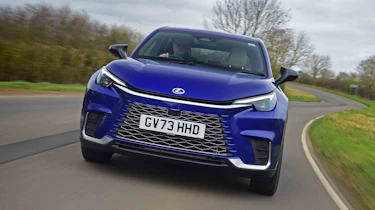
Before you dismiss the Lexus LBX as a Toyota Yaris Cross in a posh frock, it’s worth noting that it shares no body panels with its more affordable sibling. It’s difficult to stand out in the crowded small SUV market, but the LBX looks more upmarket than its more mainstream rivals, especially if you choose an optional pearlescent paint option, such as Ruby or Sonic Cooper.
Interior and dashboard design
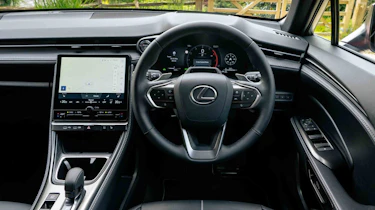
You’ll forget the Yaris Cross connection once you step inside, where the LBX feels like a smaller version of a larger Lexus SUV, complete with leather (synthetic or real) on all but the Urban model, an instrument panel that wraps smoothly into the door panels, plush materials and dense foam padding.
The Urban trim is designed to be an entry point into the LBX range and Lexus brand, and its specification reflects this. The seats are fabric rather than leather, it misses out on some driver assistance systems, there’s no auto-dimming rear-view mirror or wireless smartphone charger, and it also goes without the illuminated entry system.
For the fully fledged Lexus experience, you’ll need to look towards pricier models like the Takumi and Takumi Design. These variants feel particularly opulent, adding the likes of LED ambient lighting with 50 different colours, LED headlights with adaptive high beam, and intelligent park assist.
Materials and build quality
Take Toyota’s typically high build quality, mix it with plusher materials and you’ll end up with a Lexus. This has been a winning combination for the Japanese firm for many years, and it continues to impress right here, especially in the better-equipped cars.
Infotainment, sat-nav and stereo
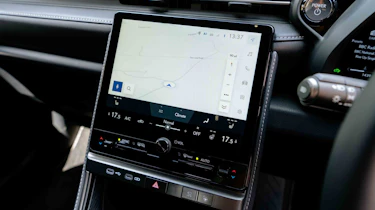
All versions of the LBX come with a 9.8-inch touchscreen that features navigation, voice control and a four-year subscription to connected services. Over-the-air updates are also offered, while wireless Apple CarPlay and wired Android Auto allow you to use your own apps instead. Premium Plus models and above also come with a 12.3-inch digital instrument cluster and head-up display, although the touch-sensitive steering wheel controls used to operate the latter are a little tricky to use. Sometimes the functions unintentionally appear in the head-up display if you skim the controls with your hands, but then you need to use an affirmative double press for them to work.
One useful feature of the central screen is the ability to access often-used functions quickly. The LBX memorises which ones are opened most frequently, and a press of an on-screen button accesses them. This is particularly handy for deactivating the car's road sign recognition software – this beeps every time a road sign is detected and also alerts you when you've momentarily crept over the last detected speed limit.
The six-speaker audio system fitted to most LBX models is good, but audiophiles will appreciate the superb 13-speaker Mark Levinson surround sound system found in the Takumi and Takumi Design models.
“Several of my passengers have struggled with the push-button interior door handles. They can be used as a conventional pull handle, too, but in reality they’re just a needless faff.” - Alastair Crooks, senior news reporter.
Boot space & practicality
Pros |
|
Cons |
|
Dimensions and size
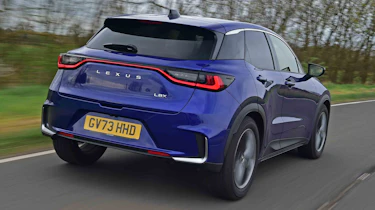
The connection with the Toyota Yaris Cross will give you an idea of how small the LBX is. At 4,190mm it's 10mm longer than its sibling, but a width of 1,825mm is a handy 60mm broader than Toyota's smallest SUV, and the LBX has a wheelbase that's 20mm longer, too. That means there's a bit more space in the cabin, but it's still on the snug side.
| Dimensions comparison | |||
| Model | Lexus LBX | Toyota Yaris Cross | BMW X1 |
| Length | 4,190mm | 4,180mm | 4,505mm |
| Width | 1,825mm | 1,765mm | 1,845mm |
| Height | 1,560mm | 1,595mm | 1,642mm |
| Wheelbase | 2,580mm | 2,560mm | 2,690mm |
| Boot space | 402 litres | 350 litres | 500 litres |
Seats & passenger space
Up front there's plenty of room, and the LBX feels just as plush as the company's bigger models thanks to generous use of premium materials. The light-coloured synthetic leather of the car we drove felt upmarket (black trim is available at no extra cost), but the artificial trim for the steering wheel was less impressive. While it had the look of leather, there’s a slightly oily feel to its texture. There's centre console storage, but it's narrow, while the door bins are on the small side, too.
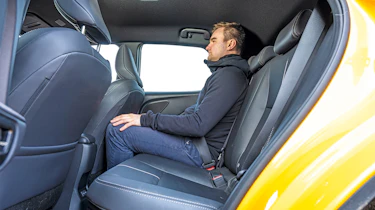
Where the LBX struggles the most is for rear passenger space. Much like the Volvo EX30, the back seats are only really good for short trips, with the middle seat being no more than a token addition.
Boot space
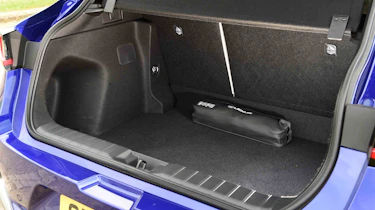
Boot space in the LBX isn't dreadful, but a capacity of 402 litres isn't much bigger than a conventional hatchback, while the seats-down capacity of just 994 litres isn’t particularly helpful for IKEA trips. There is a false floor with extra storage beneath, though. A powered tailgate is fitted to Premium Plus models and above, but we found this to be very slow in operation during testing, making it a frustration rather than a convenience.
It’s worth noting that luggage capacity drops to 317 litres in the four-wheel drive model, and there’s also a two-litre penalty in Takumi trim cars because of the subwoofer in the boot.
“If you’re a courteous driver, you’ll probably open the boot for your passengers. I’m not, and unfortunately the electric boot lid proved (fitted to Premium Plus trim and above) a headache as my passengers instinctively tried to close it manually. But the Lexus doesn’t like it when that happens and halts proceedings, making sure you have to press the close button on the lid.” - Alastair Crooks, senior news reporter.
Reliability & safety
Pros |
|
Cons |
|
Just like the Toyota Yaris Cross upon which this little Lexus shares its underpinnings, the LBX was awarded the maximum five-star crash test rating by the safety experts, Euro NCAP, when it was tested in 2024. That's impressive given that the LBX's result is based on more stringent criteria than what the Yaris Cross was subjected to when it was tested in 2021. However, the MINI Countryman that was tested at the same time performed better in all categories than the LBX.
All trim levels feature an array of driver assistance systems, including pre-collision and emergency assist, adaptive cruise control, lane-keeping assist, road sign recognition and automatic high beam. Premium models add blind spot monitoring and rear cross traffic alert into the mix, while the Takumi and Takumi Design have an adaptive high-beam system, lane change assist, front cross traffic alert, panoramic view monitor and parking assistance.
The Lexus LBX is yet to feature in our 2026 Driver Power best cars to own rankings, but the Toyota Yaris Cross did manage to rank 31st out of 50 cars, scoring well for reliability and running costs – especially in terms of fuel economy. It didn't score well for rear seat leg room, though. As a brand, Lexus finished fourth among 30 carmakers on the best manufacturer scoreboard, a fantastic result. Owners liked their car's quality and reliability, but grumbled about engine refinement, steering and road holding.
| Euro NCAP safety ratings | |
| Euro NCAP safety rating | Five stars (2024) |
| Adult occupant protection | 82% |
| Child occupant protection | 83% |
| Vulnerable road user protection | 79% |
| Safety assist | 76% |
Buying and owning
Best buy: Lexus LBX Premium
Prices range from around £30,000 to £42,500, which puts the LBX in the ballpark of the MINI Countryman and small electric SUVs such as the Volvo EX30.
In order to strike a good balance between prestige and price, we recommend opting for the LBX in Premium trim. It gets more plush materials and general goodies than the entry-level Urban specification, and Premium trim keeps the price well below the clutches of the luxury car tax. We’d also stick with front-wheel drive, because we’re pretty sure that the vast majority of LBX buyers simply won’t need four-wheel drive.
If you’d like to save on the list price, you can build your ideal Lexus LBX with the Auto Express Buy A Car service and choose the best offer from UK dealers. We also have new Lexus LBX models in stock and ready to hit the road, along with a number of appealing Lexus LBX leasing deals. We can also help you to sell your car.
Lexus LBX alternatives
The most obvious Lexus LBX rivals are other premium small SUVs like the BMW X1 and MINI Countryman. If you’re prepared to sacrifice the premium badge and an uplift in quality, the closely related Toyota Yaris Cross provides much of what the LBX offers, but at a much more affordable price.
If you’re considering moving over to an electric car, there’s plenty of upmarket choice here, too, including the Alfa Romeo Junior, BMW iX1, DS 3 E-Tense, and Volvo EX30.
Lexus LBX Takumi long-term test

Our senior news reporter, Alastair Crooks, ran a Lexus LBX Takumi as part of our long-term test fleet. While he couldn’t fault the level of quality and kit within this range-topping model, Alastair still couldn’t help but wonder whether the car was truly worthy of its £41,000-plus price tag when compared with the competition. You can read the full long-term test here…
Lexus LBX pictures
Key updates of the Lexus LBX review
21 August 2026: General update with the current 2026 Driver Power customer satisfaction survey results
December 9 2025: update to include information about the revised 2026 LBX model range
Deals on the Lexus LBX and alternatives
Frequently Asked Questions
Like Toyota, the standard Lexus manufacturer's warranty is three years or 60,000 miles, but you can extend it by 12 months or 10,000 miles at a time through routine franchised dealer servicing, up to the car being 10 years old or having covered 100,000 miles. 3 years of roadside assistance is complimentary, and you can extend this for a fee.