Mitsubishi L200 review
The L200 is back and better than ever, offering practicality, kit and great value for money


Our opinion on the Mitsubishi L200
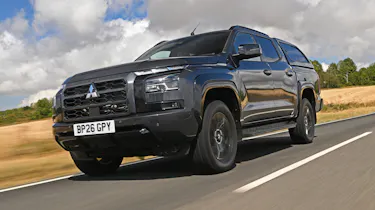
What the Mitsubishi L200 line-up lacks in variety, it more than makes up for with ambition. The Titan model is a well equipped work model, while the top-spec Barbarian offers a premium pick-up experience with an even longer list of standard equipment at a price that offers good value for money. While other makers dabble with electrification, sticking with diesel should hold the L200 in good stead.
It’s decent to drive overall, with handling that is solid rather than engaging, plenty of power and a responsive automatic gearbox, although the ratios could be better spaced for UK speed limits. There’s strong towing ability, while selectable four-wheel drive boosts traction on and off road. The rear-drive setting will help with fuel efficiency when travelling unladen, too.
About the Mitsubishi L200
There was a time when Mitsubishi had a fairly significant presence in the UK car market.
Originally launched as the Colt Car Company in 1974, it reinvented itself as Mitsubishi in the eighties, and while sales never hit the heights of Japanese rivals such as Toyota and Nissan, it found enough buyers to keep ticking over for almost five decades.
During that time, Mitsubishi carved itself a niche in the performance car market with its rally-inspired Lancer and Evo-badged machines. But perhaps an even bigger following was garnered by another four-wheel-drive model, the L200 pick-up truck.
Used - available now

2023 Hyundai
Tucson
47,808 milesManualPetrol1.6L
Cash £15,697
2023 Ford
Puma
49,038 milesManualPetrol1.0L
Cash £11,897
2022 Mercedes
A-Class
28,320 milesAutomaticPetrol1.3L
Cash £19,299
2027 Volvo
XC40
21,732 milesAutomaticPetrol2.0L
Cash £22,849Mitsubishi withdrew from the UK in 2021, but now it’s back, with two models that it believes will make an impact in the market; the Outlander PHEV and the L200. We were impressed by the latest Mitsubishi Outlander PHEV when we tested it against the new Toyota RAV4, and now it’s the turn of the L200 to show what it can do.
Unlike pick-up truck rivals such as the Ford Ranger, Toyota Hilux and Isuzu D-Max, the L200 has a small line-up, with just one powertrain and two trim levels on offer. The range kicks off with the Titan, which is geared towards business use and starts from £36,295 excluding VAT. If you use a truck for more than work, then the Barbarian has a longer spec list and more plush materials, and starts at £39,995, excluding VAT.
MPG and running costs
Pros |
|
Cons |
|
Mitsubishi has kept things simple with the L200, offering just Titan and Barbarian trim levels. The Titan is geared towards commercial use, so has smaller wheels and less standard kit, and it starts from around £36,300, excluding VAT. The Barbarian doesn’t cost much more, at just under £40,000 ex-VAT, and both models are competitively priced when compared with truck rivals.
Both variants are priced below the equivalent Isuzu D-Max, and to match Titan spec, you’d have to spend around £2,600 extra on a Ford Ranger Tremor. The top-spec L200 Barbarian costs around £4,000 less than a Ranger Wildtrak, too. The only factory-fitted option is metallic paint, with silver or grey alternatives to white for the Titan, while the Barbarian comes in black as standard, with grey and white metallics for £720 and vivid Yamabuki Orange on offer for £1,200.
Official fuel economy of 33.2mpg is quoted for the L200, but results will, of course, vary according to use. During our time with the L200, which included a long-distance motorway trip with a decent payload in the cargo bed, we saw a return of 36.6mpg, and the decoupling of the four-wheel-drive system is likely to have had a positive effect on that figure. Our return equates to a range of around 600 miles on a tankful of diesel.
In terms of insurance costs, the cheapest quote we had for our sample driver on a top-spec L200 Barbarian was £887, although the cost of cover varies according to individual use cases.
Business rates for double-cab pick-up trucks are more complicated than they used to be, now that Benefit-in-Kind rates are based on CO2 emissions, rather than commercial vehicle status. Run an L200 as a company car, and you will face steep bills, thanks to emissions of 222g/km.
However, Mitsubishi has joined pick-up rivals by offering a commercial-friendly version of the L200 that will be more affordable for business users. The double-cab body remains, but inside the rear bench and seatbelts are replaced by a flat cargo area with a mesh bulkhead behind the front seats, while the electric windows are deactivated and heavily tinted. This qualifies the L200 for the standard BiK van rate, which is £804 for 20 per cent taxpayers, and £1,608 for the 40 per cent rate.
While BiK has changed, road tax is still charged at the commercial vehicle rate for double-cab pick-up trucks. That means the L200 is fixed at £360 from year two onwards.
Load space and practicality
Pros |
|
Cons |
|
Surprisingly, the L200’s tailgate isn’t part of the central-locking system, so you have to use the physical key that’s hidden in the central-locking blipper to secure it.
Another omission from the standard kit list on the L200 is a tailgate damper. High-spec versions of most rivals have one fitted as standard, so the door drops slowly rather than letting gravity do the work. But you can only add one to the Mitsubishi via the accessories catalogue, priced at £160. When open, the tailgate measures 825mm from the ground, so loading heavy items will need a bit of muscle.
The tailgate opening is wide, though, so larger items should fit easily. The pick-up bed has a square shape and enough space between the wheelarches to accommodate a Europallet.
A payload weight of 1,100kg is well clear of the one-tonne minimum required for a double-cab pick-up to qualify as a commercial vehicle, so there won’t be much that the L200 won’t be able to carry in terms of heavy items.
Pick-ups such as the L200 are well suited to hauling, and the Mitsubishi has the maximum permissible towing weight of 3.5 tonnes at its disposal. The torquey diesel offers plenty of pulling power from low revs, while engaging high-range four-wheel drive boosts traction when dealing with heavy trailers. Mitsubishi offers towbars as part of the accessories catalogue, with prices from around £300 without fitting.
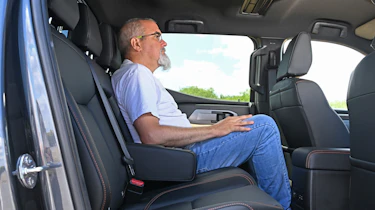
There’s nothing extraordinary about the Series 7 L200 in terms of overall size. It’s around the same length as a Ford Ranger or Toyota Hilux, although it’s five centimetres wider than the Series 6 model, which will help with interior space.
Reliability, safety and security
Pros |
|
Cons |
|
The previous generations of L200 were popular with buyers, and that’s part of the reason why Mitsubishi has relaunched it in the UK. It’s anticipating demand from existing owners wanting to replace their Series 5 and 6 models, but it also sees an opportunity to take sales from rivals that have risen in price and complexity over the years.
To help draw customers in, Mitsubishi offers a five-year/62,500-mile warranty on the L200, with the distance limit equating to the first five service intervals. This warranty cover isn’t as long as the eight years that comes as standard with the Outlander PHEV, while Isuzu and KGM offer longer distance limits on their trucks. In addition, Toyota offers up to 10 years of warranty with main-dealer servicing on the Hilux. Mitsubishi has a growing number of outlets to help keep the L200 maintained, with more than 50 showrooms and in excess of 150 service centres across the country.
Safety equipment includes the kind of kit we’ve come to expect from any passenger car, such as blind-spot detection, front and rear cross-traffic alert and lane-departure warning and prevention. But since the L200 is a slightly older design, some of the systems are less frustrating than in other new models. For example, the speed-limit warning can be deactivated and remains off whenever you start the car.
The distracted-driving system was a little over-sensitive for our liking. We found it activated even when looking away from the road and towards the main touchscreen, and also when looking to the side when approaching a roundabout, for example.
Driving and performance
Pros |
|
Cons |
|
Both L200 editions come with a 2.4-litre four-cylinder turbodiesel with selectable four-wheel drive and a six-speed automatic gearbox. There is 201bhp on tap and 470Nm of torque from a lowly 1,500rpm, which makes the L200 well suited to towing. These figures are competitive with rival four-cylinder diesel trucks, but a little behind potent (but thirstier) V6-powered diesel models.
A 0-62mph time of 12.6 seconds isn’t particularly quick, but is faster than auto-equipped versions of the Isuzu D-Max (13 seconds) and the Toyota Hilux with the same power output (12.7 seconds). However, the 202bhp 2.0 EcoBlue Ford Ranger auto is significantly quicker (10.5 seconds).
Traction will be dependent on the type of tyres fitted, but the L200 pulls away without fuss, even when the bed is unladen and rear-wheel drive is selected. The gearbox shifts smoothly between ratios to ease progress, while the claimed top speed is 112mph.
Town driving, visibility and parking
At just over 5.3 metres long, the L200 is roughly the same length as its pick-up rivals, so it’s not the most appropriate machine for urban use. The typically tall driving position is as you would expect in a high-riding truck such as this, although this is offset somewhat by a long, flat bonnet. This creates a bit of a blind spot immediately ahead of you, although it’s no worse than you’ll experience in any of the L200’s rivals.
A 12.4-metre turning circle is boosted by light steering at low speeds, while both versions of the L200 have front and rear parking sensors. A reversing camera is standard, while the Barbarian adds front and side cameras to help with all-round visibility.
One of the biggest issues we have with the L200 is the spacing of its gearbox ratios. Cruise along at an indicated 30mph, and the transmission hangs on to third gear, leaving the engine revving at 2,000rpm, which spoils refinement. Creep over the limit to 31-32mph and the box shifts up, letting the revs drop to a more refined 1,500rpm, but dip back below 30mph and the box kicks down. It spoils refinement, with our noise figures showing a reading of 92dB in third at 30mph, but 89dB when travelling only slightly faster in fourth.
Motorway driving and long-distance comfort
While the L200 isn’t particularly quick to get up to speed, it’s a decent cruiser once at the national limit. Tyre roar is well insulated and wind noise is also low, although most SUVs will deliver better refinement.
Off-road ability
A rear diff lock is standard, while Mitsubishi offers a different four-wheel-drive set-up depending on trim, with the top-spec Barbarian featuring the Super Select II system. As the name suggests, it’s an evolution of Super Select from the last L200, and offers two or four-wheel drive for road use, plus high and low-range settings with a locking centre diff for extra off-road traction. Each mode is selected via a rotary dial on the centre console, and the mode you’re in is highlighted by a graphic on the dashboard between the dials.
A short front overhang gives the L200 an approach angle of 30.4 degrees, although the long rear means there’s a shallow departure angle of 22.8 degrees. The lengthy 3,130mm wheelbase contributes to a breakover angle of 23.4 degrees, so the L200 will struggle with extreme off-road work.
Cab interior and technology
Pros |
|
Cons |
|
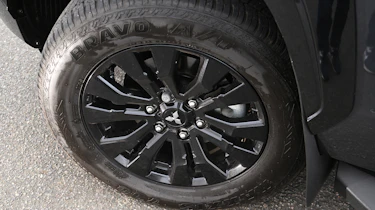
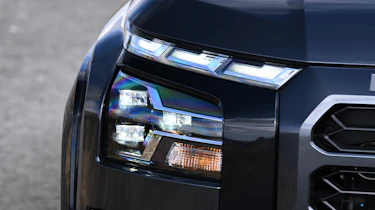
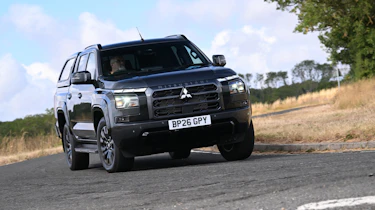
The seventh-generation L200 has an exterior design that’s evolved from the curvy series four and five, through the sharpened sixth-generation to end up with a chunky, squared-off appearance. The main difference between the Titan and Barbarian models is with the wheels (17-inch silver alloys for the former, 18-inch black items on the latter), while the Barbarian adds a body-coloured grille, standard-fit running boards, a sports bar for the pick-up bed and gloss-black detailing.
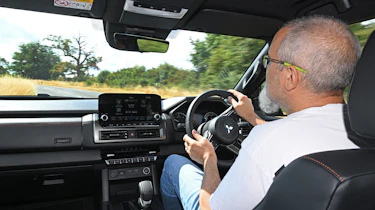
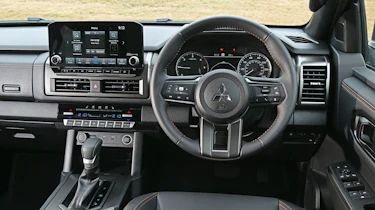
Inside, the L200 has a layout that prioritises function over form, but has some extra touches that are designed to boost the feeling of quality. The chunky design of the exterior continues inside, with the large central touchscreen taking centre stage on the dashboard.
Usefully, the two-zone climate-control system is operated via a panel that sits under the air vents, with toggles to adjust the temperature and a bank of buttons to select different settings.
Below this is a slot with wireless phone charging, plus two USB sockets – one USB-A, the other USB-C – and a 12-volt socket. Behind the drive selector is the rotary control for the four-wheel-drive system, including a button for the standard-fit hill descent control.
There are plenty of hard-wearing plastics, although there are softer-touch materials in places to boost the cabin’s appeal. The Titan model features cloth upholstery and vinyl flooring to help withstand work use, while the Barbarian adds carpet and leather seat upholstery with orange stitching for a more premium feel.
The dashboard has softer materials, too, although our test car did develop a rattle behind the main touchscreen. This was only really noticeable when negotiating cobbled streets.
Infotainment, sat-nav and stereo
Both versions of the L200 have a nine-inch touchscreen display, although this is relatively small when compared with the system used in the Toyota Hilux, not to mention the vast portrait touchscreen that features in the Ford Ranger. The software the Mitsubishi runs isn’t the most up to date on the market, either, while our car wouldn’t zoom in very far when navigation wasn’t being used.
Fortunately wireless Apple CarPlay and Android Auto are fitted, and the screen resolution when using a smartphone is perfectly acceptable.
The driver has analogue dials that flank a colour trip computer and the assorted functions within that are controlled via buttons on the multifunction steering wheel. Information about the drive modes is also displayed here.
Buying and owning
With only two models to choose from, the L200 you go for boils down to what you want from it. The Titan is a decently equipped work vehicle, but it isn’t a big jump to the Barbarian to get a truck with SUV-style kit and a higher quality cabin.
Mitsubishi L200 alternatives
You get the pick of the usual suspects in the pick-up truck class, with the big-selling Ford Ranger offering a wide variety of trims that are packed with tech, plus a range of engine options, including a petrol plug-in hybrid. The Toyota Hilux has 48-volt hybrid tech now, while an all-electric version is also offered, albeit with a high price and a low payload weight. The Isuzu D-Max also comes with diesel or electric power, with the latter featuring a one-tonne payload and an even steeper price than Toyota’s electric truck. Other options include the KGM Musso, which also has an EV option, while the Ineos Grenadier Quartermaster is a premium option that is well suited to towing.
Mitsubishi L200 pictures
Frequently Asked Questions
You get five years and 62,500 miles of warranty cover with the L200. That’s not as long as the eight-year warranty on the Outlander PHEV passenger car, while the distance limit is shorter than that offered on the Isuzu D-Max and KGM Musso.
| Truck dimensions | |||
| Body style | Height | Width | Length |
| Double cab pick-up | 1,815mm | 1,930mm | 5,320mm |
| Load area dimensions | ||||
| Body style | Height | Width | Length | Volume |
| Double cab pick-up | 500mm | 1,545mm | 1,555mm | N/A |