Best plug-in hybrids to buy 2026
The plug-in hybrid market has grown exponentially in recent years. Here are our electrified favourites in 2026

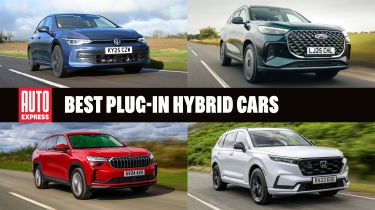
Plug-in hybrid cars (PHEVs) are great ‘stepping stones’ for those not quite ready to take the plunge and commit to a fully electric car. They offer the benefit of extended periods of electric running with the security of a petrol engine for when the battery runs flat.
The contest to be considered one of the very best plug-in hybrid cars has been hotting up in recent years, and in 2026, the cream of the crop now offer well in excess of 50 miles of all-electric electric range.
Unlike standard ‘full’ hybrids, plug-in hybrid cars have larger batteries and can be charged via a home wallbox or three-pin plug just like an EV. Standard hybrids typically have a smaller battery and are charged through driving with regenerative braking. Our expert road testers have thoroughly tested every PHEV on sale in the UK, comparing them against their rivals.
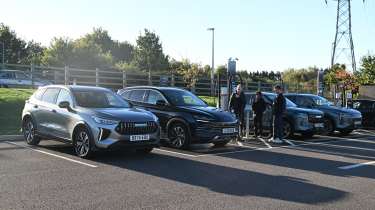
Our plug-in hybrid megatest in May 2026 was the most comprehensive of its type carried out in the UK. Each car covered hundreds of miles to find out which PHEV models perform best in the real world with their batteries fully charged or totally flat. The results helped us compile this list. We’ve given you a broad cross-section of what’s on offer including the top models available in various market sectors from SUVs and executive saloons, to hatchbacks and estates.
At the bottom of the page, we’ve also got some great advice to help you choose the right plug-in hybrid car for you.
Compare the best plug-in hybrid cars
The best plug-in hybrid car you can buy right now is the Audi A5 e-hybrid and was named our 2026 Premium Hybrid Car of the Year at the Auto Express New Car Awards.
If you need the space of an SUV, the MG HS is currently the best plug-in hybrid SUV on this list. It’s one of the cheapest plug-in hybrid SUVs and it was also named our 2026 Affordable Hybrid Car of the Year.
For those looking for a PHEV with seven seats as standard, the Chery Tiggo 8 Super Hybrid is a great choice.
| Rank | Car | Prices from |
| 1. | Audi A5 e-hybrid | £50,225 |
| 1. | BMW 530e | £60,000 |
| 2. | Volkswagen Golf eHybrid | £36,500 |
| 3. | MG HS Plug-in hybrid | £32,495 |
| 4. | Skoda Kodiaq iV | £42,140 |
| 5. | Honda CR-V e:PHEV | £50,675 |
| 6. | Mercedes C 300 e | £50,800 |
| 7. | Toyota Prius | £37,900 |
| 8. | Chery Tiggo 8 Super Hybrid | £33,600 |
| 9. | Renault Rafale E-Tech plug-in hybrid | £45,000 |
Keep on scrolling to learn more about the best plug-in hybrid cars, or click the links in the table above to jump to a specific make and model..
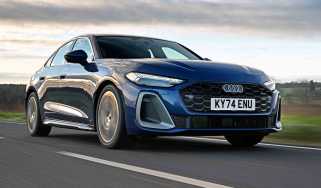
1. Audi A5 e-hybrid
If you’re looking for the very best plug-in hybrid car money can buy right now, look no further than the Audi A5 e-hybrid.
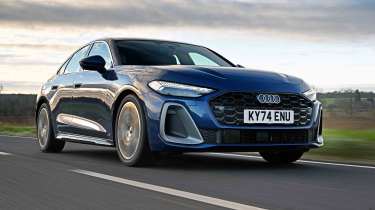
- Hybrid prices from £50,225 (saloon)
- Maximum pure-electric range: 68 miles
- Auto Express Premium Hybrid Car of the Year 2026
Pros |
|
Cons |
|
Audi has always been pretty good at making comfortable and desirable cars and the latest iteration of the A5 is exactly that. It also has an ace up its sleeve in the form of its impressive plug-in hybrid powertrain.
The Audi A5 has a wide range of engines to choose from in the form of two 2.0-litre petrol engines and a 2.0-litre diesel but we’d swerve both of these in favour of the plug-in e-hybrid system.
Granted, the e-hybrid is a little more expensive to buy than its petrol and diesel counterparts, but with an all-electric range of up to 68 miles and an official economy figure of over 140mpg, it’s certainly easier on the wallet where running costs are concerned.
On the road, the Audi A5 e-hybrid is a great all-rounder. It can seamlessly switch between electric and petrol power, and there’s enough grunt under the bonnet so you never feel like you’re lacking in power when merging onto the motorway or driving cross-country.
Settle down to a cruise and there’s very little intrusion from road, tyre or wind noise, and all engines are pretty hushed. If you’re after a sharp driver's car when things get twisty, the BMW 3 Series would feel more engaging from behind the wheel but the Audi is still very competent in this regard.
Inside, the A5 is an extremely comfortable car. The front and back seats are comfortable and there’s plenty of leg room for rear passengers. Rear headroom is compromised slightly thanks to the sloping saloon roofline, though, so if you carry taller passengers frequently we suggest you opt for the A5 Avant estate.
The boot space is a little smaller compared to the pure-petrol and diesel A5 thanks to the hybrid batteries, but with up to 361 litres of boot space in the A5 Avant e-Hybrid or 331 in the saloon, you should have plenty of space for the weekly shop or weekend trips away.
“The neatest part of the A5’s PHEV set-up is the efficiency-boosting intelligent hybrid system. In Hybrid mode, the car assesses driving conditions and the navigation route data to optimise the mix of petrol and electric power.” – Steve Walker, head of digital content.
- Who will like it: Buyers seeking a PHEV car with a premium feel a long EV range
- Who won’t like it: If you’re on the tall side, you won’t have too much headroom in the saloon.
2. BMW 530e
The BMW 530e is an exceptional all-rounder and a fine choice if you’re after a PHEV.

- Hybrid prices from £60,000
- Maximum pure-electric range: 64 miles
- Previous Premium Hybrid Car of the Year award winner
Pros |
|
Cons |
|
The BMW 5 Series has long been a staple of the company car and executive car and this latest eighth-generation has gone big on electrification in order to meet the demands of its loyal customers. The move has certainly been successful, as the plug-in hybrid BMW 530e was named our Premium Hybrid Car of the Year in 2024 and 2025. It was only narrowly beaten by the Audi A5 e-hybrid in 2026.
Thanks to its usable 19.4kWh battery, the big brutish-looking saloon claims a pure-electric range of up to 64 miles, and in our testing we even managed to match the claimed electric range in a Touring estate model. When you’ve drained the battery, there’s a punchy 2.0-litre petrol waiting in the wings to make sure you reach your destination.
Sure it’s partly electric, but the 530e is just as enjoyable to drive as a 5 Series should be and offers peerless refinement. It’s equally impressive inside, too, where you’ll find a class-leading interior that’s very well put together, ergonomically designed and filled with top-quality tech.
Unfortunately, the 530e’s plug-in powertrain does come at a premium being almost £7,000 more expensive than the pure-petrol 520i. The plug-in hybrids reduced running costs and lower company car tax band should help mitigate this initial financial sting, though.
If running costs and price tags are of no concern for you, the legendary BMW M5 has also embraced plug-in hybrid power, so it spits out 717bhp but amazingly also manages to fall into the 9 per cent Benefit-in-Kind (BiK) company car tax bracket.
“The PHEV system has a slightly sluggish step off the line in its e-mode, so it doesn't feel as effortless as a BMW i5. Once rolling though, the 530e is staggeringly refined because of its ability to shuffle around in near-silence at town speeds.” – Alex Ingram, contributor.
- Who will like it: Drivers looking for a premium PHEV with keen handling.
- Who won’t like it: If you’re on a tight budget, the big price jumps between trim levels and expensive options may be a problem.
3. Volkswagen Golf eHybrid
The Volkswagen Golf is a solid family car, but opt for the eHybrid and you’ll also enjoy one of the longest all-electric ranges of any PHEV.
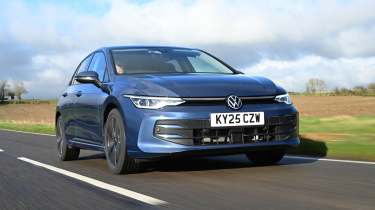
- Hybrid prices from £36,500
- Maximum pure-electric range: 88 miles
Pros |
|
Cons |
|
The Volkswagen Golf has been around for over five decades now, so it’s clear that VW knows how to create a good family car. While some of the German brand’s fully electric cars might not have quite hit the mark so far, the plug-in eHybrid engine is one of the best powertrains of its type you can currently get.
According to Volkswagen, the Golf eHybrid can officially return up to 256.8mpg and while you’re unlikely to see figures this high in the real world, it will still be efficient, providing you keep the battery topped up.
Rapid charging is offered in the Golf with peak speeds of 40kW meaning a 20 to 80 per cent charge will take around half an hour, or around four hours when using a 7.4kW home wallbox charger. It’ll also cover up to 89 miles in pure-electric mode.
On the road, the Golf won’t blow you away with livewire handling, but it is safe, predictable and well-judged, while also being fairly comfortable. Performance is plentiful with 0-62mph being dealt with in just over 7 seconds, so merging onto faster roads from a standstill should be a breeze.
When the Mk8 Golf first arrived, the cabin did have quite a few technical and ergonomic flaws, but recent updates have fixed some of these issues. The infotainment touchscreen menu is now much more intuitive to use, and physical buttons have replaced much of the haptic buttons used previously. The cabin is generally well-screwed together, although some of the materials used feel more tough and hard-wearing than the Golf’s premium price tag would suggest.
The Golf is fairly practical with plenty of storage dotted around the cabin, so families are well catered for. The boot capacity in the non-hybrid Golf is rated at 381 litres, although the battery pack in eHybrid and GTE models does eat into space quite considerably, reducing the capacity to 273 litres.
“While some rivals handle more sharply, the Golf’s set-up is very well judged for Britain’s bumpy roads. The balance is impressively neutral, and grip, especially on the front axle, is strong” – Dean Gibson, senior test editor.
- Who will like it: Buyers looking for a classily dependable family car with a long all-electric range.
- Who won’t like it: Anyone who regularly carries large and bulky items might struggle with the Golf eHybrid’s smaller boot.
Latest Volkswagen Golf eHybrid deals
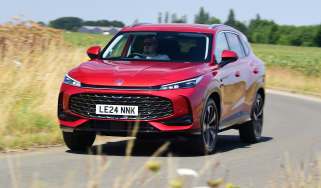
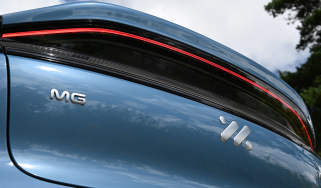
4. MG HS Plug-in hybrid
The MG HS is practical, well equipped and great value for money. No wonder it’s a hit with car buyers.
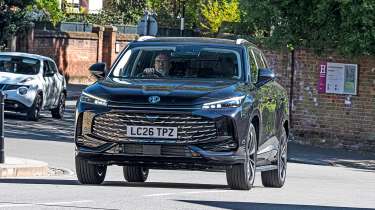
- Hybrid prices from £32,495
- Maximum pure-electric range: 75 miles
- Auto Express Affordable Hybrid Car of the Year 2026
Pros |
|
Cons |
|
Since its rebirth, MG has majored in building cars which are dependable, filled with tech and, most importantly, good value for money. Want proof? Look no further than our Affordable Hybrid Car of the Year for 2026, the MG HS.
The HS starts from a little over £32,000, but just because it’s one of the cheapest plug-in hybrids on this list, don’t think you’re going to be short-changed. It has a long all-electric range of up to 75 miles, and is a figure we got very close to during our plug-in hybrid megatest. We also saw a fuel economy figure of 46.3mpg, only 5mpg less than MG’s official WLTP test number, which is pretty impressive in the real world.
Around town, the MG HS feels much like an EV to drive partly thanks to its smooth power delivery, comfortable ride, light steering and good overall visibility. Backing out of tight spaces is made much easier thanks to the standard-fit rear camera, too.
Up the speeds and the ride remains composed, although there is a little body roll if you push on through faster corners. Road, tyre and wind noise also become quite noticeable when you get to the national limit. Performance is suitably sprightly, so merging onto faster roads from a standstill or overtaking on the motorway shouldn’t be too much of a chore.
The HS cabin doesn’t rewrite the rulebook when it comes to style, but it doesn’t feel like it's lacking in quality. The materials used are a noticeable step up compared to the old model, now giving established rivals a good run for their money.
We like the generous amount of space on offer, 507-litre boot, easily accessible Isofix child seat mounting points and generous amount of in-car tech as standard.
“Just like in the front, there’s plenty of headroom for passengers in the back of the MG HS. There’s also enough legroom to get comfortable, and you can fit three adults across the back bench.” - Ellis Hyde, news reporter.
- Who will like it: Those looking for a great value family PHEV SUV.
- Who won’t like it: You might want a more refined car if you frequently drive on the motorway.
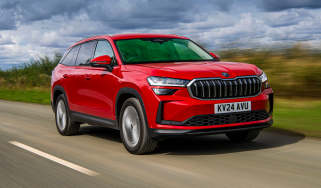
5. Skoda Kodiaq iV
Skoda is well-known for creating cars which are highly practical and offer great value for money. The Kodiaq is not about to buck that trend.
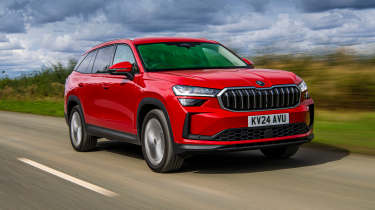
- Hybrid prices from £42,140
- Maximum pure-electric range: 76 miles
- Auto Express Large SUV of the Year 2026
Pros |
|
Cons |
|
The Skoda Kodiaq is another one of our favourite family SUVs as it’s one of those cars that seems able to do just about everything well, from its driving experience to its practicality and understated, handsome looks. The latest model also adds a genuinely luxurious-feeling interior and well judged interior tech with, we’re delighted to see, physical controls on both the steering wheel and dashboard.
It also scores a direct hit as a PHEV thanks to a seriously impressive 76-mile EV range from a 25.7kWh battery. This is achievable in the real world, and if you’re out and about, can be topped up relatively quickly thanks to 50kW fast charging.
The Skoda will be a popular choice as a company car too, because its 11g/km CO2 emissions and EV range of 70-plus miles mean a BiK rate of only 7 per cent, rising to 8 per cent in 2027/2028. It’s just a shame that to enable this, Skoda has had to sacrifice a seven-seat option, though the flip side to this is a vast 745-litre boot.
“If you’re able to keep the battery topped up, then there’s a high possibility that you could cover a day’s driving on electricity alone, although it’s reassuring to know that it’s backed up by the petrol engine.” – Dean Gibson, senior test editor.
- Who will like it: Buyers who want to pay less without compromises as the Kodiaq offers serious value for money.
- Who won’t like it: If you want a plug-in seven-seater you’ll be disappointed as Kodiaq doesn’t come in that form.
Latest Skoda Kodiaq hybrid deals
6. Honda CR-V e:PHEV
The Honda CR-V is a stalwart of the Japanese brand, and the sixth-generation car is arguably one of the best PHEV SUVs money can buy.
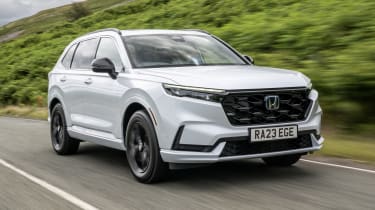
- Hybrid prices from £50,675
- Maximum pure-electric range: 49 miles
Pros |
|
Cons |
|
The Honda CR-V makes a compelling case for itself in the competitive plug-in hybrid SUV class thanks to its smooth and comfortable drive, great levels of visibility, tactile switchgear and a claimed all-electric range of just under 50 miles.
While the Honda commands a higher price tag compared to its rivals, you should be able to claw some of that back thanks to its reasonable running costs. During our 2026 plug-in hybrid megatest, the CR-V managed to go 43 miles using just electric power in a mix of urban, countryside and motorway driving. We also saw efficiency figures of 49mpg, way above the 45.6mpg Honda claims the plug-in hybrid will do without charge.
On the inside, the CR-V should withstand family life quite well. The interior is laid out in a logical fashion, feels very well screwed together, and we’re big fans of the tactile physical switches for key functions like the air conditioning. The same can’t be said for the touchscreen and infotainment system which feels both sluggish and dated compared to rivals.
Practicality is very decent in the CR-V, too. Oddly enough, there's a total of 617-litre of boot space in the plug-in hybrid CR-V which is about 30 litres more than the hybrid CR-V. There’s even space under the floor to store the charging cables, too.
Loading bulky items into the boot shouldn’t be too difficult thanks to its low boot lip. It’s also nice and square in shape, so pushchairs, luggage and large weekly shops can easily be swallowed up.
The rear doors open to 90 degrees, providing parents or grandparents who need to put children in car seats with much better access to the back seats. Adults who need to travel in the back are well-catered for, too, with generous levels of head and knee room, plus the seats can recline through eight positions to enhance comfort further on longer trips.
“When the PHEV battery is depleted, Honda’s efficient Atkinson-cycle four-cylinder engine acts as a generator to send power to the electric motor while also driving the front wheels; when it springs into life, it's hardly noticeable from behind the wheel.” - Max Adams, online reviews editor.
- Who will like it: Parents or grandparents who need to put small children in the back will like the wide opening doors.
- Who won’t like it: Those after the slickest infotainment system will be disappointed.
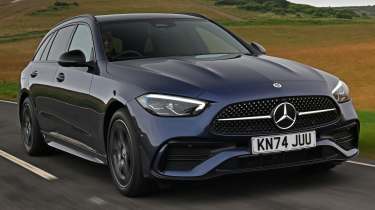
7. Mercedes C 300 e
The Mercedes C-Class has long been one of the best saloon cars on the market, and it’s even better with a plug-in hybrid powertrain.
- Hybrid prices from £50,800
- Maximum pure-electric range: 71 miles
Pros |
|
Cons |
|
While in theory plug-in hybrids offer the best of both worlds, they often have to make concessions compared to their purely combustion-powered or electric counterparts. Not the Mercedes C 300 e though. The plug-in version of the long-serving Mercedes C-Class saloon offers a zero-compromise alternative for company car drivers who aren’t quite ready to go fully electric.
It looks and feels like any other C-Class, but a rather huge 25.4kWh battery means it’s capable of driving up to 71 miles without using a drop of petrol, according to Mercedes at least.
During our plug-in hybrid group test we managed to go around 64 miles on all-electric power before the 2.0-litre petrol engine kicked in. This was in the bulkier GLC, though, but it still gives us a good indication of what C Class owners could expect to see in the real world with the same hybrid powertrain.
Its styling has been influenced by Mercedes’ flagship S-Class, as has the interior that feels almost as plush as the limousine’s. That car’s incredibly slick and intuitive MBUX infotainment system is fitted, too, displayed on a fantastic 11.9-inch touchscreen that’s standard on every model.
We’re not the only ones making these claims, either. Mercedes owners hold the brand in high regard as it went on to be crowned the best car manufacturer in the 2026 Driver Power customer satisfaction survey. Owners highlighted a great, usable infotainment system, a smooth driving experience and high-quality cabins. This makes the C-Class very tempting indeed.
“The C-Class isn’t all style without substance, though, and there are plenty of useful practical touches included to help make life a little easier from behind the wheel. The standard reversing camera will help with tricky parking manoeuvres, while Premium cars come equipped with a 360-degree camera and an Active Parking Assist system.” - Pete Baiden, web producer.
- Who will like it: The premium feel and comfort of the C-Class will suit those who regularly drive long distances.
- Who won’t like it: The boot is quite small compared to rivals, especially in saloon guise.
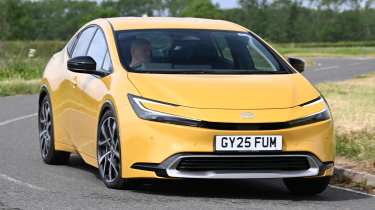
8. Toyota Prius
Toyota has given the Prius a sharp new look and it’s incredibly efficient, too.
- Hybrid prices from £37,900
- Maximum pure-electric range: 53 miles
Pros |
|
Cons |
|
The Toyota Prius has been offered with PHEV technology since its third generation, but in the UK the latest version of Toyota’s seminal hybrid is plug-in hybrid only. We’re not complaining though, because while a regular hybrid would surely be pretty efficient on its own, the latest model uses its larger battery to good effect.
Not just in terms of efficiency either, though there’s the usual caveat to give on claimed economy of well over 176mpg: you’ll need to maximise your time in pure EV mode for figures like that. You should still achieve better fuel economy figures than almost any other petrol or diesel car on the market. During our time running the Toyota Prius on our long-term test fleet, we’ve seen consistent economy figures of well over 70mpg and 400+ miles of range overall.
The plug-in is also the most potent Prius offered worldwide, with 220bhp at its disposal, for genuinely quick performance – 0-62mph comes up in only 6.8 seconds.
It’s pretty good in the corners too, certainly compared to previous versions of the Prius, and while it has some of the same compromises - such as an unusual and not always intuitive dashboard layout, and reduced practicality thanks to the sloping roof and shallow boot - excellent real-world efficiency and Toyota’s reputation for longevity more than make up for it.
“I continue to be quietly blown away by how excellent the Toyota Prius is. I love how easy it is just to climb into and go, achieving great fuel efficiency figures. The good ride quality on our rubbish town roads is also a constant source of delight.” - Steve Stucliffe, contributing editor.
- Who will like it: If you’re after a car with top class efficiency, the Prius is a great option.
- Who won’t like it: Those who need a lot of passenger or luggage space might not be impressed.
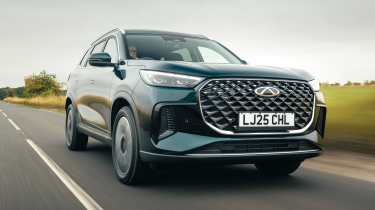
9. Chery Tiggo 8 Super Hybrid
New to UK shores, Chery clearly knows what it's doing when it comes to making affordable plug-in hybrid cars.
- Hybrid prices from £33,600
- Maximum pure-electric range: 56 miles
- Seven-seats as standard
Pros |
|
Cons |
|
New Chinese brands are currently taking the UK car market by storm, but when their cars are as well-rounded as the Chery Tiggo 8 - with its affordable price tag, high levels of in-car tech and fuel-sipping hybrid engines - it’s easy to see why.
With a starting price of under £34,000, you’re getting a great family car which should cost buttons to run. Not only was the Tiggo 8 the most efficient car which took part in our hybrid mega test, achieving over 60mpg, it thoroughly beat the second most efficient car, a Toyota C-HR, by 8mpg. It also took us 49 miles on all-electric power, just 7 miles short of its official electric range.
Clearly the Tiggo 8 has been designed with efficiency in mind, but it’s far from gutless. Sure, it’s not a driver's car with its pillow-soft ride and blowaway light steering, but its powertrain is reasonably punchy, so overtaking slower traffic or quickly merging onto fast roads shouldn’t be too difficult.
Practicality is a standout area for the Tiggo 8. Not only is it one of the best plug-in hybrid cars currently on the market, it’s also one of the best seven-seater cars. Getting in and out of the third row is quite easy thanks to wide door openings and the split folding rear second row rear seats. The rear space on offer is genuinely usable by adults over six-foot tall, although on longer journeys, we think the cramped rearmost row is best reserved for children.
Boot space is rated at a respectable 494 litres with five seats in place, although this shrinks to 117 litres when the third row of seats are up.
- Who will like it: Buyers after a plug-in hybrid car with seven seats.
- Who won’t like it: Some drivers might be put off as Chery is a new brand in the UK.
Latest Chery Tiggo 8 Super Hybrid deals
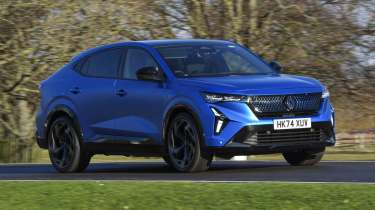
10. Renault Rafale E-Tech plug-in hybrid
If you want a plug-in hybrid with some French style, the Renault Rafale could be just the ticket.
- Hybrid prices from £45,000
- Maximum pure-electric range: 65 miles
Pros |
|
Cons |
|
The Renault Rafale might be the only plug-in hybrid car currently in the French manufacturer’s line-up, but it's also undeniably one of the very best PHEVs for the money.
The Rafale doesn’t follow the same rulebook as most of the other cars on this list with its coupe-SUV bodystyle, four-wheel drive, a tiny 1.2-litre three-cylinder turbo petrol engine underwriting its hybrid system, and a kerbweight of 2.4 tonnes. Somehow, it manages to work quite well.
Renault claims the Rafale can travel up to 65 miles on electric power, but in the real world we saw a smidge under 50 miles during our PHEV test. Once the battery had been drained, we saw an economy figure of 42.7mpg thanks to the hybridised engine which still utilises electric power from regenerative braking, even when the battery is flat.
If you’re after a comfortable long-distance cruiser, the Rafale should definitely be on your shortlist. It has long suspension travel and adaptive dampers which make light work of rough stretches of asphalt.
Around town, there’s a grown-up feel to the way the Rafale responds to steering inputs, and the rear-wheel steering helps it excel at tight manoeuvres. Just be warned that it isn’t particularly fun to drive as it feels a touch heavy and roly-poly through fast flowing corners.
The chic French styling continues on the inside. The bold interior design feels classy with its dyed cork or slate dashboard trim and electric blue fabric stitching.
All of the on-board tech can easily rival the very best cars from Germany, and we are big fans of Renault’s Google-based OpenR Link infotainment system, which is one of the best in the business.
You might think the Rafale’s sporty silhouette means it has limited practicality, but you’d be wrong. Despite its sloping roofline, even tall passengers in the rear should have no complaints. Even six-foot tall adults have headroom to spare.
The boot offers 535 litres worth of space, but the lack of underfloor storage in the plug-in hybrid version means you’ll have to store your charging cables elsewhere.
"The regenerative braking set-up isn’t quite capable of full one-pedal driving, but comes much closer than many other hybrids, because its strongest setting can bring the car all the way down to a slow creep after the driver lifts off the accelerator." - Ellis Hyde, news reporter.
- Who will like it: It’s comfortable, so will suit those who spend lots of time behind the wheel.
- Who won’t like it: Those who want a driver’s car will want to look elsewhere.
Latest Renault Rafale hybrid deals
How we choose the best plug-in hybrid cars
We pay particular attention to running costs and real-world efficiency because these are strong motivational factors for buyers in this PHEV segment. We test the electric range and fuel efficiency on all our road tests. Our 2025 range test showed the difference between claimed EV range figures and real-world numbers in PHEVs can differ a lot. While the MG HS achieved 99% of its official range, the Omoda 9 only got 82% on the same drive.
We then followed up on our 2025 range test in 2026 with another plug-in hybrid mega test to see how the technology was evolving and which powertrains and cars were the best on the market. We then compared real-world ranges, running and purchase costs and overall value to help create this list.
As it's typically larger cars which are offered with PHEV powertrains and feature on this list, we also pay closer attention to space and practicality in the cabin. The boot area can sometimes be compromised by the addition of the large battery pack so this gets plenty of attention on our tests.
A good plug-in hybrid will also transition seamlessly between the electric power source and the engine, offering quick responses and strong performance. The inevitable extra weight of the complex battery and engine combination shouldn’t be too evident in the way the car corners and rides over bumps.
Things to consider when choosing your plug-in hybrid
Plug-in hybrids might sound like the best of both worlds but as they have two powertrains, one petrol and one electric, they can be heavy and more expensive to buy compared to a pure petrol or diesel car.
This extra weight also negatively impacts fuel economy when the battery runs flat and you’re just using power from the combustion engine. This, alongside the higher starting prices means that plug-in hybrid tech tends to be offered in larger cars.
PHEV FAQs
Is a plug-in hybrid right for me?
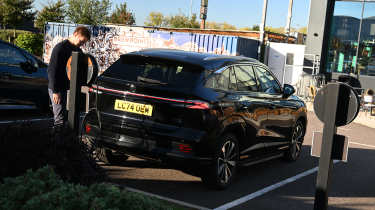
To make the most of having a plug-in hybrid, owners need to charge them regularly either at home or at work.
If you never exceed the electric range of a PHEV you will never use any fuel but once the battery is depleted on longer journeys, efficiency is likely to be worse than in an equivalent petrol car. That makes PHEVs a very cost effective option if you do lots of short trips with the occasional longer journey of 100 miles or more thrown in. If you rarely do longer journeys and have easy access to charging, a pure EV is worth considering. If you don’t have access to easy charging, do lots of long distance miles, a full hybrid or mild hybrid may prove cheaper to run.
Which is the safest plug-in hybrid?
There’s no simple answer to that particular question. For starters, every single one of the cars in our best plug-in hybrid rankings that has been crash tested by industry experts, Euro NCAP, have received the maximum five-star rating.
The Toyota Prius is the only car that we don’t have an official safety score for yet, but considering the Japanese brand’s reputation for reliability and the amount of standard safety kit it gets, we think a five-star rating is a pretty safe bet.
Which plug-in hybrid holds its value best?
According to our latest expert data, the Land Rover Defender 110 P300e is the plug-in hybrid that holds onto the most of its original value after three years of ownership and 36,000 miles covered. As much as 68% of its sticker price in fact, depending on the exact specification. Meanwhile the DS9 depreciates the most, retaining as low as 29per cent after the same period of ownership.
Deals on the best plug-in hybrid cars