New 2028 Skoda Karoq: mid-size SUV aiming to take the Chinese by surprise
A new Skoda Karoq is due in 2028, and our exclusive images preview how it could look
A new Skoda Karoq is on the way and it’s set to arrive sooner than expected. In fact, progress is so fast that the new Karoq could be here as early as 2028 as Skoda looks to match the speed of model development achieved by its Chinese competitors.
However, don’t think Skoda is just trying to rush its new mid-sized SUV into production. The Czech brand will still aim to deliver on all the same values as its other highly regarded models. Specifically, impressive levels of space, an easy-going driving experience with as few annoyances or distractions as possible will feature. The interior will also put sustainability front and centre, plus the Simply Clever ideas the brand is known for.

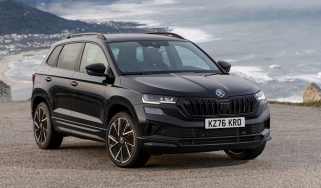
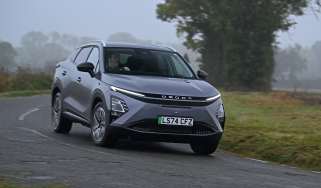
The current Skoda Karoq is fast approaching a decade on sale, but it remains one of the company’s most popular models. More than 102,000 examples were sold in 2025 alone, with roughly 10,000 of those in the UK. Key rivals such as the Nissan Qashqai and Kia Sportage have evolved much more in the past few years, and pressure in the segment is now fiercer than ever – mostly due to value-driven newcomers from China, such as the popular Jaecoo 7.
So a new model is long overdue; uncertainty around the EU’s forthcoming regulations regarding emissions was the main reason why Skoda held off from giving the all-new second-generation Karoq the green light sooner. But now it’s all systems go.
In an exclusive interview with Auto Express, Skoda’s head of technical development, Johannes Neft, revealed that the goal is to design, develop and ready this second-generation Karoq for launch in exactly three years – at least 12 months less than it would normally take the marque to bring an all-new model to market.
“This will be one of the fastest developments we will have in the Volkswagen Group and in the brand,” Neft told us. “The reason for that was it took us some time to make that decision because of the uncertainty of what’s coming up in Europe. But now we have taken the decision, and we will do that at ‘China speed’.”
Neft said the entire VW Group is working on speeding up the development processes in all areas, in common with many European car makers that are now trying to match Chinese manufacturers’ fast and agile way of working. The new Karoq will be one of the first examples of the speed the German goliath’s family of brands is now capable of.
What’s enabled Skoda to move so much faster with the new Karoq is that it will be based on an existing platform. “That really helps us and this is also what our Chinese colleagues are doing,” the development boss pointed out. “As soon as you have something existing, you can be much faster. This is what we are doing here and we try to make a lot of synergies with our existing cars as well to be fast, to be competitive.”
If you can't wait for the new model to arrive, you can buy a used Skoda Karoq for as little as £8,800 through our Buy a Car service...
What will power the new Skoda Karoq?
The MQB Evo platform that’s used by the current Kodiaq and Superb, plus the VW Golf and T-Roc, Cupra Formentor and numerous other cars, is the obvious solution. Particularly because Neft believes hybridisation is the most important thing the next-generation Karoq needs to have, with the architecture offering plenty of flexibility in that regard.
“The MQB Evo platform is still one of the most important platforms of the VW Group for sure, because it’s not only important in Europe, it’s important all around the world,” Neft added. “We are using MQB Evo in the States, in China, everywhere. Therefore this platform, for sure, will be updated as long as it is needed all around the world.”
VWs first-ever full-hybrid system will debut in the Golf and T-Roc later this year, and we’ve been told it’s coming to the Octavia as well. Here, a turbocharged 1.5-litre four-cylinder petrol engine is paired with two electric motors; one to help drive the wheels, with the other generating energy for a small 1.6kWh battery under the boot floor. This tech will allow cars to drive on pure-electric power to boost their fuel efficiency, without having to be plugged in.
A plug-in hybrid set-up may also be available in the new Karoq, such as the one found in the larger Kodiaq and Superb. This powertrain will also return to the Octavia line-up later this year. The Karoq will not be offered as an EV, with this role filled by the Auto Express Award-winning Elroq.
What will the new Skoda Karoq look like?
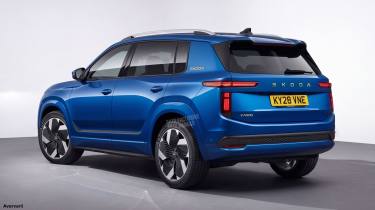
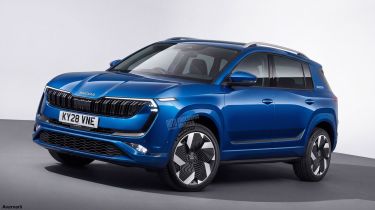
The Karoq is due to launch in 2028, but there have been no teaser images and we’re yet to spy any prototypes in testing as yet. Our exclusive images give a clue at how the model could look.
It’s not just a Kodiaq with a few feet chopped out of the middle. Skoda’s lead exterior designer Romain Bucaille would balk at such a notion, telling us: “If we repeat everything, you don’t need designers basically. A computer can do it or you just scale it, and then it all looks the same.”
The Karoq’s design will be guided more by the Vision O concept seen last year, which represents the next step in the evolution of Skoda’s ‘Modern Solid’ styling philosophy. Some of the elements have been carried over from the futuristic family wagon, including the black loop around the front, the sculpted powerdome bonnet and the razor-sharp daytime running light design.
Being petrol-powered, not electric, means the Karoq will need a tweaked interpretation of the Vision O’s Tech-Deck Face, but it should remain true to the general aesthetic of Skoda’s next-generation cars. We first saw it on the Elroq, and it also features on the new Epiq and Peaq SUVs.
As a result, we expect to see the use of a larger grille opening with vertical slats typical of Skoda models integrated into a more streamlined shape. Bucaille told us: “What is important is to have one design language and one family feeling in the showroom when we enter.
“You don’t want to have the electric cars on one side and the combustion cars on the other side and they look completely different. So we said we will keep some elements to be identified as a Skoda by the customer, whether it’s ICE, whether it’s BEV.”
So although the new Karoq is sure to look very different to the outgoing model, it will be immediately recognisable as a Skoda. Bucaille told us: “Our job is interesting because it’s the balance between how to keep the essence of Skoda’s design but how to make it new while still having that link. You don’t want to lose customers because you don’t want to do something completely different and you don’t want to lose them because you are just not evolving.”
What will the Skoda Karoq's interior be like?
Meanwhile, the interior will feature big displays running Skoda’s new Android-based infotainment system and, hopefully, physical climate controls like the ones set to appear in the flagship Peaq. In terms of Simply Clever features, all the classics should be present, such as an umbrella hidden in the driver’s door and an ice scraper tucked into the tailgate. But we’re sure the boffins at Skoda will have a few new bright ideas to go with them.
The current Karoq starts from just under £31,000, which is within a few hundred pounds of its Qashqai and Sportage competitors. We expect the new model will be similarly competitive on price within the mid-sized SUV class, although the hybrid and plug-in models will inevitably command a small premium.
The new Karoq is part of the brand’s plan to provide buyers with an equally strong selection of combustion and electric cars. Head of sales and marketing for Skoda, Martin Jahn, told us earlier this year: “We will run combustion-engined cars as long as the customers want them, as long as it’s legally possible and as long as it’s financially viable for us.”
By the end of next year, Skoda will also fit the current-generation Fabia and Kamiq with their own mild-hybrid systems, the same as we’ll see in the new Volkswagen Polo supermini.
Don't miss out! See more of Auto Express in your Google Top Stories. Click here...