Used Vauxhall Astra (Mk7, 2015-2022) review and buyer's guide
A full used buyer’s guide on the Vauxhall Astra covering the Astra Mk7 that was on sale between 2015 and 2022

Verdict
In 2016, the Astra K was European Car of the Year, so it’s no lame duck, despite disappointing results in our Driver Power surveys in 2019. There’s no knockout styling, class-leading warranty or brilliant dynamics, while owners’ forums suggest reliability can be an issue with early cars. While Vauxhall’s lack of badge appeal steers some people away from the Astra, this hatch has plenty to recommend it. It’s no class-leader, but you get plenty for your money, the roomy cabin is comfortable, plus the large sales volumes and lacklustre image conspire to ensure that the Astra can make a sensible – and good value – used buy.
In recent years car buyers have been drawn towards either bargain basement or premium car makers, which has made life difficult for firms between those extremes.
One such brand is Vauxhall, which sits very much in that middle ground by offering decent cars, but ones with little in the way of unique selling points. It’s been the same way since well before the first Astra went on sale 40 years ago, and we’ve had many versions that have been average at best; however things took a turn for the better with the Mk6, in 2009.
Used - available now

2019 Vauxhall
Astra
22,270 milesManualPetrol1.4L
Cash £10,499
2019 Vauxhall
Astra
31,935 milesManualPetrol1.4L
Cash £8,199
2021 Vauxhall
Astra
28,286 milesManualPetrol1.2L
Cash £10,397
2021 Vauxhall
Astra
45,438 milesManualPetrol1.2L
Cash £10,106That car was so good that when Vauxhall replaced it in 2015, it was with a model that didn’t look a lot different, arguably because it didn’t have to. But how does the seventh-generation iteration stack up on its own, and should you buy a used one?
History
The Mk7 Astra, or Astra K, arrived in UK showrooms in October 2015, priced from £15,295. The range consisted of 99bhp 1.4, 104bhp 1.0T, 124bhp and 148bhp 1.4T, and 197bhp 1.6T petrol engines; all of these were turbocharged, except the 99bhp unit. A 1.6 CDTi diesel motor with 109, 134 or 158bhp was also offered.
Initially the car came only as a five-door hatchback, but by March 2016 there was a five-door estate, called the Sports Tourer, with the same engines and trims as the hatch. From April 2018 a new range-topping Ultimate trim was offered only on the hatch.
A facelifted Astra arrived in September 2019 with aerodynamic improvements to improve fuel economy, a nine-speed automatic gearbox, upgraded engines and extra driver-assistance systems. The Mk8 Vauxhall Astra arrived in 2022 to replace this car.
Which one should I buy?
All of the engines, gearboxes and trims are decent enough, but the non-turbo 1.4 feels weak compared with the alternatives. Entry-level Design trim gets 16-inch alloys, air-con, cruise control, electrically adjustable, heated door mirrors, all-round electric windows and a seven-inch touchscreen with Bluetooth.
Each trim adds to that list, with Tech Line also featuring upgraded infotainment with nav, while Energy has 17-inch wheels, plus heated front seats and steering wheel. SRi has sports seats, 17-inch rims, auto lights and wipers, plus extra safety systems. The Elite has leather, heated rear seats, dual-zone climate control, and nav on Elite Nav trim. Ultimate adds LED headlights, 18-inch wheels and further safety systems.
Alternatives to the Vauxhall Astra
The Ford Focus is at the top of this segment in terms of sales; with a wide model range, keen prices and superb dynamics, it’s hard to beat. But VW’s Golf gives the Ford a run for its money due to excellent engines, a classy cabin, hi-tech equipment and refinement.
The SEAT Leon is more keenly priced, while the Mazda 3 is a blast to drive, has a superb interior and is well equipped. The Hyundai i30 and Kia Ceed provide a great balance of space, kit, build quality, reliability and value, while the Peugeot 308 is worth shortlisting for its comfort and low running costs.
What to look for
Engines
Some early Astra K petrol engines suffered piston ring failure. Using Dexos 2 oil rather than Dexos 1 is key to avoiding this.
Dials
Fuel gauges in early examples of the Astra K could under-read at times, but software updates should have fixed this on most cars by now.
Motor
The Astra’s 1.4-litre turbocharged engine can suffer from a flat spot at around 3,000rpm, especially when the motor is under load.
Clutches
Be warned: worn clutches on low-mileage cars and noisy front suspension seem to be disappointingly common traits.
Interior
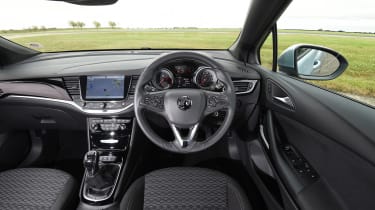
The Astra’s dash looks quite modern and of a high-quality finish; it’s also fairly user-friendly. Some cars had glitches with Android Auto smartphone integration, but software updates should have fixed them. Cabin space is good, with lots of room for four people, although it’s tight for five. The boot is a competitive 370 litres with the seats up, or 1,210 litres with them down; the estate has 540 and 1,630 litres.
Running costs
The Mk7 needs servicing every 12 months or 20,000 miles, with three levels of check-up: Interim, Main and Major. Engines are chain-driven, except the 1.2 turbo, which has a wet cambelt with no fixed replacement interval. Only cars built from 2019 have this, neither Vauxhall nor its dealers could give us a cost to fit one.
Recalls
The Astra K has been recalled four times. In December 2016 airbag issues affected 1,745 cars (including some Merivas). Brake-hose issues saw 713 Astras recalled in July 2018; only officially converted police cars were affected. Braking problems caused the third action in December 2018, where 37,167 models had a series of unspecified faults. In October 2019, 1,688 Astras and Insignias were recalled for poorly welded seat frames.
Driver Power owner satisfaction
The Astra Mk7 crept into the Driver Power 2019 New Car Survey in 75th place (out of 75); it was 70th out of 100 in the Used Car Survey. It didn’t score highly in any area; the only ones in the top 30 were for infotainment and the convenience of the switch positioning. Most scores were mid-table, but front-seat comfort, interior quality and the brakes all came towards the bottom.
Vauxhall Astra (2015-2022) review: What we said
Extracts from our 2021 in-depth review of the Mk7 Vauxhall Astra...
The Astra was trailing its rivals slightly before it benefited from an update in 2019 that brought some great engines and some useful trim revisions. It can’t quite match the Volkswagen Golf or Ford Focus as a complete package but the Astra is a capable, comfortable and efficient all-rounder nonetheless. There should be an Astra to suit most needs thanks to a range of trims, and the good value Griffin model is very well equipped.
It’s not the last word in driving fun, but this Astra was developed in the UK and it shows – it performs very well on our roads. It also looks great inside and out, especially after its subtle nip-and-tuck update in 2019, while the up-to-date engines have helped to keep Vauxhall’s family favourite competitive.
About the Vauxhall Astra
The Vauxhall Astra has long stood alongside its big-hitting Ford Focus and Volkswagen Golf rivals as one of the biggest names in the UK family car market. Now in its seventh generation and refreshed in 2019 with an updated engine and trim level line-up, the Astra remains competitive in a segment that’s packed full with talented rivals.
It’s not just the big names like the VW Golf, Ford Focus and Honda Civic that the Astra has to battle with these days, as the crowded compact hatchback class includes an impressive roster of rivals from the sporty SEAT Leon and Mazda 3 to the more comfort and practicality focused Peugeot 308, Skoda Octavia and Renault Megane. These days, even the Kia Ceed and Hyundai i30 are dependable and well-equipped alternatives for once dyed-in-the-wool Astra fans.
Still, the Astra continues to tick most boxes – it’s spacious, well put-together and its engines blend performance and economy well. It’s good to drive, boasts a particularly comfortable ride and comes well equipped throughout its revised (and easier to understand) range. The Astra range includes a five-door hatchback and a revised Sports Tourer estate, so buyers seeking more space have an alternative to the British brand’s SUV offerings, too.
Trim levels have been reduced to just four in the current Astra line-up, namely the best-selling Griffin Edition, the Business Edition Nav, the SRi Nav and the Elite Nav Premium, but the grades are still a little bit confusing. For instance the cheapest Griffin comes very well-loaded with 18-inch diamond cut alloy wheels, LED headlamps, dual-zone climate control, 7-inch touchscreen with satnav, all-round parking sensors and heated seats and steering wheel, as well as a driver assistance pack with lane keeping assistance and automatic emergency braking.
Business Edition Nav trim is more expensive but less showy thanks to smaller 16-inch alloys, and you lose the LED lighting and dual-zone climate control function. Cruise control plus automatic headlamps and wipers are on the spec list instead. SRi Nav brings back the LED headlamps and dual-zone climate control, and also gives you front fog lamps, automatic emergency braking and a sports-style driver’s seat. Elite Nav Premium has a larger 8-inch touchscreen, perforated leather seat trim inserts, an 8-inch digital dash display, the driver assistance pack and heated seats. Hot-hatch fans will be disappointed by the lack of a sporty VXR model, however.
The entire Astra engine line-up was updated in 2019 with a view to improving fuel economy, emissions and performance. The petrol range consists entirely of turbocharged three-cylinder engines: three 1.2-litre units with 110PS, 130PS and 145PS respectively, plus a 1.4-litre unit with 145PS that’s available exclusively with a ‘Stepless’ CVT transmission.
The three diesels are turbocharged three-cylinder units too; 1.5-litres with 105PS or 122PS. They each can be had with a six-speed manual gearbox, but the more powerful version is the only car in the range with a conventional automatic – a nine-speed unit.
Engines, performance and drive
The Vauxhall Astra is built and was developed in the UK – not something that most of its rivals can claim. This means that it’s particularly suited to our roads; the suspension is tuned for imperfect tarmac so ride quality and body control are excellent. Tweaks to the car’s chassis came with the 2019 update but these were fairly subtle – there wasn’t much wrong with the way the old car went about its business.
The recently updated engine range has paid dividends in the way the Astra drives. We’re particularly fond of the diesels, which boast plenty of torque for unruffled acceleration; they’re particularly in-keeping with the Astra’s smooth, well resolved driving experience.
Elsewhere, the slick but slightly rubbery feeling manual gearbox impresses, as do the responsive steering and reassuring brakes. Rather than being a hatchback that only excels when taken by the scruff of its neck, the Astra is a great drive most of the time and remains a quietly competent car.
In corners, the steering feels light and quick, and while there isn’t a lot of feedback, it allows you to make the most of the tenacious grip on offer and place the car easily through bends.
What may surprise you is that the car is as rigid in its sportier settings – SRi models and above sit on the same chassis settings as other cars, with only wheel and tyre combinations making a slight difference to the ride and handling balance. For the record, we’d be very happy with an SRi model, with a ride that is composed and much more compliant than its predecessor’s.
You’ll feel bumps, but the dampers take the edge off them nicely and control the body tightly so you can carry speed in total safety. This also means the Astra is a quiet and refined cruiser, and there’s little wind or road noise at motorway speeds.
Overall, the Ford Focus is the better driver’s car and a Volkswagen Golf is more polished – but ultimately there will be little to complain about in the way the Astra drives for most.
Engines, 0-60 acceleration and top speed
The Astra’s engine range was reworked in 2019 to improve emissions, fuel economy and performance across the board. There are four petrol engines and two diesels to pick from, available in conjunction with a six-speed manual, nine-speed auto or a CVT depending on which you go for.
A trio of turbocharged 1.2-litre three-cylinders headline the petrol range, producing 108bhp, 128bhp and 143bhp.
There’s a 1.4-litre three-cylinder too, producing an identical 143bhp to the highest-powered 1.2-litre engine, but with more torque and fitted exclusively with a continuously variable transmission (CVT). Low emissions should appeal especially to fleet users, while 0-62mph times around the nine-second mark mean it’s no slouch.
Our preferred engines are the diesels, badged Turbo D and producing either 104bhp or 120bhp, from a 1.5-litre turbocharged three-cylinder. We tried the more powerful of these and found it a perfect fit; its smooth character and torquey delivery tally up nicely with the car’s well-sorted chassis. You can have it with a six-speed manual or an excellent nine-speed automatic if you prefer. The more powerful models are able to crack 0-62mph in just under 10 seconds.
MPG, CO2 and running costs
The Vauxhall Astra’s refreshed engine range brings with it improvements in fuel economy and emissions. Average fuel economy figures don’t dip below 50mpg, aside from the most powerful 1.4-litre 143bhp CVT auto model at 49.6mpg.
The most efficient options in the range are the diesels. The lesser-powered six-speed manual version in entry-level SE spec, returns a maximum of 65.7mpg under the WLTP testing procedure, and emits just 113g/km of CO2. Provided you don’t need to drive in diesel-banned city centres very often, this engine is the most frugal choice.
Vauxhall claims all 1.2-litre petrol versions (110PS, 130PS and 145PS) manage to emit 119g/km of CO2, while WLTP figures show average efficiency of up to 54.3mpg.
The automatics fare well, too. The CVT-equipped, 143bhp 1.4-litre engine manages 50.4mpg with CO2 emissions from 129g/km, while the most powerful 1.5-litre diesel auto version returns up to 56.5mpg on average and emits 133g/km of CO2.
There’s little doubt that the Astra’s revised engine line-up has kept it competitive in this segment – it’s a welcome bonus that each unit performs well too.
Interior, design and technology
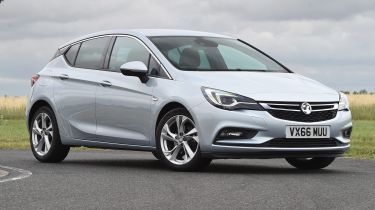
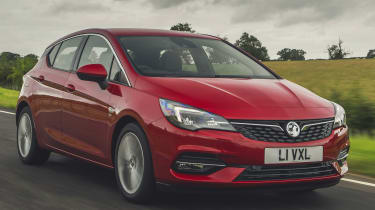
Compared with some of its conservatively styled rivals, the latest Astra looks sharp. From the neatly sculpted front bumper and grille to the swept-back headlamps and sharp creases running down the sides, it packs plenty of visual punch. In SRi guise, the Vauxhall looks surprisingly sporty, and this is enhanced by standard-fit 17-inch alloy wheels.
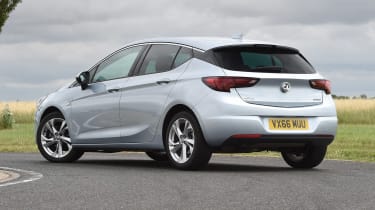
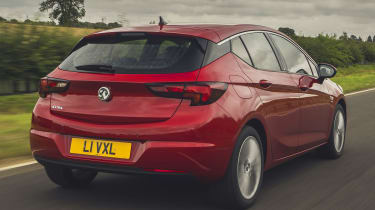
A rising window line follows the ridge running through the door handles, culminating in a flick that almost meets the roof at the top of the bootlid. This design flourish does reduce rear visibility, but the upshot is that it gives the Astra an athletic stance in profile. Narrow tail-lights mounted high up continue the sporty theme, while a boot spoiler and narrow rear window make the car look more compact.
Inside, the Astra is feeling its age slightly despite a mild freshen-up in 2019. It’s functional, ergonomically sound and feels built to last, but it simply can’t match the quality of a Volkswagen Golf, the style of a Mazda 3 nor the great infotaiment of a Ford Focus or Kia Ceed. Still, it’s not terrible by any means and remains a comfortable place to spend time – particularly in higher-spec versions.
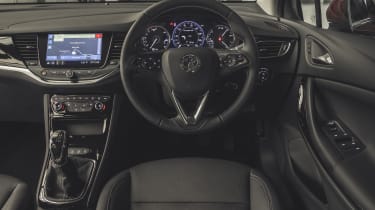
Vauxhall interior design has been impressive of late, with a stylish, easy to use dash and good-quality materials used, too. The Astra takes that a step further with strong tech on board as well – all operated through an intuitive seven- or eight-inch touchscreen.
That screen sits neatly in a classy piano black surround that stretches across the width of the dashboard and is underlined by a stylish piece of chrome-effect trim. The main instruments also have an information screen between them and the graphics are nice and clear.
Navigate the range and you’ll find all manner of goodies either standard fit or as optional extras. 360-degree parking sensors and self-parking system feature, along with LED headlights – which strangely are standard on the smaller Corsa, but not here. Heated and ventilated seats, dual-zone climate control and a premium Bose stereo are also available.
Sat-nav, stereo and infotainment
All Astra models get Apple CarPlay and Android Auto as standard, while models further up the range get a larger eight-inch touchscreen. While the graphics don’t look quite as crisp as you'll find in a Kia Ceed or Ford Focus, the unit is incredibly functional and works well, with a logical layout.
Practicality, comfort and boot space
When it comes to space for all the family, the Astra does a good job of offering decent, if not spectacular, accommodation for five people. It’s not quite as generous in the back as a Skoda Octavia, but it’ll keep passengers happier than those in a Ford Focus. The boot is a decent size and shape, too, although the Astra Sports Tourer estate offers more space for around £1,500 extra. The Astra’s centre stack doesn’t have a big lidded tray like in a Golf, although a pair of cup-holders, decent door bins and two USB charging points in the rear, boost usability.
Size
The Astra is more or less the same size as most of its major rivals – differences between it and the Ford Focus or SEAT Leon are so small as to be insignificant. It’s a little longer than the latter (4,370mm vs 4,282mm) but has a smaller boot by 10 litres.
Leg room, head room & passenger space
Although the Astra is smaller than its previous iteration, it offers more space for passengers. Set the driver’s seat for a six foot-tall driver and a six foot passenger will be able to get into the back easily (the doors open nice and wide in the back, which is handy for fitting child seats and children), while knee and headroom are both impressive. It does feel noticeably darker and less airy in the rear than in cars like the Ford Focus, however.
There’s plenty of adjustment for the driver’s seat and the steering wheel, while forward visibility is good. Over the shoulder visibility is slightly compromised by the rising waistline of the car and hefty rear pillars.
Boot
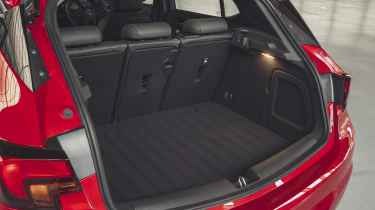
Open the Astra’s boot and you’re presented with a nice square shape and a ribbed floor – very handy to stop items rolling around. There’s a bit of a lip to heave things over, but it’s no worse than in most hatchback rivals.
Thanks to its simplified rear suspension layout, the Astra offers a bigger boot than its predecessor, with a 370-litre capacity. However, it still trails the most spacious hatchbacks, such as the Honda Civic and Peugeot 308, for luggage space.
Fold the seats down – which is easy enough to do – and there’s a step between the boot floor and the seat backs. That can be eradicated if you choose to go for a space-saver spare wheel, in which case the boot floor rises to the same level as the backrests when the seats are folded. The downside is a slight reduction in boot capacity.
Our Car Tax Checker tool lets you check your tax status and renewal date in seconds. Check your VED car tax now...