Volkswagen ID.5 review
Coupe-SUV version of the ID.4 costs more, carries less and offers marginal efficiency gains over its sibling

Our opinion on the Volkswagen ID.5
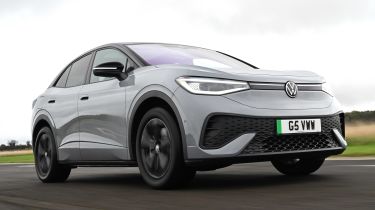
As with many coupe-SUVs, the Volkswagen ID.5 offers sportier looks and better efficiency than its standard-shaped sibling (in this case, the VW ID.4), but you pay extra for the privilege and have to accept a compromise on practicality. Thankfully, VW’s EV platform offers plenty of the latter even in coupe-SUV guise. It delivers a comfortable and dynamically acceptable drive, too. Hence, it’s not such a hardship to choose the ID.5. However, you’ll have to do a lot of miles before the benefits of its greater efficiency cancel out the price difference between the ID.4 and ID.5.
About the Volkswagen ID.5
Coupe-SUVs are a bit of a contradiction, but that hasn’t stopped manufacturers tapping into the style to help shift more units. In fact, cars such as the Volkswagen ID.5 could make a better argument in their favour, because an EV needs smooth aerodynamics to boost efficiency, and yet the SUV part of the equation means there’s some semblance of practicality still on offer.
The ID.5 is the sister car to the ID.4, and it features the same range of battery and drive configurations. The only real difference is with the roofline, with the ID.5 featuring a lower roof and a shallow tailgate that does without a rear windscreen wiper.
Used - available now

2022 Toyota
C-HR
22,000 milesAutomaticPetrol1.8L
Cash £18,750
2016 Toyota
Yaris
76,100 milesAutomaticPetrol1.5L
Cash £7,994
2014 Ford
C-Max
52,900 milesManualDiesel1.6L
Cash £6,995
2018 Bentley
Bentayga
32,250 milesAutomaticPetrol6.0L
Cash £51,995Under the skin, there’s a rear-mounted electric motor that sends power to the back axle, while 4MOTION four-wheel drive is available on the twin-motor variants. There are three battery sizes available, while Essential, Match, Black Edition and GTX trims are offered.
We've pitched the VW ID.5 against the Skoda Enyaq Coupe in a twin test, where we found that while the ID.5 provides a similarly relaxing driving experience, its interior wasn't as well finished as what you'll find in the Enyaq Coupe, and the infotainment (now updated to a 12.9-inch screen with improved software) harboured too many annoyances to justify us putting this VW ahead of the Skoda.
Volkswagen ID.5 prices and latest deals
Updates and revisions to the ID.5 line-up mean that starting prices have fallen over time, and the line-up kicks off with the Pro Essential at around £37,000. Interestingly, the smaller battery Pure Match is pricier, at £41,000, while the Pro Match is £5,000 more at around £46,000. The Black Edition comes in at around £48,000, while the flagship GTX is around £54,000.
For those looking to take advantage of the Government’s electric car grant (ECG), two versions of the ID.5 qualify for the ‘Band 2’ discount. Both the entry-level ID.5 Pure Match and Pro Essential get a £1,500 discount, helping to make them more affordable for those going electric.
If you’re interested in other versions of the ID.5, you can still find plenty of great deals via our Find a Car service. You can configure your ideal VW ID.5 and receive top offers from our huge network of dealers, browse the very latest VW ID.5 leasing deals or take a look at the best used VW ID.5 models. If you already have a car and need to sell it, be sure to visit our Sell My Car page.
Performance & driving experience
Pros |
|
Cons |
|
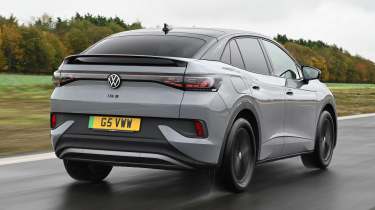
Volkswagen’s dedicated MEB electric vehicle platform has proven its versatility in a range of EVs, and here in the ID.5, there’s plenty of comfort on offer. The smallest wheel option available measures 19 inches, but the tyre has tall sidewalls and actually looks a little lost in the ID.5’s wheelarches – that seems odd to say for a large rim size that was considered big not even a decade ago – but the trade-off here is a plush ride on all road surfaces.
Electric motors, 0-60mph acceleration and top speed
With 0-62mph times starting at 8.9 seconds and going down from there, no ID.5 is slow off the line, while the GTX is at the quicker end of the EV drag race scoreboard at 5.4 seconds to achieve the same acceleration sprint. With direct drive to the rear wheels, the ID.5 pulls away on full throttle with zero fuss, while 4MOTION four-wheel drive boosts the GTX even further.
Our preferred Pro 77kWh version gets from 0-62mph in a highly respectable 6.7 seconds, which is the same as the entry-level Skoda Enyaq Coupe, but a little behind the equivalent Long Range Rear Wheel drive Tesla Model Y, which gets from 0-62mph in 5.4 seconds.
| Model | Power | 0-62mph | Top speed |
| ID.5 Pure 52kWh | 168bhp | 8.9 seconds | 99mph |
| ID.5 Pro 77kWh | 282bhp | 6.7 seconds | 112mph |
| ID.5 GTX 79kWh | 335bhp | 5.4 seconds | 112mph |
Town driving, visibility and parking
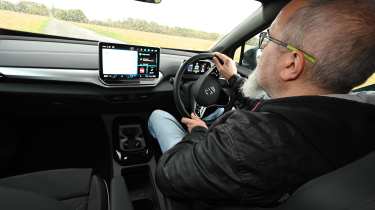
Comfort is the watchword for the ID.5, because much like the ID.4, there’s a quiet refinement that means every drive is relaxing. There are 19-inch wheels as standard, but they’re fitted with tyres that have a substantial sidewall, so bumps are absorbed easily.
Light controls and a decent turning circle boost the ID.5’s manoeuvrability, although rear visibility is compromised due to a lack of rear wiper and a trim piece that bisects the rear window.
As you might expect from an electric car, the ID.5 has quick responses from a standstill, and it easily keeps pace with traffic. Throttle response is progressive, so you can be pretty smooth in stop and go traffic.
There are only two levels of energy recovery on offer, and these are chosen via the drive selector. The standard ‘D’ mode offers conventional coasting, but switching to the ‘B’ setting adds some more resistance when slowing. It’s quite subtle when compared with some rival systems, and you still need to apply the brakes to come to a complete halt.
Country road driving and handling
A rear-motor, rear-wheel-drive configuration gives the ID.5 links with the original Beetle, but there are no signs of that car’s wayward rear-biased handling traits. You can feel the electric motor pushing the car if you use all of its power, although the car’s electronics soon intervene if it senses that the tyres are being overwhelmed.
For most of the time, the ID.5 remains neutral and well balanced, although the car’s weight does limit the amount of fun to be had. Body roll is kept in check reasonably well, but this still feels like a heavy car in corners. It’s best to make the most of the ride, which remains comfortable at higher speeds.
Motorway driving and long-distance comfort
Things don’t change much on the motorway, where the ID.5 is quiet, smooth and comfortable. There’s more than enough power on tap to get up to the national limit without any fuss; simply press the throttle, and you’re away. There’s minimal road and wind noise, too.
"When you’re on the motorway, the VW’s lane-assist system can occasionally tug the wheel if you drift slightly from the centre, and it gets quite firm in its response if you change lanes without indicating. It’s easy enough to deactivate the system via the main touchscreen, although you have to do this every time you start the car." – Dean Gibson, Senior test editor
Range, charging and running costs
Pros |
|
Cons |
|
While a coupe-SUV body offers a compromise in terms of practicality, it makes up for it with greater efficiency. Overall, the Volkswagen ID.5 can go further on a full charge than the ID.4 that uses the same batteries, although there are variations depending on which trim level you choose. There are three battery sizes offered that come in Pure, Pro and GTX guises, and respectively they have 52kWh, 77kWh and 79kWh of usable capacity – VW quotes these figures to give you a better idea of how far you’ll be able to go on a charge.
Electric range, battery life and charge time
The smallest Pure battery offers an official range of 277 miles from a full charge, while upgrading to the 77kWh battery unlocks a range of 344 miles in the same trim level. However, the official figures vary according to trim level. The Black Edition uses the Pro powertrain, but VW quotes a shorter official range of 341 miles; blame the extra weight of the standard-fit panoramic glass roof for that anomaly.
At the top of the range, the GTX has the biggest battery, but also the most power and 4MOTION four-wheel drive, so VW quotes 327 miles of range for that one.
During our time with the ID.5 Black Edition we saw a return of 3.7 miles per kWh on roads ranging from urban to motorway, which is pretty efficient in the compact electric SUV class.
Peak charging speeds aren’t at the cutting edge of the electric movement these days (145kW for the 52kWh battery, 135kW for the 77kWh battery, 185kW for the 79kWh battery), but you can still get the car from 10-80 per cent capacity in under 30 minutes from a powerful enough source.
If you want to fully replenish the 59kWh battery in the base car using a standard 7.4kW home wallbox, it'll take about nine hours, while the larger capacity 77kWh and 79kWh units require around 12 hours to be fully recharged.
| Model | Battery size | Range | Insurance group |
| ID.5 Pure | 52kWh | 227 miles | 25 |
| ID.5 Pro | 77kWh | 344 miles | 35 |
| ID.5 GTX | 79kWh | 327 miles | 41 |
Insurance groups
Group ratings are slightly higher for the ID.5 than they are for the ID.4, so that’s another extra expense that you’ll need to factor in. They start at 25 and span all the way to group 41, while the ID.4’s groupings are 23-39.
Tax
The revised £50,000 luxury car surcharge threshold (which comes in from 1 April 2026 but applies retrospectively to cars registered from 1 April 2025) means the majority of the range is only subject to the standard rate of vehicle excise duty (VED), which is £195 at the time of writing. The GTX Edition is over this limit, which means you'll be charged £620 per annum from the second time the vehicle is taxed until it is six years old.
As with all electric cars, the ID.5 currently attracts a mere three per cent Benefit-in-Kind (BiK) company car tax rate, rising to four per cent for the 26/27 tax year, and five per cent for the 27/28 tax year.
Depreciation
The ID.5 has residual values in the 44-48 per cent range after three years or 36,000 miles, which is a similar ballpark to the ID.4. According to our figures, that's better than its Skoda Enyaq Coupe sibling, which will only retain between 41 and 43 per cent over the same period. However, the Nissan Ariya is likely to retain between 48 and 59 per cent of its initial value, while the Tesla Model Y is likely to retain between 49 and 67 per cent.
To get an accurate valuation on a specific VW ID.5, check out our free car valuation tool...
Interior, design and technology
Pros |
|
Cons |
|
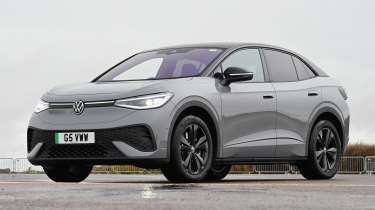
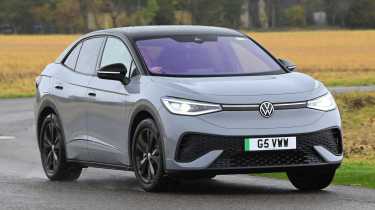
The design of the Volkswagen ID.5 differs from that of the ID.4 from the window line up, with a gentler curve to the roofline and a more hatchback-style rear end. The rest of the design echoes that of its sibling, so it’s clean and simple, with large VW badges and slender LED lights front and rear.
There’s chrome trim and machined alloy wheels for most trims in the line-up, while the formula for the ID.5 Black Edition is simple: take the top-spec Pro Match model and add gloss-black detailing and a bit of extra kit on board. To that end, there are 19-inch gloss-black alloys featuring those neat VW centre caps that remain upright every time you’re stopped, plus a contrast black roof with panoramic glass. Inside, the front seats are upgraded to sportier items featuring VW’s ‘ArtVelours’ microfibre upholstery and electric adjustment and a massage function for the driver’s seat.
Ironically, while Grenadilla Black is a colour option, you can also get the Black Edition in Kings Red, Glacier White, Blue Dusk or Moonstone Grey, while the wheels can be upgraded to 20 inches for an extra £500.
The updates are relatively subtle, but the £2,000 premium that the Black Edition commands over the Pro Match model is less than you would pay for panoramic glass (£1,000) and the £1,400 Interior Style Plus pack that adds massage seats to that model. So the Black Edition does offer some decent value for money to go with its different style.
Interior and dashboard design
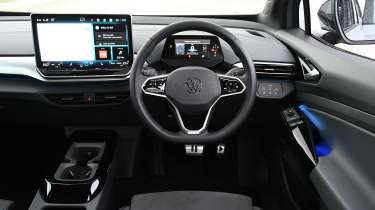
The cabin is carried over from the ID.4, so there’s a straightforward, clean design, but there’s little of the flair that you’ll find in rival models such as the Renault Scenic or Peugeot E-3008. The simplified dashboard design is dominated by the main touchscreen, while the driver benefits from a small dashboard display with essential information only.
One irritation that’s carried over from the ID.4 is the fitment of touch-sensitive steering wheel controls. They’re surprisingly awkward to use when you want them, but then they’re too easy to brush when you’re turning the wheel, so you can end up cranking up the volume or engaging cruise control by accident.
Materials and build quality
Disappointingly, material quality in the cabin is rather average, with a few too many hard plastics on display. Piano black plastic and aluminium trim give it a bit of a lift, while flock-lined door bins do add an upmarket touch. The materials aren’t the best, but the build quality is still up to VW’s usual high standards.
Infotainment, sat-nav and stereo
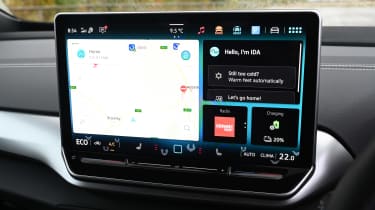
All versions of the ID.5 come with a 12.9-inch central touchscreen as standard, and this is used to control nearly all of the functions on board. This includes the climate settings, although a strip of quick-access functions, such as the climate temperature and heated seats, are a permanent feature across the bottom of the display. There are sliders to adjust the temperature and radio volume under the screen, but they aren’t the easiest to use while on the move.
Quick loading times - particularly for route mapping - are a plus point, while wireless Apple CarPlay and Android Auto are convenient features that work better than the built-in software. As well as the main display, there’s the useful 5.3-inch digital instrument pod, which is fitted to the steering column and adjusts with the steering wheel so it’s always visible.
"I’ve never found VW’s touch-sensitive controls that easy to use. They are either too sensitive or not sensitive enough, and it seems odd to be pressing a piece of plastic without it moving under your finger to confirm that you’ve actually made a selection. Newer cars, such as the latest Tiguan, have moved back to physical buttons, so I just hope they’ll appear on the ID.5 in the future, too." – Dean Gibson, Senior test editor
Boot space & practicality
Pros |
|
Cons |
|
The sportier roof line of the ID.5 is designed to cut through the air more cleanly than the ID.4’s, and while some coupe-SUVs also have to contend with compromised practicality, that isn’t really the case here. There is less headroom than in an ID.4. but only the very tall will notice the difference. Other than that, and the view out of the rear-view mirror, cabin space is largely identical to the ID.5.
Dimensions and size
As you can see from the figures, the ID.5 is lower than the ID.4 of course, but it’s also slightly longer. The Ford Explorer and Renault Scenic are similar in size, while the Peugeot E-3008 is the closest ID.5 rival in terms of having a coupe-style roof, but it’s taller and wider, but has a shorter wheelbase than the VW.
| Dimensions comparison | |||
| Model | Volkswagen ID.5 | Volkswagen ID.4 | Renault Scenic |
| Length | 4,599mm | 4,584mm | 4,470mm |
| Width | 1,852mm | 1,852mm | 1,864mm |
| Height | 1,618mm | 1,634mm | 1,572mm |
| Wheelbase | 2,771mm | 2,771mm | 2,785mm |
| Boot space | 549-1,734 litres | 543-1,734 litres | 545-1,670 litres |
Seats & passenger space
There’s a wide range of wheel and seat adjustment in the ID.5, and the added bonus of the digital driver’s display being attached to the steering column means it moves with the wheel to remain in sight irrespective of your driving position. On higher-spec cars, the front seats are upgraded to sportier items featuring integrated head restraints and VW’s ‘ArtVelours’ microfibre upholstery. There’s also electric adjustment for the front seats with a massage function.
There’s good storage here, too, with a deep central recess for drinks that has an adjustable divider featuring a bottle opener. Ahead of that, the cubby incorporates a wireless phone charger on some models, while there’s a second tray above that. The door bins have a flock lining to stop items rattling around, and there’s good space in here, too.
The back seats also offer a generous amount of space, and as we’ve already mentioned, the sloping roof only really causes issues if you’re tall, because there’s still plenty of headroom on offer. The flat floor gives room for all three passengers to sit comfortably, and legroom is good. There are air vents and a USB socket in the back, too.
Boot space
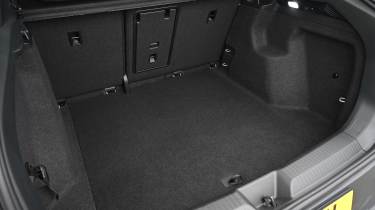
Volkswagen quotes a cargo capacity of 549 litres for the ID.5, which is six litres more than in the ID.4. This is measured to the window line, so the more steeply raked tailgate doesn’t factor into this. As with the ID.4, there’s storage under the floor for charging cables, but there’s no extra space under the bonnet.
The back seats have an offset split, while a ski hatch allows you to load longer items while keeping the two outer seats in place. The boot is easy to load, thanks to a floor that’s level with the boot lip, while a slight rise in the floor when the back seats are folded helps with getting larger items out.
Towing
As with the ID.4, the best version for towing is the ID.5 GTX, which has a maximum capacity of 1,800kg. 4MOTION models can tow up to 1,200kg, while the rest of the range is limited to 1,000kg. It’s worth noting that any towing you do will have an impact on overall range, and if you’re hauling the maximum, it can reduce the car’s range by up to half.
Reliability and Safety
Pros |
|
Cons |
|
The ID.5 is based on the VW Group’s MEB platform that is used by a wide range of electric models, so strength in numbers should help it to gain a reputation for reliability. And with fewer moving parts to contend with, this should help with overall customer satisfaction, too.
The ID.5 shares its five-star Euro NCAP rating with the ID.4, which was tested by the safety body in 2021. On top of that, the ID.4 (and therefore the ID.5 as well) earned Advanced status for its advanced on-board safety technology.
Standard safety kit includes adaptive cruise control, autonomous emergency braking with cyclist and pedestrian detection, a driver fatigue alert system, a dynamic road sign display, and a lane Assist function.
The ID.5 sells in too few numbers to appear in the Driver Power owner satisfaction survey as a model in its own right, but the Volkswagen brand finished in a disappointing 27th position out of 32 manufacturers in the brands poll in 2025.
| Euro NCAP safety ratings | |
| Euro NCAP safety rating | Five starts (2021) |
| Adult occupant protection | 93 per cent |
| Child occupant protection | 89 per cent |
| Vulnerable road user protection | 76 per cent |
| Safety assist | 85 per cent |
Buying and owning
Best buy: Volkswagen ID.5 77kWh Match Pro
Pro models offer the longest range, and we don’t see why you’d need 4MOTION four-wheel drive, so we’d stick with the rear-drive version. Match trim has plenty of kit, too.
Volkswagen ID.5 alternatives
The ID.5 has a number of rivals that use the same MEB platform it’s based on, most obvious of which is its sister car, the ID.4. Elsewhere, the Cupra Born is a slightly smaller rival, while the Audi Q4 e-tron is more upmarket, and Skoda Enyaq is roomier. These two also offer coupe-SUV alternatives that are similar in concept to the ID.5, called the Q4 Sportback e-tron and the Enyaq Coupe.
Beyond the VW Group, the Ford Capri and Explorer are also based on MEB underpinnings, but with Ford’s input on suspension and handling, and they’re slightly more engaging to drive as a result. Our 2022 Car of the Year, the Nissan Ariya, is a strong contender, while the Volvo EC40, Genesis GV60, Kia EV6 and Tesla Model Y all have comparable specs and have similar price tags to the ID.5.
Deals on the Volkswagen ID.5 and alternatives
Key updates of the Volkswagen ID.5 review
26 March 2026: General update to reflect the updated expensive car supplement threshold and the latest depreciation data.
8 December 2025: update to discuss the Pro Black Edition and what this trim level includes.
Pictures of the Volkswagen ID.5
Frequently Asked Questions
The ID.5 is one of the more efficient compact electric SUVs around, and demonstrates how a bespoke EV platform can help with efficiency. When we had the ID.5 Pro Black Edition for a week in chilly weather, we saw a return of 3.7 miles per kWh, which is decent for a car of this size. That means a range of around 285 miles is on offer from the 77kWh battery, around 60 miles less than the official range figures.