Used Volkswagen ID.5 (Mk1, 2022-date) buyer’s guide: huge depreciation makes EV very attractive
A full used buyer’s guide on the Volkswagen ID.5 coupe-SUV that’s been on sale since 2022

Verdict
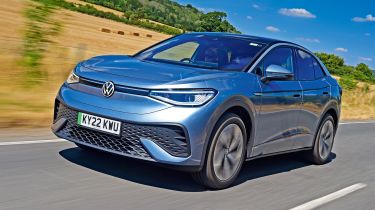
Many cars are hard to recommend new, because high asking prices make them poor value for money. You could accuse the Volkswagen ID.5 of this, but as is often the case, it’s a different story as a used buy. Sharp depreciation means you’re paying far less for a car that is very usable in terms of range and practicality, and it’s comfortable, too. Most ID.5s have an official range of 300 miles or more, and as fuel prices surge while electric car values drop, it’s cars like this that make the transition from ICE to EV more appealing. While the ID.5 is no class leader, you get a lot for your money as a used buy, and that’s not something that you’ve always been able to say about Volkswagen.
There’s been an explosion in the popularity of SUVs over the past quarter of a century, and they’ve become so ubiquitous in those 25 years that it’s hard to remember a time when our roads weren’t awash with them.
Believe it or not, it’s almost two decades since the first coupé-SUV was launched. The BMW X6 arrived in 2008 and even its maker was taken aback by how popular it was; the result has been a slew of coupé options for many big-selling SUVs.
Used - available now

2024 Hyundai
i20
33,688 milesManualPetrol1.0L
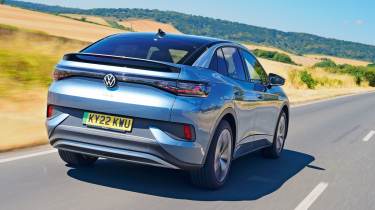
Cash £11,800Volkswagen launched its first electric SUV, the ID.4, in late 2020; a year later its coupé sibling, the ID.5, arrived. As with all coupé- SUVs, if ultimate practicality isn’t important to you, and you’d rather have an extra dash of style, then this upright-but-rakish family car might be just the ticket.
History
The ID.5 sent on sale in January 2022 with a 77kWh battery and a choice of three power outputs. The ID.5 Pro had 171bhp, the Pro Performance came with 201bhp, and at the top of the range was the all-wheel-drive 295bhp GTX 4MOTION. The Pro and Pro Performance came in Tech and Max forms, while the GTX was sold only with Max trim, but from June 2022 all powertrains were also available in Style form.
After November 2023, a significantly more efficient drive unit was fitted, with extra power and torque, faster charging and a slightly longer range. The model line-up was also simplified to Style Pro and Tech Pro (with 282bhp), or there were the 335bhp GTX 4MOTION and GTX Style 4MOTION.
A Match trim option joined the range in January 2024, then from November 2024 there were also Pure Match (with a 52kWh battery) and GTX Edition trims, too; a Black Edition was launched in May 2025.
Which one should I buy?
All ID.5s weigh more than two tonnes, with the GTX coming in at 2,242kg. For this reason we’d avoid the 171bhp Pro powertrain because it feels a bit lacking in power; the 201bhp Pro Performance is significantly perkier, while the GTX is very quick and also has four-wheel drive as standard; cheaper models are rear-wheel drive.
The model line-up and kit levels have changed quite a bit throughout the ID.5’s life, but you can expect either a 10 or 12-inch touchscreen, matrix LED headlights, three-zone climate control, a head-up display and a powered tailgate. Some versions also have massaging front seats and a panoramic glass roof.
Confusingly, VW offered an array of equipment packs, many of which were standard on most trim levels, but extra-cost options on others. The GTX Max is the only model that featured all of them as standard.
Prices
The cheapest way into Volkswagen ID.5 ownership is with an early 80,000-mile Pro Style. However, Style is by far the most common trim found on the used market, although there are also plenty of Matches available, too. The GTX is unusual and, as expected, is the most expensive model.
You can buy a used Volkswagen ID.5 for less than £18,000 through our Buy a Car service, while a used Volkswagen ID.5 GTX is available for just over £25,000.
Check the price of a Volkswagen ID.5 with our free car valuation tool...
On the road
The ID.5 is a heavy SUV, and there’s no escaping that. Reach a corner a little too fast, and while there’s lots of grip to get round, you can feel the car’s weight. However, there’s a good balance between ride and handling, so while big wheels can adversely affect comfort levels, stick with the smaller sizes and you’ll like how supple things are.
The VW is also quite enjoyable to drive in terms of steering feedback, while performance ranges from fairly leisurely to very swift: 0-62mph takes 8.9 seconds in the 171bhp editions, but a mere 5.4 seconds with the GTX.
Alternatives to the Volkswagen ID.4
Volkswagens are meant to feel more premium – and arguably more desirable – than Skodas, but the Enyaq Coupé has a nicer (and slightly more spacious) interior, plus the same running gear.
The ID.5’s cabin is on par with the Ford Mustang Mach-E’s, but if you want something that feels more premium, we’d suggest giving the Kia EV6 a try, while we reckon the Tesla Model Y is also a step up. As you’d expect, the Audi Q4 e-tron Sportback feels more luxurious.
If a smaller car will suit your needs, check out the Cupra Born, while the Ford Capri and Explorer, Nissan Ariya, Genesis GV60 and Volvo EC40 are all worth a closer look as well.
What to look for
On the pull
Every ID.5 can tow. They’re all rated at a maximum of 750kg if the trailer is unbraked, while rear-wheel-drive models can pull up to 1,000kg if the trailer is braked. The GTX can pull a 1,400kg braked trailer.
Touch of glass
Lots of ID.5s have a panoramic glass roof, which can creak as the rubber seals dry out. Lubricating the rubber can stop the creaking, but many owners say the fix isn’t permanent and fresh lube is needed.
Handle this
The only ID.5 recall was for door handles that activate for no reason, which is ironic because a common fault with these cars is inactive exterior door handles, because the keyless entry can work erratically.
Pump it up
A heat pump was a £1,050 option for the ID.5 when new. There’s much debate on whether the cost is worthwhile from a financial point of view, but efficiency is much improved.
Interior
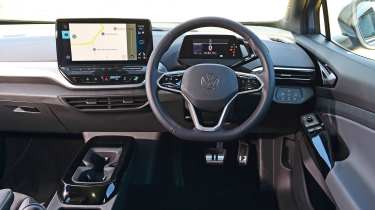
Two cornerstones of VW interiors are good quality and intuitive controls. The ID.5 falls short in both areas, with the infotainment below par in several respects, but facelifted cars are better. Practicality is great, with plenty of space in the back for three adults, while the boot capacity is good, at 549-1,734 litres. The more upright ID.4 is a little better.
Running costs
All ID.5s need to be serviced every two years regardless of how many miles they’ve covered in that time. Expect to pay £250 for this work to be done, but if you also include a replacement pollen filter, the cost will be £320, plus another £75 to renew the brake fluid, which is due every two years. These costs are all approximate and figures vary around the country.
Insurance groups range from 25 to 36 for regular editions of the ID.5, but if you buy a GTX, you’ll have to contend with groups 39-41. All ID.5s are subject to a £200 annual fee for VED, and because many breach the £50,000 barrier, you could be liable for the additional £440 expensive-car supplement if registered after 1 April 2025. Fuel costs vary wildly; rely on public charging and you can easily pay 10 times more than you’ll pay on a cheap overnight tariff at home.
Recalls
The changes from ICE to EV were seismic for VW, which received a lot of criticism for the user interfaces and electronics in its cars.
With software issues a real problem for lots of ID. owners, it’s interesting that there has been just the one recall for the ID.5 so far. That compares with three each for the ID.4, ID.7 and ID. Buzz, while the ID.3 has been the subject of two campaigns. The sole ID.5 recall was issued in November 2025 and it affected cars built between June 2023 and August 2024.
The problem centred on the door handles, which could unexpectedly activate as the car was being driven, allowing the door to open. The fix was a software update that warned the driver that the door was open. As with all modern cars, keeping the software up to date is essential.
Driver Power owner satisfaction
Most years there are between three and five VWs in our Driver Power new-car surveys, but there have been no EVs from the brand yet. In our 2025 Driver Power poll, for example, the Polo, Golf and T-Roc appeared, in 34th, 49th and 38th places respectively; the Tiguan came 51st so it didn’t quite get into the survey. But there has been no sign of any ID. models so far, and even more worrying is VW’s performance in our Brands survey: it came 27th out of 31 in 2025, and 29th out of 32 in 2024.
Don't miss out! See more of Auto Express in your Google Top Stories. Click here...
Used Volkswagen ID.5s for sale

2024 Volkswagen
ID.5
19,004 milesAutomaticElectric
Cash £21,543
2024 Volkswagen
ID.5
24,834 milesAutomaticElectric
Cash £20,328
2024 Volkswagen
ID.5
25,707 milesAutomaticElectric
Cash £20,490
2024 Volkswagen
ID.5
24,370 milesAutomaticElectric
Cash £20,680
2024 Volkswagen
ID.5
37,523 milesAutomaticElectric
Cash £20,451
2024 Volkswagen
ID.5
37,269 milesAutomaticElectric
Cash £20,649
2024 Volkswagen
ID.5
3,974 milesAutomaticElectric
Cash £24,549
2024 Volkswagen
ID.5
32,898 milesAutomaticElectric
Cash £19,900
2024 Volkswagen
ID.5
70,000 milesAutomaticElectric
Cash £16,950