Dacia Spring review
The Dacia Spring is a truly affordable electric alternative to a petrol car, but there are some compromises to be made

Our opinion on the Dacia Spring
On first impression, the Dacia Spring makes a tempting case for itself, with its low price making it easier to overlook the flaws that often come with a car built down to a budget.
However, delve a little deeper, and those shortcomings, chiefly the poor refinement and budget tyre choice, could make or break the Spring as a viable ownership proposition. We’d happily overlook past Euro NCAP safety ratings, because attempting to meet the safety organisation’s high standards would make the Spring prohibitively expensive, while great efficiency, ease of use and manoeuvrability mean it’s the perfect choice as a second car, especially if you’re doing plenty of urban journeys.
About the Dacia Spring
The Spring is Dacia’s first fully electric car, and it’s also the smallest model the firm offers in the UK. Both of those things are likely to attract new buyers to the brand, and this is backed up by data from the continent. Dacia says that based on Spring sales in Europe, where the car was available in a pre-facelift guise, 79 per cent of buyers were new to the brand, and 93 per cent had never purchased an electric car before.
Given that it’s now the entry point to the company’s line-up, the Spring is quite intriguing. It was first introduced into Europe in 2021, but it can actually trace its origins back to China in 2019, where it’s manufactured and sold as the Renault City K-ZE, as well as under some other Chinese brands. The Renault City K-ZE is the electric version of the Renault Kwid, which is a budget petrol model in China.
Used - available now

2026 Dacia
Spring
252 milesAutomaticElectric
Cash £12,550There have been a host of changes to the K-ZE to transform it into the Dacia Spring, chief among them being the safety kit, such as including six airbags, more electronics and a reinforced chassis. A further update in 2026 also saw the Spring gain a new battery and some aerodynamic tweaks in order to boost efficiency. There’s even a van version available, the Dacia Spring Cargo, which is a two-seat delivery model that’s classified as a commercial vehicle.
In order to find if the Dacia Spring is the king of the (zero-emission) city, we lined it up against its most direct rival, the Leapmotor T03, in a twin test. While we can’t fault the Spring’s starting price as well as its efficiency, the T03 offers superior refinement and space for a very similar amount of money, so it claimed the victory.
Dacia Spring prices and latest deals
The Dacia Spring starts from around £16,000, which makes it one of the very cheapest full-size electric cars on sale in the UK, and it’ll only cost you another £1,000 to upgrade to the range-topping Extreme model. In other words, the entire line-up is very competitively priced.
You can save even more if you spec your new Dacia Spring via the Auto Express Buy a Car service. You can also find plenty of tempting deals on used Dacia Springs, and we can even help you to sell your car.
Performance & driving experience
Pros |
|
Cons |
|
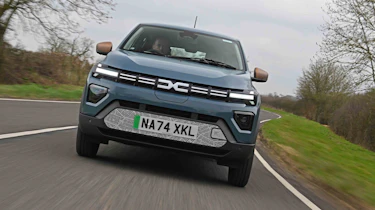
Dacia’s 2026 upgrades saw both variants of the Spring gain a tiny power boost. The entry-level Spring 70 packs 69bhp, while the slightly more powerful Spring 100 features 99bhp. These two models replaced the Spring 45 and Spring 65, which got 44bhp and 64bhp respectively in the line-up.
While it’s fair to assume that this EV isn’t going to be winning many drag races, this slight increase in power does make it just that bit more suited to higher speed motorway driving. Also, thanks to the car’s sub-1,000kg kerbweight and the fact that its peak torque is available from pretty much the second you touch the throttle, the performance feels readily available in most driving scenarios. If you want to soften the throttle response (and boost the car’s range), the Eco button does just that.
| Model | Power | 0-62mph | Top speed |
| Spring 70 | 69bhp | 12.3 seconds | 77mph |
| Spring 100 | 99bhp | 9.6 seconds | 77mph |
Performance, 0-60mph acceleration and top speed
While the Spring could originally lay claim to being one of the very slowest new cars on sale, Dacia’s round of updates has given it a pretty significant kick in its step. The less-powerful Spring 70 can now accelerate from 0 to 62mph in 12.3 seconds, and while this is still nowhere near hot-hatch quick, it’s a very welcome improvement from the 45’s lethargic 19.1-second run.
It’s the Spring 100 that’ll appeal most to cost-conscious speed demons, though, as this will get to 62mph in 9.6 seconds. Another welcome relief compared to the old 65’s 13.7-second time. Both revamped variants will go up to 77mph, meaning motorways are just about on the cards.
Budget cars are often fitted with budget tyres, and the first Dacia Spring that we tested featured rubber from Chinese brand Linglong, which we find hard to accept even on cheap motors. These tyres offer poor grip and feedback, and we’d find it reassuring to know that the best possible rubber sits between road and car in the case of an emergency. In comparison, when we tested the Spring against the Leapmotor T03, that model was fitted with Continental tyres, which provided both plenty of grip and better refinement.
Town driving, visibility and parking
The Spring’s basic controls need just a little more refinement to make it a nicer car to drive around town. We found the throttle and brakes are quite abrupt when they first engage, which makes it hard to drive smoothly at low speeds. It’s very noticeable if you’re inching into a tight parking space, when it becomes hard to creep slowly and precisely.
The Dacia’s brake regeneration also doesn’t engage as subtly as other systems. This can be felt when trying to hold the car at a constant speed on a downhill stretch of road; the regen grabs and then releases, giving a bit of a nodding-dog sensation to those on board.
While the steering is a little sticky around the straight-ahead, it’s very light, and the 9.63-metre turning circle is brilliant in tight spots. The ride is fairly soft, and despite the car’s short wheelbase, it isn’t too bouncy, either.
Country road driving and handling
If your Spring is fitted with the cheaper tyres and you’re a little too keen with that already sharp throttle, it’s easier than you might imagine to spin the front tyres away from a standstill, even in the dry. These tyres also don’t help a car that’s already short on steering feedback, making it seem even more remote.
That aside, there’s fun to be had maintaining momentum in the Spring along a twisty road. Body roll is reasonably pronounced, so you can figure out when the (low) limits of the tyres’ grip are being reached. And when that happens, the Dacia feels neutral, because the stability control cuts in fairly harshly.
Motorway driving and long-distance comfort
This isn’t the sort of car any of us will see pounding up and down the M1 on a daily basis, but the Spring will sit at 70mph quite happily if it needs to, and the official top speed stands at 77mph.
You do have to cope with quite a noticeable amount of wind and particularly road noise, though, while the narrow, tall body is a little susceptible to crosswinds.
“It’s so refreshing to drive an EV that feels light on its feet; even though there’s not much outright power, the Spring lives up to its name with the way it responds to the throttle away from rest.” – Alex Ingram, former chief reviewer.
Range, charging & running costs
Pros |
|
Cons |
|
Although it’s actually smaller than the original 26.8kWh pack, Dacia claims that the revamped Spring’s 24.3kWh battery will still return the same 140-mile range as the older car. This is thanks to some aerodynamic tweaks as well as the battery pack’s lithium iron phosphate chemistry.
On paper, the Spring tips the scales at around 1,000kg, which is very light by electric car standards. This works greatly in its favour when it comes to efficiency, as the little Dacia doesn’t waste lots of excess energy by having to cart around too much mass.
During our EV ‘drive until they die’ range test, the Dacia Spring managed to cover 109.1 miles from a full charge before it ran out of juice. This made it the first car to ‘die’ before it reached its destination, but this was expected by virtue of the battery’s comparatively minute size.
Given its size, purpose and range, the Spring is best suited to a buyer who can top up at home, so the fact that its rapid-charge speed hits only 40kW is not a huge issue. Officially, a 20-80 per cent top-up takes 29 minutes.
If you want to save energy when it’s cold, you can pre-heat the Spring while it’s plugged in. However, as you might expect at this price point, there’s no energy-efficient heat pump available to help reduce the load on the drive battery on cold days.
| Model | Battery size | Range | Insurance group |
| Spring 70 | 24.3kWh | 140 miles | 25 |
| Spring 100 | 24.3kWh | 140 miles | 28 |
Insurance groups
Depending on the powertrain, the Spring sits in either group 26 or 28 (out of 50) for insurance. That’s high for a small city car, although the Leapmotor T03 isn’t much lower in at least group 25. If you’re not too fussed about electric power, the petrol-powered Kia Picanto will be far more affordable to cover, as this goes as low as group 3.
Tax
While electric cars now incur the standard rate of VED road tax, company car drivers still benefit from the lowest Benefit-in-Kind (BiK) tax rates. However, the Dacia’s limited battery range might restrict its appeal as a commuter car.
Depreciation
The Spring is predicted to hold on to roughly 39 per cent of its value after three years or 36,000 miles. That’s a very similar performance to the Leapmotor T03, which retains 40 per cent after the same period. For those who are torn between petrol and electric power for their new city car, the combustion-powered Kia Picanto holds on to 52 to 53 per cent.
To get an accurate valuation on a specific model check out our free car valuation tool...
Interior, design & technology
Pros |
|
Cons |
|
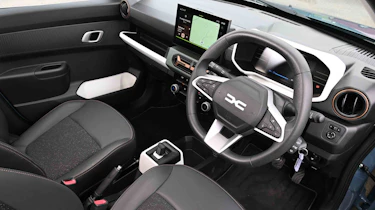
The Spring’s fantastically intuitive cabin looks funky, but predictably feels a little cheap in places.
Interior and dashboard design
A basic, rugged cabin design is exactly what you would expect of a car at the Spring’s price, and from that point of view, it hits the brief. The dash design takes inspiration from the Duster’s, with its copper highlights and angular air vents, but the simplicity of the main controls is what the Spring does so well.
Everything, including the electric window switche, is grouped around the middle of the dash, and the air-conditioning controls take the form of big, chunky buttons that are easy to use on the move. The media volume controls, located on the right-hand side of the steering column, are barely changed from Renaults that came out 30 years ago. There’s a good reason for that: they remain incredibly intuitive to use. This is a basic vehicle that teaches some significantly more expensive new cars a thing or two about ergonomics.
Materials and build quality
This is a cheap model, and in places it really feels like it. The plastics are hard, the doors close with a hollow clang, and sound insulation is in short supply. This isn’t a big deal in isolation, but the Leapmotor T03 feels significantly more substantial for similar money.
Infotainment, sat-nav and stereo
Tech is certainly thin on the ground aboard the Spring, but a digital instrument panel (something that would have been unheard of on a city car barely five years ago) is standard on every model. The display is similar to the set-up used by the latest Duster, and it’s bright, sharp, and presents information clearly.
Dacia’s standard-fit Media Nav Live system isn’t feature-packed, nor is it the fastest or most responsive touchscreen we’ve ever tested. However, for the money, it’s very hard to fault. The system is largely logical, simple and looks smart, with clear graphics that are easy to read.
Pairing a smartphone to use Apple CarPlay or Android Auto connectivity is very straightforward, and the 10.1-inch screen is positioned high enough on the dash to be seen, but not so high that it’s a distraction.
Expression models have a simplified New Media Control system with DAB radio and connectivity via the Dacia Media Control smartphone app, so you can use your smartphone for multimedia functions.
“Simplicity can be seen everywhere, from the single windscreen wiper and washer jet, to the steel wheels. This is motoring without unnecessary fripperies or any pretence to be sporty or posh.” – Alex Ingram, former chief reviewer.
Boot space & practicality
Pros |
|
Cons |
|
The Spring is a tiny car, so space comes at a premium. Yet it’s not unreasonable compared with some similarly sized city cars, and boot capacity is excellent against key rivals.
Dimensions and size
A tall body gives an SUV-like look, but in every other dimension, the Dacia Spring is proportioned like a city car. Its narrow body means it’s easy to manoeuvre, while a short overall length means there are compromises in terms of interior space.
| Dimensions comparison | |||
| Model | Dacia Spring | Leapmotor T03 | Kia Picanto |
| Length | 3,701mm | 3,620mm | 3,670mm |
| Width | 1,583mm | 1,652mm | 1,625mm |
| Height | 1,519mm | 1,577mm | 1,500mm |
| Wheelbase | 2,420mm | 2,400mm | 2,400mm |
| Boot space | 308 litres | 210 litres | 255 litres |
Seats & passenger space
The Spring’s lofty driving position provides great all-round visibility. While the seats are more comfortable than they look, a lack of height and reach adjustment in the steering wheel means that not everyone will find their ideal seating position. There is no left-foot rest, but there’s lots of space in the footwell beside the small brake pedal to find a comfortable spot.
Interior storage isn’t in short supply, with Dacia claiming as much as 32.7 litres in the cubbies and bins. The insides of the large door bins are white so that items are easier to find, even when it’s dark. Elsewhere, there’s a shelf above the glovebox, and an open area just ahead of the gear selector, which is ideal for a smartphone.
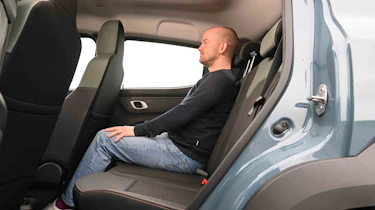
This is not a big car, and that means that rear-seat space is fairly limited. But kneeroom only just falls short of what you get in compact SUVs such as the Jeep Avenger; headroom is tighter, even though the seat base is a little too close to the floor.
There are only four seats, so the narrower cabin isn’t much of an issue. Yet the Leapmotor T03 and the Hyundai Inster both offer more space in the back.
Boot space
At 308 litres, the Spring’s boot capacity is very generous for such a small vehicle. With the rear seats folded, that volume grows to 1,008 litres. The rear seat back folds in one piece; while more expensive cars split the seat back in two, a single-piece fold isn’t unusual at this price point. However, the need to simultaneously tug two fabric hoops on either side in order to unlock the seat from its upright position is a bit irritating.
Add the optional Storage Pack (which costs less than £300), and not only do you get an extra box in the boot and a front central armrest, but the Spring benefits from storage under the bonnet, too; the 35-litre plastic tray is perfect for holding the charge cables. It’s also an ideal spot given that the Spring’s charge port is on the nose.
“In Extreme trim, the Spring has vehicle-to-grid connectivity, allowing you to power a wide range of high-powered appliances, such as an electric barbecue, by using an adapter inserted into the charging port.” – Alex Ingram, former chief reviewer.
Reliability & safety
Pros |
|
Cons |
|
Dacia is yet to submit the latest version of the Spring for assessment by Euro NCAP, and it doesn’t plan to do so until 2027, when the car will have uprated safety-assist systems. The pre-facelift model achieved one star in testing by the safety body, with low scores in both the occupant protection and safety-assist categories.
All cars get six airbags, cruise control and a speed-limit warning. The latter can be easily disabled through the MyPerso function. This lets drivers program a single button to change the assist settings exactly to their liking.
Buying and owning
- Best buy: Dacia Spring 70 Extreme
With such low prices, we don’t think it’s a stretch to upgrade to the top-spec model. For only £1,000 more you’ll get more kit and better performance.
Dacia Spring alternatives
The Dacia Spring faces a tough battle to convince UK buyers, because in addition to the similarly priced Leapmotor T03 and the similarly sized but more expensive Hyundai Inster, the Spring has to fight off a range of second-hand EVs that are available for similar cash. A used Vauxhall Corsa Electric or Fiat 500e both easily fall below the £15,000 mark.
Then there are the EV sceptics that need to be convinced, because cars such as the Kia Picanto are able to travel a lot further on a full tank, which could be all the attraction needed for buyers unable to charge an EV at home.
Key updates of the Dacia Duster review
16 February 2026: Updated to include details about Dacia Spring's revised powertrains.
Frequently Asked Questions
If you want no-nonsense transport for short journeys, are happy to go electric and are able to charge an EV at home, then the Dacia Spring makes a lot of sense. It’s affordable, practical for its size and fine to drive, if rather unexciting.
Deals on the Spring and alternatives
More reviews
Which Is Best