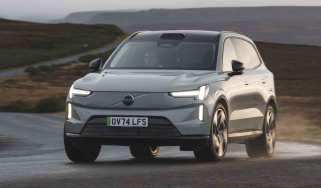
Volvo EX90 review
The Volvo EX90 is a quick, quiet, and roomy electric 7-seater that competes with premium rivals, but its efficiency disappoints


Our opinion on the Volvo EX90
As the brand's flagship car, the Volvo EX90 goes big on technology but retains some Scandinavian design to give it a unique presence in the premium SUV market. The interior quality is as you’d expect from a Volvo; it’s bright, airy and not as subdued as many of its German rivals. That, combined with the excellent amount of space and the useful standard kit list means the EX90 will work well as high-end family transport.
It’s also ludicrously quick for a family-oriented SUV in ‘Performance’ trim, but we suspect the Single Motor version will be a better fit for most people’s needs.
About the Volvo EX90
With seven seats and pure-electric power, the Volvo EX90 doesn’t actually have that many close rivals. Neither Audi nor BMW offers an EV with seven seats, while the Mercedes EQS SUV costs £30k more than the Volvo. Looking below, there are the Kia EV9 and Hyundai Ioniq 9 SUVs that provide all-electric motoring for seven, although they may not have the prestige a Volvo buyer will be looking for.
The Volvo is available in Single Motor, Twin Motor and Twin Motor Performance guises, with the Single Motor model using the smaller 92kWh battery, and both the Twin- and Twin Motor Performance models utilising a bigger 106kWh battery.
Used - available now


So far, we’ve tested the EX90 extensively in the UK and Europe.
Volvo EX90 prices and latest deals
Pricing for the latest EX90 starts at just over £80,000 for the Single Motor in Plus trim, with the Twin Motor version with its larger capacity battery and greater driving range coming in at around £87,000. Ultra trim is only available in Twin Motor form, and comes in at just under £94,000. The top-of-the-range EX90 is the Twin Motor Performance Ultra at a little under £97,500.
If you fancy moving your brood around under electric power and feel the seven-seat EX90 is the one for you, there are plenty of great deals to be found via our Buy a Car service. You can configure your ideal Volvo EX90 and receive top offers from our huge network of dealers, browse the very latest Volvo EX90 leasing deals or take a look at the best used Volvo EX90 models. If you already have a car and need to sell it, be sure to visit our Sell my Car page.
Performance & driving experience
Pros |
|
Cons |
|
It’s fairly common for car makers to pump up the power in their EVs to help overcome their weight, and Volvo has a habit of packing its electric SUVs with plenty of punch. The 450bhp Twin Motor model is fast, but then the Performance pushes things even further, thanks to its 670bhp output. In reality, the Single Motor EX90 is likely to have more than enough punch, while its rear-wheel-drive layout means there shouldn’t be any issues with traction off the line.
The EX90 is lower than the XC90, but it’s also longer and wider than its ICE sibling, and with EV power, it’s substantially heavier, too. At 2,513kg for the Single Motor and 2,689kg for Twin Motor versions, the EX90 is 218 to 394kg heavier than the most portly version of the XC90, the T8 plug-in hybrid.
Volvo isn’t one to festoon its cars with a multitude of driving modes, though alongside the one-pedal mode selection, you can also change the steering weight and the suspension from ‘soft’ to ‘firm’. There’s also a setting to de-couple the rear motor power in the Twin Motor car for better efficiency and a ‘Performance’ mode in the Performance trim to boost power.
Performance, 0-60mph acceleration and top speed
The 456bhp Twin Motor manages a zero to 62mph sprint in 5.5 seconds, with the 680bhp Performance model reducing that time to 4.2 seconds, and severely increasing the risk of spilled drinks if you boot it away from a drive through restaurant.
The hottest EX90 is even quicker than the 544bhp Mercedes EQS 580 which has a 4.7-second 0-62mph sprint time. Volvo introduced a limited top speed of 112mph to all of its cars a number of years ago, and that’s exactly what all EX90s will do flat out.
We’re yet to try the Single Motor EX90, but we suspect its 333bhp output and 6.8-second 0-62mph time will be more than up to the task of hauling seven people and their luggage around. It's significantly quicker than the entry-level two-wheel drive Hyundai Ioniq 9 and Kia EV9, both of which cover the same sprint in 9.4 seconds.
| Model | Power | 0-62mph | Top speed |
| EX90 Single Motor | 333bhp | 6.8 seconds | 112mph |
| EX90 Twin Motor | 456bhp | 5.5 seconds | 112mph |
| EX90 Twin Motor Performance | 680bhp | 4.2 seconds | 112mph |
Town driving, visibility and parking
In urban areas you’ll naturally want to set the steering and suspension to the ‘soft’ setting. The steering doesn’t feel overly light, with a suitably reassuring weight to it given the EX90’s mass. Despite it being a big seven-seater, the EX90 is pretty easy to navigate around tight areas thanks to its boxy shape. One odd feature is the shape of the windscreen - the Lidar positioning above means that it curves at the top. This isn’t really an issue for visibility, which is a pretty good, thick A-pillars aside.
No amount of electronic trickery can completely disguise the kerb weight of the EX90, which is most noticeable at slow speeds on rough roads. The 22-inch wheels fitted to Ultra trim models contribute to some fidgeting at times. Big speed bumps and potholes are pretty well damped, although there’s usually an audible thud. We suspect the slightly smaller 21-inch wheels fitted to Plus trim cars will be a better fit for those who value ride quality.
The pedal feel is a little jerky around town, too. The brakes, while delivering phenomenal performance at speed, can be difficult to modulate carefully, which is why most will stick one-pedal mode on and be done with it. There’s not much travel in the acceleration pedal before the EX90’s reserves of power kick in, so you have to treat it with more finesse than expected here.
The EX90 doesn’t feature rear-wheel steering, like you’ll find on other luxury SUVs such as the Range Rover. With a 1mm longer wheelbase than the XC90, the EX90 has a turning circle of 12.2 metres - about average for a car of this size but well down on the Mercedes EQS’s (with its rear-wheel steer) 10.9-metre figure.
Country road driving and handling
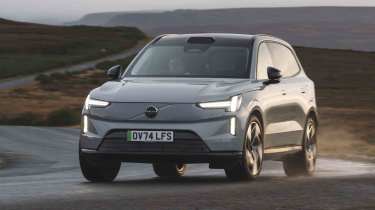
There’s a comfort-orientated set-up for the EX90, so it’s not at its best when hustling along a twisty road. We’ve tried the model in Ultra trim with air suspension, and even then the set-up is trying hard to keep the car’s heavy kerbweight in check. A high centre of gravity doesn’t help, and body roll starts to make itself felt even at moderate speeds.
There are firmer settings available for the steering and suspension, but the difference
is minimal because of the sheer weight that the set-up has to cope with. Mid-corner imperfections cause the car to wallow over them, and the BMW is far more capable of maintaining body control on A and B-roads.
The strong brakes do a good job of scrubbing off speed, yet you’re aware of the car’s size and weight every time you use them. The e-motors’ instant throttle response means you’ll have no trouble slingshotting out of corners.
Motorway driving and long-distance comfort
The EX90 is more refined the faster you go. The steering settles down so you have to make fewer inputs, the instant torque makes high-speed overtakes a doddle and the suspension is compliant, with imperfections serenely negotiated without feeling detached from the road.
On the motorway you’ll find the big electric Volvo to be a civilised cruiser and the brand’s claim of ‘the quietest Volvo ever made’ quite believable. Wind noise wasn’t an issue in our Ultra trim EX90 test car with standard laminated side windows that boost refinement, although the big tyres made themselves heard. As with the XC90, Volvo’s wonderful seats are the biggest reason why you could easily eat up the car’s range in one sitting.
“The Performance version does exactly what it says on the tin, and makes the EX90 feel noticeably quicker in a straight line than other versions in the range, although no different from other EX90 models in the corners.” – Richard Ingram, deputy editor.
Range, charging & running costs
Pros |
|
Cons |
|
Volvo has provided the EX90 with two colossal battery sizes: 92kWh for the Single Motor and 106kWh for the Twin and Twin Motor Performance versions. A sleek front end without the grille you’d find on the XC90, flush-fitting door handles and aerodynamically optimised wheels all contribute to a relatively low 0.29 drag coefficient.
Electric range, battery life and charge time
On paper, the EX90’s official figures are impressive, with up to 378 miles of range claimed for the Twin Motor model, depending on spec, and 371 miles for the Performance version. The smaller battery in the Single Motor car offers around 350 miles of range.
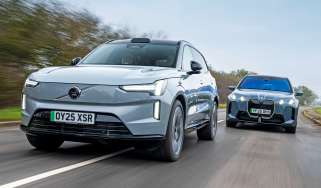
We’ve tested earlier versions of the EX90 with a 400-volt electrical system, and managed 2.7 miles per kWh in cold weather. However, in similar conditions the BMW achieved 3.5mi/kWh, giving it a longer range courtesy of its larger battery.
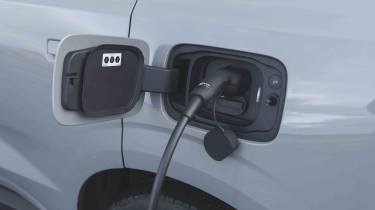
Volvo updated the EX90 with an 800V system for 2026, which means faster charging times with a 10 to 80 per cent top-up taking 22 minutes. Bi-directional charging lets you use it to power appliances or even send energy back to the grid. Three-phase 11kWh AC charging is also included as standard.
Home charging remains quite a lengthy process, though, with a typical 7.4kW wallbox needing 16 hours to fully recharge the 92kWh battery, and the bigger 106kWh version needing to be plugged in for 18 hours.
Unfortunately, no EX90 can match the overall range figures of its Polestar 3 and Polestar 4 siblings, so if you can live without seven seats and just want to go the furthest distance between charges, those would be the cars to go for. While more expensive, the seven-seat Mercedes EQS has a bigger 118kWh battery, so both the 450 and 580 versions go just over 400 miles per charge.
When we tested the real-world range of the earlier 400V architecture cars, which Volvo claimed would deliver an average efficiency of 2.9mi/kWh, we managed to equal this figure. That was done under favourable conditions on the west coast of America. In our more recent drive, we managed just 2mi/kWh in the cold and wet conditions on our Berkshire test route. That’s despite having a standard-fit heat pump and only two occupants - with seven people on board, that figure would probably be worse.
| Model | Battery size | Range | Insurance group |
| EX90 Single Motor | 92kWh | 351.1 miles | 50 |
| EX90 Twin Motor | 106kWh | 378.4 miles | 50 |
| EX90 Twin Motor Performance | 106kWh | 374.7 miles | 50 |
Insurance groups
Although it’ll be cheap to tax compared to a similar-sized petrol or diesel SUV, insurance will be equally expensive because every EX90 sits in group 50 - the highest band. Alongside a standard alarm and gear shift lock, the EX90 has an immobiliser and a ‘double lock’, the latter allowing for exterior and interior locking. If you’re after an electric seven-seater that’s a bit cheaper to cover, you’ll need to look towards the Peugeot E-5008 (groups 33 to 40).
Tax
All EVs qualify for the standard annual rate of VED road tax, and because no version of the EX90 comes in below the £50,000 electric luxury car tax limit, you’ll also need to pay that. Luxury car tax involves a supplementary fee on top of the standard rate of VED from the second time the vehicle is taxed up until it is six years old.
Company car drivers will at least enjoy the lowest applicable Benefit-in-Kind (BiK) rates compared with a traditional petrol or diesel car because the EX90 has zero tailpipe emissions. However, EVs will also be subject to an eVED pay-per-mile fee if that comes into effect from April 2028 as planned.
Depreciation
Residual values are pretty good for the Volvo EX90, because our experts predict that the range will cling to between 53 and 57 per cent of its value after three years of 36,000 miles. That’s better than the Mercedes EQS SUV, which only maintains between 42 and 44 per cent over the same period.
To get an accurate valuation of a specific model, check out our free car valuation tool...
Interior, design & technology
Pros |
|
Cons |
|
While the Volvo EX90 might look rather similar to the XC90, Volvo has done more than simply take its big-selling combustion-engined SUV, slap a battery in it and call it a day. The EX90 sits on Volvo’s bespoke SPA2 electric architecture already seen in the new Polestar 3.
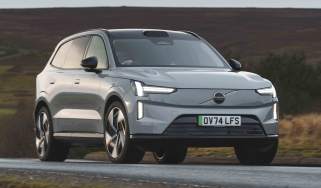
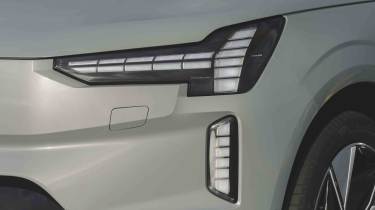
The all-electric EX90 gets a cleaner front end with an evolutionary take on that car’s ‘Thor’s Hammer’ daytime running lights. These are set into pixel-like segments and are animated, giving the car a unique ‘welcome’ signature when you lock or unlock the car. The rear end is typical Volvo, too, with a set of LED tail lights that stretch right up to the roofline.
The standard 22-inch wheels suit the car’s proportions well. They feature an interesting quirk where there’s no Volvo-branded centre cap, with a ‘Volvo’ script on one of the spokes instead.
Depending on how into technology you are, you may think the roof-mounted Lidar might act as a proud symbol of the EX90’s cutting-edge software, or make it look like a premium London taxi.
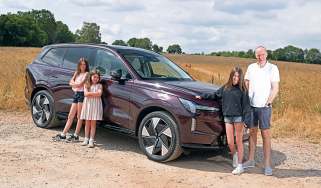
Both versions of the EX90 get a selection of no-cost paints. There are eight to choose from, with a dark ‘Mulberry Red’ the stand-out option for us. There’s a lot of gloss black elements to the EX90’s exterior - ranging from the roof rails, window surround and rear bumper and spoiler mouldings.
Our preferred trim level is actually the entry-level Plus due to its extensive list of standard features. It includes:
- 21-inch alloys
- A 360 degree camera system
- Electric front seat and steering wheel adjustment with driver memory
- An electric tailgate
- 14-speaker BOSE sound system
- Google-based sat-nav
- Heated front and rear seats
- A heat pump
If you want the ultimate luxury experience, Ultra trim adds adaptive LED headlights, a 1,610-Watt Bowers & Wilkins surround sound system with 25 speakers, ventilated seats, front seat massage with electric side bolster adjustment, and adaptive air suspension.
Interior and dashboard design
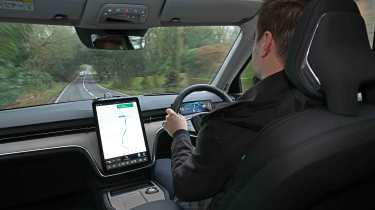
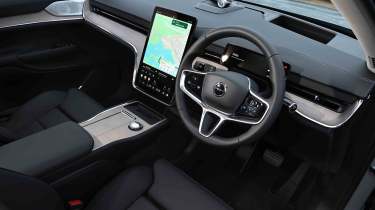
The design similarities of the EX90 to the XC90 carry over to the inside, although there are a few quirks to differentiate them. The cabin looks and feels more minimalist than the XC90. This does come at the expense of functionality to a degree but we don’t feel like the EX90 would be a hassle to live with. The dashboard is dominated by the 14.5-inch central screen with few physical buttons to speak of. The steering wheel utilises physical buttons that are also touch-sensitive - they’re perfectly easy to use, however.
Like the new Polestar 3, the window switches on the EX90 consist of three buttons. To operate the fronts or rears you have to press a touch-sensitive button on the door - it’s a set-up we’ve seen in Volkswagen Group models previously, which have since backtracked on future models. We much prefer a traditional four-switch layout.
There’s a range of three ‘Nordico’ faux-leather interior colours for the EX90: light grey, light brown or black. There’s also a wool blend option instead of the Nordico which is offered in a mix of black and light grey. We’d certainly opt for a bit of colour in the EX90, which can look a bit drab in pure black.
Materials and build quality
Quality is very good, as you’d hope and expect on a car costing the best part of £100,000. Everything is tightly screwed together, and both the leather trim and more sustainable wool alternative feel high-end. The seats are supportive and comfortable, and ergonomically, everything seems to fit and fall to hand really nicely.
The EX90 will be built in China for some markets, although UK cars will come from South Carolina, USA. The only issue for us that arose during testing was the headlight swivel warning light came on - something that an over-the-air update would sort out in the coming months, we’re told. To ‘reset’ the EX90, the clear volume knob in the centre console needs to be held down - at which point the car’s infotainment system will turn off and on again.
Infotainment, sat-nav and stereo
We’d love to say the brand learned from mistakes made on the smaller Volvo EX30, but the EX90 was designed first, so that’s not strictly true. Still, it’s good to see the maker’s flagship EV fitted with a set of easy-to-read digital dials and a head-up display – rather than channelling all that essential info through the main central screen.
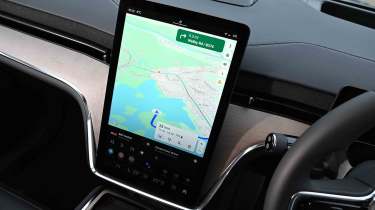
It makes everything much easier to navigate. The main display runs Android Automotive (not to be confused with the car’s Android Auto smartphone tech) and is super slick and responsive. The inclusion of Google Maps (other apps are available) means you can search for nearly anything and it’ll effortlessly direct you to your destination, updating along the way to avoid traffic or include charge stops. Turn-by-turn mapping can be replicated in the instrument cluster, too.
Elsewhere, the incredible Bowers and Wilkins stereo with Dolby Atmos needs to be heard to be believed, while the USB-C ports dotted around the cabin should ensure the family can keep their devices topped up. Our test model didn’t feature Apple CarPlay, but that has since been added as part of an over the air (OTA).
“The exterior camera set-up is excellent, with a mix of 360-degree views along with a rear-view camera on the big screen to make parking much easier than you might think in such a big car.” – Richard Ingram, deputy editor.
Boot space, comfort & practicality

Pros |
|
Cons |
|
The EX90 seats seven, while measuring over five metres long and two metres wide. This is a big car, even if it doesn’t feel as cumbersome as a Kia EV9.
The benefit, of course, is a huge cabin with space for the whole family – regardless of whether you choose to prioritise people or luggage.
If you’re more interested in how spacious the seats are, then it’s mixed news. Those up front and in the middle row receive plenty of space, though the two chairs in the third row are best reserved for children.
Dimensions and size
Being 84mm longer and 33mm wider than the XC90, the EX90 feels like a big car from behind the wheel, but it crucially doesn’t feel unwieldy. Its traditionally boxy SUV shape means it's relatively easy to pilot around tight, countryside villages with a lofty ride height for great visibility.
| Dimensions comparison | |||
| Model | Volvo EX90 | Mercedes EQS SUV | Hyundai Ioniq 9 |
| Length | 5,037mm | 5,125mm | 5,060mm |
| Width | 2,039mm (2,113mm inc mirrors) | 1,959mm (2,127mm inc mirrors) | 1,980mm |
| Height | 1,747mm | 1,742mm | 1,790mm |
| Wheelbase | 2,985mm | 3,210mm | 3,130mm |
| Boot space | 310-1,915 litres | 245-2,020 litres | 338-2,419 litres |
Seats & passenger space
It might have a chunky battery underneath the floor and a high ride height, but it’s fairly easy to step into the EX90 because it sits a bit lower compared to the XC90. Once you’re in, you’ll notice how bright and airy the cabin is (if you avoid the black interior) thanks to the large window area and the standard-fit panoramic roof.
Those up front are treated to a first-class experience, with supportive leather (or wool)-lined chairs and loads of room to stretch out. Move to the middle row and despite the tiered, theatre-style seating, there’s certainly plenty of headroom. Legroom could be better, however, and while this is improved by sliding the seats rearward, that luxury comes at the expense of those in the very back.
The two rearmost seats, therefore, are best reserved for children. Especially as these chairs both come with Isofix points – a bizarre rarity in seven-seat cars. Those in the third row also get their own cupholders; passengers in row two are forced to use the central armrest to store their drinks, which is useless if you’re sitting three abreast.
Boot space
With all seven seats in place, there’s 310 litres of boot space – that’s as much as most modern superminis, and more than enough room to squeeze in a few soft bags.
The rearmost row folds into the floor at the touch of a button. Doing so frees up 655 litres to the window line – or even more if you’re prepared to sacrifice your view out the back. In two-seat mode, there’s a van-rivalling 1,915 litres; officially down on the Mercedes EQS SUV, but you may find the Volvo’s more upright rear end makes it the more practical car outright.
Towing
If you choose the Pack and Load option for around £1,600, you’ll get an electric retractable tow bar that will allow for a towing capacity of 2,200kg in the Twin Motor and Twin Motor Performance models. That’s much better than the 1,587kg the Mercedes EQS SUV offers. High-end Ultra versions of the EX90 also features the most important function of a good tow car: self-levelling air suspension.
The less expensive Single Motor is rated to tow 1,500kg, which is still better than the 900kg the equivalent rear-wheel drive Kia EV9 manages, but 100kg shy of the Hyundai Ioniq 9, which can handle 1.600kg.
You’ll need to be careful with regard to the towing mirrors you’ll need, because the EX90 has a frameless side mirror design that you cannot clamp traditional extended mirrors to.
“There’s room under the boot floor to put stuff out of sight, and there’s a frunk capable of keeping a charge cable or two. Annoyingly, it’s opened via a lever in the front footwell; Volvo isn’t alone in restricting access in this way, but I’d prefer a button on the key.” – Richard Ingram, deputy editor
Reliability & safety
Pros |
|
Cons |
|
Volvo leans heavily on its safety record, and the EX90 is certainly a safe place for the occupants inside, according to Euro NCAP. They have awarded this car its maximum five stars out of five rating in 2025. But, it wasn’t all perfect, because the EX90 was heavily criticised in the vulnerable road user section for poor pelvis protection of pedestrians and cyclists - only scoring 0.5 points. Without that extra half-point, however, the car wouldn’t have achieved its five-star rating.
In theory, you shouldn’t have to rely on its passive safety systems because the EX90 comes with a comprehensive list of standard active safety assistance features, such as pedestrian and cyclist steering avoidance, autonomous emergency braking (AEB), blind spot monitoring with rear cross traffic alert, road and speed limit sign recognition, and adaptive cruise control.
The car even comes with eye-tracking technology with steering assist, which sounds an alarm if it thinks you’re getting distracted. Thankfully, it’s not particularly intrusive, and in our experience, only really activates in extreme circumstances.
The EX90 hasn’t appeared in the Driver Power owner satisfaction survey yet, but the Volvo brand slotted in at 13th (out of 31) in the best manufacturer rankings – ahead of Kia, Audi and Hyundai, but behind BMW and Mercedes.
| Euro NCAP safety ratings | |
| Euro NCAP safety rating | Five-stars (2025) |
| Adult occupant protection | 92% |
| Child occupant protection | 93% |
| Vulnerable road user protection | 82% |
| Safety assist | 86% |
Buying and owning
Best buy: Volvo EX90 Single Motor Plus
The EX90’s Plus trim comes with plenty of equipment as standard and is better value than Ultra models. It misses out on the fancier Bowers and Wilkins sound system and adaptive air suspension of the range-topping model, but we don’t think those items are worth the significant extra outlay you’d need to spend in order to get into an Ultra trim model.
The more potent Twin Motor set-up and bigger battery in reality only gives you an extra 30 miles per charge and a 1.3 second quicker 0-62mph time, so you might as well stick with the Single Motor model. The twin motor performance is significantly quicker, but do you really need a family seven-seater that does 0-62mph in 4.2 seconds? We don’t think so.
Volvo EX90 alternatives
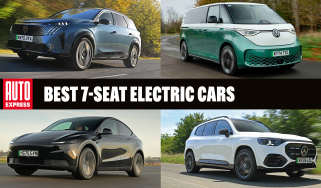
Because of its high price tag, the Volvo EX90’s rivals comprise the BMW iX, Mercedes EQE SUV and the Polestar 3 - which shares the same platform. Not all of those cars can offer the same seven-seat practicality as the Volvo, though. The Kia EV9 and Hyundai Ioniq 9 are worth considering for pure-electric seven-seater buyers.
An ‘outside the box’ option would be the long-wheelbase version of the Volkswagen ID. Buzz. While it looks like a van, it is one of the most stylish vans around, with plenty of charming design cues that hark back to the original VW bus. Its vast footprint could be a little unwieldy in town, but then the EX90 is hardly small either.
The ID. Buzz is far more spacious inside, which is likely to score big points with family car buyers. It is slower than the EX90, but for the intended purpose of shuttling a family around, that’s hardly a deal breaker. It is much slower to depreciate, too, which helps it secure some surprisingly competitive finance deals.
Key updates of the Volvo EX90 review
17 March 2026: Updated to include the latest driving impressions from our BMW iX vs Volvo EX90 twin test.
18 December 2025: Updated with the latest 2025 Euro NCAP crash test results and information about the current power and range figures that come with the revised 800V architecture.
Frequently Asked Questions
The EX90 comes with a three-year or 60,000-mile warranty as standard. All new Volvo electric cars have an extended battery warranty valid for eight years or 160,000km (99,000 miles) or whichever comes first. During the warranty period, Volvo will guarantee a 70 per cent state-of-health for the battery.
Deals on the EX90 and alternatives
More reviews
Long-term tests
Which Is Best