Used BMW 7 Series (Mk6, G11, 2015-2022) review
A full used buyer’s guide on the BMW 7 Series covering the 7 Series Mk6 (2015-2022)

Verdict
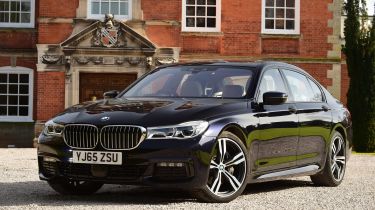
The Mercedes S-Class often gets the most plaudits in this class, and while they are undoubtedly very well deserved, the BMW 7 Series is also worthy of admiration. This flagship saloon features efficient engines, is beautifully built, and packed with the latest high-tech gadgetry. And, thanks to the heavy depreciation that hits every luxury saloon, you can buy a four-year-old 7 Series for a seemingly bargain price. However, while purchase costs are one thing, running costs are quite different, so consider how much you’ll have to pay to insure and maintain one of these impressive beasts. Having said that, the 7 Series stands ahead of both the S-Class and A8 for driving dynamics, while easily competing with them in terms of luxury. So if you fancy a large saloon with a sporting edge, look no further.
BMW was founded more than 100 years ago, and has since focused almost solely on making premium cars that are great to drive. The firm faced bankrupcy back in the fifties, but has since gone on to produce some of the most desirable, dynamic and premium cars on the road.
While the 3 Series and 5 Series and, lately, the X3 and X5 SUVs have been at the heart of this success, a host of supporting models have played their part, including the 7 Series luxury saloon. This first went on sale in 1977, and is in its sixth generation now. Packed with tech and offered with fine powertrains, it’s one of the key players in its market, and is definitely worth considering.
Used - available now

2022 BMW
7 Series
48,000 milesAutomaticPetrol3.0L
Cash £33,989
2015 BMW
7 Series
57,367 milesAutomaticPetrol3.0L
Cash £13,490
2019 BMW
7 Series
65,800 milesAutomaticDiesel3.0L
Cash £25,990
2019 BMW
7 Series
119,000 milesAutomaticDiesel3.0L
Cash £16,999Models covered
- BMW 7 Series Mk6 (2015-2022) - BMW’s flagship saloon blends luxury with sharp handling, and can be a fine buy.
History
The Mk6, or G11 (G12 for the long-wheelbase version) 7 Series arrived in October 2015. At launch there were 261bhp 730d and 315bhp 740d diesels, or a 321bhp 740i petrol, all with a 3.0-litre six-cylinder engine; a 442bhp 4.4-litre V8 750i soon joined the range and, in July 2016, the 321bhp 740e plug-in hybrid arrived, with a 2.0-litre petrol engine and an 83kW electric motor, plus standard four-wheel drive. The M760Li xDrive joined at the end of 2016, sitting at the top of the range with a 592bhp twin-turbo 6.6-litre V12 engine.
A facelift in spring 2019 brought a bold new nose with an over-sized grille, plus extra standard equipment and refreshed instrumentation. At the same time, the four-cylinder 740e was replaced by the six-cylinder 745e, which is capable of driving in electric-only mode for 36 miles; its predecessor could only manage 29 miles. The Mk7 (G70) 7 Series arrived in 2022, complete with giant grille, to replace this car.
Which one should I buy?
In terms of economy, running costs and purchase price, the diesels make the most sense, especially as they’re all Euro 6-compliant, so shouldn’t be penalised for entering any Clean Air Zones. These engines are the best for lots of long-distance high-speed motorway driving, but the plug-in hybrids can also make sense, although they’re rarer and you’ll pay more for one. The petrol-engined models are harder to justify because they’re thirsty, and not much more refined than the diesels.
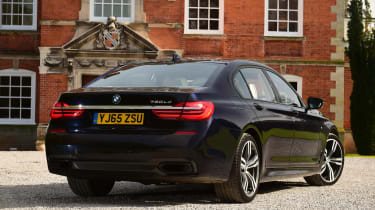
Equipment varies according to which model you buy, but all 7 Series are well equipped, with items such as four-zone climate control, an eight-speed automatic transmission, LED headlights, plus heated front and rear seats all being standard.
Alternatives to the BMW 7 Series
The Mercedes S-Class is the go-to luxury saloon for many, thanks to its cutting-edge comfort and safety. The big Merc is hard to fault, adored by the chauffeur industry, and the most readily available luxury car.
The Audi A8 also gives the 7 Series a hard time with its aluminium construction, four-wheel drive and superb ergonomics, as well as its efficient engines and high-tech cabin. Another aluminium-bodied rival is the Jaguar XJ, which is now out of production and never sold in large numbers, but is still desirable thanks to its distinctive looks, wonderful interior and engaging handling. Finally, don’t overlook the Lexus LS, which is packed with equipment and tends to be incredibly reliable, but is usually somewhat harder to find on the used market.
What to look for
All-wheel drive
The xDrive name denotes BMW’s four-wheel-drive system. All engines got an xDrive option apart from the 750i.
Back seats
A three-person rear bench seat was standard on the 7 Series, but two individual electrically reclining chairs were optional extras.
Tyres
Every variant of the 7 Series was fitted with run-flat tyres when new. Switching to standard rubber improves the car’s ride comfort and refinement.
Parking
In March 2017, BMW introduced a remote parking option for the 7 Series, allowing the car to be manoeuvred from outside using controls on the key fob.
Interior
The interior is arguably one of the major stars of the 7 Series show, with all cars coming crammed with a huge selection of equipment, all the luxury materials you could ask for, and plenty of space; long-wheelbase models are especially roomy because they have an extra 14cm of rear legroom.
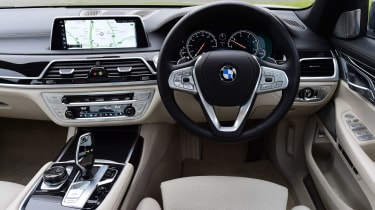
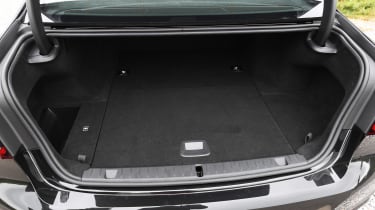
Numerous option packs that could be specified when the car was new allow for upgraded leather and entertainment, so pin down exactly what you’re buying – search filters on online buying sites will be very helpful here. Boot space is fine, at 515 litres, but the rear seats don’t fold down, so don’t make the mistake of assuming they do.
Running costs
Whichever engine you have, it needs to be serviced every two years or 18,000 miles. The regime essentially alternates between minor and major (or Inspection I and Inspection II, as BMW calls them), but all BMWs have condition-based servicing, so there’s no schedule for when many parts are replaced. The car flags up when parts need replacing, and the timing will depend on the model’s age, mileage and how it’s been driven.
An oil change costs £158.70, while an Inspection I (oil and filter) costs £282.64. An Inspection II service entails renewing the oil and filter along with the air and fuel filters; this is priced at £438.41. All 7 Series are chain-driven, so there are no cambelts to replace.
Recalls
BMW has recalled the 7 Series six times so far. The first was in July 2016 because some of the earliest cars had faulty airbags. Problematic brake-light switches led to the next action, in June 2017, with leaking oil coolers being the reason for the third campaign, in July 2017.
The fourth recall affected most of the models in BMW’s range, and was launched in August 2018 because faulty crankshaft-sensor software could lead
to the engine stalling or running poorly. The fifth recall also affected a wide range of BMW models, this time because the exhaust gas recirculation (EGR) valve could leak, potentially leading to a fire. The most recent recall, in October 2018, once again affected multiple models across the BMW range, and was because cars had left the factory with faulty crankshaft-sensor software.
Driver Power owner satisfaction
The 7 Series hasn’t appeared in any new or used Driver Power surveys, because it doesn’t sell in large enough quantities. And while the review on Carbuyer.co.uk mentions poor reliability, it’s from a sample of just one. Our 2020 Driver Power brands’ survey saw BMW come 27th out of 30, with owners giving a thumbs up to the firm’s infotainment systems, transmissions and engines, but criticising the running costs and styling.
BMW 7 Series (Mk6, 2015-2022) review: What we said
Extracts from our 2019 in-depth review of the Mk6 BMW 7 Series...
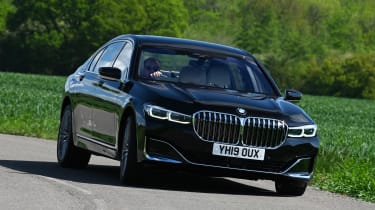
You certainly can’t knock BMW for the facelifted 7 Series. The new look really won’t be to all tastes but you certainly won’t miss it in passing, and at first glance many may look at this heavily updated G11 generation car as if it is actually a brand new model altogether.
With such a large body and uncharacteristically light steering it's not as rewarding to drive as smaller BMWs, but few models in this segment prioritise sharp handling. Luxury, refinement and technology are areas where these cars are designed to deliver and in that respect, the BMW 7 Series excels.
About the BMW 7 Series
A major update to the BMW 7 Series in 2019 gave it a look that perhaps takes a little getting used to, but there's no arguing that this luxury limo is still one of the most hi-tech cars for sale in the UK today. The range has been revised along with the visual update, but the BMW 7 Series still majors on technology, refinement and delivering some of the best handling in the luxury car class.
As before, there are petrol and diesel options, while a plug-in hybrid is also available. There are long and short wheelbases and while there's plenty of technology as standard, BMW also offers a wide range of options. Prices start from around £73,000, while you'll need to add another £20,000 to bag the top-of-the-range 750i M Sport model
Chief rival for the BMW 7 Series is the Mercedes S-Class, while the Audi A8 and Lexus LS are also fighting for sales in the class. Elsewhere, the Maserati Quattroporte is a more extravagant choice, as are the Bentley Flying Spur or the far more expensive Rolls-Royce Ghost.
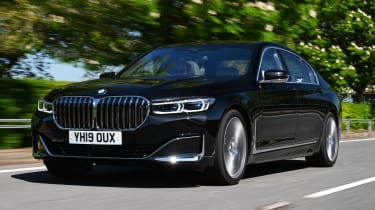
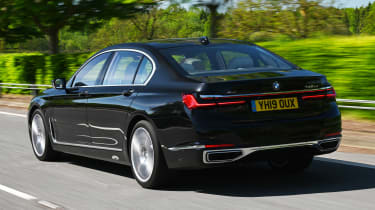
That imposing grille added to the 7 Series is designed to appeal to the Chinese market. Small changes to the lines down the sides of the car appear, while the rear end is now dominated by a full-width, chrome finished LED taillight. There are standard and M Sport variants on offer, and if you go for the latter you get a slightly sportier look and blue detailing on the brake calipers.
Inside, the 7 Series is well appointed with plenty of wood, leather and Alcantara materials used throughout. It doesn’t move towards BMW’s newer interior designs as used on the brand’s other two luxury offerings: the new X7 SUV and the reborn 8 Series. However, the older, softer-edged design is ageing gracefully and the cabin oozes quality.
While there's an M Sport trim upgrade, BMW expects most buyers to go for the BMW Individual service, which offers a tailor-made car buying experience. It allows you to customise the interior and exterior to your heart's content, as well as add a variety of packs to upgrade the technology and seating as much as possible.
The model line-up comprises 740i and 750i petrols (the M760Li is no longer available), the 745e plug-in hybrid, plus 730d and 740d diesels. The basic models use straight-six petrol and diesel engines, while if you pick up a used M760Li you'll be able to experience its mighty V12. All cars us an eight-speed automatic gearbox, while rear-wheel drive or xDrive four-wheel drive is offered across the range.
Engines, performance and drive
With such a huge array of interior tech and acres of space, it seems a bit of waste to spend your time behind the wheel of the 7 Series where you can’t experience any of it. So, the best way to make the most of BMW’s flagship is to get someone to drive it for you – something frequently done by the type of people who buy this type of car.
However, if you do find yourself having to get behind the wheel it’s one of the better luxury saloons for keener drivers. The 7 Series feels more agile than the Mercedes S-Class or Audi A8 due to the use of lightweight carbon fibre in its construction. The steering could do with some added weight as it is quite light, but it’s accurate enough.
The 3.0-litre diesel in the big-selling 730d model works seamlessly alongside an eight-speed automatic gearbox, allowing for smooth and relaxing progress. It’s as accomplished as you’d expect any six-cylinder BMW to be. The 7 Series is also deceptively quick as it’s so quiet, so you pick up speed very quickly without realising you’re doing so.
In all honesty, few will ever require more than that offered by the 730d. BMW's 740d is xDrive (four-wheel drive) only, which may prove useful during our notoriously wet winters.
The 740i six-cylinder petrol and the V8 powered 750i, while nice and untapping some proper performance in the 750i’s case, strike us as being left-field choices. The one-size-fits-all 730d is a solid choice, with the plug-in hybrid 745e an efficient option that will probably hold more appeal with business users. The bonkers, V12-powered M760Li is no longer available on the 7 Series price list.
Air suspension comes as standard on every model and ride quality stacks up very well indeed. However, the BMW’s setup isn’t quite as mastered as what you’ll find springing its chief rival: the Mercedes S-Class.
It’s just ever so marginally firmer than an S-Class – a trade-off for its marginally better handling characteristics. There’s a special ‘adaptive’ mode for the suspension, which uses the car’s navigation to set the car up for the road and terrain that’s coming up ahead.
The range-topping M760Li xDrive model uses clever tech to limit body roll and add a touch of rear-wheel steering to increase agility. It doesn't transform the big car into a sports model, but will surprise you with a degree of sportiness that rivals miss out on.
0-62mph acceleration and top speed
The base 7 Series is the 730d and it’s more than sufficient for most buyers’ needs. Powered by a smooth six-cylinder, 3.0-litre turbocharged diesel engine, power stands at 261bhp. 0-62mph is dispatched in a hot-hatchback-rivalling 6.1 seconds, with top speed limited to 155mph.
Over the last few years this has been by far the biggest-selling model, hence why the 730d powertrain is available in six specific models. Alongside the regular 730d, there’s the all-wheel-drive 730d xDrive and the long-wheelbase 730Ld. All models are available in racy-looking M Sport trim too. xDrive cars are quicker to 62mph (5.8 seconds), with the extra heft of the long-wheelbase 730Ld dropping the benchmark sprint down to 6.2sec.
For extra diesel shove, the 740d xDrive uses a more powerful version of BMW’s 3.0-litre turbodiesel. It develops 316bhp and features all-wheel drive by default, dropping 0-62mph to 5.3 seconds. Few will need more than the 730d, however.
If you prefer petrol, there's a punchy 3.0-litre inline-six 740i with 335bhp or the powerful 528bhp V8 750i, with the former offered in long or short wheelbases; the 750i is considered sportier and only comes on the shortened platform.
The 740i manages 0-62mph in 5.5 or 5.6 seconds, and the 750i shaves that to 4.7 seconds. The 4.4-litre turbo V8 unit is shared directly with the latest M850i, but it’s not as boisterous in this application and noise is kept at a disant burble due to the 7 Series’ sound-deadening.
The (now discontinued) M760Li held the title of fastest-ever BMW with a 0-62mph time of 3.7 seconds, until it was matched by the M850i coupe. Sadly, it won’t be able to reclaim its crown, but you may wish to track down a used example, as it’s absurdly fast for such a large car and few full-size luxury saloons are quite as characterful.
The new 745e and 745Le plug-in hybrid options are impressive, and are our favourites. While the previous PHEV 7 Series was a four-cylinder, this new six-cylinder setup feels far more befitting of the model’s prestige and adds an extra degree of smoothness, refinement and performance to the hybrid option. The six-cylinder engine develops 282bhp, with 111bhp from the electric motor. Peak combined power is 389bhp with a colossal 600Nm torque.
Priced roughly the same as the V8 powered 750i, the 745e is a completely different proposition, majoring on the quietness of its powertrain and the ability to glide silently on electric power only. Immediately, it makes sense in a car like this but it’s not short of performance either, with the long-wheelbase xDrive equipped version managing 0-62mph in 5.1 seconds. To drive, it does well to hide the heft of its battery and motor setup too.
MPG, CO2 and running costs
If you’ve got the money to splash on a car like the 7 Series you may not be fazed by how much it’s likely to cost you to run.
However, for those taking the plunge while wishing to keep as much cash in the bank as possible, petrol options can be ruled out straight off the bat. Even if you cover an average number of miles you’re likely to be looking at some big fuel bills. BMW claims 32-35mpg for six-cylinder 740i models, depending on specification, while the 750i doesn't fare quite so well with an average of 26-27mpg.
The (now discontinued) M760Li really is in a class of its own for high fuel consumption. BMW claims, 20.8-21.6mpg, but the average prospective buyer of a V12 powered BMW these days is unlikely to be bothered.
Under WLTP testing, the entry-level 730d returns up to 51.4mpg. The extra weight of the long wheelbase 730Ld doesn't harm economy much, with a maximum quoted figure of 50.4mpg. Adding xDrive four-wheel drive imposes a bigger penalty, with a best of 47.9mpg quoted.
Go for the 740d which has xDrive as standard, and the difference between it and the 730d xDrive is marginal, with a best quoted figure of 47.1mpg, or 46.3mpg for the long wheelbase version.
In terms of efficiency, the best performer is the plug-in 745e. Its battery assisted drive system has a best quoted economy of 141.2mpg, while the 745Le xDrive version manages 134.5mpg. How close you get to those figures will depend entirely on how often you can charge the battery up, but the 745e's emissions will be more relevant to company and fleet users. While the 730d has emissions ranging from 144-170g/km, the 745e manages 41-56g/km, depending on wheel size and drive layout, which means low Benefit In Kind rates. BMW claims a maximum range of 34 miles on electric power only, up to speeds of 68mph.
You’ll have to pay extra for a rapid charging cable, however – BMW only provides a 13-amp cable as standard. An array of optional extras related to charging are offered, including home wallbox installation.
Interior, design and technology
Can we avoid it any longer? The facelifted BMW 7 Series has a simply enormous, unmissable, chromed front grille. Styling is something we always discuss subjectively at Auto Express, but we’re willing to push the boat out here and mark the BMW’s card as slightly vulgar – much like the largest SUV in the range, the BMW X7. The side profile and rear of the brand’s limo hit the sweet spot though, with just the right mix of sportiness and sophistication.
If you’d prefer to bias the look in favour of the former, M Sport trim cars with angular, M car inspired bodykits and racy looking wheels are also available. Speaking of wheels, BMW offers a total of ten designs to choose from, ranging from 18-inch multispoke items as standard, to luxurious and sporty M Design 20-inch options.
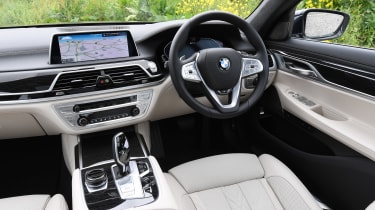
Unlike the exterior, the cabin doesn’t change wholeheartedly with this facelift. But that’s no bad thing. The 7 Series interior still oozes quality both from a material and design standpoint, though it remains closely linked with the BMW 5 Series – an S-Class makes its flagship status known more obviously inside.
Spec a long wheelbase model and there’s a long list of fancy but expensive optional extras you can choose to turn the 7 Series into the ultimate mobile living space. Airline-style executive seats can recline up to 36 degrees, while a champagne chiller can be fitted in place of the middle seat.
The rear-seat entertainment system features two high-definition displays offering access to online services and movies, while on-board wifi allows you to stream or download directly from the web.
One of the most fascinating bits of tech is the gesture control technology, which allows drivers to control the stereo, answer incoming calls and set the navigation by simple hand gestures. It’s a feature no other luxury saloon currently offers.
Sat-nav, stereo and infotainment
New on the facelifted car is the fitment of a fully digital instrument panel as standard, while BMW’s iDrive infotainment system is still up there as class leading software. The central infotainment display sizes up at 10.2-inches, it’s bright, clear and a doddle to use either through touch input or the rotary dial placed near the gear selector.
Navigation, Wi-Fi and Apple CarPlay and Android Auto connectivity are included as standard alongside a great Harman Kardon audio system. An enhanced Bowers and Wilkins surround-sound setup can be found on the options list.
Practicality, comfort and boot space
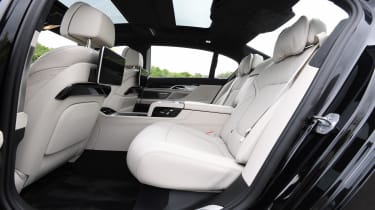
While there are both long and short wheelbase options, the extended 7 Series is more popular and ultimately a more impressive place to spend your time. Opt for some of the more expensive interior trims and one of the rear seat packages (reducing the number of seats from five to four) and you can transform the rear quarters into something special.
You couldn’t really want for any more in terms of space and specification, while BMW has also managed to replicate the air of quality common to some of the world’s greatest (and most expensive) saloon cars – clearly it has taken a few pointers from luxury brand Rolls-Royce in that department.
Up front, there are no complaints about the amount of space on offer, and the cabin layout will be familiar to anybody that has driven a modern BMW. While BMW has added touchscreens and even gesture control (whereby a hand waved in a set movement achieves specific commands) the iDrive control wheel and shortcut buttons are still some of the most user-friendly controls you'll find in any car.
As you’d expect from a BMW there’s plenty of adjustability for the driver to toy with, so you’ll find no problem getting into a comfortable driving position. The controls at hand are all ergonomically sound – the wheel especially – lending particularly well to the 7 Series’ status as a good limo to drive. You’ll find plenty of storage around the cabin too. It is a big car, after all.
Size
The latest G11/G12 (standard and long-wheelbase generations) 7 Series is 26mm longer than the previous model, so there’s no shortage of space inside. A six-foot adult will have more than enough room sat behind another adult, but the long wheelbase model adds another 140mm to the length of the car if required. The 7 Series is slightly shorter than a Mercedes S-Class, but it is marginally wider.
Leg room, head room & passenger space
The regular-wheelbase length 7 Series is a spacious executive limo, but long-wheelbase cars boast the wow factor. Legroom is enormous, while the 7 Series’ width means shoulder room is good too. Up front, the driver should have no problem finding a comfortable driving position.
Be default the rear seating arrangement is a bench capable of seating three, but BMW offers two expensive optional packages. The Rear Seat Comfort Package adds comfort seats with massage function and an entertainment pack consisting of two ten-inch monitors capable of receiving digital TV. On long-wheelbase cars the Rear Seat Comfort Plus Package is available, adding full-size executive seats and a middle centre console, transforming the car into a proper limo.
Boot
A 515-litre boot provides plenty of space, but there is no split folding rear bench to boost capacity. That volume of space is five litres bigger than you'll find in the 7 Series' main rival – the Mercedes S-Class – although in reality you're unlikely to be able to tell which one has more space in everyday use.
That’s said, opt for either of the plug-in hybrid options we prefer and you’ll have to deal with a slightly smaller boot, given the battery and motor tech eats a little into the BMW’s boot space.
Buy a car with Auto Express. Our nationwide dealer network has some fantastic cars on offer right now with new, used and leasing deals to choose from...