BYD Shark review
The Shark is a very convincing pick-up truck debut from BYD


Our opinion on the BYD Shark
The BYD Shark pick-up comes with plenty of kit and enough interior space to really work as a plug-in hybrid family vehicle. The Shark’s blend of quietness and off-road ability is pretty remarkable, but the on-road dynamics, especially in urban areas, aren’t as impressive. BYD has made sure the upstart Shark remains competitive in the fledgling plug-in hybrid pick-up truck market, though.
About the BYD Shark
BYD is looking to quickly cover the most important market segments in the UK, and next on its hit list is pick-up trucks, which it aims to conquer with the BYD Shark.
The pick-up truck sector is a tricky one to succeed in. The Mercedes X-Class, the Nissan Navara it was based on, the Fiat Fullback and the Mitsubishi L200 have all fallen by the wayside in recent years - although the L200 has made a comeback. If there’s one brand with the ambition and resources to take a slice of the pick-up pie, it’s BYD.
The Shark has already been on sale in several other markets, including Australia, where it’s become the country’s most popular plug-in hybrid choice. It’s not quite the most popular truck or ‘ute’ over there - that honour goes to its biggest rival, the Ford Ranger - which is also our 2026 Pick-up Truck of the Year.
Used - available now

2024 Citroen
C3 Origin
7,743 milesAutomaticPetrol1.2L
Cash £12,000
2017 Honda
Jazz
47,086 milesManualPetrol1.3L
Cash £8,995
2023 Honda
Jazz
51,710 milesAutomaticPetrol1.5L
Cash £12,995
2024 Cupra
Formentor
22,910 milesAutomaticPetrol1.5L
Cash £19,874The BYD Shark exclusively available with a plug-in hybrid powertrain, and a powerful one at that. In terms of payload, though, it’s nowhere near as capable as the Ford, as we proved in our BYD Shark versus Ford Ranger twin-test.
MPG & running costs
Pros |
|
Cons |
|
With diesel quickly falling out of favour, and its price currently at high levels, the petrol plug-in hybrid (PHEV) Shark seems to have arrived at exactly the right time for UK pick-up truck buyers. Better still, it’s got one of the most compelling PHEV set-ups on the market, courtesy of a 32.2kWh battery pack slung underneath the chassis that’s capable of a claimed 55 miles on a charge – more than double that of the Shark’s sole PHEV pick-up rival, the Ford Ranger.
Being a plug-in hybrid doesn’t mean much to those at the DVLA these days, so annual tax is £360, the same as plenty of much less fuel-efficient trucks. The Shark’s excellent CO2 emissions have a knock-on effect for Benefit-in-Kind (BiK) rates for company car users though: at just 23g/km, the bill for a lower-rate taxpayer in the 2026-27 tax year is only £844, rising to £1,688 for a higher-rate earner, which is a significant saving over the Ford Ranger PHEV, let alone diesel rivals.
Electric range, battery life and charge time
You’d have to drive like a saint to hit the official 55-mile range figure in daily use. The Shark keeps a quarter of the battery in reserve, so real-world range is closer to 30-plus miles. But even in hold mode (to preserve the battery state of charge), it frequently runs on electric power alone.
Running in hold mode with the engine active, the Shark still showed an instant consumption figure of 28-30mpg at motorway speeds, while economy over a longer distance was nearer 38mpg. Both figures are better than you'd expect from a diesel-engined rival in this class, and around town in pure EV mode that gap would only widen.
The Shark has a DC rapid charger capability, which isn’t something you often see on PHEVs Although not massively relevant for the UK, where public charging is expensive, the 55kW limit is impressive, making for a 30 to 80 per cent top-up in 21 minutes. It’ll be far more cost-effective to keep the battery charged at home from a 7.4kW wallbox, which will take about four and a half hours starting with zero per cent charge.
Load space & practicality
Pros |
|
Cons |
|
There are no issues here. A side step and grab handle make hopping into the (heated and ventilated) front seats fairly easy. The Shark has quite an airy feel up front, with a wide but low centre console and a relatively upright windscreen that means the A-pillars aren’t too intrusive for vision.
Cabin storage is pretty good, from the cooled smartphone tray between the seats, to large door bins, a deep centre cubby, and a small tray ahead of the passenger to supplement a relatively small glovebox. One glaring omission is the lack of a heated steering wheel.
Rear space
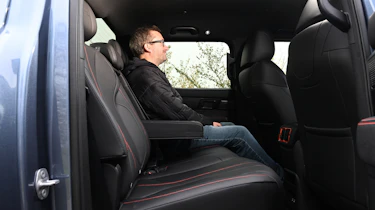
Pick-ups aren’t always known for their rear-seat accommodation, but the Shark fares pretty well. With the driver’s seat set for a five-foot eight-inch driver, rear kneeroom is better than in a lot of family cars, and there’s space for feet under the front seat, with plenty of headroom.
The bench is comfortable and, with the usual caveat that the centre rear seat is never quite as generous as the outer ones, shifting five people from one job site to another is well within the Shark’s remit. For family users, the outer rear seats have Isofix points, and among the BYD’s safety features are a child-presence detection system and rear-door child locks.
Load space
BYD has made a compromise with the Shark, trading the way it drives day to day for ultimate load-carrying capability.
A load length of 1,555mm, bed height of 535mm and load-space width of 1,490mm are all pretty competitive, if not class-leading, and while the tailgate (which is released electrically and folds down on damped struts) is quite high when down. BYD makes it easier to get up there with a fold-out step – but doesn’t say how much weight it can take. Like the Ranger, it has three-pin plug sockets under a flap to the side of the bed, and load-area lighting is also standard.
What may limit the Shark is its 790kg payload, shy of the one-tonne rating of several rivals. Towing capacity is also lacking at 2,500kg, some 1,000kg less than a Ford Ranger, although BYD is said to be looking into improving this.
Performance & driving experience
Pros |
|
Cons |
|
BYD hasn’t taken any half measures with the powertrain. A 1.5-litre four-cylinder turbo petrol engine doesn’t sound like much against a 2,710kg kerbweight, but it’s not working alone. It’s essentially a generator to support a total system output of 430bhp and 652Nm of torque, thanks to beefy electric motors on both axles. The result is startling performance for a pick-up, with 0-62mph occurring in only 5.7 seconds.
While the engine does kick in to maintain charge, the BYD functions like an electric vehicle, with seamless power and a variable torque split at all times. The engine can work in parallel, too, supplying extra power directly to the wheels when demand is high. With no propshaft running between the axles, BYD has used that space to fit a 32.2kWh battery pack, contributing to the claimed 55-mile EV range.
Town driving, visibility and parking
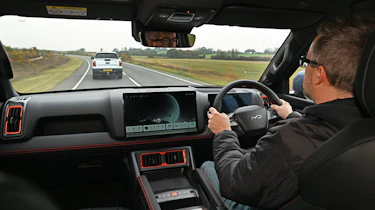
Despite its size, the Shark feels wieldy in town. A relatively upright windscreen aids vision, while the squared-off bonnet makes it fairly easy to see the car’s corners. Some credit must go to the suite of cameras, too. Indicate, and a small blind-spot camera pops up on the screen to complement the view out of the large mirrors. You also get a 360-degree view when parking, and the big central display gives an excellent clear picture.
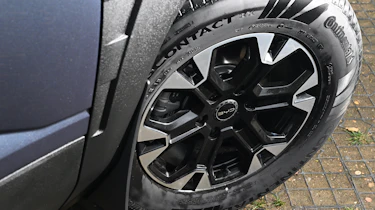
Heavy-duty suspension and chunky tyres mean potholes are a breeze, and generally the BYD rides well considering it’s designed to take a 790kg load in the back. Occasionally, however, you’ll get a typical separate chassis ‘shudder’ over certain bumps. With so much power on tap, the Shark is quick away from the lights, but also very smooth in day-to-day driving.
Country road driving and handling
The Shark’s performance comes into its own on the open road, with none of the slightly slovenly feel you get from some rivals in this class.
The high kerbweight means it ultimately doesn’t feel like a 400- plus horsepower car, but it’s still twice what we’re used to from a diesel pick-up, so progress is pretty effortless. The Shark can feel a little boat- like if you negotiate a roundabout or country road a little too quickly, and the steering calibration isn’t quite right. It makes sense for the big, heavy Shark to have suitably heavy steering, but the inconsistent resistance to your inputs isn’t the nicest or most confidence-inspiring feeling. The brakes are strong, though.
Motorway driving and long-distance comfort
Pick-ups haven’t always been at home on a motorway, but the Shark feels like it is. You’ll probably forget it’s a truck in fact – it’s more like a large SUV. Wind and road noise are minimal, and even when the engine kicks in to keep the battery topped up, it quickly fades into the background. It feels rock-solid at motorway speeds, and the driving position is comfortable over long distances. But the regenerative braking are a little slow to kick in and not that strong, even in its highest regen setting.
| Model | Power | 0-62mph | Top speed |
| Shark DMO | 430bhp | 5.7sec | 111mph |
Cab interior & technology
Pros |
|
Cons |
|
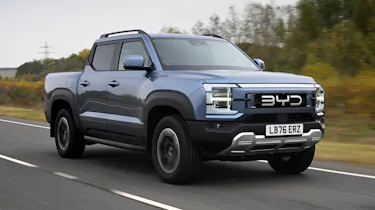
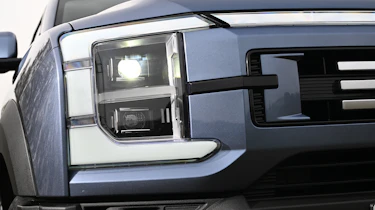
Square-edged, with chunky wheelarch pressings and a distinctive nose, the Shark hits all the right notes. Our Atlantis Blue model looked handsome, but BYD offers Sunrise Orange for something more eye-catching.
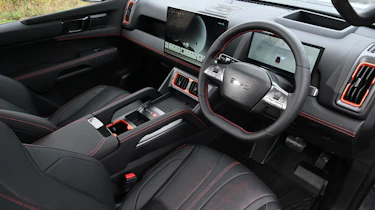
The interior also has a more futuristic feel than most competitors, mainly courtesy of the sizeable centre touchscreen and in-vogue two-spoke steering wheel. But chunky grab handles on the centre console and contrasting orange stitching and trim elements mean there’s a bit of character inside, too.
BYD’s cars tend to look and feel pretty good on initial inspection, and that carries over to the Shark, where all the important stuff – steering wheel, seats and other areas you regularly interact with – being tactile and suitably solid. The vegan leather used on the steering wheel and seats seems hard-wearing.
Importantly, the Shark also seems well put together on the outside, particularly around the bed, which is likely to take some punishment in its role as a working vehicle.
Infotainment, sat-nav and stereo
The Shark’s in-car tech centres around a 15.6-inch touchscreen. You’ll be using it a lot, because the majority of the car’s functions are operated through here, including all of the heating and ventilation controls and, less obviously, the headlights. We could do without the latter, but at least the indicators and flasher/main beams are still on a stalk shared with the wiper controls, and there are physical buttons on the steering wheel.
The touchscreen is clear and responsive, and has some useful shortcuts, such as swiping three fingers to quickly change the temperature or fan speed. Android Auto and Apple CarPlay integration is standard, too, and setting up the latter is a doddle.
Reliability & safety
Pros |
|
Cons |
|
Brand new at the time of writing, it’s hard to judge how the Shark might treat its owners in the long term, which gives some long-running rivals the edge given dependability is a big selling point for a hard-working pick-up truck. On the other hand, BYD scored higher as a brand than some of its rivals in the 2026 Driver Power survey. Its 16th place finish isn’t outstanding in the greater scheme of things, but it was ahead of Toyota in 19th and Ford in 21st, whose Hilux and Ranger are key rivals.
The BYD is covered by a six-year/93,750-mile (150,000km) warranty, eight years/ 93,750 miles for the drive unit, plus eight years/125,000 miles of battery-pack coverage.
ANCAP, the Australian equivalent of Euro NCAP, tested the Shark in 2025 and awarded a full five-star score. This has been carried over to Euro NCAP, which ran tests to supplement the ANCAP result. Scores of 82 per cent for adult occupants and 86 per cent for child occupants are competitive, while 74 per cent for vulnerable road users matches a Ranger.
The 87 per cent safety-assist score is impressive, and unsurprising given the BYD’s fairly comprehensive range of systems. The Advanced Driver Assistance Systems (ADAS) are unintrusive most of the time. Despite the Shark’s width, it doesn’t panic when you need to cross a white line, and the driver monitoring won’t bleep at you if you look both ways at a junction or peer at the touchscreen for a few seconds.
Buying, prices and deals
The Shark is offered in a single specification called Design, starting from £47,295. You’re getting plenty of equipment for that, with the large infotainment system, heated and ventilated front seats, a 360-degree parking camera plus front and rear parking sensors, a head-up display, and adaptive cruise control among the highlights. The only cost options are the colours, although they’re quite expensive at £1,100 each.
BYD Shark Alternatives
If it has to be a plug-in hybrid, there’s only one – the Ford Ranger PHEV. It’s quite a bit more expensive, but it is the better pick-up overall.
If it’s the electric running that are of interest, you could go for a fully electric pick-up, but your options are similarly limited, with the Isuzu D-Max EV, Toyota Hilux BEV, KGM Musso EV and Maxus eTerron9 being the only options available. All but the KGM are very expensive, and all apart from the D-Max have less impressive payloads than the BYD.
If you’re open to a conventional diesel pick-up, this will open up many more alternatives, including combustion versions of the Hilux, D-Max and Musso (that last one’s actually a different truck entirely) plus the Volkswagen Amarok, Mitsubishi L200 and, of course, the market-leading Ford Ranger.
BYD Shark pictures
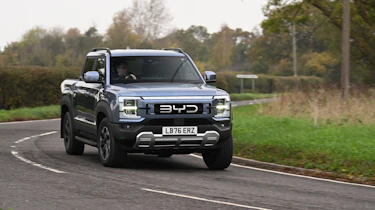
BYD Shark dimensions
| Body style | Height | Width | Length |
| Double cab | 1,925mm | 1,971mm | 5,457mm |
Load area dimensions
| Body style | Height | Width | Length |
| Double cab | 535mm | 1,200mm (between wheelarches) | 1,555mm |
Frequently Asked Questions
The BYD Shark is a very good pick-up truck, and a unique one in the strong electric-only range it provides.