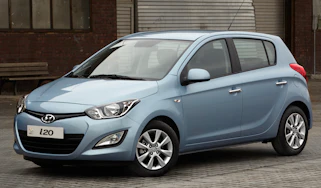
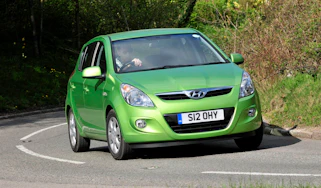
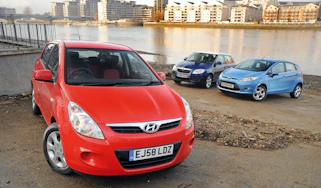
Hyundai i20 review
Hyundai i20 is a competitive supermini that offers plenty of appeal and practicality

Our opinion on the Hyundai i20
The Hyundai i20 delivers an entertaining chassis, sweet-spinning three-cylinder engine, impressive practicality, and a high level of standard equipment. Add a strong warranty and affordable finance rates, and it looks like a compelling package.
It’s not perfect, though. The interior is let down by mixed material quality, it has a firm low-speed ride on its larger wheels, and the limited engine range might not suit all. For those reasons, we still think the Renault Clio is a better all-rounder, but the i20 is closer to the top of the class than ever before.
About the Hyundai i20
The steady march of progress continues at Hyundai, and the latest i20 is one of the best demonstrations so far of this gradual improvement – it’s the most complete i20 yet, and the closest Hyundai has got to building a supermini capable of taking on the class-leading Renault Clio, Skoda Fabia and Volkswagen Polo.
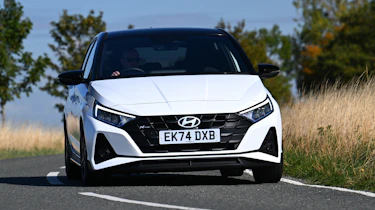
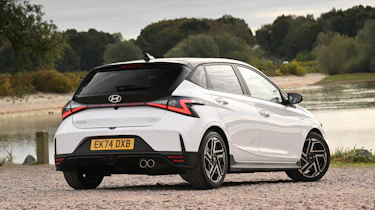
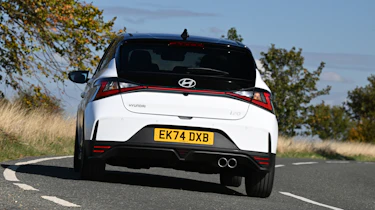
While based on the same platform as its predecessor, Hyundai has developed the car in every area. You won’t fail to notice the sharp styling, particularly the slash-cut flanks which ape the SEAT Ibiza. All versions feature a new grille, and the Hyundai badge has been moved to a more prominent position near the bonnet's leading edge.
Used - available now


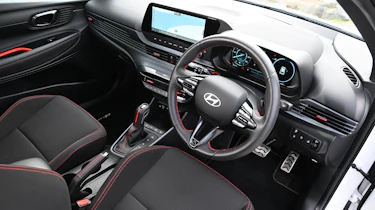
There have been similar advancements inside, with a more modern design and the notable application of a fully digital instrument cluster on Black Line models and above, which adds a high-tech feel. Unfortunately, that doesn’t quite stretch to the interior materials, which lag behind some rivals.
We’ve driven the i20 in both pre- and post-facelift forms. Hyundai’s revamping efforts weren’t enough to see off the Citroen C3 when the two superminis faced each other in our twin test. The i20 fell short of its French rival due to drawbacks that included a sluggish infotainment system and a limited range of engines.
Hyundai i20 prices and latest deals
Pricing for the Hyundai i20 line-up kicks off with the Element model from just under £20,000. There’s a bit of a jump up to Black Line trim at around £23,000, while the high-end Tech Line trim comes in at around £24,300. The sporty N-Line S is only available in manual form for around £25,000.
If you build your perfect Hyundai i20 via the Auto Express Buy a Car service. We also have plenty of new i20s in stock and ready to go, along with a number of used Hyundai i20 deals. We can also help you sell your car.
Performance & driving experience
Pros |
|
Cons |
|
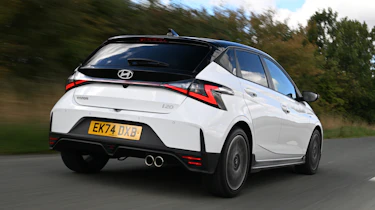
Following a further refresh of the i20, the 1.0-litre, three-cylinder turbocharged unit has been reduced from 99bhp down to 89bhp. It’s still available with a choice of six-speed manual or seven-speed automatic transmission, and peak torque remains the same at 172Nm.
Refinement is good, however. The three-cylinder unit is a little more vocal on start-up than the equivalent Stellantis engine, but it settles down nicely on the move. There’s no hybrid assistance on offer here, either; some sort of clever electrical tech would be welcome considering the underwhelming power and torque outputs.
Unfortunately, despite a positive feeling gear lever movement, the manual gearbox still isn’t perfect. While less noticeable than before, we still feel the engine mapping cuts and re-engages the power clumsily when the clutch pedal is pressed, with the change from first to second gear when setting off being jerky, leading to the car feeling awkward to drive around town. Rivals like the Skoda Fabia and VW Polo are much more satisfying to drive.
Thankfully, the seven-speed dual-clutch gearbox is much better; apart from occasionally being a little slow to kick down – something that engine needs to do every once in a while, given its modest power – it’s smooth and responsive. However, it’s a pricey £1,250 option on an affordable car like the i20, and only makes sense if you can’t drive a manual.
| Model | Power | 0-62mph | Top speed |
| i20 1.0T GDi Element | 89bhp | 11.5 seconds | 112 mph |
| i20 1.0T GDi Tech Line DCT | 89bhp | 12.8 seconds | 111 mph |
Performance, 0-60mph acceleration and top speed
It’s under the bonnet where the i20 doesn’t get off to the strongest of starts. Performance is merely okay rather than outstanding; a 0-62mph time of 11.5 seconds for the manual and 12.8 seconds for the auto means that some forward planning is needed when making overtakes and accelerating along motorway slip roads.
The i20 is a little slower than the 11.2 seconds it takes the 1.2-litre Vauxhall Corsa to achieve the same 0-62mph dash, while the 94bhp 1.0-litre Volkswagen Polo manages the sprint in 10.8 seconds.
Town driving, visibility and parking
Superminis need to be easy to drive, and – that manual gearbox aside – the i20 is a doddle. It feels suitably compact on the road, giving the driver the confidence to squeeze through tight gaps and into very small parking spaces, while the steering is light at low speeds and the turning circle is tight. The ride is well judged, too; it’s a little firmer than the average for the supermini class, but it could never be considered harsh. Instead, it simply does a solid job of keeping the body composed and controlled over speed bumps and poor road surfaces.
Country road driving and handling
Since the Ford Fiesta departed the class, finding a supermini that even a keen driver would enjoy using has become much trickier. The i20 manages to get closer to filling that gap than most rivals. It’s helped by sweet steering, which is really well weighted and has a response that feels just right for the chassis, and allows you to get into a smooth flow on a country road.
That firmer-than-average suspension set-up makes the i20 quite agile when turning into a corner, and it’s also resistant to body roll. Thanks to that firmness not bringing with it a crashy ride, some passengers can find the i20 more comfortable than softer options in this class, because the body doesn’t wallow from one bump to the next.
Motorway driving and long-distance comfort
For a relatively small car, the i20 feels impressively stable at high speeds, with more composure than rivals such as the Vauxhall Corsa. However, the engine again becomes its downfall, because there’s not much oomph once it’s up to the national speed limit, which makes overtaking and long motorway inclines a bit more tiring than in many of its rivals.
“Both the Hyundai i20 and Citroen C3 have a slightly fidgety low-speed ride, but the i20 is better at isolating the sound of bumps and knocks from its occupants.” - Alex Ingram, chief reviewer.
MPG & running costs
Pros |
|
Cons |
|
During a week behind the wheel of the i20 DCT auto (pre-revisions), we averaged just shy of 50mpg. Considering there’s no hybrid assistance to boost town-driving efficiency, that’s a fairly strong return, and one which helps the car run some electrically assisted superminis very close. In another test of the manual version against its Vauxhall Corsa equivalent, we saw an average efficiency of 45mpg.
Since these tests, the i20 engine range has been revised again with slightly less power and torque. The most efficient in the range is the 1.0T N-Line S manual at 52.3mpg and 123g/km, while the 1.0T DCT Tech Line is the worst at 47.9mpg and 133g/km. If you’re after better fuel economy, try a Toyota Yaris, because its hybrid system is much more efficient at 68.9mpg and 92g/km.
| Model | MPG | CO2 | Insurance group |
| i20 1.0T GDi Element | 49.6mpg | 130g/km | 11E |
| i20 1.0T GDi Tech Line DCT | 47.6mpg | 133g/km | 14E |
| i20 1.0T GDi N Line S | 52.3mpg | 123g/km | 15E |
Insurance groups
Depending on the trim level, the i20’s insurance ranges from groups 11 to 15. The highest is for the N-Line S with a manual gearbox, and the lowest is for the Element trim with a DCT ’box; the automatics sit one group lower than the equivalent manual trim.
The Vauxhall Corsa, meanwhile, starts from group 19. However, those in need of the cheapest premiums will want to look towards the Volkswagen Polo, because this starts in group 3, while a similarly powerful 1.0 TSI Life is in group 9.
Tax
As with all of its supermini brethren, including the electric ones, the i20 will face Vehicle Excise Duty (VED) charges of £195 per year from years two to six.
While an i20 is less likely to be a company car choice, its higher CO2 emissions compared with a hybrid supermini, such as a Toyota Yaris, or an all-electric alternative like the Vauxhall Corsa Electric, will make the Hyundai more costly to run in terms of Benefit-in-Kind (BiK) company car tax.
Depreciation
Again, depending on trim, the i20 is predicted to hold onto between 46 and just under 50 per cent of its original value after three years or 36,000 miles. The least expensive Element trim is likely to maintain its value the best.
This is similar to the VW Polo, but not quite as good as the Renault Clio, which is expected to retain between 50 to 57 per cent of its original value over the same period.
To get an accurate valuation on a specific model check out our free car valuation tool…
Interior, design & technology
Pros |
|
Cons |
|
While the i20’s cabin is generously kitted out, it feels a little cheap compared with the strongest competition – and the infotainment technology is starting to show its age.
Interior and dashboard design
There’s some visual interest with the unusual four-spoke steering wheel design, vents that seem to flow into the rest of the dashboard, while a 10.25-inch digital instrument display (standard from Black Line trim and above) gives the i20 a high-tech feel. However, there’s a depressing lack of colour used – even with the Lucid Lime interior stitching option. It’s nowhere near a Citroen C3 in terms of imagination.
Materials and build quality
Quite a few different grades and textures of plastic are used throughout the i20’s cabin, but all of it feels hard and scratchy. However, other parts, including the switchgear and the three-spoke steering wheel fitted to the N-Line S trim, look and feel more expensive than what’s on show elsewhere.
Infotainment, sat-nav and stereo
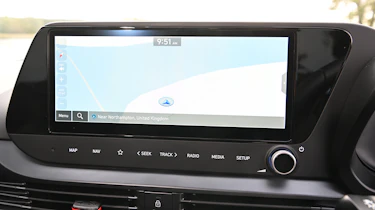
Newer Hyundais have gained slicker infotainment set-ups, but the i20 has been left behind. The loading times of its system are slow; it’s at its worst when booting up, and because you need to dive into a convoluted menu to switch off the driver-assist systems, you will have to wait a while if you want to adjust them before setting off. Button presses and swipes on the mapping screen take time to register, as well.
While the touchscreen infotainment system isn’t troubling the class best, the i20’s digital driver’s display still looks sharp and easy to read. The graphics are clear, and the design and colour scheme of the round dials alter according to the driving modes. This feature is standard on every model in the range, so even the base Element trim feels suitably hi-tech, especially because the likes of rear parking sensors and a reversing camera are included.
A high-end BOSE sound system is worthwhile having if you like your music, but it’s reserved for the pricey £1,000 Tech Pack on Tech Line models, or the range-topping N-Line S trim.
“Sometimes, choosing a pick of the range is easier said than done – but for the i20 it’s a no-brainer. The entry-level Element is so well equipped for a supermini, the majority of buyers will be satisfied putting their money there.” - Alex Ingram, chief reviewer.
Boot space & practicality
Pros |
|
Cons |
|
The i20 makes the most of its modest footprint, delivering a great mix of cabin space and boot capacity that stands up well against the most roomy options in the class.
A suite of cubbyholes makes it easy enough to stash stuff around the i20’s cabin, and we approve of the decent-sized glove box, which is far more useful than what you’ll find in a Peugeot 208 or Vauxhall Corsa. The cubby ahead of the gearlever is more than suitable for a mobile phone or two, and in Premium models and above, it comes with a charging pad.
Dimensions and size
The i20 is right in the supermini ballpark, with a length of just over four metres, at 4,065mm. It’s also 2,061mm wide (including mirrors), and 1,450mm high. The wheelbase is 2,580mm, which is 10mm greater than its predecessor. For comparison, those figures are within a few millimetres of the Volkswagen Polo.
| Dimensions comparison | |||
| Model | Hyundai i10 | Renault Clio | Citroen C3 |
| Length | 4,065mm | 4,053mm | 4,015mm |
| Width | 2,061mm (inc mirrors) | 1,988mm (inc mirrors) | 2,017mm (inc mirrors) |
| Height | 1,450mm | 1,440mm | 1,577mm |
| Wheelbase | 2,580mm | 2,583mm | 2,540mm |
| Boot space | 352-1,165 litres | 391-1,069 litres | 310-1,188 litres |
Seats & passenger space
It’s hard to fault the i20’s driving position. The seat and the steering wheel each have loads of adjustment, and the mirrors are a good size, so all-around visibility is fine. A huge glovebox (required to hold Hyundai’s enormous owner’s manual), roomy door bins and a pair of cup-holders offer decent storage options up front.
While the cheap-looking and flimsy-feeling door panels might make rear passengers wonder whether they’ve been forgotten about, there is at least plenty of space on offer. Headroom is fine – if not as generous as in the taller Citroen C3 – while knee room is excellent for a circa four-metre-long car. The seats have a fairly long squab, giving decent under-thigh support for all. The centre seat is a touch narrow – normal in a small supermini such as this – but otherwise it’s very soft and surprisingly comfortable.
Rear passengers willing to share can use the USB-C port to charge their devices – a feature lacking in rivals such as the Vauxhall Corsa. However, some alternatives hide their Isofix child-seat mounts behind plastic covers; the i20’s are behind zips in the fabric, and a bit of rummaging around within the internal cushion is required in order to locate them.
Boot space
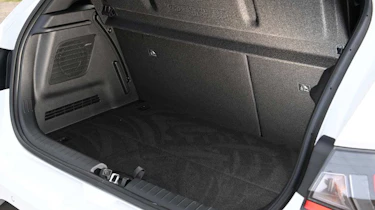
A 352-litre load volume is among the biggest available in the supermini sector, while the space itself is surprisingly versatile, too. An adjustable floor comes with Tech Line trim, and it can be set at two levels. Positioned in its highest setting, it forms a near-level platform with the rear seatbacks when they’re folded down, to the benefit of loading bulky items into the boot.
With the seats folded, there’s 1,165 litres of space available – better than in a Renault Clio or Vauxhall Corsa. Little slots in the plastic beside the seatbacks can be used to hold the belts in place when folding that rear row – a simple but very smart idea. We also like that you can store the parcel shelf up against the back seats if you need to remove it in order to carry a taller item in the boot.
“The i20 matches the Citroen C3 for knee room, but is a little behind in other areas. The Hyundai’s boot is a close match for its rival’s, and an adjustable floor makes the space more versatile.” - Alex Ingram, chief reviewer.
Reliability and safety
Pros |
|
Cons |
|
When it comes to customer satisfaction, the Hyundai brand could do better. It has dropped four places compared with last year, coming in 20th out of 31 manufacturers in the 2025 Driver Power survey. While that is above SEAT (24th), VW (27th), and Dacia (29th), it was beaten by the likes of Citroen (16th), Skoda (12th), Honda (10th), Suzuki (9th), and Renault (6th).
The i20 scored a four-star Euro NCAP safety rating when tested in 2021. That’s disappointing given that the Volkswagen Polo got the full five-star rating when tested under the same criteria. The German car received superior marks for adult-occupant protection and safety assistance.
Hyundai’s supermini packs plenty of useful safety tech, from autonomous emergency braking, speed limit warning, and lane-keep assistance. You’ll need to go for the high-end N-Line S trim in order to get blindspot warning, though.
| Euro NCAP safety ratings | |
| Euro NCAP safety rating | Four stars (2021) |
| Adult occupant protection | 76% |
| Child occupant protection | 82% |
| Vulnerable road user protection | 76% |
| Safety assist | 67% |
Buying and owning
Best buy: Hyundai i20 1.0T GDi Element
It may be the cheapest model, but the entry-level Element trim is fitted with enough kit to meet the needs of the vast majority of supermini buyers. While the manual gearbox certainly isn’t the slickest to use, we’d still recommend avoiding the £1,250 automatic transmission unless you specifically require an auto.
Hyundai i20 alternatives
The i20’s facelift left the range with just a single engine choice: a 89bhp turbocharged, 1.0-litre, three-cylinder petrol. It misses out on mild-hybrid technology like its Peugeot 208 and Vauxhall Corsa rivals, which we think is an odd choice given the benefits it brings in terms of additional performance and efficiency.
There are plenty of full-hybrid alternatives like the Honda Jazz, Renault Clio E-Tech, and Toyota Yaris; all of which boast impressive fuel efficiency. Of course, there’s also an ever-increasing number of fully electric superminis to consider, such as the Renault 5, Citroen e-C3 and BYD Dolphin.
Key updates of the Hyundai i20 review
26 February 2026: Updates to the trim and engine line-up of the i20 range.
Deals on the Hyundai i20 and alternatives
Hyundai i20 history
Hyundai i20 Mk3: 2020-present
The Mk3 Hyundai i20 arrived in 2020, and it marked a big shift in the character of the car – no longer was it a dirt-cheap bargain, because prices were now on par with many of its main rivals. There were plenty more changes, too: the Mk3 was much more fun to drive and striking to look at than previous versions. Not every trait of the older i20 generations was thrown out on the third-gen car, though – equipment levels and practicality across the board were good, and pre-facelift cars came with a selection of peppy petrol engines – with the hot i20 N being a particular highlight. Read our full Mk3 Hyundai i20 buyer’s guide here…
Hyundai i20 Mk2: 2015-2020
While not as big a leap forward as its predecessor, the Hyundai i20 Mk2 was nevertheless handily better in several areas than the Mk1 model. Practicality improved a bit, and the car was much more stylish – especially if you ignored the five-door version and went for the sportier three-door i20 Coupe instead. Like the old car, the i20 Mk2 was also well equipped and represented good value compared to some of its rivals. Read our full Mk2 Hyundai i20 buyer’s guide here…
Hyundai i20 Mk1: 2008-2014
The Mk1 Hyundai i20 arrived in 2008, and was a big improvement over the Hyundai Getz supermini that preceded it. Practicality was good for such a small car, and the combination of competitive pricing and impressive equipment levels made the i20 Mk1 a tempting value-oriented alternative to other superminis like the Vauxhall Corsa, Toyota Yaris and Ford Fiesta. A choice of petrol and diesel engines were available, and the Hyundai i20 Mk1 only came in a versatile five-door hatchback form.
Hyundai i20 pictures
Frequently Asked Questions
During our twin test with a Citroen C3, the Hyundai i20 managed 49.6mpg in mixed driving.