Mercedes CLA review
Mercedes CLA is a highly capable electric car that represents a huge step forward for the brand’s EVs


Our opinion on the Mercedes CLA
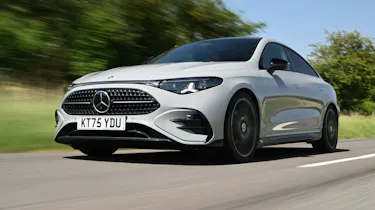
If ever there was a car that demonstrates a stark difference in ability depending on which powertrain you choose, then the Mercedes CLA is it. The all-electric model is a convincing EV at the very top of its game, with excellent efficiency and a long driving range, but the CLA Hybrid petrol-electric set-up isn’t quite as polished.
Where the EV is responsive and smooth, the Hybrid can sometimes be jerky and hesitant. But both versions deliver excellent comfort, refinement and technology, with the kind of equipment that you’d normally find in an E-Class or even an S-Class limo. There’s good handling on offer, too, and while passenger space is tight, anybody driving a CLA will feel like they’re behind the wheel of a mini executive saloon.
About the Mercedes CLA
There’s a lot riding on the Mercedes CLA. It’s part of a fresh outlook for the firm that will influence the next-generation, more upmarket Mercedes A-Class when it arrives in 2029. It was first launched in all-electric guise, but was quickly followed by the petrol-electric CLA Hybrid, after Mercedes decided to hedge its bets on whether electrification would take over the new-car market.
The CLA is based on Mercedes’ latest MMA platform, which has been optimised for efficiency, but not at the expense of the kind of comfort or luxury that the brand is known for. The drive layout is dependent on powertrain, with lower-spec versions of the Hybrid featuring a front-wheel-drive configuration, while the electric car has rear-wheel drive. Four-wheel drive is standard in 4MATIC cars, with the EV adding a second electric motor to the front axle. As well as a four-door saloon, there’s also the CLA Shooting Brake, which is somewhere between a hatchback and a proper estate car.
Performance & driving experience
Pros |
|
Cons |
|
The driving experience varies according to the powertrain. The CLA Hybrid doesn’t have the most refined petrol-electric set-up, and you have to carefully judge your inputs to ensure the system doesn’t deliver jerky responses.
Used - available now


It’s the same powertrain for all three Hybrid variants, with a 1.5-litre turbocharged four-cylinder petrol engine joined by a 30bhp electric motor for electric assistance.
On the CLA 180 and CLA 200 it sends power to the front wheels via an eight-speed DCT twin-clutch automatic transmission, while the CLA 220 4MATIC adds a propshaft so that power is also sent to the rear axle.
| Model | Power | 0-62mph | Top speed |
| CLA 180 Sport Executive | 134bhp | 8.8 seconds | 135mph |
| CLA 200 AMG Line Executive | 161bhp | 8 seconds | 144mph |
| CLA 220 4MATIC AMG Line Premium | 187bhp | 7.1 seconds | 147mph |
Performance, 0-60mph acceleration and top speed
If there’s enough charge in the small 1.3kWh battery, then the CLA Hybrid will sit in silence when stopped with the Normal drive mode selected. If you pull away gently, the electric motor will propel the car, but there isn’t much power from this, so it won’t be long before the petrol engine cuts in. It does so with quite a rough jerk, so the Mercedes system isn’t the most refined that we’ve encountered.
If you like to be smooth with your pedal inputs, it might be counterintuitive to give the Hybrid a bigger dose of throttle so that the engine fires up immediately. You’ll pull away a bit more dramatically, but you won’t have to endure the later shudder through the gearbox. But the hesitant stop-start system is difficult to avoid if you’re driving in slow traffic.
The alternative is to switch to Sport setting, which sees the engine running even at a standstill, thus eliminating the jerky transition between electric and petrol modes.
Likewise, if you keep your speed above 70mph, then the engine won’t shut off, but we don’t recommend exceeding the speed limit to achieve this. The EV is a far smoother than the Hybrid at all speeds, whether you’re in Normal or Sport.
Town driving, visibility and parking
The CLA’s chassis is comfortable, even in cars fitted with the largest 19-inch alloy wheels. The suspension soaks up smaller imperfections well, delivering some of the best ride comfort in the executive car class. Cracks and potholes in the tarmac deliver a thump through the cabin, although these are felt more than they are heard, with good sound insulation keeping passengers unaffected.
All CLAs have a reversing camera and front and rear parking sensors to help with low-speed manoeuvrability, while Mercedes offers advanced self-parking technology.
Country road driving and handling
The CLA isn’t the most engaging saloon to drive – leave that to the BMW 2 Series Gran Coupe – but if you’re looking for a competent- yet-comfy car, then it’s worth considering.
Grip is strong, and the steering is very well suited to the response of that chassis, meaning there isn’t much understeer from the front-wheel-drive CLA Hybrid.
We’ve tested it in front and four-wheel-drive forms, and the handling is neutral and tidy; there’s slight body lean when cornering, while the steering has the perfect balance of weight and speed of response. The all-wheel drive system provided excellent traction on wet, snowy roads, too.
While the electric CLA’s clever braking set-up offers a smooth transition from regenerative to friction braking, the Hybrid is a different matter. The pedal seems to lose bite when coming to a complete stop, which lets the car run away from you slightly. It’s something owners will adapt to, but it is a little annoying.
Motorway driving and long-distance comfort
The CLA has a superb ride at higher speeds: it feels composed while still offering a plush and comfortable experience. Whether you choose a model with 18 or 19-inch wheels, they are perfectly capable of ironing out the majority of road imperfections.
General refinement is excellent. The EV’s powertrain is totally silent, and the hybrids are reasonably hushed, even when the petrol engine is running. Road noise is a bigger concern than the engine’s faint hum.
Aerodynamic efficiency keeps wind noise to a minimum and is helped by small wing mirrors. Rearward visibility is still pretty good despite this, although the shallow rear windscreen limits your view directly behind.
MPG & running costs
Pros |
|
Cons |
|
The headline efficiency figures are stolen by the all-electric CLA, but the Hybrid model is pretty impressive, too.
Mercedes quotes a WLTP-tested return of 56.5mpg for both the CLA 180 and CLA 200 in Sport trim with 18-inch alloys, but this drops a little when 19-inch wheels and the extra kit of higher-trim variants is added, with the top-spec AMG Line Premium Plus having quoted figures of 54.3mpg for both engine outputs.
The extra drag of the all-wheel drive system in the CLA 220 4MATIC means its figures aren’t quite as strong, ranging from 52.3mpg for the Sport model and dropping to 50.4mpg with the AMG Line Premium Plus.
Mercedes claims that the CLA Hybrid can recuperate up to 25kW of energy when slowing down, in any gear, which will help to recharge the battery.
During our time with the CLA 200 in top-spec Premium Plus guise on a mix of urban streets, country roads and motorways, we saw a return of 45.3mpg, which translates into a range of nearly 430 miles when the 43-litre fuel tank is full.
| Model | MPG | CO2 | Insurance group |
| CLA 180 Sport Executive | 56.5mpg | 115g/km | 28 |
| CLA 200 AMG Line Executive | 54.3mpg | 117g/km | 32 |
| CLA 220 4MATIC AMG Line Premium | 51.4mpg | 126g/km | 35 |
Insurance groups
The Hybrid starts in Group 27 for the CLA 180 Sport, while the CLA 200 is in Group 30 and the CLA 220 4MATIC is in Group 33. Upgrading to different trim levels will bump up the group rating, with the top- spec CLA 220 4MATIC AMG Line Premium Plus sitting in Group 35.
In comparison, the electric CLA has higher groupings, starting in Group 37 for a CLA 200 Sport, rising to 45 for a CLA 350 4MATIC AMG Line Premium Plus.
Tax
If you’re looking at a CLA as a company car, choose the EV. While P11D prices are similar between the electric and Hybrid line-ups, the EV’s low Benefit-in-Kind tax rate slashes costs so that even the most expensive CLA 350 4MATIC costs taxpayers a fraction of the Hybrid models.
In the 2026/27 tax year, this version has a four per cent charge that will cost lower-rate taxpayers around £450 a year, whereas the base CLA 180 Sport hybrid has annual bills around the £2,140 mark.
Road tax varies according to which model you choose, too. The luxury car tax means all versions of the Hybrid bar the entry-level CLA 180 Sport are subject to the £440 additional payment in years two to six, because they cost more than £40,000. But since the threshold for EVs is £50,000, most of the electric line-up pays the standard £200 rate; only the highest-spec CLA 250+ and all the CLA 350 4MATIC models pay the extra.
Depreciation
Perhaps it has something to do with those higher tax costs, but the CLA Hybrid has weaker residuals than the EV.
They range between 46 to 48 per cent for the Hybrid, whereas the EV is in the 50-56 per cent range, which is pretty impressive for an executive saloon. In comparison, the petrol BMW 2 Series Gran Coupe is in the 48-51 per cent range, but the Audi A3 is in a similar ballpark to the CLA Hybrid.
Interior, design & technology
Pros |
|
Cons |
|
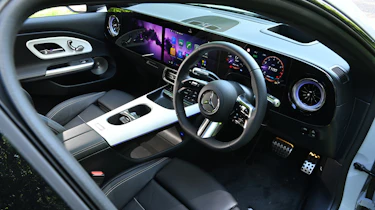
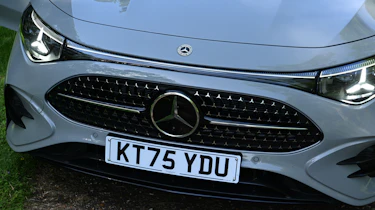
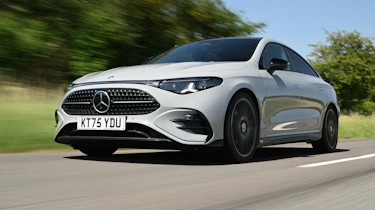
With sweeping lines and frameless window glass, the current CLA is a clear evolution of the two generations that came before it. But Mercedes has gone large with the three-pointed star detailing, including on the grille and within the lights. In fact, lighting is a big part of the CLA’s tech package, with an illuminated grille for all cars, plus a lightbar across the tailgate. There’s ambient LED lighting inside, too, with multiple colours available.
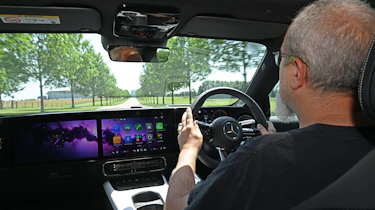
Merc’s MBUX operating system is one of the better set-ups on the market, which is a good thing, because the CLA largely relies on the touchscreen for all of its functions.
All cars come as standard with a 14-inch main display and a 10.25-inch instrument pod as part of an upright all-in-one dashboard layout that puts technology at your fingertips.
Interior and dashboard design
The sheer size of the touchscreens means they dominate the interior, but there are some neat details elsewhere. The turbine-style circular air vents at either end of the dash are familiar from other Mercedes models, while all the vent controls feel solid and click into position when you re-centre them.
Sport models have a satin finish for the centre console, and part fabric/artificial leather seats. AMG Line adds carbon-effect grey plastic and white highlights for the doors and seats. Premium cars add brushed aluminium trim, while the Premium Plus has matt white ‘natural fibre’ inserts with grey pinstripes for a different look.
Materials and build quality
The CLA’s metal-effect switches feel upmarket, as do the steering wheel and positive column stalks. There are some harder plastics lower down in the cabin in areas where feet are likely to kick, but overall it’s a fine place to sit. We’re unsure how well the glossy black finish of the main dashboard will hold up to everyday life, though.
Infotainment, sat-nav and stereo
Owners of modern Mercedes will be familiar with the CLA’s touchscreen system, although there’s new software to run it. This helps the CLA offer enhanced services, such as over-the-air updates, more apps and AI-assisted voice control via the “Hey Mercedes” prompt.
Using the touchscreen is a piece of cake, with rapid responses and a large enough display so it’s easy to select the option you want with a first press of the screen. The climate controls are a permanent fixture at the bottom of the display, so they’re easy to use, while large Home and back buttons help you to navigate without becoming lost in the menu system.
Navigation comes as standard, and this can be shown on the main home screen or the driver’s display, or you can even add it to the second passenger display that is available on higher-spec versions. We do wonder about the usefulness of this third screen – it can be handy for watching videos or operating in-car functions, but we found that most passengers made a beeline for the main screen instead.
There isn’t a natural place to rest your hand while navigating through the central display, making it harder to select functions while on the move. Also, we found that the voice-recognition system would activate erratically when it would ‘hear’ the “Hey Mercedes” prompt in any conversations that you might be having with other occupants.
The multifunction steering wheel has two pairs of horizontal spokes, all with different touch-sensitive controls. They’re not the easiest buttons to use while on the move because they need a gentle touch to work properly. For example, changing the volume can go from quiet to loud quite quickly unless you gently slide your thumb up the spoke.
Boot space & practicality
Pros |
|
Cons |
|
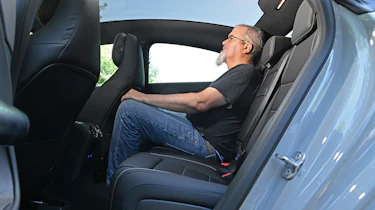
The Mercedes CLA is more compact than many executive saloon rivals, while the swooping shape of the roof and rear end means passenger and boot space isn’t quite as generous as you’ll find in some rivals. That’s not to say it’s cramped, and a long wheelbase, panoramic glass roof and flat floor mean there’s a reasonable amount of room in the back, certainly more than in the previous CLA.
Dimensions and size
While the CLA is longer and wider than the car that it replaced, it’s still relatively compact. It’s close in size to the Audi A3 saloon, so is smaller than cars such as the Tesla Model 3 or Polestar 2, which are considered rivals to the larger Mercedes C-Class.
| Dimensions comparison | |||
| Model | Mercedes CLA | Audi A3 Saloon | BMW 2 Series Gran Coupe |
| Length | 4,723mm | 4,504mm | 4,546mm |
| Width | 1,855mm | 1,984mm | 1,800mm |
| Height | 1,468mm | 1,417mm | 1,445mm |
| Wheelbase | 2,790mm | 2,635mm | 2,670mm |
| Boot space | 405 litres | 425 litres | 360 litres |
Seats & passenger space
You’re faced with an upright dash in the CLA, but the view forward is better than in other recent Mercedes saloons, while a wide range of seat and wheel adjustment means that most drivers will find a comfortable position. You’ll realise that the main touchscreen is close to hand, too, so you don’t have to stretch across to use it.
There’s a poorer view to the rear, courtesy of the steeply raked back window that leaves just a letterbox-like opening to look out of. At least there’s a reversing camera and rear parking sensors to help position the car.
Storage up front comprises a deep bin beneath the central armrest, plus cup-holders on the centre console with another tray set beneath, where you’ll find the USB sockets. A wireless charging tray is located ahead of the cup-holders. The door bins are large, but access is a little narrow due to the shape of the armrests above.
On the driver’s side, the window switches feature the same two-stage setting as you’ll find in some of Volkswagen’s electric models. There are just two switches, so if you want to open the rear windows, you have to press a button to operate them.
Access to the back seats is a little tricky due to the low roof and small door openings, but once there, you’ll find a reasonable amount of space. Headroom can be a little tight for taller occupants, but legroom is fine, and the back seats are comfortable.
The CLA Hybrid has a slight hump in the floor for middle-seat occupants (for the CLA 220 4MATIC’s four-wheel drive system), but it’s not as large as some transmission tunnels. The floor is a little high, so under-thigh support could be better, but overall the cabin is comfortable.
The backs of the front seats include cargo nets, while rear passengers have their own air vents and two USB sockets. The door bins are similar to those in the front, with tight access but deep sides for larger items.
Boot space
There’s a 405-litre cargo area on offer, but larger items will be tricky to load courtesy of the narrow boot opening, which is wider at the bottom than it is at the top, due to the location of the boot hinges. The powered tailgate seems pointless for a small tailgate such as the CLA’s, but you can lock the whole car by pressing it.
The back seats fold to help you load longer items in, but if you need more space, we’d advise paying the £1,000 premium and moving to the CLA Shooting Brake.
Reliability & safety
Mercedes simplified the electronics in the latest CLA, so this should help it to be more reliable than past generations. It’s too early to say if the maker has been successful, though, so we’ll have to see how the model fares in future Driver Power surveys.
A five-star Euro NCAP rating from December 2025 shows that Mercedes continues to deliver when it comes to passenger safety in its cars, no matter their size. There’s a full suite of safety systems on board, with all models featuring blind-spot detection, traffic-sign recognition, brake assist, exit warning, lane-keeping assist and adaptive cruise control.
| Euro NCAP safety ratings | |
| Euro NCAP safety rating | 5 stars (2025) |
| Adult occupant protection | 94% |
| Child occupant protection | 89% |
| Vulnerable road user protection | 93% |
| Safety assist | 85% |
Buying, prices and deals
Best buy: Mercedes CLA 200 AMG Line Executive
Prices for the hybrid-powered Mercedes CLA start from around £38,800 for the CLA 180 in base Sport trim. However, we’d invest some more cash and opt for the CLA 200 in AMG-Line Executive trim, as you’ll get much more kit and power for around £45,000.
Remember, you can save when you build your new Mercedes CLA with the Auto Express Buy A Car service. We also have a selection of CLA leasing deals to choose from, as well as new CLA models in stock right now.
Mercedes CLA alternatives
If you’re in the market for a compact executive car, the usual suspects have their own entries for you to choose from. There’s the BMW 2 Series Gran Coupe if you’re after something sporty, while the Audi A5 comes with the option of plug-in hybrid power. If you’d prefer a more compact hatchback or saloon, the Audi A3 is still an appealing prospect, and it’s one of the ever-decreasing models to offer a diesel engine.
Of course, you shouldn’t forget the Mercedes CLA Electric. With its lower running costs and increased refinement over the hybrid, this is definitely worth a look if you’re prepared to make the switch.
Mercedes CLA pictures
Frequently Asked Questions
The CLA is covered by Mercedes’ standard warranty which lasts for three years with no mileage limit.
Deals on the CLA and alternatives