Mitsubishi Outlander review
Mitsubishi is back in the UK, and the all-new Outlander PHEV is a strong start


Our opinion on the Mitsubishi Outlander
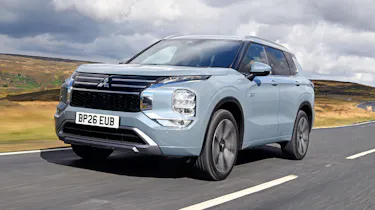
The Outlander PHEV’s return to the UK, along with the Mitsubishi brand as a whole, couldn’t have come at a better time. Delivering a longer electric range than before, it’s a great option for anyone not yet ready for the jump to a full EV, and its familiar branding will stand out amid the many emerging Chinese options. It feels a bit dated in places, but is generally a strong family SUV, offering plenty of space and a lot of equipment for the money.
About the Mitsubishi Outlander
While Mitsubishi had a hiatus of nearly five years in the UK, the Japanese company continued to develop and produce new models for other markets. Now the latest Outlander PHEV is spearheading the company’s return, but it’s not a brand-new model: it replaced the third-generation Outlander PHEV (the one that established itself as a popular plug-in hybrid in the UK) in international markets from 2022 onwards.
Our expert road testers have driven several versions of the Outlander PHEV on a variety of roads in the UK, and also on some rougher surfaces. We’ve even compared it to the Toyota RAV4 and Hyundai Tucson in a group test where it came second behind the Toyota.
Performance & driving experience
Pros |
|
Cons |
|
Under the Outlander’s skin is a combination of parts sourced from within the Renault-Nissan-Mitsubishi Alliance. It uses the CMF-CD platform that also forms the basis of the Renault Rafale and Austral SUVs, as well as the Nissan Qashqai and X-Trail, but the powertrain is Mitsubishi’s own.
Performance, 0-60mph acceleration and top speed
The petrol-electric set-up is an evolution of the one used by the previous Outlander PHEV, yet with improvements in every area. It’s still based around a 2.4-litre petrol engine, but there have been updates to the electronics, while the electric part uses more powerful motors and a larger drive battery.
Used - available now

2018 Mitsubishi
Outlander
55,232 milesAutomaticDiesel2.3L
Cash £11,399
2020 Mitsubishi
Outlander
17,245 milesAutomaticPetrol2.0L
Cash £18,550
2019 Mitsubishi
Outlander
54,142 milesAutomaticPetrol2.0L
Cash £13,499
2019 Mitsubishi
Outlander
68,000 milesAutomaticPetrol2.0L
Cash £11,994Unlike most rival PHEVs, the Outlander is exclusively four-wheel drive, with a rear-mounted motor sending power to the back wheels instead of a propshaft. There’s a total output of 295bhp and a 0-62mph time of 7.9 seconds – not rapidly fast for the class, but quick enough for everyday use. Most of the time the transmission remains front-wheel drive, but the extra traction from the rear motor can be felt during hard acceleration.
Town driving, visibility and parking
As with most rival PHEVs, the Outlander cruises around on electricity alone at low speeds for as long as there is charge in the battery. But when the petrol engine does cut in, it’s pretty hushed, with just a distant hum from beyond the dashboard to break the peace.
A high-set driving position helps with manoeuvring at low speeds, as do the standard-fit front and rear parking sensors and reversing camera. Combine this with positive steering and a responsive chassis, and the Outlander is easy to drive in town.
Country road driving and handling
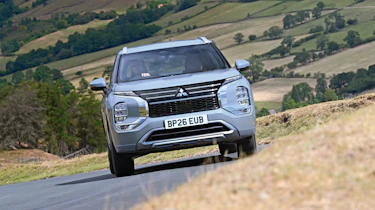
Head for the open road and you’ll find the Outlander springs a bit of a surprise. Mitsubishi has seen fit to include Super All-Wheel Control (S-AWC), which is a development of the hi-tech systems originally found in the Lancer Evo line of high-performance, rally-derived saloons. This includes electronic torque distribution between the front and rear axles via the electric motors, plus lateral torque vectoring and four-wheel brake control to adjust the car’s line through corners.
Overall the system is very effective, and the Outlander exhibits sharp turn-in and plenty of grip. Its only limitations are the car’s naturally high centre of gravity and the grip offered by comfort-biased SUV tyres.
On test, we found that the lane-assist system was a little too sensitive when detecting the edge of the road. It would activate along twisty country lanes even when driving a reasonable distance from the kerb.
Different drive modes that are selectable via a rotary dial on the centre console can transform the Mitsubishi’s ability. There are three power settings (Eco/Normal/Power) while Tarmac, Gravel, Snow and Mud modes adjust the throttle, steering and S-AWC system according to prevailing conditions. On a brief off-road drive, our Outlander coped perfectly well with wet gravel, while hill-descent control offered us stability on steep slopes.
Motorway driving and long-distance comfort
Getting up to the national limit when there isn’t enough energy in the battery causes the engine to fire up, but while the revs soar due to the CVT-style gearbox, it’s a distant noise and the powerplant soon settles once you’re up to speed. The cabin is quiet and refined once you’re there, and the suspension does a decent job of smoothing out the bumps.
| Model | Power | 0-62mph | Top speed |
| Mitsubishi Outlander PHEV 2.4 | 295bhp | 7.9 seconds | 106mph |
“It’s not too much of a stretch to say the Outlander PHEV has rally heritage - its all-wheel drive system is a development of the setup first found in the Lancer Evolution models.” - Dean Gibson, senior road test editor.
MPG & running costs
Pros |
|
Cons |
|
The combination of petrol and electric drive works well and delivers decent fuel efficiency when the battery is flat. The claimed WLTP economy figure is 313.2mpg, but that doesn’t mean much because of the test conditions. We did a number of miles in the Outlander PHEV to run the battery down, and once in that state fuel economy registered at 41.7mpg. That included plenty of motorway miles, while more urban use should see this figure increase because the hybrid system will be more active.
Electric range, battery life and charge time
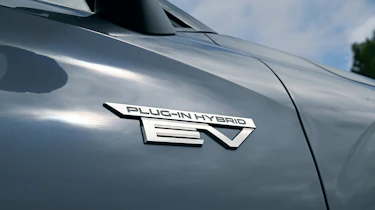
The Outlander PHEV uses a 22.7kWh battery, up from 13.8kWh in the previous model. That’s the same size as the pack in the latest Toyota RAV4, but Mitsubishi quotes an all-electric range of 53 miles, compared with up to 85 miles for the Toyota. We saw an estimated range of 49 miles from a fully charged battery in warm weather.
Boosting the battery is simple, with a 39kW DC maximum rate that can take capacity from zero to 80 per cent in just over half an hour. A home wallbox can fully charge a flat battery in six and a half hours. As well as a CCS socket, the Outlander also features a ChaDeMo connection – an obvious clue to its Japanese production roots.
You can use different battery settings while driving, all selectable via a button on the centre console. Normal mode manages energy flow between the electric motor and engine, EV Priority uses electric drive as much as possible, and Save keeps the engine running to reserve electricity, although we did find the system still consumed battery power in this setting – just at a reduced rate when compared with Normal mode.
Finally, there’s Charge. This replenishes the battery while driving, but really punishes fuel economy: we saw the trip reading 24.8mpg on a 55-mile journey that added 16 miles of range. This is best used on free-flowing motorways when the engine is running by default. At urban speeds the energy put back into the battery is quickly reused in stop-start traffic.
Tax
There are only two versions of the Outlander PHEV on the price lists, and both exceed the £40k luxury car tax threshold – although that isn’t uncommon with pricey plug-in hybrid SUVs.
Business users will benefit from decent company car tax savings when compared with diesel and pure-petrol SUVs. The Outlander isn’t the most tax-efficient plug-in hybrid on the market, however; it offers costlier rates than the RAV4 PHEV.
Depreciation
Residuals of 47 per cent aren’t anything special: even the ageing Hyundai Tucson offers stronger values.
Interior, design & technology
Pros |
|
Cons |
|
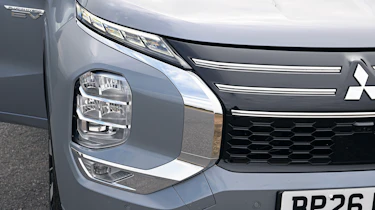
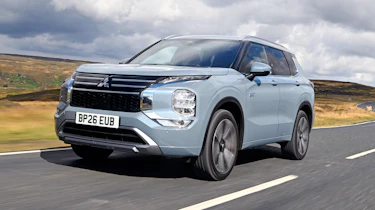
A large, imposing grille with plenty of chrome trim dominates the Outlander’s nose. If it wasn’t for that, the front would look like most other family-sized SUVs; at least the new look gives it an instantly recognisable face.
Interior and dashboard design
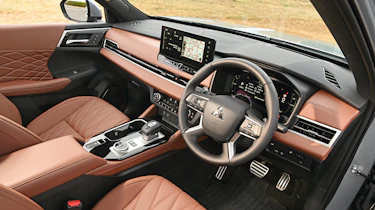
While the exterior is a little gaudy, the Outlander’s cabin has a more upmarket feel, especially in top-spec Diamond guise. This comes as standard with diamond-quilted black leather upholstery, while a tan finish is a no-cost option with selected exterior colours. The dashboard design is simple, with a high-set touchscreen and a logical control layout.
Materials and build quality
Everything feels well built inside, with premium finishes and soft-touch plastics in the right places. Leather trim for the steering wheel and seats, plus a smattering of metal-effect trim, boosts the car’s appeal. The gloss-black plastic on the centre console is likely to get scratched pretty quickly, though.
Infotainment, sat-nav and stereo
One area where the Outlander shows its true age is with its infotainment system. This uses the same typeface as you’ll find in a Nissan Qashqai, and the resolution doesn’t look as sharp as in the likes of the Hyundai Tucson. At least there is a separate physical climate-control panel.
The Outlander’s headlights are also a bit old-tech. There are no fancy auto main-beam functions or matrix cut-outs, while the light itself isn’t the brightest at night.
Boot space & practicality
Pros |
|
Cons |
|
Boxy lines deliver decent interior space for passengers and luggage alike in the Outlander, and the seven-seat option is handy.
Dimensions and size
The Outlander’s dimensions are pretty average for the class. When compared to the Hyundai Tucson and Toyota RAV4 we tested the Outlander against, the Mitsubishi sat between the two in terms of length and wheelbase, but was just about the lowest and narrowest of the trio.
| Dimensions comparison | |||
| Model | Mitsubishi Outlander | Toyota RAV4 | Hyundai Tucson |
| Length | 4,600mm | 4,720mm | 4,535mm |
| Width | 1,855mm | 1,862mm | 1,865mm |
| Height | 1,700mm | 1,751mm | 1,650mm |
| Wheelbase | 2,690mm | 2,704mm | 2,680mm |
| Boot space | 867 (measured to roof) - 1,821 litres | 672 - 1,690 litres | 558 - 1,721 litres |
Seats & passenger space
The diamond-quilt upholstery (including on the doors) looks smart, while top-spec Diamond models have heated and ventilated front seats plus full electric driving-position adjustment.
The centre console isn’t too high, and there are two cup-holders next to the drive selector plus a slot for phones, although it isn’t big enough for the largest devices. A central armrest bin features a USB connector to go with the two that are ahead of the drive selector. The door bins are deep, but not very long.
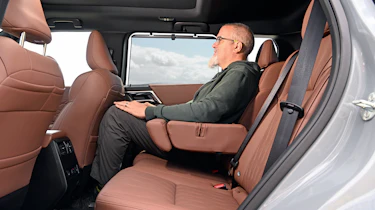
There’s reasonable room in the back for three, and less of a transmission tunnel for middle-seat occupants to deal with. A panoramic glass roof boosts the sense of space inside, but it doesn’t restrict headroom.
Diamond models are boosted by the inclusion of heated outer back seats and a separate temperature control for the rear cabin, while two USB sockets are featured, too. The door pockets are deep but cut short by the twin speakers fitted as part of the Yamaha sound system. The Outlander has two Isofix points.
Boot space
The standard-fit powered tailgate opens to reveal a boot that measures up to 867 litres from the floor to the roof. The load space has a level load lip and there are flat sides, but there isn’t much space under the boot floor because of the location of the PHEV drive battery. That means any charging cables will need to be carried in the boot, rather than under the floor. Fold all the seats flat and there’s 1,821 litres of space.
Towing
The Outlander has a braked towing capacity of 1,400kg in both versions of the car. If you need a mid-size SUV that can tow a heavier trailer or caravan, the 2.0-litre diesel-powered Skoda Karoq can handle up to 2,100kg.
“It’s nice to have the option of seven seats, but attention needs to be paid to Mitsubishi’s ‘5+2’ description - the third row is cramped.” - Steve Walker, head of digital content.
Reliability & safety
Pros |
|
Cons |
|
Mitsubishi has relaunched in the UK with one of the longest warranties around: eight years or 100,000 miles, whichever comes sooner. This should ease potential owners’ minds. Mitsubishi is only recently back in the UK, after all, but it is worth pointing out that the brand always scored strongly for reliability in previous Driver Power surveys.
While the Outlander has been on sale in Europe for around 18 months, it hasn’t been tested by Euro NCAP. However, it’s achieved top marks in similar tests in the USA, South America and Australia, and the long list of safety features should ensure passengers and other road users are protected. Setting up some of the systems can be a bit fiddly, while the driver-inattention warning can be a bit over-sensitive, activating when you’re looking across to enter a roundabout, for example.
Buying, prices and deals
Best buy: Mitsubishi Outlander Nativa level
The range starts with the £46,995 Nativa, which gets the ‘5+2’ seating arrangement and a strong standard equipment list. Among the highlights are 20-inch alloy wheels, keyless entry/ignition, front/rear parking sensors, a rear parking camera, heated front seats, an electrically adjustable driver's seat, synthetic leather upholstery, a 12.3-inch infotainment system, wireless Apple CarPlay/Android Auto, an eight-speaker Yamaha sound system, a head-up display, a digital rear-view mirror, dual-zone climate control, a powered tailgate and a heated steering wheel. That’ll be more than enough stuff for most, and the extra pair of seats is a handy thing to have, even though they’re not that big.
The Outlander Diamond is £3,000 more. It drops to a five-seater layout while adopting even more kit, including three-zone climate control, a hands-free tailgate, a 12-speaker Yamaha sound system, a wireless phone charging pad, leather upholstery and electrically adjustable front seats with ventilation and a massage function.
You can save on the list price by building your new Mitsubishi Outlander with the Auto Express Buy A Car service. We also have a selection of Outlander leasing deals, and can even help you to sell your car.
Mitsubishi Outlander Alternatives
The Toyota RAV4 is probably the Outlander’s closest competitor, which is why we put the cars against each other in a triple test with another key rival, the Hyundai Tucson.
The 5+2 layout in the Nativa gives the Outlander a practicality edge against those two, though - if seating for up to seven is a necessity, you could also consider the Nissan X-Trail, although there’s no plug-in hybrid version.
There’s no shortage of spacious and budget-friendly PHEVs from Chinese manufacturers, but cars like the Geely Starray and Jaecoo 7 aren’t as well-rounded as the Mitsubishi nor any of the other competitors we’ve just mentioned.
Mitsubishi Outlander pictures
Frequently Asked Questions
The Outlander is a good car that blends value, practicality and tidy driving manners.
Deals on the Outlander and alternatives