New Subaru E-Outback 2026 review: a leap forward for the brand’s rugged estate
The new Subaru E-Outback is an improvement on its petrol-powered sibling, but it still trails many talented electric rivals


Verdict
For those who have been desperately searching for a practical electric family SUV that offers some genuine off-road ability, the Subaru E-Outback will be just the ticket. It’s also a massive improvement over the old petrol-powered Outback in almost every possible way, especially performance. However, we’re expecting it to cost the same as a BMW iX3 or Volvo EX60, which makes this brand-new Subaru look like yesterday’s news and nowhere near as good value for money as the countless other similarly versatile, but admittedly less rugged, SUVs on the market.
Despite the durable, dependable and unpretentious Subaru Outback having a large, incredibly loyal customer base, the new, seventh generation of the go-anywhere, do-anything family car isn’t coming to the UK – or anywhere in Europe for that matter. The amount of CO2 its old-fashioned boxer engine emits and the resulting high taxes make it “simply unsellable” here, we were told, but thankfully the all-electric replacement arrives this summer, and it’s keeping the iconic nameplate alive.
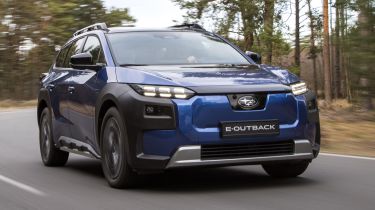
Importantly, this all-new Subaru E-Outback is not just a battery-powered version of the old petrol-guzzling model. It’s the bigger, boxier brother of the brand’s two other electric SUVs, the Solterra and Uncharted, and uses the same dedicated EV platform. But while its siblings are essentially re-badged Toyotas, this SUV-cum-estate-car is the first EV Subaru has designed in-house and it’s been tuned slightly differently to Toyota’s bZ4X Touring.
Used - available now

2023 Subaru
Outback
24,059 milesAutomaticPetrol2.5L
Cash £26,899
2023 Subaru
Outback
21,864 milesAutomaticPetrol2.5L
Cash £30,209
2023 Subaru
Outback
31,457 milesAutomaticPetrol2.5L
Cash £21,299
2023 Subaru
Outback
25,535 milesAutomaticPetrol2.5L
Cash £26,968Compared with the Solterra, the E-Outback is 155mm longer, all of which has been added to the rear, resulting in 633 litres of boot space. That’s about 180 litres more than its sibling and nearly 50 litres more than the Skoda Enyaq offers, although others like the Tesla Model Y can haul even more stuff.
At least the E-Outback’s boot is a wide, square space, and thanks to the height-adjustable floor there’s no lip to lug stuff over, so chucking in heavy bags and items should be easy. There’s enough space beneath the boot floor for the charge cables too, and various hooks and sockets dotted around, but sadly no additional space under the bonnet. Lower the 40:60-split rear bench and you get 1,718 litres to play with, however that’s also not a class-leading figure either.
Having a higher roofline than the Solterra also means more headroom for rear passengers in the E-Outback and we found there is indeed plenty for even six-foot tall adults, plus loads of legroom. However, while the floor is almost flat – which is helpful if you have three people in the back – it’s also quite high, so longer-limbed passengers don’t get much under-thigh support. If you’ve got small children rather than teenagers, the two sets of Isofix points in the rear bench are easily accessible and the doors open fairly wide, so fitting a child seat shouldn’t be a hassle.
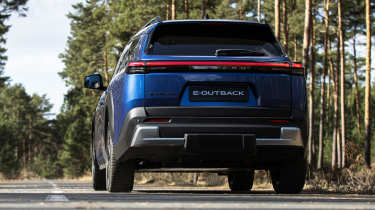
Every E-Outback also comes with roof rails that can carry 80kg when you’re driving, or up to 317kg when you’re stationary – ideal for a roof tent, which is the sort of thing Subaru people might like.
Of course, this being a Subaru, the E-Outback features permanent, symmetrical all-wheel-drive courtesy of two electric motors – one on each axle – that together also provide a healthy 375bhp and a 0-62mph time of 4.5 seconds. That makes this two-tonne load lugger the fastest road car Subaru has ever made.
The last Outback took more than 10 seconds to complete the same sprint, and emitted a serious racket as the naturally aspirated 2.5-litre boxer engine dragged the car forward. The E-Outback, on the other hand, gets up to motorway speed like it’s falling out of bed and its all-wheel-drive system offers excellent traction even on very wet surfaces.
Our first time at the wheel of the E-Outback was at a proving ground outside Berlin, Germany, so we’ll reserve final judgement on its ride quality and handling until we can drive this car on public roads. That said, the steering is direct and well weighted, the car feels planted and we found the body movement well controlled when hustling the car through slalom courses.
Subaru has worked to minimise any ‘diving’ when you lift off the throttle and the regenerative braking system starts to slow the car. It seems to have done the trick, because we didn’t feel much movement when the regen kicked in. However, it’s hard to think of any rival SUV that really suffers from this issue and we wish Subaru had developed a one-pedal mode for the car as well, because this can make driving in stop-start town traffic easier.
There are four levels of the brake regen, which the driver can flick between using the paddles behind the square steering wheel, but we didn’t feel there was much difference between them; even the strongest gently slows the car.
As good as the E-Outback is designed to be on the road though, what’s supposed to set it apart from other electric family SUVs is how it copes when the tarmac runs out. There’s 211mm of ground clearance, for starters, plus underbody protection for the battery and numerous systems to help tackle difficult terrain, including Grip Control, which is basically off-road cruise control that can maintain a set speed climbing steep inclines. Hill Descent Control does the same thing when you’re returning back down, and there are dedicated modes for Snow/Dirt or Deep Snow/Mud.
Admittedly we didn’t try rock crawling in the E-Outback, but it took everything we threw at it in its stride and the transparent bonnet view from the camera system proved useful when trying to avoid large obstacles.
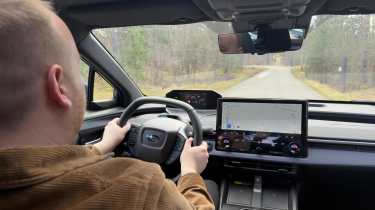
The interior is the same as in Subaru’s other electric cars, featuring a 14-inch touchscreen with an infotainment system borrowed from Toyota and physical dials for adjusting the cabin temperature. It’s a pretty good set-up overall, but not the most impressive in this class. Quality feels solid too and we appreciate Subaru sticking with physical buttons, which are spread across the steering wheel and centre console.
The company says the 74.7kWh battery offers up to 327 miles of range and can be charged from 10 to 80 per cent in less than half an hour – figures that are on par with many other electric family SUVs but not exceptional.
The Subaru E-Outback is due to go on sale in the UK sometime this summer, with pricing and specifications yet to be confirmed. But given that the Solterra is priced from about £52,500 we suspect the E-Outback could start from as much as £60,000.
Unsurprisingly, plenty of other electric family SUVs are available with all-wheel-drive for a lot less, such as the dual-motor Vauxhall Grandland that costs a little over £36k, or the nearly range-topping Skoda Enyaq 85x, which is priced from under £50k. The Jeep Compass Electric AWD should sit somewhere in between those, making it another far more affordable, yet still rugged, alternative to the Subaru.
In fact, if we’re on the money, the Subaru E-Outback will cost about the same as the new BMW iX3, Volvo EX60 and Mercedes GLC, which are far more upmarket, more cutting-edge zero-emissions SUVs. The BMW also comes with all-wheel drive as standard like the Scooby, yet delivers about 200 miles of extra range and can charge twice as quickly.
Did you know you can sell your car through Auto Express? We’ll help you get a great price and find a great deal on a new car, too.
| Model: | Subaru E-Outback |
| Price: | £60,000 (est) |
| Powertrain: | 74.7kWh battery, 2x e-motor |
| Power/torque: | 375bhp/438Nm |
| Transmission: | Single-speed automatic, all-wheel-drive |
| 0-62mph/top speed: | 4.5 seconds/112mph |
| Range: | 327 miles |
| Max. charging: | 150kW (10-80% in 28 mins) |
| Size (L/W/H): | 4,845/1,860/1,675mm |
| On sale: | Summer 2026 |