Used Toyota C-HR (Mk1, 2017-2023) buyer’s guide: futuristic styling helps hide its age
A full used buyer’s guide on the Toyota C-HR covering the C-HR Mk1 that was on sale between 2017 and 2023

Verdict
In a world of plug-in hybrids, the Mk1 Toyota C-HR quickly started to show its age in terms of powertrain tech, because it features just a small battery pack with no plug-in facility. But there’s still a lot about this compact crossover that appeals, including the high-quality interior, efficient hybrid engines and that sharp styling, which still looks fresh. The driving experience can’t quite compete with the most engaging models in the class, and with the market for supermini-sized crossovers currently buoyant, the Toyota is up against some stiff opposition. But the ace up the car’s sleeve is its maker’s reputation for peerless dependability, so if you want a small crossover that’s painless to own, the C-HR should fit the bill very nicely.
Toyota is a fascinating company with a fascinating history. Founded in 1937, it was one of the first Japanese car makers to sell its wares in the UK, arriving here in 1965. Toyota has sold more than three million cars here since then, and started building models in Derbyshire in 1992.
Now one of the world’s biggest car makers, vying for supremacy with the Volkswagen Group, Toyota has built a massive following largely because of its peerless reputation for exceptional reliability, and therefore terrific ease of ownership. Stand-out design and driving pleasure have been less evident until recently, but these are no longer forgotten; and the C-HR is the evidence of that, with its distinctive design and engaging dynamics.
History
The C-HR was unveiled at the Geneva Motor Show in spring 2016, but the first cars weren’t delivered in the UK until January 2017. Buyers could choose between a 114bhp turbocharged 1.2-litre petrol engine or a 120bhp 1.8-litre Hybrid. While the hybrid came only with front-wheel drive and a CVT automatic transmission, the 1.2T was offered in manual or automatic forms, the latter with front or all-wheel drive.
Used - available now


There was a choice of Icon, Excel and Dynamic trims, with a Design grade added in June 2018; in April 2017 a hybrid Limited Edition was introduced, restricted to just 100 units. The 1.2T engine was dropped in November 2019, when a 180bhp 2.0-litre Hybrid version arrived, along with improved infotainment, with all C-HRs getting Apple CarPlay and Android Auto as standard.
Prices
Check out our Buy a Car service to find a great deal on a used Toyota CHR, with prices starting from under £9,000.
Which one should I buy?
The 1.2-litre petrol engine is sweet enough, and it may suit you best if you do mainly long-distance motorway trips. But for most users the Hybrids will make the most sense, and these will probably also prove easier to sell on. All C-HRs are well equipped, with even the entry-level Icon having 17-inch alloys, automatic wipers, dual-zone climate control, a six-speaker hi-fi, an eight-inch multimedia display and a reversing camera.
Excel cars gets 18-inch wheels, privacy glass, ambient interior lighting, heated front seats, nav, part-leather trim, front and rear parking sensors, keyless go, auto-folding door mirrors and extra safety kit. Dynamic trim has LED headlights and a black roof, but is essentially a sportier version of the Icon, with most of the Excel’s luxury features.
Alternatives to the Toyota C-HR
Small crossovers are among the most popular cars available, so brands have embraced them. The Volkswagen Group offers the Skoda Karoq, SEAT Ateca and VW T-Roc, which all appeal for their build quality, tidy handling and efficient engines. The Ford Puma is slightly smaller, but impresses with its practicality, value and engaging driving experience. Peugeot’s 3008 is another strong contender, with its ready availability, keen prices and upmarket cabin.
The Nissan Qashqai is comfortable and versatile, the Kia Sportage and Hyundai Tucson are great value and reliable, while the sharply styled Mazda CX-5 has a premium cabin and excellent dynamics. None of these cars comes as a hybrid; if this is important to you take a closer look at the Lexus UX, which is closely related to the C-HR.
What to look for
Towing
The 1.2T in manual form can tow 1,300kg; 1.2T autos can pull 1,100kg, but the 1.8 and 2.0 Hybrid models can haul just 725kg.
Gearbox
Very few C-HRs are fitted with a manual gearbox, so it’s CVT mostly. It’s not the slickest transmission, so make sure you’re happy with it.
Safety kit
Entry-level Icon cars have no blind-spot monitoring or rear cross-traffic alert; until the 2019 facelift lane-departure warning was an option.
Cracks
The most popular thread on the UK C-HR owners’ forum is about cracked windscreens, with damage in the top right corner of the glass the most likely area.
Common faults
Some owners complain of wind noise from ineffective window and door seals, plus nav glitches. Shorter kids may find the back-door handles tricky to reach, and the cabin is gloomy once they’re in there.
Interior
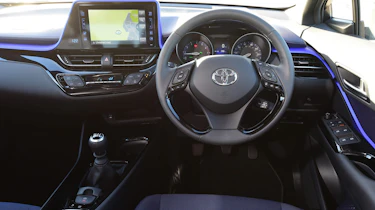
The C-HR’s dashboard is far from bland, but it’s not over-designed. Indeed, it’s very user-friendly, with a decent blend of physical and touchscreen controls. The cabin is also very well made, with plenty of premium materials and more space than you might expect. There’s room for five adults if they’re not too big, and boot space is okay, at 377 litres with the rear seats in place, or 1,164 litres with them folded; many rivals are better, but these figures ensure a decent level of practicality.
Running costs
All C-HRs need to be serviced every 10,000 miles or 12 months, with maintenance alternating between minor and major. No fresh cambelts are required because the engines are chain-driven. The battery warranty will run for up to 15 years, plus if you’re hit with an unexpectedly large bill, some dealers offer up to six months’ interest-free credit to pay. An array of service plans is available, which don’t save you cash, but let you to pay on a monthly basis.
Recalls
The C-HR has been recalled six times so far, all of them between December 2017 and November 2019. The first campaign was launched because the hybrid powertrain hadn’t been bolted together properly and could work loose; the second came in January 2018, because some cars were fitted with fuel tanks that could leak.
Faulty software that could lead to the ESP not working correctly was the reason behind the third recall, in February 2018. Then in October 2018 came the next two recalls: a wiring harness could chafe and then short out in the engine bay, leading to a fire, while the rear wheel bearings weren’t fitted correctly in 3,297 C-HRs built between June and August 2018. The most recent action was issued in November 2019, because some C-HRs were fitted with faulty seat-mounted side airbags.
Driver Power owner satisfaction
The Toyota C-HR was a regular member in the top 10 in our annual Driver Power ownership surveys, which is indicative of just how happy C-HR owners are with their cars. The C-HR historically posted strong scores across the board, with no untoward grades in any of our 10 categories. Owners were most taken with the ride and handling, while its exterior design and build speaks for itself.
Toyota C-HR: what we said
Extracts from our Toyota C-HR test drive in October 2023
The first-generation Toyota CH-R majors on interesting, funky design - which is crucial in this image-conscious crossover class. Inside, there are plenty of high-grade materials and a decent tally of kit, while the layout is good too, although the small back windows do make the rear feel a little claustrophobic.
Under the skin the C-HR uses the Toyota New Global Architecture which delivers composed handling and a comfortable ride, and you won't find many cars in the class that can rival the Toyota hybrid for its advanced powertrains and real-world efficiency.
Smartly styled, good to drive, practical and featuring a classy cabin, the C-HR is a tempting alternative to more mainstream crossover models.
Engines, performance and drive
As Toyota has developed the C-HR with European and UK drivers in mind, its suspension has been tuned to cope with the unique demands of twisting and bumpy roads found both in Britain and on the Continent. In terms of the engineering, the C-HR's TNGA platform trumps most rivals. MacPherson strut front suspension is conventional enough, but it's paired with double wishbones at the rear, which is a more advanced set-up than the torsion beam rear axle used on most rivals, so it delivers better ride and handling than most, too.
When you get behind the wheel of the C-HR, it instantly feels sportier and more dynamic than rival machines. The steering is nicely weighted and although there’s not much connection to the front wheels, it’s easy to place the car where you want on the road. It helps that there’s less roll than in most crossovers, while the body movement you do feel is better controlled.
Toyota’s chassis feels firmer than some crossovers, but the damping is nicely judged, so it ties the body down well for faster cornering yet still manages to take the edges off bumps smoothly, delivering a composed and controlled, but comfortable, ride.
Front-wheel drive is standard across the range, while all versions get a choice of Sport, Normal and Eco modes, which alter the weight of the steering, the throttle response and CVT gearbox strategies to suit your mood and the road conditions. However, we found that the car felt most natural in Normal. The steering is well weighted and the high driving position gives a good view ahead, making it easy to place the car on the road and promoting confidence through corners.
The hybrid’s CVT does require extremely delicate application of the throttle to stop the engine revs soaring. Mechanically this car is identical to the fourth-generation Prius, but it lacks that car’s impressive refinement and response. Even when accelerating reasonably gently, the gearbox sends the revs soaring – a problem that’s exaggerated by the petrol unit’s harsh note when extended.
In all other respects, the C-HR is a quiet and comfortable choice. Bigger bumps can be felt in the cabin, but most of the time the Toyota does a very good job of shrugging of poorly surfaced roads. And while there’s some wind rustle around the A-pillars, the rest of the interior is calm and composed on the motorway.
0-62mph acceleration and top speed
The C-HR is based on Toyota’s New Global Architecture chassis that also underpins the brand’s previous-generation Prius eco car and the current Corolla, as a result, the platform was designed with the acceptance of hybrid powertrains in mind. However, the more powerful 2.0-litre engine feels less strained than the 1.8-litre model, with Toyota re-engineering the steering and suspension to allow for the heavier 2.0-litre unit.
It’s likely that buyers who use the car as an urban runaround will appreciate the CVT auto and silent electric mode, but keen drivers will find the unit frustrating.
There’s certainly no denying Toyota has invested a lot of time and money in hybrid technology. Intensive development has led to the 1.8-litre unit delivering 40 percent thermal efficiency, which is higher than any other traditional petrol engine. The electric motors are also smaller yet deliver a stronger power to weight ratio, while the battery pack itself provides the same energy but is reduced in size by 10 percent.
The combined power output of the system is 120bhp, while torque is 142Nm from the internal combustion engine and 163Nm from the electric motor. Power for the 2.0-litre version is 181bhp, with torque at 190Nm via the ICE and 202Nm from its electric motor. Yet while these changes proved largely successful in the Prius, the new hybrid power unit isn’t quite as impressive in the C-HR.
Like all of Toyota’s petrol/electric models, a CVT (Continuously Variable Transmission) gearbox sends power to the wheels. This set-up theoretically delivers the ultimate in performance and efficiency, as it can constantly vary the gear ratio to keep the engine operating at its most efficient.
However, even gentle applications of the throttle send the engine revs soaring to a thrashy and coarse drone. Unlike the old Prius, the C-HR doesn’t seem as keen to use the electric motor to boost acceleration at low speeds.
The hybrid unit also doesn’t engage the battery power enough for silent electric running. There is an EV mode, which carries the car for around a mile in zero emissions mode, but left to its own devices only very, very gentle throttle applications will stop the petrol motor cutting in. Toyota has added a Sport setting to the hybrid, which sharpens the throttle response a little. However, it’s undermined by the transmission, which is slow to respond – and when it does drop a gear, the engine revs head skywards once again.
MPG and CO2
Like all petrol-electric hybrid models, the C-HR delivers some compelling efficiency claims. Less slippery aerodynamics meant the bluffer and higher-riding C-HR couldn’t match the Prius for economy and CO2 emissions, but Toyota's claims of 57.6mpg and CO2 emissions of 110g/km for the 1.8 VVT-i version are impressive. The 181bhp 2.0-litre variant manages a figure of 53.2mpg on the WLTP combined cycle, with CO2 emissions from 119g/km.
Company car users may not be too impressed by the C-HR's Benefit-in-Kind rates of 27-29 per cent, but private buyers will find the crossover's excellent real-world economy appealing.
The previous-generation Prius found favour with taxi firms due to its excellent efficiency but with the new fifth-generation Prius not coming to the UK, pressure will be on the latest all-new C-HR and the Corolla to encroach on the space left by the Prius.
Interior design and technology
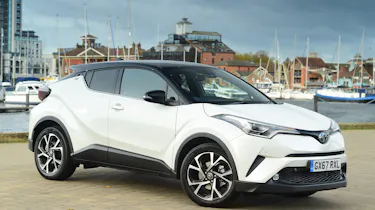
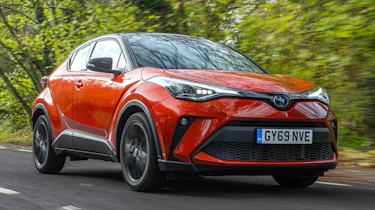
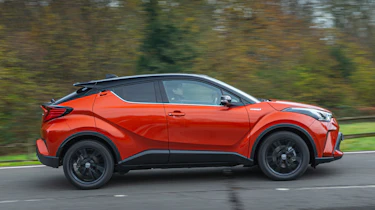
Toyota went bold with the design of the C-HR. Not only did its blend of coupe styling cues and jacked-up suspension help it stand out in this class, neat detailing also boosts its kerb appeal.
Heavily based on the C-HR concept that made its debut at the 2014 Paris Motor Show, the Toyota still stands out from the compact crossover crowd. In fact, apart from the adoption of a five-door layout, the production version looks remarkably similar to the show star.
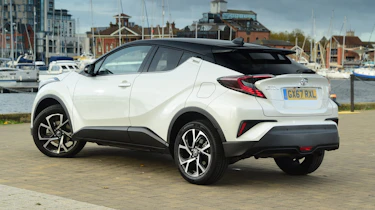
Like upmarket machines such as the BMW X6 and Mercedes GLE Coupe, the C-HR features a low roofline that gives it the rakish profile of a coupe. This illusion is heightened by the fact the handles for the rear doors are hidden in the C-Pillars. Yet it's Toyota's daring combination of creases, curves and eye-catching angles that really grabs the attention.
All versions got alloy wheels and distinctive LED running lamps, while Excel models stand out at night courtesy of their bright LED headlamps and tail lights. The CH-R was offered with a number of optional paint colours, some of which came with a contrasting black finish for the roof panel.
2020 saw Toyota introduce the facelifted C-HR and on the outside it was distinguished by reshaped LED headlights, a new front grille and a smoothed-over front bumper with new air intakes and fog lamps. There was also a new rear diffuser with extra chrome details and a revised pair of LED tail lights, which fared into a new gloss black lip spoiler.
The C-HR maintained its premium appeal inside too. The wraparound dashboard places the driver firmly at the centre of the action, while multiple shapes and textures give the interior a funky look. Neat details include the diamond pattern that’s repeated in the door trim, headlining, multi-function wheel buttons and climate controls.
Toyota has given the interior a lift courtesy of some coloured accents, while the Excel model includes a smart dark brown upper dashboard. However, it’s the quality of the cabin that really grabs your attention. Soft touch plastics are used throughout, while gloss black inserts add a touch of class. As you’d expect from Toyota, everything is solidly screwed together.
Toyota didn’t scrimp on the standard kit, either. All versions get climate and adaptive cruise control, automatic lights and wipers, an auto dimming rear view mirror and eight-inch touchscreen infotainment system. The Design trim features keyless entry, heated seats, parking assist and power folding mirrors, while Excel versions include luxuries such as a heated steering wheel and black leather upholstery.
Sat-nav, stereo and infotainment
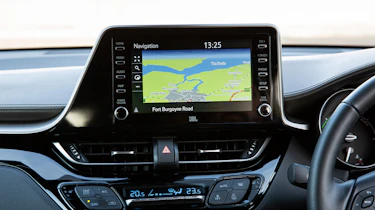
Toyota updated the infotainment system in 2019 – with the Touch 2 media system featuring Apple CarPlay and Android Auto connectivity as standard. This makes a big difference, because it allows owners to bypass Toyota’s otherwise fiddly infotainment set-up, which is hindered further by the dated graphics and a poor layout.
In addition, all cars include Bluetooth, a DAB radio, a 4.2-inch TFT driver information display and a reversing camera.
Practicality, comfort and boot space
The C-HR does a good job of disguising its size, with its sleek coupe proportions making it appear more compact than it is. In reality, the C-HR occupies the same footprint as models such as the Nissan Qashqai and SEAT Ateca. That said, the Toyota’s style doesn’t come without compromise, and the C-HR isn’t as practical as more conventional crossover rivals.
Inside, there’s decent legroom in the rear and a surprising amount of headroom given the sloping roofline. Access is fairly straightforward, because despite its coupe looks the C-HR benefits from a five-door layout, with the rear door handles set into the window frames. The rear doors feature a wide opening, and only taller occupants will find the low roof a bit of pain when lowering themselves in.
The boot is roomy and well-shaped, but is closer in size to a compact family hatchback’s than its traditional crossover rivals’. Still, the C-HR has a large tailgate opening and it’s easy to load items despite the lip.
Upfront, the driver and passenger get plenty of space and seat adjustment. You sit slightly higher than in a traditional hatchback, while the low dashboard and large windscreen give a panoramic view out.
As you’d expect of a car aimed at families as well as younger buyers, there’s plenty of handy cubby space. The front door bins are large and will comfortably accommodate half-litre bottles, there’s a large glovebox and a deep, lidded container between the front seats. There’s also a trinket tray ahead of the gearlever that’s perfect for smartphone storage.
Size
In terms of its external dimensions, the C-HR is close in size to the previous-generation Nissan Qashqai, but shorter than a VW Tiguan. The Toyota’s sleek lines fool the eye into thinking it’s a more compact model like the Nissan Juke.
The five-door body means access to the C-HR is straightforward, while forward visibility from the driver’s seat is excellent. It’s less impressive in the rear, where the thick C-Pillars force occupants to lean forward if they want to see out. Visibility out of the back window is acceptable, although the rising window line and thick pillars mean you can’t see much when checking your blind spot to change lanes. This is where the standard-fit reversing camera really helps during manoeuvres.
Legroom, headroom and passenger space
The vast C-pillars and small rear windows mean that occupants in the back of the C-HR will feel quite claustrophobic. However, get the tape measure out and you’ll find that the Toyota is on par with the Nissan Qashqai for legroom, while the high set front seats means there’s plenty of space to tuck your feet under.
By placing the base of the rear bench low, Toyota has also created a surprising amount of headroom. And while the rear bench isn’t as wide as some rivals, there’s just enough room for adult passengers.
Boot
Open the C-HR’s large tailgate and you’ll discover a usefully shaped load bay that’s free of awkward intrusions. At 377-litres it’s a decent size according to the standards set by regular compact hatchback models, but it significantly trails the SEAT Ateca’s 485-litre load bay.
The C-HR also lacks some of the clever storage features we’ve come to expect from crossover models. There’s a small amount of storage space underneath the boot floor, but that’s about it.
Come and join our WhatsApp channel for the latest car news and reviews...