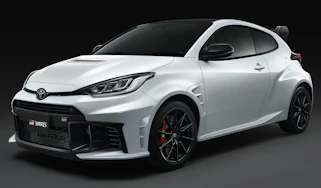
Toyota GR Yaris review
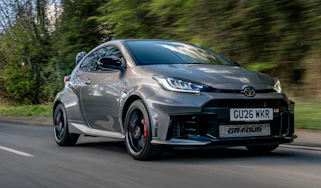
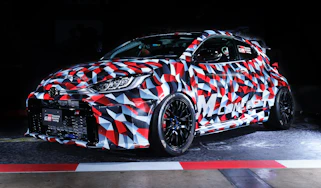
Developed as a ‘World Rally Car for the road’, the Toyota GR Yaris is a ferocious little hot hatch
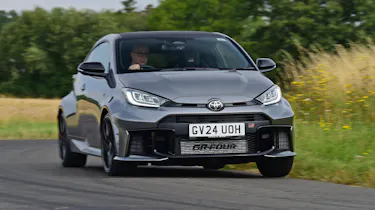

Our opinion on the Toyota GR Yaris
Some may have scoffed when they heard that the Toyota GR Yaris hot hatch was designed as a “rally car for the road”, but the brand has genuinely pulled it off, creating a seriously capable and entertaining machine that reminds us of the Subaru Impreza Turbo and Mitsubishi Evo cars we used to lust after.
With its standard-fit four-wheel drive system and compact supermini chassis, the GR Yaris will gladly be chucked around in any direction. Hit a straight and the engine offers a real punch whenever you floor the throttle, which is all the more impressive when you remember that this is a turbocharged three-cylinder.
About the Toyota GR Yaris
Toyota’s upgrades to the GR Yaris have pushed the price upwards over time, but they’ve brought some notable changes to this fiery hot hatch, too. You’ll struggle to notice any real differences between the facelift and original models at first glance, but it’s underneath where the brand has addressed the older GR Yaris’ flaws.
This was never exactly a “weak” car to begin with, mind you, as you’ll find one of the world’s most powerful three-cylinder engines at its heart. In short, there’s one fundamental outcome with every GR Yaris regardless of its age or spec: you’re going to have a tonne of fun.
Used - available now

2027 Toyota
GR Yaris
2,622 milesManualPetrol1.6L
Cash £50,299
2020 Toyota
GR Yaris
33,990 milesManualPetrol1.6L
Cash £26,990
2020 Toyota
GR Yaris
40,817 milesManualPetrol1.6L
Cash £25,647
2020 Toyota
GR Yaris
6,000 milesManualPetrol1.6L
Cash £32,250While they’re of a similar size, it’s important to remember that the Toyota GR Yaris has very little in common with the regular Toyota Yaris. You’ll need to be especially careful not to become confused by the standard car’s GR Sport trim, as this only offers cosmetic raciness rather than a massive performance boost.
A number of the GR Yaris’s rivals have faced the axe during its lifetime, but the result of our twin test against the Ford Fiesta ST may help to explain why the GR Yaris lives on. The ST was certainly an enjoyable car, but we declared the Toyota the winner due to its phenomenal performance, raw driving thrills and class-leading abilities.
Toyota GR Yaris prices and latest deals
When it first arrived, the Toyota GR Yaris already commanded a strong starting price of nearly £30,000. However, this spicy supermini has steadily worked its way upwards over the years, and it now commands no less than £46,200.
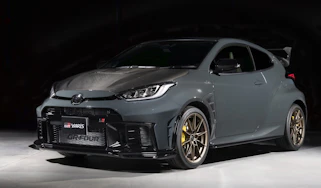
There are some pricier special edition models to pick from, too. These cars have had their drive modes configured by rally drivers Sebastien Ogier and Kalle Rovanperä, and while this is certainly a unique touch, you’ll be paying out an eye-watering £60,000 for the pleasure.
Performance & driving experience
Pros |
|
Cons |
|
Toyota hasn’t been shy in declaring the GR Yaris ‘A World Rally Car for the road’, so it needed to ensure its three-door pocket rocket lives up to such a billing.
Things get off to a pretty good start with its turbocharged 1.6-litre three-cylinder engine, which is designed to comply with world rally regulations. This is by far one of the most powerful three-pots in the world, and it’s more than happy to be worked hard. There’s a decent soundtrack to be enjoyed, too, along with plenty of mischievous turbo whistle.
| Model | Power | 0-62mph | Top speed |
| GR Yaris (all variants) | 276bhp | 5.2 seconds | 143mph |
Performance, 0-60mph acceleration and top speed
As part of a series of mid-life updates in 2024, the GR Yaris was given a power boost. Although its original outputs of 257bhp and 360Nm weren’t exactly modest, the fiery little three-cyl now pumps out 276bhp and 390Nm of torque. This large dose of power is combined with a kerbweight of less than 1,300kg, and it doesn’t take a genius to figure out the result.
Peak power is produced between 3,250-4,600rpm, and the result is a claimed 0-62mph time of 5.2 seconds and a 143mph maximum speed. In comparison, a Volkswagen Golf GTI Clubsport takes 5.6 seconds.
But, to focus solely on straight-line speed would be to do the GR Yaris a disservice, as its ability to travel cross-country with unnatural speed and agility would put most supercars to shame — it’s that good.
Town driving, visibility and parking
The GR Yaris’ small size means it’s pretty much as easy to manoeuvre around the urban streets as its hybrid-powered namesake. The ride remains firm over imperfections and bumps at lower speeds, but it’s still perfectly tolerable.
Country road driving and handling
Hit the open road and, to put it simply, the GR Yaris is as fast as it is agile. It feels planted in just about every scenario and really inspires confidence as you push things to the limit (provided it’s wearing suitable tyres). Once the turbo spools up, the little Yaris starts to gain momentum at a serious pace, so you’ll need to keep a very close eye on the speedometer if you go anywhere near a public road.
Along with its tweaks to the engine, Toyota also revised some of the suspension components. The front anti-roll bar has been stiffened and all four springs have been firmed up, too.
The GR Yaris is fitted with a GR-Four all-wheel-drive system as standard, and this has been revised in the facelifted car. It features three separate driving modes: Normal, Gravel and Track, with each one varying the power that’s sent to the front and rear wheels.
Motorway driving and long-distance comfort
The GR Yaris does a better job being a motorway cruiser than its looks would have many believe, but it’s still a firm-riding, loud and rather thirsty car, so it’s difficult to recommend for a daily long-distance commute.
“The six-speed gearshift is mechanical – a little notchy perhaps, but it’s satisfying and positive to use.” - Dean Gibson, senior test editor.
MPG & running costs
Pros |
|
Cons |
|
It’s probably fair to say that most buyers looking towards the Toyota GR Yaris aren’t really concerned about fuel economy and overall efficiency. Customers are far more likely to be enthusiasts with a stronger interest in lap times than MPG figures.
Regardless, the GR Yaris shouldn’t be too costly to run as it’s capable of around 32mpg on the WLTP combined cycle. It’s worth remembering, however, that if you’re intent on exploiting the car’s full performance then you’ll see a marked drop-off in this economy figure. CO2 emissions of up to 197g/km also hammer home just how different this car is to its hybrid-powered namesake (that only emits 109g/km).
However, part of the tech that Toyota has engineered into the GR includes a revised direct fuel-injection system that helps to maintain economy and keeps emissions down.
| Model | MPG | CO2 | Insurance group |
| GR Yaris | 32.5mpg | 197g/km | 43 |
| GR Yaris Aero Performance | 32.5mpg | 197g/km | 44 |
| GR Yaris Ogier | 32.5mpg | 197g/km | 44 |
Insurance groups
The regular GR Yaris resides in insurance group 43 (out of 50) while the special editions move up to group 44. As you probably expected from such a fiery little car, premiums will be pretty expensive, and the similarly-powerful Volkswagen Golf GTI Clubsport is able to undercut the Toyota by quite a significant margin as it only sits in group 31.
Tax
Every variant of the GR Yaris costs over £40,000 when new, so they all incur the combustion-powered luxury car tax surcharge. This will add an extra £440 onto your annual road tax bill between the second and sixth year after the car is registered for the first time.
Pure-petrol power and rather high emissions mean the Toyota GR Yaris is a pretty poor choice if you’re a company car driver who wants to save on their taxes. Fully electric hot hatchbacks like the Abarth 500e, Alpine A290, and Cupra Born VZ bring the very lowest Benefit-in-Kind (BiK) rates, but they’re nowhere near as rally car-eqsue to drive as the Toyota is.
Depreciation
The bespoke nature of the GR Yaris and how well it has been received, particularly in the UK, means that residual values are remaining buoyant. Our market data suggests that after a typical three-year/36,000-mile ownership period, the three-door hot hatch should retain around 54 to 56 per cent of its original list price.
Compare this to the Volkswagen Golf GTI Clubsport’s 45 per cent retention after the same length of time or mileage, and the Toyota’s desirability on the used market becomes a bit more obvious.
To get an accurate valuation for a specific model, check out our free car valuation tool...
Interior, design & technology
Pros |
|
Cons |
|
From the outset, the Toyota GR Yaris has been designed to meet specific targets for downforce, aerodynamic performance, and stability. This means only the headlights, rear lights, door mirrors and the shark fin antenna on the roof are shared with the regular Toyota Yaris.
The body had to be specifically designed to meet the requirements of the World Rally Championship and, compared to the regular Toyota Yaris model, the GR is 55mm longer, 60mm wider and between 45-95mm lower in height due to its sloping roofline.
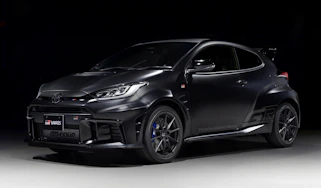
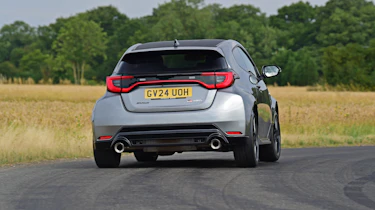
Toyota’s three-door design for the GR brings a coupe-like profile, while the tapered roofline has a functional purpose in helping to move air over the rear spoiler which helps to create useful downforce. The overall impression is of a squat, purposeful machine, with powerful-looking rear haunches just giving a hint of the original Renault 5 Turbo.
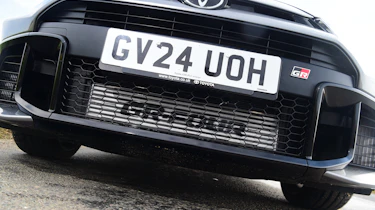
Although Toyota revised the GR Yaris in 2024 with a number of upgrades, the only visual difference on the outside is some improved mesh grille to protect the radiator.
Interior and dashboard design
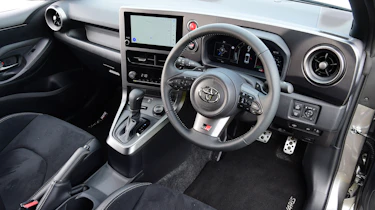
It’s on the inside where some of the biggest changes took place during the facelift. Now, the GR Yaris features a completely redesigned dashboard. It’s a slightly unusual (and very square) design, but the idea behind it is to make the driver feel more like they’re sitting in the car, rather than on it. Quirky appearance aside, though, the revised dash layout is reasonably ergonomic.
There aren’t many options to choose from in the GR Yaris configurator, but the good news is that the GR Yaris comes with its fair share of mod cons. Standard kit in the facelifted model includes an eight-inch touchscreen accompanied by a 12.3-inch digital driver’s display, dual-zone air-conditioning, automatic windscreen wipers and sports seats.
The aforementioned seats are as supportive as you’d hope for in a car that’s designed to be hurled around each and every corner you can find, but thankfully they’re also comfortable enough for daily journeys (although longer motorway runs could require the occasional stretching break).
Materials and build quality
Quality-wise, the GR Yaris is typical Toyota. It’s far from being the brightest or plushest place to be, but everything feels durable and very well put together. The same can be said for pre-facelift cars, too.
Infotainment, sat-nav and stereo
As part of its series of mid-life upgrades, the GR yaris received a revised eight-inch touchscreen infotainment system. This unit runs Toyota’s Connect+ software, and it comes with Apple CarPlay and Android Auto connectivity, along with a six-speaker sound system.
Although this new system is an improvement compared to the one it replaced, we found it frustratingly slow on multiple occasions during testing. On the plus side, it is at least easy to navigate.
“The seemingly large rear-view mirror is directly in your eyeline going round left-hand bends.” - Dean Gibson, senior test editor.
Boot space & practicality
Pros |
|
Cons |
|
A three-door hot hatchback that’s been designed with track use in mind isn’t going to be on the shortlist of a growing family but, once inside, you’ll find that the Toyota GR Yaris offers just about acceptable room for a performance supermini.
Dimensions and size
The GR Yaris has a much smaller and shorter stance than the Volkswagen Golf GTI Clubsport, but it is actually slightly wider.
| Dimensions comparison | |||
| Model | Toyota GR Yaris | Volkswagen Golf GTI Clubsport | Cupra Leon 300 |
| Length | 3,995mm | 4,295mm | 4,656mm |
| Width | 1,805mm | 1,789mm | 1,799mm |
| Height | 1,455mm | 1,741mm | 1,467mm |
| Wheelbase | 2,560mm | 2,630mm | 2,680mm |
| Boot space | 174 litres | 381 litres | 380 litres |
Seats & passenger space
There’s a reasonable amount of space up front in the GR Yaris, which is important because it has been designed to be a fully-fledged driver’s car. Leg and headroom are ample for a car of this size, but with a lot of dark trim around the cabin some might feel it a little enclosed and slightly claustrophobic.
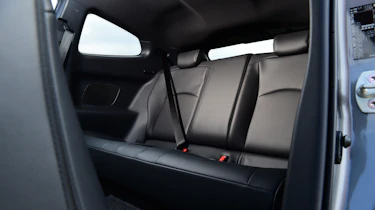
A three-door design obviously makes it a little more tricky for rear passengers to enter and exit the car, and headroom is certainly on the tight side. Only two seats are available in the rear compared to three in the standard Yaris model. Adults will struggle to get comfortable in the back of the GR Yaris, but the seats do have Isofix points for the youngest occupants.
Boot space
Boot capacity for the GR Yaris is just 174 litres, and this is miniscule even when compared to the standard Yaris’ 286 litres. This small capacity is mainly due to the battery being stored in the rear, as well as the packaging of the bespoke suspension and four-wheel-drive system taking up space.
Those who need a more family-friendly hot hatchback with similar power will be better off with a five-door model like the Volkswagen Golf GTI Clubsport or its Cupra Leon 300 sibling. These both offer more than double the GR Yaris’s bootspace, along with far more room for the rear passengers.
Reliability & safety
Pros |
|
Cons |
|
With Toyota’s reputation for reliability and the level of engineering that’s gone into producing the GR Yaris, this hot hatchback appears to be holding up very well.
Toyota has a little bit of work to do when it comes to wowing its customers, though. According to the most recent Driver Power best car manufacturer rankings, Toyota only scored a rather mediocre 14th place out of 31 brands. However, Lexus (Toyota’s luxury arm) managed a highly respectable second place.
The GR Yaris probably won’t be crash tested by Euro NCAP due to its relatively low production volume, and it’s worth noting that the GR does not carry-over the standard model’s full five-star safety rating because it’s been so comprehensively modified.
Having said that, all versions of GR Yaris come with a fair share of standard safety kit, including adaptive cruise control, lane trace assist, road sign assist and emergency steering assist. If you want parking sensors, rear cross traffic alert, safe exit assist or a blind spot monitor, though, you’ll need to fork £60,000 for one of the special editions.
Buying and owning
- Best buy: Toyota GR Yaris (standard)
The special editions are certainly desirable, but there’s little point in chucking thousands of extra pounds at them when the standard GR Yaris offers just as many white-knuckle thrills.
Toyota GR Yaris alternatives
The petrol-powered hot hatchback market has dwindled in recent years. The Honda Civic Type R was arguably the GR Yaris’s most direct competitor, but this is no longer available to buy brand-new in the UK.
Today, you’ll need to look towards the Volkswagen Golf GTI Clubsport, Cupra Leon 300 and BMW M135 for hot hatches that produce a similar amount of power to the Toyota. All of these cars are larger five-door models, though, so they’re rather different machines to the small and mighty Yaris.
Alternatively, the electric hot hatchback market is growing, with entries like the Abarth 500e, Alpine A290, Cupra Born and MG4 XPower combining high performance with very low running costs.
Key updates of the Toyota GR Yaris review
27 April 2026: Inclusion of our most recent driving impressions, along with the latest pricing and depreciation data.
Frequently Asked Questions
All Toyota models are covered by a three-year, 60,000-mile warranty as standard. However, if you keep to the servicing schedule and have all the work carried out by an approved Toyota workshop, this can be extended up to ten years or 100,000-miles — whichever comes first.
Deals on the GR Yaris and alternatives
More reviews
In-depth reviews
Road tests
Which Is Best