Used Volkswagen ID. Buzz (Mk1, 2022-date) buyer’s guide: stand out from the SUV crowd
A full used buyer's guide on the Volkswagen ID. Buzz that has been on sale in the UK since 2022

Verdict
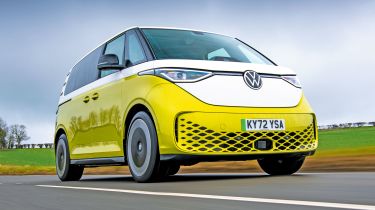
When we first drove the Volkswagen ID. Buzz in 2022, we said: “It’s hard to see how any vehicle could live up to this much hype, but the ID. Buzz has been worth the wait. It’s not quite as practical as its van-based rivals, but it trumps the myriad SUVs it competes with when it comes to space and family-friendly features. It’ll sell on image alone, but beneath the retro styling and functional cabin, there’s a really capable, compelling EV.” Since then we’ve run two as long-termers on our test fleet and we haven’t changed our minds, because we think the ID. Buzz still makes a brilliant all-rounder. But some examples have been glitchy, so check any potential purchase carefully.
Ask 100 people to name a conservative car maker and the chances are that quite a few will say Volkswagen. Yet now and again, this rather staid firm causes a stir with a new model launch.
It’s usually around the unveiling of something that harks back to Volkswagen’s past: think New Beetle in the late nineties, then ID. Buzz almost a decade ago. Yes, you read that right; Volkswagen first showed the ID. Buzz concept as long ago as 2017, but it would take another five years for the production vehicle to go on sale.
Used - available now

2024 Volkswagen
ID. Buzz
21,860 milesAutomaticElectric
Cash £30,995
2024 Volkswagen
ID. Buzz
29,953 milesAutomaticElectric
Cash £36,047
2024 Volkswagen
ID. Buzz
28,192 milesAutomaticElectric
Cash £37,995
2024 Volkswagen
ID. Buzz
31,689 milesAutomaticElectric
Cash £34,988Since then, excitement around the ID. Buzz has died down as the car has become a more common sight on our roads. Some owners have also had more than their fair share of problems. So is it a model to get excited about as a used buy, or one that you should avoid?
History
The production ID. Buzz was unveiled in March 2022 and went on sale four months later. All of these first models (Life, Style, 1st Edition) had a 77kWh battery, a 201bhp motor and rear-wheel drive. Within a couple of weeks, the range was bolstered by a Cargo (van) version with exactly the same mechanical specification.
By September 2024 a seven-seat long-wheelbase (LWB) version had been added to the range, in Life and Style forms, both with an 86kWh battery and a 282bhp motor. This stretched edition was 250mm longer than the regular five-seat model and carried a premium of just £510; there was a choice of five, six or seven seats.
At the same time the ID. Buzz GTX went on sale. Available in standard and long-wheelbase forms, the 335bhp GTX got a 79kWh battery and two motors for four-wheel drive.
Which one should I buy?
The standard-wheelbase ID. Buzz has the smallest battery, but it’s easier to park, at 4,712mm in length; the long-wheelbase model is 4,962mm between the bumpers, but it had a usefully bigger battery and a lot more practicality, yet prices are virtually identical. The GTX is costly and we’d say probably not worth the premium, but all other trims are worth a look.
The entry-level Life comes with sat-nav and a 10-inch touchscreen, LED headlights, 19-inch alloy wheels, Android Auto and Apple CarPlay, dual-zone climate control, a heated windscreen, adaptive cruise control, front and rear parking sensors plus a rear camera and privacy glass. Style trim adds ambient cabin lighting, upgraded cloth, matrix LED headlights, a powered tailgate and 20-inch wheels. The 1st Edition also has these extra features – apart from the powered tailgate – and it adds a 12-inch touchscreen and 21-inch wheels.
Prices
You can buy a used Volkswagen ID. Buzz for less than £32,000 through our Buy a Car service. The cheapest examples are typically Life editions on a 72-plate and with around 50,000 miles on the clock.
Check the price of a used Volkswagen ID. Buzz with our free car valuation tool...
On the road
All ID. Buzzes are restricted to 99mph but even the slowest can crack 0-62mph in less than eight seconds; the standard-wheelbase GTX cuts this to 6.1 seconds.
Of course, it’s not about outright performance, even if there’s enough to make decent progress. Although the ID. Buzz is not for enthusiast drivers, it’s reasonably competent. Avoid the biggest wheels and the ride is fairly compliant, but there’s plenty of lean in corners with no sportiness, even with the GTX. Where the ID. Buzz is in its element is on motorways, where refinement and comfort are superb.
Alternatives to the Volkswagen ID. Buzz
Stellantis offers a trio of rivals in the Citroen e-SpaceTourer, Peugeot e-Traveller and Vauxhall Vivaro Life Electric, but none has the charm of the VW. All are significantly cheaper to buy, but much rarer on the used market and smaller batteries mean they have a range that can be little more than 100 miles in the winter.
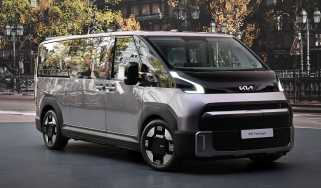
The Toyota Proace Verso is a rebadged version of these Stellantis models and shares the same traits. Elsewhere, the Kia PV5 looks smart, is nice to drive and good value as well as efficient, plus has a decent range in big-battery (71kWh) form. The Lexus LM is another option, but it’s a hybrid rather than an EV, and used prices start at £85k.
What to look for
Software glitches
On forums, by far the biggest gripe among owners is with the electronics, and especially the infotainment system. Regular updates can be helpful, but hard resets are still something that you sometimes have to perform.
Braking bad
As with any EV, the mechanical brakes don’t get much use because of the regenerative braking set-up. This can lead to corroded discs and unnerving noises; forums are full of owners who are unhappy with this.
On the range
The battery size, trim level, driving style and ambient temperature all affect the range. As a rule of thumb, expect 180-210 miles from the 77kWh battery, and 220-250 miles from the 86kWh battery.
Pump it up
No ID. Buzz came with a heat pump as standard, but it’s worth having one to improve the range in the winter. All models could be fitted with a heat pump at extra cost; it was a £1k option.
Interior
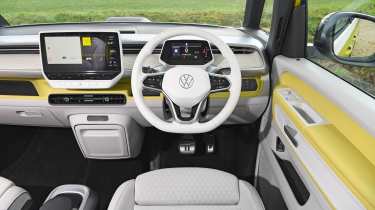
The interior design is as eye-catching as the exterior, mixing retro and modern, and the quality is generally good. SWB models have five or six seats, LWB five, six or seven, so pin down the configuration. It’s brilliantly practical with lots of cubbyholes and space for people and luggage, and LWB boot space is up to 1,495 litres with five seats in use.
Running costs
A service is due every two years, with no set mileage interval. Expect to pay £240 for this at an official dealer, including fresh brake fluid, but the first three services and the initial MoT are included in the purchase price of the car. On its own, replacing the brake fluid costs £79.
Insurance costs are likely to be a touch high, but probably no more than you’d expect. While the entry-level ID. Buzz sits in group 31, most models are in groups 33-41, with the range-topping GTX in group 42. Because all ID. Buzzes cost more than £50,000 when new, until their sixth birthday they’re all liable for the £440 expensive car supplement on top of the standard annual £200 fee.
The standard warranty is three years or 60,000 miles, while the battery pack has a guarantee that lasts for eight years or 100,000 miles.
Recalls
VW has recalled the ID. Buzz a total of five times. The initial two came in September 2024, the first for the Cargo because the parcel shelf could come adrift, potentially causing injury. The other action was due to front suspension glitches.
In December 2025 another two campaigns were issued, the first because sharp edges on the air- conditioning block could lacerate the airbags, the other because of faulty modules in the battery packs. These could discharge quickly, cutting range and potentially overheating; replacement modules were the solution.
The most recent recall came in March 2026 and it was for the same problem as the previous campaign, but this time far more vehicles were included in the recall (4,182 compared with 19).
Driver Power owner satisfaction
Every year there are a few VWs included in our surveys, but so far no electric ID car has appeared. That might be down to being outnumbered by ICE models, but when VW’s long-standing products do feature, it’s rarely very highly. This year there are four cars: T-Roc (27th), Polo (29th), Tiguan (31st) and Golf (46th), so all in the bottom half of the table. In our 2026 Brands survey, Volkswagen came 26th out of 30 entries, showing there’s plenty of room for improvement.
Don't miss out! See more of Auto Express in your Google Top Stories. Click here...
Used Volkswagen ID.Buzz for sale
2024 Volkswagen
ID. Buzz
21,860 milesAutomaticElectric
Cash £30,9952024 Volkswagen
ID. Buzz
29,953 milesAutomaticElectric
Cash £36,0472024 Volkswagen
ID. Buzz
28,192 milesAutomaticElectric
Cash £37,9952024 Volkswagen
ID. Buzz
31,689 milesAutomaticElectric
Cash £34,988
2024 Volkswagen
ID. Buzz
21,390 milesAutomaticElectric
Cash £35,499
2024 Volkswagen
ID. Buzz
42,889 milesAutomaticElectric
Cash £31,591
2024 Volkswagen
ID. Buzz
21,980 milesAutomaticElectric
Cash £33,399
2023 Volkswagen
ID. Buzz
20,733 milesAutomaticElectric
Cash £38,883
2023 Volkswagen
ID. Buzz
21,136 milesAutomaticElectric
Cash £37,499