New Volkswagen ID. Tiguan prototype review: more than just a rebadged ID.4
Volkswagen set to bolster EV range as ID.4 gets extensive overhaul and transitions into the ID. Tiguan

Verdict
The Volkswagen ID. Tiguan drives similarly to the old ID.4 - which is no bad thing as we found the ID.4 comfortable and refined, if a little dull. The key changes come in the shape of the interior usability and as we’ve seen on other new VWs, the company is stepping in the right direction.
One of the automotive industry’s worst-kept secrets has finally been confirmed after Volkswagen announced the successor to its all-electric ID.4 will be called ID. Tiguan.
The ID. Tiguan is based on the ID.4, but Volkswagen clearly thinks the amount of changes over the old car are sufficient to warrant a new name. The decision also aligns with Volkswagen’s strategy of giving its electric cars more familiar names – as we’ve recently seen with the ID. Polo and we will see with the forthcoming ID. Golf.
Volkswagen’s chief designer, Andreas Mindt, previously told us: “In my opinion, you have to have names. The original Beetle was the Volkswagen 1200; it’s not a name. But the audience immediately gave it a name. These names are so human; you can humanise them. This is what we want to chase – this human element on a Volkswagen. I love it.”
Used - available now

2024 Volkswagen
Tiguan
35,410 milesAutomaticDiesel2.0L
Cash £22,520
2023 Volkswagen
Tiguan
49,540 milesAutomaticPetrol1.5L
Cash £17,090
2023 Volkswagen
Tiguan
48,102 milesAutomaticPetrol1.5L
Cash £20,674
2023 Volkswagen
Tiguan
39,993 milesAutomaticPetrol1.5L
Cash £19,122Taking the Tiguan name puts plenty of pressure on the newcomer. Launched in 2007, the Tiguan has been Volkswagen’s best-selling car globally since 2017, having passed the nine-million mark earlier this year. It will have to not only replace the ID.4, but the ID.5 too, because there’s currently no word from Volkswagen about a replacement for the coupe-SUV variant.
Volkswagen ID. Tiguan: first drive
The full unveiling of the new ID. Tiguan is due soon, but before then we’ve had the opportunity to get behind the wheel of a prototype model. The first thing we notice getting in are the external door handles. In the ID.4, they looked like a physical handle but had a hidden button, whereas now there are more traditional grab handles. Inside, you get the same lever-action handles as in the new T-Roc, and these uncomplicated changes set the tone for the new ID. Tiguan.
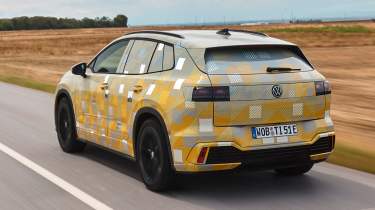
We suspect the car we tried was a higher-spec model, possibly an R-Line, considering the larger 20-inch wheels and the fact that it had different bumpers to other ID. Tiguan prototypes.
Inside, the ID. Tiguan has the same steering wheel as the new ID. Polo. Unlike the electric supermini, where the wheel feels a little too big for the car, in the larger ID. Tiguan it’s better proportioned, while the physical controls embedded within are a huge improvement over the ID.4’s.
Most of the dashboard in our pre-production car was covered, but we can check out the huge new 15-inch touchscreen – a unit we’ve already experienced in other large Volkswagens including the ID.7, Tayron, Touareg and the combustion-engined Tiguan. As in those other cars, the neat overall design with clearly laid out menus and sharp response times is mixed with a slightly fussy method of operating the shortcut toggles at the top; they’re still too small to operate seamlessly on the move.
Below the screen a bank of physical controls (also taken from the recently launched ID. Polo) replaces the woeful touch-slider climate and audio controls that VW is thankfully phasing out across its line up. The new switches don’t feel flimsy and have a knurled finish that makes them look fairly premium. The hard points of the ID. Tiguan’s interior are the same as the ID.4’s, so things such as the driving position, visibility and space are virtually unchanged - but that’s no problem, given that we never had an issue with these in the old car.
Andy Mindt previously told us that mistakes had been made with the most recent Golf: “Our satisfaction rating dropped down with the Golf Mk8, big time. The swiping things, you know, the touch sliders – it dropped down big time. So it’s that easy to improve this rating with this little thing.”
The total number of changes implemented on the new ID.Tiguan over the ID.4 will apparently be “like the change from Mk5 to Mk6 Golf”, we’re told. Those two models used the same underpinnings, but the later edition was referred to as a new generation by VW.
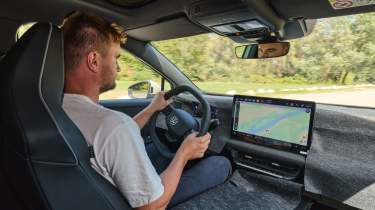
On the move the ID. Tiguan doesn’t feel drastically different to the ID.4. Our short drive over some smooth roads near Vienna airport in Austria didn’t particularly challenge the Dynamic Chassis Control (Volkswagen’s adjustable damping suspension) much. Switching between the softest and firmest settings didn’t bring a huge change in ride quality - and certainly not to the same extent we’ve felt in other Volkswagens with the same suspension technology.
Unlike the ID.4, the ID. Tiguan gets a new one-pedal drive mode. It works perfectly well in the new car, slowly coming on once you lift off the accelerator, giving a nice, smooth deceleration to a full stop.
We didn’t get a chance to properly stretch the legs of this test car. However, as we found with the ID.4, there’s a typical EV immediacy to the acceleration in the new car. The calibration of the accelerator means it’s not difficult to drive smoothly at the same time either.
What will the Volkswagen ID. Tiguan’s exterior look like?
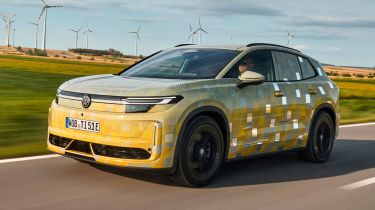
Although the fundamental proportions of the ID.4 have been kept in place for the new car, the prototype we’ve seen on public roads clearly shows a very different design language is in the works, featuring cleaner bodywork and sharper lines, with a closer tie to recent ID-branded VWs such as the ID.3 Neo and ID. Polo.
One of the criticisms of the current ID.4 is its blobby design, which looks out of kilter with VW’s fundamental themes of solidity and stability. This certainly seems to have been addressed, because underneath the prototype’s camouflage, you can see that elements such as the door sills and lower bumpers are now flatter and squarer, giving the whole design a stronger-looking base.
The nose is all-new, with headlights that sit within a distinct frame. Just as it is on the ID. Polo and ID. Cross, this element is illuminated right the way across, highlighted by a large glowing VW badge at its centre.
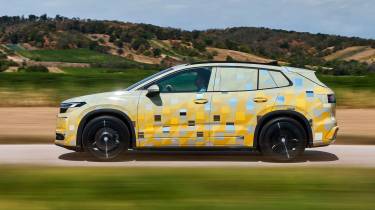
At the rear, the ID. Tiguan has adopted the same lighting signature as the new ID. Polo and ID. Cross, and as on those cars, it will sit within a grey enclosure. The rear badge is illuminated, too.
Most of these elements are consistent with our exclusive images, suggesting we were on the right track when we broke the story back in 2025 after speaking with VW’s head of design Andy Mindt.
What battery and powertrain options will be offered?
The specifics remain under wraps for now, but at the moment the ID.4 is currently offered with 52kWh and 77kWh batteries, and either a single-motor rear-wheel-drive layout or a dual-motor all-wheel-drive set-up.
We expect the same battery options as offered on the newer ID.3 Neo however, which will see a new 58kWh lithium iron phosphate (LFP) pack introduced to go with the existing 77kWh unit. The LFP battery technology, according to VW CEO Thomas Schäfer, will be a “major step forward in terms of cost for [VW]”, hopefully helping reduce list prices on entry versions of future ID. cars.
Don’t expect the small-battery model to nudge beyond the 300-mile mark considering the lighter ID.3 Neo reaches up to 297 miles with that battery.
For longer-range versions of the ID. Tiguan, we anticipate the revised bodywork might help push the current ID.4’s maximum 351-mile range a bit further.
How much will the Volkswagen ID. Tiguan cost?
The current ID.4 costs from £36,995 and rivals like the Ford Explorer, Skoda Enyaq and Renault Scenic all come in under £40,000. We expect the new ID. Tiguan will cost around the same as the outgoing ID. 4 to ensure it stays close to the competition.
Now the iD.4 has been on sale for a number of years, there are loads of excellent used options to pick from on the Auto Express Buy A Car service with prices kicking off under £12,000.
| Model: | Volkswagen ID. Tiguan |
| Price: | £37,000 (est) |
| Powertrain: | 77kWh battery, 1x motor |
| Power: | 187bhp (est) |
| Transmission: | Single-speed automatic, rear-wheel drive |
| 0-60mph: | 8.5 seconds (est) |
| Top speed: | 99mph (est) |
| Charging: | 165kW (10-80% in 28 minutes) (est) |
| Range: | Over 350 miles |
| Size (L/W/H): | N/A |
| On sale: | Expected early 2027 |