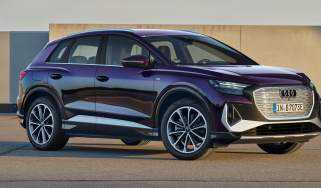
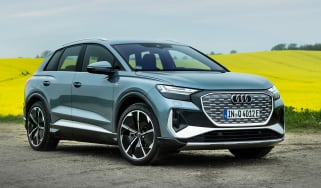
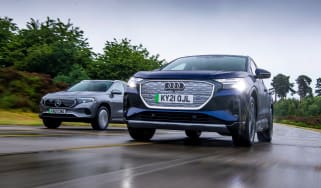
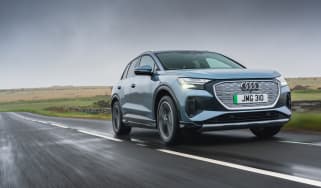
Audi Q4 e-tron review
The Audi Q4 e-tron is a popular premium EV with efficiency and upmarket style that stood out on our tests
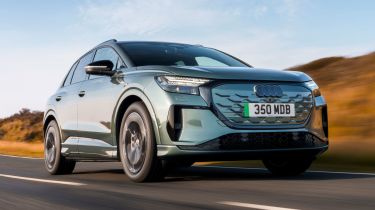

Our opinion on the Audi Q4 e-tron
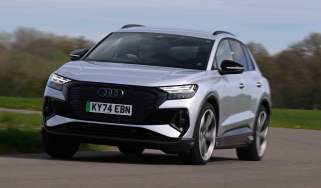
Audi has done a good job of turning the Volkswagen Group’s electric platform into a proper Audi with the Q4 e-tron. It features the kind of materials and high-quality switchgear that the company is famous for, and it delivers an impressive amount of space for its compact size.
The electric powertrain returns decent efficiency when compared with rivals and the performance on offer is pretty good, too. We’d steer clear of the Sportback model, because it only offers a marginally better driving range than the standard Q4 e-tron with worse practicality for a higher price. A number of rivals offer better value for money than Audi’s smallest EV so you’ve got to want that brand image and extra quality.
About the Audi Q4 e-tron
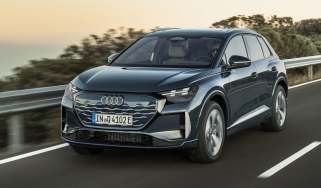
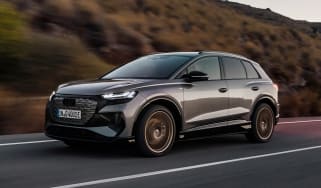
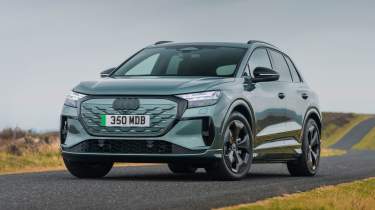
Audi’s electric line-up continues to expand, but one of its first EV efforts, the Q4 e-tron, remains among the most popular choices with buyers. It’s easy to see why; this family SUV offers the Audi premium badge appeal at a price that isn’t too far beyond the level of numerous mainstream alternatives.
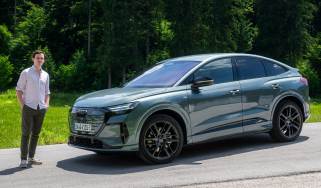
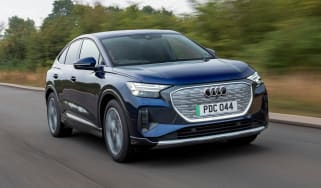
There’s a conventional five-door SUV variant and a sportier ‘coupe SUV’ alternative, in the shape of Audi Q4 e-tron Sportback. In both cases, the Q4 e-tron line-up includes two battery sizes, three power outputs and either rear-wheel drive or quattro four-wheel drive. The entry point is now called simply the e-tron, which has a net battery capacity of 59kWh and rear-wheel drive, while the e-tron Performance has more power and 77kWh usable pack. The old 45 quattro has been dropped, which means the next model up in the range is now the e-tron quattro Performance, with the same 77kWh battery pack but all-wheel drive and a 335bhp output.
Used - available now


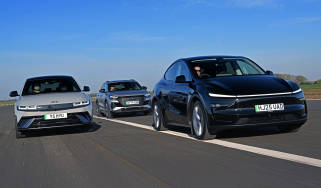
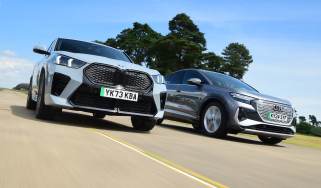
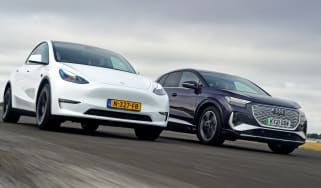
There’s no shortage of rivals for the Audi Q4 e-tron, and we’ve put this German SUV up against two of its fiercest competitors – the Tesla Model Y and Hyundai Ioniq 5.
Performance & driving experience
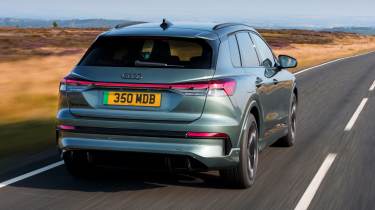
Pros |
|
Cons |
|
Audi has finally ditched its confusing numeric naming strategy for different powertrain outputs, and has rationalised the range as part of the 2026 facelift to just three models, badged e-tron, e-tron Performance, and e-tron quattro Performance. The actual electric motors and battery packs are carried across from the pre-update cars, so performance figures remain largely unchanged.
Whichever powertrain is fitted, the latest Q4 e-tron is smooth and torquey, with a well-judged throttle response that feels much more positive than in the slightly lethargic early Q4s. Black Edition models have paddles on the wheel to adjust energy recuperation. We’d recommend setting the recuperation to manual in the infotainment to switch off the unpredictable adaptive regen system.
Electric motors, 0-60mph acceleration and top speed
The Q4 range starts with the e-tron, which uses a single motor driving the rear wheels and produces 201bhp, which is enough for an 8.1-second 0-62mph time. This car gets a battery with a 59kWh net capacity. Next is the e-tron Performance, which keeps the rear-wheel drive layout but has a larger battery with a 77kWh net capacity, and power climbs to 282bhp, which trims the 0-62mph time to 6.6 seconds, despite an extra 105kg to carry around thanks to the bigger battery.
The e-tron quattro Performance replaces the old 55 e-tron quattro, which means 335bhp split across both axles, albeit powered by the same 77kWh battery as the regular Performance. This trims the 0-62mph time down to 5.4 seconds.
| Model | Power | 0-62mph | Top speed |
| Audi Q4 e-tron | 201bhp | 8.1sec | 99mph |
| Audi Q4 e-tron Performance | 282bhp | 6.6sec | 112mph |
| Audi Q4 e-tron quattro Performance | 335bhp | 5.4sec | 112mph |
Town driving, visibility and parking
The Q4 e-tron’s turning circle is much tighter than cars from rivals, including the Tesla Model Y and Hyundai Ioniq 5, so it’s a little easier to manoeuvre it into a tight parking spot. On the largest 21-inch wheels and the lowered suspension of the Black Edition (both it and the S line sit 15mm lower than the entry-level Sport trim) the ride is barely on the right side of firm. It’s a little thumpy over big bumps at low speeds, which is why we’d aim for models with smaller wheel sizes and a little more sidewall on their tyres. A newly introduced one-pedal driving mode, adjusted via steering wheel paddles, has made progress even more effortless than before.
Country road driving and handling
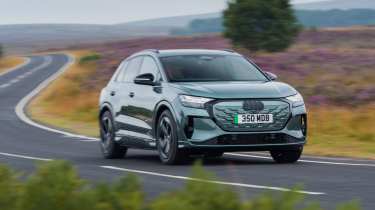
The Audi strikes a competent ride and handling balance on a twisty road, which makes it better to drive than a Tesla Model Y, and a big part of that is down to its steering. It’s well matched to the responses of the chassis, so you can load the car up through a corner without feeling like you’re stuck in a computer game, as is the case with the Tesla.
The Audi is at its best in rear-wheel-drive form, where a little throttle application coming out of a corner gently pushes the car around from the back, in a way that makes it feel more sweetly balanced than many other EV options in this segment.
The one proviso is that the Q4 e-tron can pitch onto its back axle under very hard acceleration, which can make the front wheels a little light if you’re clumsy with the right pedal in a corner. The BMW iX1 is sharper through corners but is let down by its firm ride and lifeless steering, while one of the best in the class for drivers is the Ford Capri. Using the same MEB underpinnings as the Audi, Ford’s engineers have managed to hit a real sweet spot between comfort and fun.
Motorway driving and long-distance comfort
The Audi’s high-speed stability makes it an accomplished long-distance cruiser. However, both the Model Y and the iX1 have a narrow advantage when it comes to isolating their occupants from road and wind noise.
“There’s not too much body roll when travelling fast through corners, and the Audi Q4’s supple suspension soaks up much of the shock of any bumps you might encounter.” – Tom Jervis, consumer reporter
Range, charging & running costs
Pros |
|
Cons |
|
Electric range, battery life and charge time
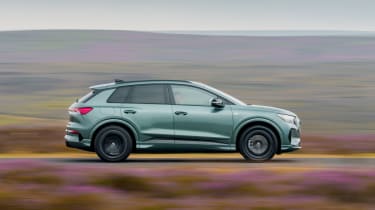
With 2026’s updates came some small changes to the range and recharging figures for the Q4 e-tron. In standard Sport trim, the regular e-tron with the 59kWh net battery is rated at 269 miles, an improvement on the 40 e-tron’s old 250 miles thanks to some small tweaks to the powertrain and slightly better aerodynamics.
Next up is the e-tron Performance, which replaces the previous 45. In Sport trim, the range climbs from 320 miles to 352 miles. In the previous car we recorded a real-world range of 262 miles, based on an efficiency of 3.4 miles per kilowatt-hour, while on the launch of the e-tron Performance in 2026 (albeit on different roads), the 4.1mi/kWh efficiency displayed by our car would translate to a real-world 320 miles. Naturally, this will vary depending on your own driving situation, weather, and a host of other factors.
Opt for the quattro Performance, and claimed range drops by 22 miles compared with a rear-wheel drive e-tron Performance. The new 330-mile figure still represents a 10-mile improvement on the 55 e-tron quattro’s number, though.
All versions should charge quicker, too. The top-spec car still gets the fastest charging speed, now 185kW rather than 175kW, while the e-tron and e-tron Performance max out at 160kW and 165kW, respectively. Audi says a 15-80 per cent top-up takes less than half an hour in any model. Pre-conditioning before rapid charging ensures you’ll get better charging rates when you do stop, though our experience of the previous model suggests it can take up to half an hour for the battery to be in its happy place, ready for the fastest charging.
For those able to charge up at home utilising a typical 7.4kWh home wallbox charger, it’ll take around 10 hours to fully recharge the smaller-capacity battery, and around 13 hours to fully charge a Q4 with the larger pack.
| Model | Battery size | Range | Insurance group |
| Audi Q4 e-tron | 59kWh | 269 miles | 30E |
| Audi Q4 e-tron Performance | 77kWh | 352 miles | 37E |
| Audi Q4 e-tron quattro Performance | 77kWh | 330 miles | 40E |
Insurance groups
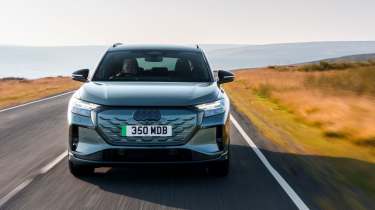
Insurance groups for the refreshed Q4 e-trons are quite similar to what went before. The range starts a couple of groups lower, in group 30 for the entry-level e-tron Sport. The mid-range e-tron Performance is in group 37, while the quickest e-tron quattro Performance is in group 40.
Tax
All electric cars are now liable for the standard rate of VED road tax, and the Audi Q4 e-tron’s pricing structure means that several models find themselves above and beyond the £50,000 luxury car tax bracket. As a result, owners will pay a combined annual VED bill of £640 between years two and six after the car is first registered, though first-year tax is just £10.
EVs would also be subject to an eVED pay-per-mile fee if that comes into force from April 2028 onwards.
There’s still good news for company car drivers, though, as EVs continue to attract the very lowest Benefit-in-Kind (BiK) tax rates. It presently attracts a four per cent rate in the 2026-2027 tax year.
Depreciation
According to our resale valuation data provided by CDL, the Q4 e-tron will retain between 40 and 45 per cent of its original value over three years or 36,000 miles. The Q4 e-tron Sportback is expected to maintain between 41 and 43 per cent over the same period.
In comparison, the Kia EV5 is predicted to retain 47 per cent over the same period, while the Tesla Model Y will still be worth between 51 and 60 per cent.
To get an accurate valuation on a specific model check out our free car valuation tool…
Interior, design & technology
Pros |
|
Cons |
|
The Q4 e-tron’s cabin is fairly logically laid out, and the ergonomics are reasonable, but some buyers would have hoped for a little more style and a better-quality finish for the money.
Interior and dashboard design
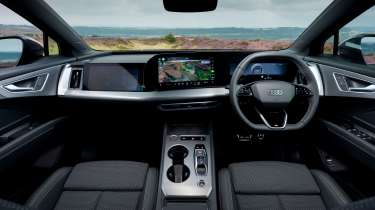
The Q4 e-tron’s cabin feels more driver-centric than many other models from Audi’s line-up, especially since 2026’s updates. Where the original model bridged the gap between Audis both old and new, the latest car has followed the lead of the brand’s latest vehicles and put a lot more emphasis on screens. The driver and infotainment displays still wrap around you as before, but they’re now housed in one curved unit, while on top-spec Vorsprung models, a separate screen has appeared on the passenger side of the dashboard.
Along with this, the console between the driver and passenger has grown, closing the gap that used to be between the drive selection panel and the centre armrest. The smartphone cubby is now in a more sensible place at the front of this console, and the drive selector, starter button, handbrake switch and other buttons are now closer to the driver, flanked by cupholders.
It’s not quite got the wow-factor of the BMW iX1 or the Peugeot E-3008, but it’s fairly smart to look at. One downside of the new layout is that the air con controls, previously a row of physical buttons, have been swallowed up by the touchscreen.
Materials and build quality
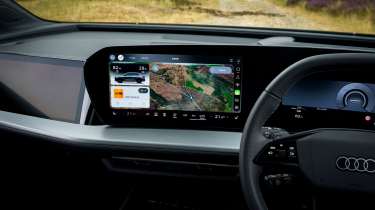
Audi’s perceived quality has taken a dip in form from its high point around 10 years ago, and the Q4 is one of its cars that doesn’t quite live up to the lofty standards that built the brand’s reputation. It’s not shoddy by any means, but the E-3008, iX1 and even the Skoda Enyaq from VW Group stablemate Skoda feel at least as plush inside.
Infotainment, sat-nav and stereo
The Q4’s central touchscreen is almost modestly sized by the standards of some rival systems. But this, in many ways, works in its favour; it’s not so large that it overpowers the cabin design, yet it’s large enough that the on-screen keys are easy to use, even on the move. The passenger screen fitted to Vorsprung trim is also 12 inches, and it can be used for everything from basic in-car entertainment functions, to streaming Disney+ or YouTube content. The screen is designed so that it isn’t visible to the driver, and just looks like a black display.
The main menu page has large shortcut tiles that are colour-coded and easy to understand, while the Google Earth graphics on the navigation screen look great. The latest 2026 car has also added wireless smartphone charging and rear USB ports as standard, even in the basic Sport trim.
“We have issues with the touch-sensitive steering wheel buttons, because on more than one occasion, I clipped the ‘skip track’ button by accident while driving.” – Alex Ingram, special contributor.
Boot space & practicality
Pros |
|
Cons |
|
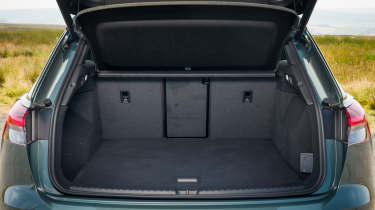
The Q4 e-tron’s cabin is impressively spacious, offering nearly as much leg and headroom as the larger Q6 e-tron. The boot is on the larger side of the class average, too.
Dimensions and size
As its name suggests, the Q4 e-tron’s falls squarely between the Q3 and Q5 in terms of length, but thanks to its electric platform, there is nearly as much space inside as you’ll find in Audi’s next largest electric SUV, the Audi Q6 e-tron. There are short overhangs front and rear, but again, this doesn’t compromise boot space. The figures in the table below are for the regular Q4 e-tron, but the sleeker Sportback differs slightly, with a length of 4,603mm and height of 1,620mm (width and wheelbase remain the same).
| Dimensions comparison | |||
| Model | Audi Q4 e-tron | Kia EV6 | Tesla Model Y |
| Length | 4,588mm | 4,680mm | 4,790mm |
| Width | 1,865mm | 1,880mm | 1,982mm |
| Height | 1,639mm | 1,550mm | 1,624mm |
| Wheelbase | 2,764mm | 2,900mm | 2,890mm |
| Boot space | 520-1,490 litres | 490-1,300 litres | 890-2,138litres (measured to roof) |
Driving position, seats & space in the front
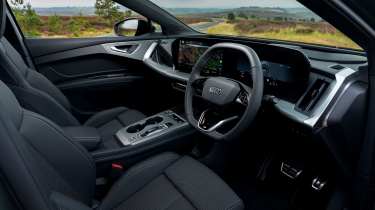
The Q4’s driving position is high, so there’s a decent view of the road ahead, and the seat has loads of adjustment. Cabin storage has improved since the 2026 update with a larger centre console that puts the cupholders in a more accessible place, has a better cubby for phone charging, and still has some storage underneath. The glovebox is only half-sized, however, due to the fuse box taking up part of the space.
Seats & space in the back
Passengers have loads of space to stretch out in the back of the Q4, and the seats are very comfortable, too. The angle of the backrests is a little more reclined than in a Tesla Model Y, which works in the Audi’s favour, while there’s loads of foot space, too.
Boot space
At 520 litres, the boot matches the likes of the Hyundai Ioniq 5 for overall volume. The Audi’s is more usable though, because the load bay is deeper, allowing for more bulky items to be loaded inside. Drop the rear seats and the volume grows to 1,490 litres. But the Q4 doesn’t have a front boot.
“Passengers won’t complain about a lack of head or legroom because it’s roomy inside, and there’s enough space in the boot for all their stuff.” – Alex Ingram, special contributor.
Reliability & safety
Pros |
|
Cons |
|
Audi has a reputation for producing stylish, premium cars with a high standard of fit and finish, but the brand has historically scored poorly in the Driver Power customer satisfaction survey. After jumping from 27th place in 2024 to 19th out of 31 manufacturers in 2025, Audi has tumbled back to 23rd place from 30 brands in the 2026 survey, a long way behind rivals Mercedes (1st) and BMW (5th), though thankfully ahead of its parent company Volkswagen in 26th.
The Q4 e-tron retained its highest five-star safety rating from industry body Euro NCAP as part of its retest in 2025. It scored 91 per cent for adult occupant protection and 87 per cent for child passenger protection. The standard safety kit is good, with all cars getting cruise control with a speed limiter and lane-departure warning.
| Euro NCAP safety ratings | |
| Euro NCAP safety rating | Five stars (2025) |
| Adult occupant protection | 91% |
| Child occupant protection | 87% |
| Vulnerable road user protection | 79% |
| Safety assist | 73% |
Buying and owning
- Best buy: Audi Q4 e-tron Performance
The Q4 e-tron currently starts around the £46,300 mark, for an e-tron with the smaller battery and in Sport trim. Pricing jumps by £3,000 for S Line trim, to £52,200 for a Black Edition, and £59,000 for the Vorsprung – and that’s without even upgrading to Performance or quattro Performance drivetrains.
The e-tron Performance pricing covers a range from £51,000 to around £63,700, while the quattro Performance spans £56,000 to £69,000. Sportback models are roughly £2,000 more, like for like.
Our favourite Q4 e-tron remains the one in the middle of the range, after the updates in 2026. By opting for the e-tron Performance you get, as the name suggests, a little more pep than the entry-level car, but also a bigger battery for greater range. We’d likely still plump for sporty S Line trim too, which typically has slightly more dynamic styling and more kit to play with, and the desirability of S Line models among used buyers ensures residual values are often better than the basic Sport too - though you usually pay a small penalty in ride quality due to the larger wheels.
Use the Auto Express Buy A Car service to build your perfect Audi Q4 e-tron, and you can save thousands of pounds. You can also see the very latest used Q4 e-tron deals, and we can even help you to sell your car.
Audi Q4 e-tron alternatives
If you want a posh Audi SUV, then the Audi Q3 is your petrol and plug-in hybrid alternative that’s closest the Q4 in size.
There are other premium contenders that the Q4 e-tron has to beat, and it holds up fairly well against them. It’s more efficient than the expensive Genesis GV60, its range is better than the BMW iX1, and it’s more roomy inside than the Mercedes EQA. The main contender in the small premium electric SUV class is the Tesla Model Y, which offers a long range, lots of kit and the convenience of the Supercharger network, as well as competitive pricing.
If you can’t get on board with a Tesla, then our other favourite in the class is the Hyundai Ioniq 5. It looks more like a hatchback than the Q4, but it’s big, and offers lots of space inside.
Audi Q4 e-tron pictures
Audi Q4 e-tron 50 quattro: long-term test

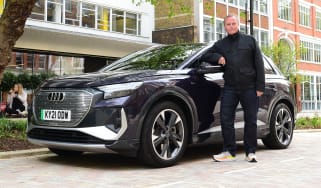
In 2022, our former Editor-in-chief, Steve Fowler, ran the now-discontinued Audi Q4 e-tron 50 quattro over a six-month, long-term test. He found the lower sports suspension on his S line model a little too firm, but was otherwise highly impressed by the car’s user-friendly design. The large boot area worked perfectly for his dog, Sky, and he found the underfloor storage space for the charging cables very handy. Steve averaged 3.2 miles per kWh on his test in mixed driving.
Frequently Asked Questions
The Q4 will need a service every 24 months. That makes Audi’s costly service plan seem even poorer value, especially when there are fewer moving parts that need to be maintained.
Deals on the Q4 e-tron and alternatives