Best 7-seat electric cars to buy 2026
Looking for a large, electric car with seven seats? We’ve listed the best options currently available

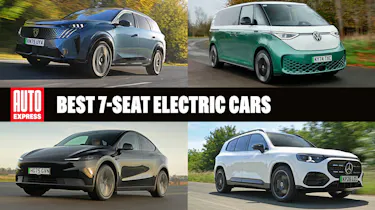
Not long ago, if you wanted a seven-seat electric car, you really didn’t have many options. In 2026 though, EV drivers looking for large load-luggers with seven seats have more choice than ever before.
To comfortably carry six or seven adults, plus any accompanying luggage, you’re going to need a large vehicle and so the available options for buyers seeking a seven-seater that runs on electric power mainly boil down to MPVs or SUVs.
Lots of the electric MPVs on today’s market are based on commercial vehicles and offer huge amounts of space as a result, while the SUVs tend to be a little less roomy in the third row but tend to deliver a more premium feel in terms of the cabin environment and driving experience.
If an electric seven-seater doesn’t work for you, then there are plenty of petrol, diesel or plug-in hybrid powered 7-seater cars which may suit your needs, but which electric seven-seater should be on your shortlist? We’ve detailed the best currently on sale to help you find your perfect car.
Compare the best 7-seater electric cars
Our expert road testers have driven every electric seven-seater car on the market over hundreds of miles to find the best from the rest. The best 7-seater electric car currently on the market is the Tesla Model Y thanks to its great efficiency and access to the Tesla Supercharger network.
If you prefer your car to come with some retro flair then the Volkswagen ID.Buzz can’t be beaten for its mix of style and space.
| Rank | Make and model | Prices from | Buy |
| 1. | Tesla Model Y | £42,000 | Deals |
| 2. | Volkswagen ID.Buzz LWB | £59,500 | Deals |
| 3. | Kia EV9 | £65,000 | Deals |
| 4. | Mercedes GLB Electric | £46,000 | Deals |
| 5. | Hyundai Ioniq 9 | £65,000 | Deals |
| 6. | Peugeot E-5008 | £39,000 | Deals |
| 7. | Volvo EX90 | £73,000 | Deals |
| 8. | Citroen e-SpaceTourer/ Peugeot E-Traveller/ Vauxhall Vivaro Life Electric | £37,000 | Deals |
| 9. | Mercedes EQS SUV | £130,000 | Deals |
| 10. | Citroen e-Berlingo/ Peugeot E-Rifter/ Vauxhall Combo Life Electric | £31,500 | Deals |
1. Tesla Model Y
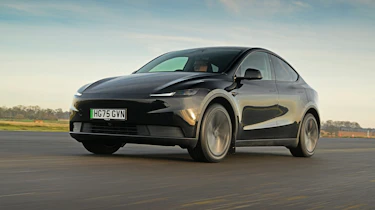
Elon Musk might be a divisive figure, but there’s no denying that the Tesla Model Y is a cracking seven-seat EV.
- Prices from £41,990
Pros |
Cons |
|
|
It’d almost be a surprise not to see some kind of Tesla in a rundown of the best electric cars in a particular segment. And with the Tesla Model Y offering versions with seven seats, it earns a spot in this group too.
What it can’t do is compete with the space offered by some other seven-seaters here. The Model Y is relatively compact, and the pair of extra seats (an option of around £2,500) is very much kids-only, mostly thanks to the restricted headroom of that sloping roof line. But sometimes all you need is a pair of occasional seats for your offspring’s school friends, and it does the job there.
With five seats in place, the boot space is very generous at 845 litres and it’s a nice usable shape, too, ideal for loading bulky items. If that wasn’t enough, there’s a good amount of under floor storage which is useful for storing things like charging cables or tyre pumps, and up to 88 litres of storage in the ‘frunk’.
Tesla tends to nail all the EV essentials, too. In Standard form, you get an 63kWh battery pack and up to 315 miles of range, and it’s still quick with a 6.9-second 0-62mph time. But it doesn’t cost much either considering how much car you’re getting, with a price tag under £42,000. Tesla’s Supercharger quick-charging network remains the best of its type as well.
“While the Model Y was disappointingly firm when first launched, the current car is far more refined and better to drive.” Dean Gibson, senior test editor.
2. Volkswagen ID.Buzz LWB
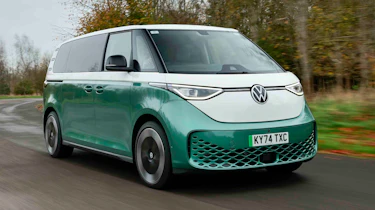
Want an MPV with both space and style? The Volkswagen ID.Buzz has both by the bucketload.
- Prices from £59,500
Pros |
Cons |
|
|
In essence, MPVs are just large boxes on wheels with the aim of providing the maximum amount of seats and space possible. The Volkswagen ID.Buzz offers exactly this and more with its funky retro styling.
What can be thought of as a modern-day interpretation of the iconic Type 2 Kombi, the ID.Buzz is far from a one trick pony. Volkswagen has utilised some clever packaging meaning there’s enough room for up to seven passengers, and a competitive amount of boot space at 306-litres when the third row is in place, which is competitive for a seven-seater car.
Powering the ID.Buzz LWB is a 86kWh battery pack which can officially return up to 293 miles according to VW. Having lived with an ID.Buzz LWB for six months, we saw an average of between 3.1 and 3.4 miles per kWh, resulting in a real-world range of between 260 and 280 miles.
On the road, the ID.Buzz feels just like a big car, so if you’re used to driving an SUV then you should settle in behind the wheel very quickly. The turning circle is tight and the high driving position and good all-round visibility means it’s very manageable to drive around town. With 282bhp and instant torque on tap, it’s both very nippy and a comfortable cruiser.
“There’s not much to match the ID. Buzz’s blend of capability, capacity and style in the family-car space, while the 60-per-cent residual value after three years and low running costs will help offset some of the outlay. - Steve Walker, head of digital content.
3. Kia EV9
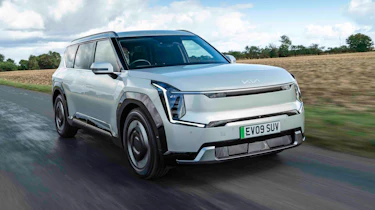
Kia might not be well-known for making large luxury cars, but the EV9 is a very fine example
- Prices from £65,000
Pros |
Cons |
|
|
The Kia EV9 is big – which is always a good start for a seven-seater. While some cram a back row in that limits extra passenger capacity to children only, even adults will be able to squeeze into the rearmost row in the EV9, provided they’re not too tall. Kneeroom is the greatest limitation but headroom and elbow room are both surprisingly good. And there’s still a 333-litre boot behind the seats – only around 50 litres less than the entire boot in a Volkswagen Golf.
You’ll have to get used to piloting a vehicle that’s five metres long and about two metres wide of course, though the EV9 makes that easier than it might be thanks to the visibility from those fairly upright windows, plus the predictable behaviour of the electric powertrain.
There are several settings for regenerative braking, the strongest allowing one-pedal driving, and there’s enough power to make light work of most driving situations. You’re also well-catered for when it comes to range. While the seven-seat version of the EV9 is only available in GT-Line trim, it comes with a colossal 99.8kWh battery, which can go up to 313 miles on a single charge.
Given its size, it’s not the best urban vehicle, as the length does hinder low-speed manoeuvrability, and the low-speed ride is also a bit brittle, in contrast to its smoother behaviour out of town. But along with satisfyingly chunky styling and a smart, modern cabin, the EV9 has a lot going for it even if you’re not using all seven seats.
“For length and width, the EV9 is almost on par with a Land Rover Defender 110, meaning UK parking bays will feel a real squeeze - you’ll always have some of the car hanging out of the space, and getting in and out won’t be easy with cars parked next to you either.” - Dean Gibson, senior test editor.
4. Mercedes GLB Electric
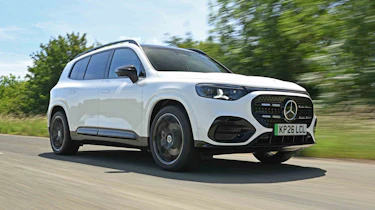
If you want a premium electric seven-seater which majors in comfort, the Mercedes GLB could be the car for you.
- Prices from £46,000
Pros |
Cons |
|
|
Mercedes is currently getting into its stride with its new generation of electric cars, all of which offer very competitive range, bucketloads of tech, and in the case of the Mercedes GLB Electric, seven-seats with lots of space.
The Mercedes GLB Electric is available in two power guises: the GLB 250+ with 268bhp and the 350 which comes with 4MATIC all-wheel drive and 349bhp. Both cars are sprightly off the line and with only the one 85kWh battery to choose from, both cars can crack at least 360 miles on a single charge.
When we tested the GLB 250+, we saw an estimated range of 315 miles from a fully charged battery and 3.6 miles per kWh which translated into a real-world range of 306 miles. We found the ride to be incredibly comfortable thanks to its soft suspension set up, and the cabin was well insulated even on the roughest stretches of tarmac.
On the inside, there’s no shortage of tech. All cars come with a massive 14-inch high-resolution touchscreen, but step up to Premium and Premium Plus models and your passenger can have a 14-inch screen, too. It’s easy to use and incredibly quick, although some menus aren’t intuitive to navigate.
The GLB is quite a spacious car for its class. Its boxy shape means there’s plenty of head and knee room for passengers, although the third row is best reserved for children in our experience.
The boot is rated at 540-litres with five seats in place, and this is much larger than the 500 litres of its BMW X1 rival. Electric models also benefit from 127 litres worth of space under the bonnet, plus some nifty storage under the floor and around the wheel arch.
“The two rearmost seats lift out of the boot floor via pull cords, but you have to make sure the middle row is slid forward a little to ensure the rear headrests lift clear of the seat backs.” - Dean Gibson, senior test editor.
5. Hyundai Ioniq 9
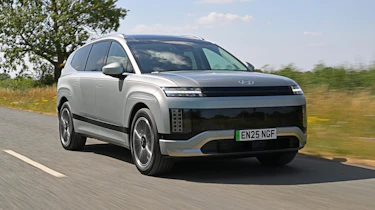
If the Kia EV9 doesn’t quite float your boat, the closely-related but equally impressive Hyundai Ioniq 9 just might.
- Prices from £65,000
Pros |
Cons |
|
|
The Hyundai Ioniq 9 nails the electric seven-seater car brief from the get-go: it’s spacious, comfortable, and a big battery gives it plenty of range.
Talking of the battery, the Ioniq 9 comes with a massive 110kWh unit which can return up to 385 miles on a single charge. During our time driving an Ioniq 9 in top-spec Calligraphy spec, we achieved 2.6 miles per kWh and saw a real-world range of around 300 miles.
This being a large car, you’re not short-changed when it comes to cabin space. Even with all seven seats in place, there’s 338-litres worth of boot space, expanding to 908 litres when the third row is folded down. There are few complaints when it comes to head and knee room for rear passengers either, even for those in the very back row.
Unlike some seven-seater EVs on this list, the Ioniq 9 might feel a bit intimidating to those not used to driving a large car because it’s more than five meters in length. Despite its sheer size, there’s plenty of driving tech to help you pilot this SUV thanks to its array of sensors and cameras, not to mention a commanding driving position.
“The Ioniq 9’s relatively jerky throttle isn’t too much of an issue when driving solo, but if you have passengers who are prone to motion sickness, it might be better to select Eco mode, which rounds off the response to make it smoother, while also boosting efficiency.” - Dean Gibson, senior test editor.
6. Peugeot E-5008
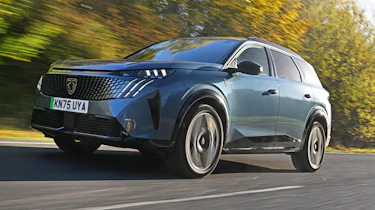
If style is near the top of your wishlist in a seven-seater family car, then the Peugeot E-5008 is a worthy contender.
- Prices from £39,000
Pros |
Cons |
|
|
When shopping for a seven-seater car it’s probably fair to say that style isn’t the number one priority. But it certainly doesn’t hurt, and the Peugeot E-5008 is among the sharper-looking family-haulers you can currently buy.
It has the same distinctive cues as the cars across Peugeot’s lineup, such as claw-like lighting details and an intricate grille design – but actually, the real highlight is the interior.
For design, and even for perceived quality, it has the measure of just about any other seven-seat EV you’d care to mention at this price.
The latest iteration of the brand’s i-Cockpit layout, the small-diameter steering wheel sits below a curved 21-inch screen, and is flanked by dramatic fabric-trimmed dashboard elements that feel as good as they look. We recommend thoroughly test-driving the car and its infotainment system though, as the i-Cockpit layout isn’t to everybody’s taste.
It scores well on practicality, the seventh-row seats just about accommodating teenagers, but still leaving 348 litres behind, and if you run the car as a five-seater, luggage space opens up to 916 litres. Range, meanwhile, is up to 413 miles if you opt for the 97kWh battery pack, though it’s a shame a heat pump is only optional on all cars but the range-topping GT-Line Premium.
“The second row seats slide forward and backwards; this both allows the third row a little more space when six and seven occupants are on board and, combined with a backrest that drops flat, improves access into that third row.” - Dean Gibson, senior test editor.
7. Volvo EX90
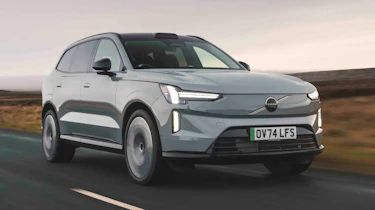
Roomy, stylish and big on tech, the Volvo EX90 is a dependable premium SUV.
- Prices from £73,160
Pros |
Cons |
|
|
The Volvo EX90 is effectively the electric version of the XC90, Volvo’s legendarily practical, safe, and pragmatic large SUV. And all the qualities that made the combustion model such a great car for family buyers are present and correct in the EV too, right down to the handsome styling that looks good on the drive, but doesn’t shout too loudly about it.
As a seven-seater, it’s pretty typical of most others of this type. Fantastic space for those up front, adequate for those in the middle, and a rearmost pair better reserved for children. You might expect more here given the EX90’s five-metre length, but the quality’s high and there’s a 310-litre boot even with all seven seats in place.
The minimalist cabin design looks modern and most of the things you interact with work well – even if the touchscreen is responsible for more functions than we’d like.
The 376-mile range looks good on paper but real-world efficiency isn’t great, despite the standard heat pump; we’ve seen 2mi/kWh on a wet and windy day, for a real-world range of barely more than 210 miles. 250kW charging then is quite welcome.
“There’s room under the boot floor to put stuff out of sight, and there’s a frunk capable of keeping a charge cable or two. Annoyingly, it’s opened via a lever in the front footwell; Volvo isn’t alone in restricting access in this way, but I’d prefer a button on the key.” – Richard Ingram, deputy editor.
8. Citroen e-SpaceTourer/ Peugeot E-Traveller/ Vauxhall Vivaro Life Electric
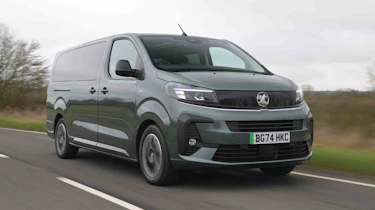
These MPVs are available in many different but similar flavours, but you can’t overlook the value offered by the Citroen e-SpaceTourer.
- Prices from £36,995
Pros |
Cons |
|
|
Citroen’s largest MPV, the SpaceTourer, is now solely available in electric form as the e-SpaceTourer. Based on the Dispatch panel van, the e-SpaceTourer is available with the sole option of a 136bhp electric powertrain with a 75kWh battery. It gives the e-SpaceTourer the endurance of up to 217 miles on the WLTP cycle.
You’ll still need regular charging on a long road trip then, but 100kW fast charging means a 5-80% top-up takes around 45 minutes – enough for you and your six passengers to answer the call of nature and grab some snacks.
Besides badges and minor styling tweaks, the Citroen is identical to the Peugeot E-Traveller and Vauxhall Vivaro Life Electric – so your decision might come down to which dealership is closest or offers the best deal.
“The electric motor is nearly silent, which combined with a complete absence of vibration, makes it much more relaxing to drive compared to previous diesel versions.”. - Alex Ingram, contributor.
9. Mercedes EQS SUV
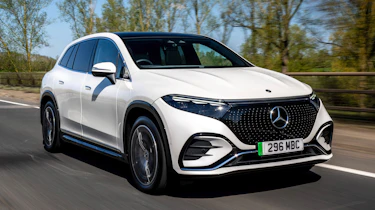
If you want a seven-seat electric car which oozes luxury, the Mercedes EQS SUV should be on your shortlist.
- Prices from £130,000
Pros |
Cons |
|
|
Mercedes flagship EQ model, the EQS SUV, offers premium comfort, practicality and technology expected from the German manufacturer, as well as a commanding £130,000 price tag.
The EQS SUV comes with a whopping 118kWh battery, and motors producing 360bhp and 800Nm of torque, allowing the premium seven-seater to travel up to 400 miles on a charge according to the WLTP test procedure, although this may be lower in real-world driving conditions.
On the move, the EQS SUV is smooth and quiet, with the air suspension setup being on the softer side. This allows the Mercedes to feel fluid over rolling tarmac, as well as providing a good level of comfort on A-roads and motorways.
However, in certain situations, sharper bumps highlight the EQS SUV’s colossal 2,895kg kerb weight through noticeable suspension thumping. And braking sharply can confuse the regenerative and friction braking set-up, allowing for brake performance to drop off momentarily. Additionally, rear-axle steering helps drivers navigate tight spaces.
The vast cabin has a 12.8-inch central touchscreen running the latest MBUX infotainment system which is crisp, sharp and very nice to use.
“The rear-wheel steering is even more useful in tight spots, because it reduces this vast, 5.1-metre-long car’s turning circle to about the same size as a family hatchback at 11 meters.” - Sean Carson, contributor.
10. Citroen e-Berlingo/ Peugeot E-Rifter/ Vauxhall Combo Life Electric
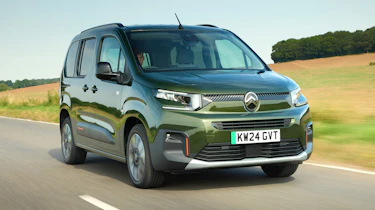
If you like the sound of the medium-sized Stellantis MPVs above but wish there were smaller options, check out the e-Berlingo, E-Rifter or Combo Life Electric.
- Prices from £31,500
Pros |
Cons |
|
|
Citroen, Peugeot and Vauxhall all offer two van-based MPVs, and now the smaller ones are electrified too.
The Citroen e-Berlingo is our favourite of the crop. Not only is it the cheapest, but you also benefit from Citroen’s Advanced Comfort front seats which are comfortable and supportive.
Three modes are included: Eco, Normal and Power. The former limits power to just 80bhp and restricts the air conditioning system to save range, while ‘Power’ is best reserved for heavy loads, Citroen says. Charging from zero to 80% can be achieved in half an hour at a public fast-charger.
Inside, the interior is characterful, cheerful and sensibly designed for what is basically a van, but don’t expect too much in the way of squidgy plastics and damped switches. You get creature comforts like air conditioning and Apple CarPlay and Android Auto.
Being based on a van, very few cars on this list can match the e-Berlingo when it comes to space. There’s a total of 28 cubbies with a whopping 186 litres worth of combined cubby space and 775 litres of boot space. If that wasn’t enough, opt for the Berlingo XL and this rises to 1,050 litres.
“The Berlingo is perfect for growing families as the cabin is wide enough to accommodate three child seats together, Access is easy, thanks to huge sliding doors and a flat interior floor, too.” - Dean Gibson, senior test editor.
Why EVs make great seven-seater cars
You might think that the sheer size and bulk of a seven-seater would be incompatible with an electric powertrain, but that isn’t the case.
Running costs
Electric seven-seaters make a lot of sense for those who make a lot of short trips such as commuting or doing the school run, as this is where the lower running costs, zero-tailpipe emissions and quieter ride can really pay off, especially in congested or urban environments.
Driveability
Alongside the additional space offered by a seven-seater, the abundance of torque offered by an electric car is ideal for moving heavy loads or lots of people frequently.
Be warned though, the quoted range of EVs can be adversely affected by the amount of weight on board and a fully-loaded electric seven-seater may deliver significantly fewer miles per charge than the official WLTP range figure suggests.
Don't miss the best of Auto Express on Google! Make us a preferred source. Click here...