Peugeot 5008 review
The sharp-looking Peugeot 5008 is highly versatile and is available in a variety of hybrid or fully electric forms

Our opinion on the Peugeot 5008
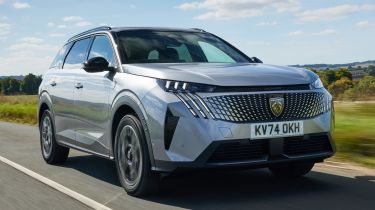
We highly rated the previous Peugeot 5008 as a versatile family car, and the good news is that this latest incarnation provides more of the same. The design inside and out is even more striking than its predecessor, and its quality continues to impress. Space and practicality have been improved; there’s more equipment onboard, and you have a diverse choice of powertrains – including an all-electric version. The entry-level 5008 Hybrid should suit most needs, but you’ll want to look towards the all-electric E-5008 if you’re a company car user because of its much lower benefit-in-kind (BiK) tax rate.
About the Peugeot 5008
The move to electrification shows just how far the 5008 has come since it was introduced in 2009 as a slightly ungainly seven-seat MPV. Its second outing in 2017 reinvented the 5008 as a stylish large SUV, which was much better received by both motoring critics and car buyers alike. It’s very much evolution rather than revolution with the third-generation model, which builds on the foundation of its popular predecessor.
Right now, every Peugeot 5008 and E-5008 is fitted with seven seats, which isn't always a given with this sort of car – especially those that offer plug-in hybrid power. There are four trim levels to choose from: Allure, Allure Premium, GT, and GT Premium. If you’re considering the fully electric model, we also have a dedicated in-depth Peugeot E-5008 review.
Used - available now

2026 Peugeot
5008
4,226 milesAutomaticElectric
Cash £39,990So far, we’ve tested the 5008 and E-5008 extensively on UK roads, even running the 5008 hybrid in GT trim on a long-term test. We also twin-tested the 5008 against the Kia Sorento.
Engines, performance & drive
Pros |
|
Cons |
|
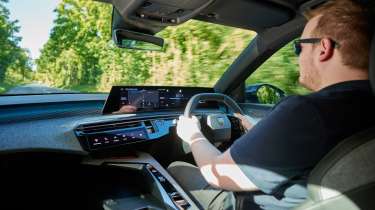
Family buyers will be pleased to hear the Peugeot 5008 continues to prioritise comfort and refinement over driving thrills. The suspension does a decent job absorbing the bumps and various other imperfections on UK roads, and relatively low amounts of wind and road noise make their way into the cabin at higher speeds. Buyers of the 5008 can choose from a hybrid, a plug-in hybrid, while the fully electric version has a choice of three different options, which you can read about in a dedicated in-depth Peugeot E-5008 review.
Performance, 0-60mph acceleration and top speed
The Hybrid combines a 143bhp 1.2-litre turbocharged petrol engine and an electric motor to give a 0-62mph time of 11.3 seconds. The e-motor is designed to add a little low-down punch when the engine is under load, helping to give a smoother power delivery than non-hybrid Peugeots of recent years, both when pulling off from a standstill.
The vibration of the three-cylinder unit is noticeable as it comes to life, but noise is otherwise very well suppressed. While performance is adequate, the modest power output means it does start to struggle a little when the car is loaded up with either plenty of luggage or seven occupants.
The Plug-in Hybrid version combines a larger 1.6-litre turbocharged petrol engine with a more potent electric motor and a 21kWh battery. The system power output is 222bhp and there is 350Nm of torque – enough for 0-62mph in 8.3 seconds.
| Model | Power | 0-62mph | Top speed |
| 5008 Hybrid 145 e-DSC6 | 143bhp | 11.3 seconds | 123mph |
| 5008 Plug-in Hybrid 225 e-DSC7 | 222bhp | 8.3 seconds | 137mph |
Town driving, visibility and parking
Despite measuring nearly 4.8 metres long and 1.9 metres wide, the 5008 is a relatively easy car to drive around town, helped by its tall driving position that provides a clear view of your surroundings, plus a very clear rear-view camera (something not always guaranteed). Its incredibly light steering and fairly tight turning circle helps when manoeuvring around town.
However, the brake regeneration set-up isn’t the slickest system, and there can be quite a noticeable step between the motor regen and the physical discs and pads stepping in.
We also found that the hybrid system in the Hybrid 145 falters when moving away from a standstill if you try to drive on electric power because its 21bhp electric motor lacks the grunt to propel this big Peugeot. It’s more useful as an aid to the petrol engine, providing a small boost of power at low speeds that can be helpful when merging into traffic.
During long-term testing, our senior photographer, Pete Gibson, found the 1.2-litre engine can sound a little gruff when accelerating at town speeds.
Country road driving and handling
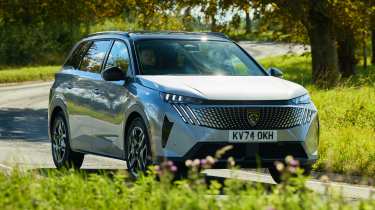
It’s certainly a stretch to suggest that the 5008 is fun to drive, but compared with its seven-seat SUV rivals, the Peugeot appears agile and light in the corners, making it feel more like a family hatchback than a lumbering SUV.
There’s a good reason for that: the 5008 is light compared with similar models. At just over 1,700kg, the French model is more than a quarter of a tonne lighter than the Sorento. The light steering that is so useful at low speeds feels a little too light on a twisty road.
The brake pedal doesn’t inspire confidence, either, because the initial travel is very soft. Lean on it a little harder, though, and the brakes offer plenty of power.
Motorway driving and long-distance comfort
The car’s impressive refinement continues at higher speeds, where the Peugeot’s soft ride comes into its own. If we’re being very picky, the large wheels seem to transmit a little fidget into the cabin, however fast you’re travelling. It’s not harsh, but it’s always present, taking the edge off what is otherwise a really comfortable cruiser. We suspect this is because the car has been set up to cope with a cabin full of passengers and luggage rather than partially loaded with just two adults onboard as we tended to have on our drives.
The hybrid system can allow for the engine to switch off and coast once you’re up to speed, adding to the level of refinement when cruising on the motorway.
“The electrical part of the hybrid system covers most areas where the small petrol engine struggles. However, it’s not great when pulling away from junctions, because the engine can’t hide the demands it’s under. It’s by no means a dealbreaker, but you have to balance your expectations.” - Pete Gibson, senior photographer.
MPG & running costs
Pros |
|
Cons |
|
The latest evolution of the Peugeot 5008 offers buyers a choice of models to suit their lifestyle and driving habits. For instance, if it's the maximum convenience you’re after, the entry-level 5008 Hybrid doesn’t need to be plugged in for a charge. Instead, it recuperates energy when the car slows down to top up its 0.9kWh battery.
The small battery only allows the 5008 Hybrid to cover very short distances at low speeds on battery power alone, but that’s enough for it to return up to 52.5mpg, according to Peugeot. During our long-term testing of a Peugeot 5008 Hybrid GT over the course of over 16,000 miles, we managed to achieve an average of 45.5mpg.
Above this is the 5008 plug-in Hybrid, which, as its name suggests, needs charging whenever possible, because it features a much larger 21kWh battery. But the benefits are a claimed fuel efficiency of 122.8mpg and 48 miles of pure-electric range.
| Model | MPG | CO2 | Insurance group |
| 5008 1.2 Hybrid 145 Allure 5dr e-DSC6 | 52.5mpg | 128g/km | 23 |
| 508 1.6 Plug-in Hybrid 225 Allure e-DSC7 | 122.8mpg | 63g/km | 35 |
Electric range, battery life and charge time
The Peugeot 5008 Plug-in Hybrid offers a pure-electric range of 48 miles thanks to its 21kWh battery, which should allow most people to commute to work or do the school run without using any petrol. The plug-in hybrid Skoda Kodiaq iV can cover 75 miles on battery power alone, but it is only available with five seats.
The 5008 Plug-in Hybrid has a maximum charging speed of 3.7kW, so fully recharging it will take around five-and-a-half hours from a typical 7kW home wallbox charger. In comparison, the equivalent plug-in hybrid Kodiaq is capable of up to 11kW of AC charging, and can even handle 40kW DC rapid charging, for a 20 to 80 per cent battery top-up time of under 30 minutes.
Finally, there’s the fully electric version, and you can read about it in a dedicated in-depth Peugeot E-5008 review.
| Model | Battery size | Range | Insurance group |
| 5008 1.6 Plug-in Hybrid 225 Allure 5dr e-DSC7 | 21kWh | 48 miles | 35 |
Insurance groups
The Peugeot 5008 starts in insurance group 23 for the entry-level hybrid and goes up to 35 for the plug-in hybrid. Costs are likely to be lower than the Hyundai Santa Fe, which starts in group 33 and goes up to 36 for the plug-in hybrid. However, the Skoda Kodiaq should be more affordable to insure because it starts in group 18 for the entry-level mild-hybrid petrol, while the plug-in hybrid Kodiaq iV is in group 24.
Tax
Every 5008 is subject to the standard rate of VED road tax. Stick with the 1.2 Hybrid in either Allure or Allure Premium trims and avoid adding too many options, and you can avoid the luxury car tax surcharge for all petrol and hybrid cars that cost more than £40,000 when new. Go above this threshold, and there will be an additional charge of £640 per annum, which applies from the second time the vehicle is taxed until it is six years old.
Company car drivers will be better off with the plug-in hybrid version, which has a lower Benefit-in-Kind (BiK) rate compared with the 1.2 Hybrid. The plug-in hybrid attracts a 10 per cent BiK rate for the '26/'27 tax year, 11 per cent in the '27/'28 tax year, rising to 18 per cent for the '28/'29 tax year.
For an even lower BiK rate, you'll need to go for the electric Peugeot E-5008, which you can read about in our dedicated review.
Depreciation
According to our market data, the hybrid and PHEV versions of the Peugeot 5008 are predicted to maintain between 44 and 46 per cent of their initial value after a period of three years or 36,000 miles. For comparison, the Skoda Kodiaq should retain between 50 and 56 per cent of its value over the same period, while the Kia Sorento should retain between 51 and 60 per cent of its value over the same period.
To get an accurate valuation of a specific model, check out our free car valuation tool...
Interior, design & technology
Pros |
|
Cons |
|
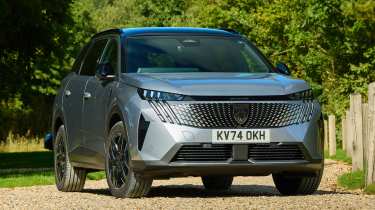
Until now, the Peugeot 5008 has always been, in effect, a stretched, seven-seat version of the Peugeot 3008. However, the two cars have diverged slightly, with the 3008 adopting a sloped, coupe-esque roofline, while the 5008 has stuck with a boxier shape to provide maximum cabin space.
All 5008s come with lots of hi-tech kit as standard. Our preferred version is the entry-level Allure, which includes:
- LED headlights
- 18-inch alloy wheels
- Wireless Apple CarPlay and Android Auto
- Wireless smartphone charging
- Two-zone climate control
- A reversing camera.
For just over £1,000 more, Allure Premium adds the driver's seat and 360 vision and drive assistance packs, which means it has adaptive cruise control, blind spot monitoring, a 360-degree camera system, front parking sensors, high-beam assistance, and electric driver's seat adjustment. It also comes with gloss black roof rails and heated front seats.
The GT model in some ways isn't as well equipped as Allure Premium, because it misses out on the 360 Vision Drive pack, but this can be added for £600. It also misses out on an electric driver's seat, but this time you'll have to add the expensive £1,100 Minstral black embossed Alcantara trim – although they will throw in driver's seat memory settings and electric passenger seat adjustment as part of that package. As standard, GT comes with larger 19-inch alloy wheels, more advanced ‘Pixel’ LED headlights, eight-colour interior ambient lighting, heating for the steering wheel and front seats, second-row sunblinds, front parking sensors, adaptive cruise control and a hands-free electric tailgate.
Lastly, GT Premium includes some semi-autonomous lane-centring assistance that might be useful for motorway driving, a 360-degree parking camera system, a driver monitoring system, a front seat massaging function, 20-inch alloys and Alcantara trim.
If you frequently have to park in tight car parks, the aforementioned 360 vision and drive assist pack adds a 360-degree camera system, which could be worth including. For those who regularly go on long drives, the £300 AGR driver’s seat pack with front seat heating is another worthwhile option on Allure trim, because it adds extra adjustments to the driver’s seat, such as lumbar and extended thigh support.
Interior and dashboard design
Peugeot’s interior design team has been on top form for the best part of 10 years now, and the 5008 is as good as it gets – no other model in this class looks as stylish, unique and luxurious.
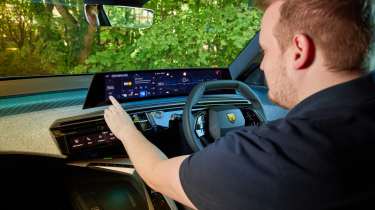
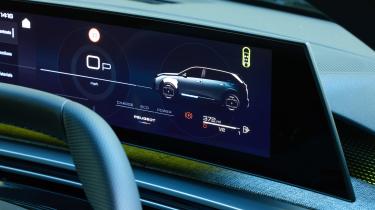
The sweeping dashboard that wraps around the driver looks like it could have been lifted straight from a concept car, but it’s one that really works. The curving panel ahead of the driver integrates both a digital instrument display and a touchscreen infotainment set-up, while a lower secondary touchscreen, which can be programmed to display shortcut keys to the driver’s preferences, is well positioned.
The lower span of the dash that extends into the centre console houses a few physical controls: the window heater, the drive-mode select switch and volume dial, among others.
Materials and build quality
That slick design is backed up by a sturdy finish and great material quality. It’s hard to pick out much hard plastic in the areas that are closest to hand, and everything feels solid and upmarket. It’s smart enough to compete with the fit and finish levels of many more expensive premium German SUVs.
Infotainment, sat-nav and stereo
As with the rest of the 5008’s interior, the infotainment system looks stunning. Peugeot calls it a 21-inch display; in reality, it’s two smaller screens linked together to form one near-continuous, gently curving panel.
The graphics are sharp, and the colours are bright. However, the system isn’t the slickest on the market and occasionally lags in response to touches. During our test of car infotainment systems, we examined a Peugeot 3008 using the same infotainment system as the 5008 and ranked it as one of the most distracting systems because we struggled to navigate the cluttered menu layout.
Our senior photographer, Pete Gibson, also found the system glitchy when he drove a Peugeot 5008 during a long-term test. There were times when the screen went blank on him, requiring him to stop the car to switch it off and back on again to reboot the system.
“Most passengers have commented on the Mercedes-like illuminated dash. The colour can be changed, and now that I’m doing more night driving, I’ve gone for a clean white light and turned the brightness down. By default, it’s a bright blue, which is reflected in the windows and reduces visibility at night.” – Pete Gibson, senior photographer.
Boot space & practicality
Pros |
|
Cons |
|
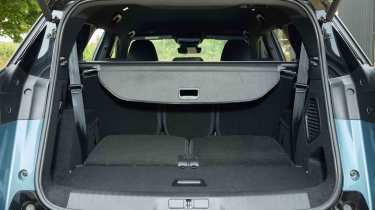
It’s best to consider the Peugeot 5008 as a five-seater with sixth and seventh seats that are there for occasional use. The first two rows are among the most spacious and comfortable in the seven-seat SUV sector, but the French machine’s third row is cramped.
Dimensions and size
The Mk3 Peugeot 5008 measures 4,791mm from nose to tail, which is 150mm longer than its predecessor. The wheelbase has been stretched by 60mm, too. For context, that means this 5008 is slightly larger than the latest Skoda Kodiaq, but not quite as big as the Hyundai Santa Fe or Kia Sorento.
| Dimensions comparison | |||
| Model | Peugeot 5008 | Kia Sorento | Skoda Kodiaq |
| Length | 4,791mm | 4,815mm | 4,758mm |
| Width | 1,895mm (2,108mm inc mirrors) | 1,900mm | 1,864mm (2,133mm inc mirrors) |
| Height | 1,694mm | 1,700mm | 1,659mm |
| Wheelbase | 2,901mm | 2,815mm | 2,791mm |
| Boot space | 259-1,815 litres | 179-1,996 litres | 340-2,035 litres |
Seats & passenger space
For all the cabin design’s wow factor, there’s a divisive feature that has split the opinion of our testers in Peugeots since its introduction: the i-Cockpit. A small steering wheel is designed to sit below the line of the digital dials, but depending on what drivers find most comfortable, the top of the wheel rim can block a portion of that panel. Some people get on with the layout, while others really struggle with it – even from one Peugeot model to another – so we recommend prospective customers try for themselves before making a purchase decision.
That aside, the dashboard line is fairly low relative to the seating position, so forward visibility is great for a car in this class. The cabin has lots of storage areas, including two covered bins and cup-holders between the front seats, plus wide and deep door pockets. If you want lumbar adjustment on the entry-level Allure trim, you’ll need to spend £300 on the AGR Driver’s seat & front seat heating pack.
Deep cutouts in the backs of the front seats eke out a few extra millimetres of knee room for occupants in the middle row, but overall space is a little down on the larger Hyundai Santa Fe and Kia Sorento. The 5008 offers those in the back 545-948mm of knee room according to our measurements, while the Sorento has a more generous 735-957mm of space. The Sorento is also wider, with 1,576mm of elbow room compared with 1,432mm in the 5008. We also found the Kia to offer greater head room at 989mm compared with 967mm for the Peugeot.
The back seats in the 5008 are sculpted and comfortable to settle into, and there’s loads of foot room beneath the front seats and only a very small hump in the floor. Even the middle seat, though narrower than the outer ones, is soft and comfortable, making it a nicer place to sit than the equivalent spots in the Kodiaq or Sorento. We found middle row seats are mounted higher than those up front, a bit like stadium seating, to give those travelling in the back a slightly better view.
You can stick adults in the third row if you have to, and the middle bench can slide forward by up to 15cm to provide some extra legroom, but some people will find their knees pressing up against the bench in front. What’s more, the only amenities are two small cup holders.
Boot space
Thanks to a 259-litre boot with all seven seats in place, the 5008 beats the Sorento for storage, but can’t quite match the Kodiaq. That capacity includes an underfloor storage area, something that the Kia doesn’t have.
Fold the third row of seats down, and the 5008’s volume starts to lag behind its closest rivals. Yet a 748-litre boot is very generous, as is the 1,815-litre volume in its two-seat layout. The seats leave a pronounced dip in the floor at their bases when folded, so the load area isn’t as flat or level as it is in some competitors. The lip to load items into the boot is also higher than some of its rivals, we measured it to be 788mm or 61mm higher than a Kodiaq.
Towing
The 5008 Plug-in Hybrid can tow up to 1,300kg, which is the highest towing capacity in the range. Below that are the 73 and 97kWh E-5008 models that can both tow up to 1,000kg, while the entry-level 5008 Hybrid can only tow up to 750kg.
“One more practical element that’s missing from the Allure model is a powered tailgate. Some people love this feature, but given the number of times I have to open and close the boot every day while I’m working, I prefer a manual release – it’s quicker and quieter.” - Pete Gibson, senior photographer.
Reliability & safety
Pros |
|
Cons |
|
Safety experts Euro NCAP have given the 5008 the same four-star-out-of-five score as the smaller 3008, because the two cars have near-identical front structures and safety tech on board.
An overall result of four stars is due largely to the 5008 missing out on some standard driver-assist tech. To get all of the systems, buyers must add the 360-degree Vision and Drive Assist Pack, which brings a self-steering function to the adaptive cruise control, a 360-degree parking camera, blind-spot monitoring, rear cross-traffic alert and driver-attention assist.
Peugeot finished seventh overall in the most recent Driver Power rankings, with owners loving the exterior and interior design of their cars, while the practicality, economy and ride and handling all received praise, too.
Meanwhile, the ownership experience of the 5008 was a little hit-and-miss according to our latest 2026 best cars to own list, placing 35th out of 50 cars. Hits included practicality, boot space, rear seat leg room, child-friendly features, seating versatility, and ride comfort. Misses included the infotainment system and its mixture of physical and touch-sensitive controls, along with the driving experience.
| Euro NCAP safety ratings | |
| Euro NCAP safety rating | Four stars (2025) |
| Adult occupant protection | 80% |
| Child occupant protection | 85% |
| Vulnerable road user protection | 79% |
| Safety assist | 62% |
Buying and owning
Best buy: Peugeot 5008 1.2 Hybrid Allure
Prices for the Peugeot 5008 (along with a number of Peugeot cars) have been revised to make them better value. This means prices now start at around £38,500 for our preferred Allure 1.5 Hybrid, allowing it to undercut the cheapest seven-seat Skoda Kodiaq. The 5008 Plug-in Hybrid has had an even bigger price reduction, starting from £43,000. That's still a little more than the cheapest plug-in hybrid Kodiaq iV, but it only comes with five seats, whereas the Peugeot has seven.
We recommend the 1.2 Hybrid because it helps keep the price and running costs affordable for family car buyers, and provides just about enough performance while still managing respectable fuel economy. Entry-level Allure comes with all the essentials while keeping the price below the £40,000 limit.
Check out our latest new car deals and leasing deals for the top offers available now with the Auto Express Buy a Car service. Don't forget, we can help you to sell your car, too.
Peugeot 5008 alternatives
For those looking for the best large SUV, the Skoda Kodiaq has you covered. It’s our reigning large SUV car of the year winner because of its keen pricing, practicality, and well-made and easy-to-use interior. We especially like its innovative ‘Smart Dials’ that make simple tasks such as adjusting the climate control or putting on a heated seat child's play. Company car drivers will also appreciate how far the plug-in hybrid can go on a charge and how quickly it can be recharged.
The Hyundai Santa Fe is another top large SUV choice. Its head-turning looks have real presence while its additional size compared with even the extremely spacious Kodiaq means you’ll have no trouble getting everyone and their luggage in for a day trip or annual family holiday. It’s expensive, though, which is why the Kodiaq remains our top choice.
While there aren’t many seven-seat EVs, the E-5008 does pose a threat to electric SUVs like the Kia EV9 and Hyundai Ioniq 9.
Peugeot 5008 1.2 Hybrid GT long-term test
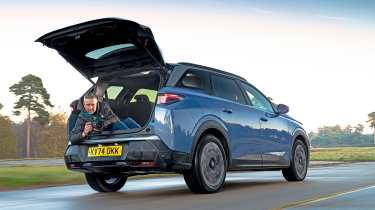
Senior photographer, Pete Gibson, ran a 1.2 Hybrid version of the Peugeot 5008 in high-end GT trim. He covered over 16,000 miles in it and found it to be a good motorway cruiser and a practical SUV for carrying around all his camera equipment.
He wasn’t a fan of the regenerative braking system and its odd brake pedal feel, its rather noisy engine under acceleration, and infotainment system that needed a hard reset on more than one occasion. He also had the chance to drive the lower Allure trim when his car required a service, which he found to be the better value option compared with his range-topping GT trim car, because it still felt similarly premium inside, aside from missing some ambient interior lighting. You can read the full long-term test here…
Key updates of the Peugeot 5008 review
29 June 2026: General update to include the recent reduction in pricing for some Peugeot models
Frequently Asked Questions
The Peugeot 5008 comes with a three-year, 60,000-mile warranty.
Deals on the 5008 and alternatives