Used Skoda Octavia (Mk3, 2013-2020) review and buyer's guide
A full used buyer’s guide on the Skoda Octavia covering the Octavia Mk3 (2013-2020)

Verdict
Skoda has been one of the most consistent brands in our annual Driver Power satisfaction survey. And while the second-generation Octavia arrived way back in 2004, it still ranked 14th in our Driver Power 2017 used car poll; the latest model was 10th in 2018’s new car survey. It’s easy to see why owners love their Octavias. They are spacious and excellent value, with a wide range of engines and trim levels that are perfect for those wanting fast fun or ultimate economy. Throw in excellent reliability, backed up by a generally dependable dealer network, and you’ve got the perfect recipe for a family car with huge appeal.
In 1991 Skoda became a part of the Volkswagen Group, and five years later the first Octavia was built. This was a car that put the Czech brand on a trajectory to greatness.
The second-generation model that arrived in 2004 cemented the Octavia’s place in the market and, by the time the third iteration appeared in 2013, Skoda’s mid-size family car had become a firm favourite in the UK.
As buyers move into SUVs and crossovers, the class in which the Octavia sits is becoming less popular. Yet this makes the Skoda even more appealing, because few rivals can match its credentials in the family market.
History
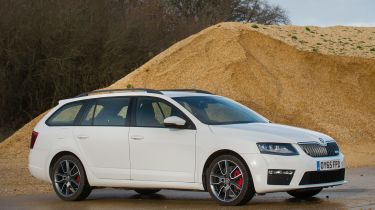
The Octavia Mk3 hatch arrived in March 2013 with 1.2 TSI and 1.4 TSI petrol engines, plus 1.6 TDI or 2.0 TDI diesels, as well as S, SE or Elegance trims. The latter was soon renamed SE L. By June 2013 the estate was launched with the same model structure as the hatches, and three months later the first vRS hatch and estates appeared, with turbocharged 2.0-litre petrol or diesel engines; a 4WD version was introduced in January 2016.
Used - available now

2017 Skoda
Octavia
53,778 milesManualPetrol2.0L
Cash £14,649
2020 Skoda
Octavia
47,556 milesManualPetrol1.5L
Cash £10,697
2021 Skoda
Octavia
40,713 milesAutomaticDiesel2.0L
Cash £17,197
2019 Skoda
Octavia
34,363 milesAutomaticPetrol1.0L
Cash £10,697The GreenLine that arrived in January 2014 was pegged at 88mpg and 85g/km, then in May 2014 a new range-topper arrived, the Laurin & Klement, followed by the 4WD Octavia Scout hatch in July that year. In January 2017 a facelifted Octavia was launched, with new tech, a restyled nose and a new interior. The Mk4 Octavia arrived in 2020 to replace this car.
Which one should I buy?
Even the smallest engines are perky, but it’s the bigger units that provide more relaxed mile-munching abilities, especially when paired with Skoda’s excellent DSG automatic transmission. Buy one of the four-wheel-drive editions and you’ve got the perfect tow car.
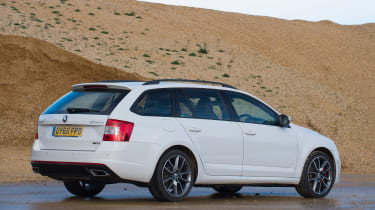
Entry-level Octavias are fitted with 16-inch alloy wheels, Bluetooth, DAB radio, air-con, a cooled glovebox, hill hold assist and powered front windows.
The SE adds rear parking sensors and climate control, while the Elegance/SE L spec brings 17-inch alloy wheels, cruise control, Alcantara and leather trim, sat-nav, plus electrically adjustable, heated and foldable door mirrors.
Range-topping Laurin & Klement trim also features 18-inch wheels, bi-xenon headlights, heated front seats (the driver’s is also electrically adjustable), adaptive cruise control plus Park Assist.
Alternatives to the Skoda Octavia Mk3
The Ford Mondeo is a good all-round rival that is widely available, decent to drive, superb value and reasonably reliable. The Vauxhall Insignia shares many of the Mondeo’s attributes and is also in plentiful supply.
Less obvious is the Toyota Prius, which finished fourth in our Driver Power 2018 satisfaction survey. There’s no estate, but practicality is still good, as are economy and reliability. Just beating the Octavia in this year’s poll was the Honda Civic, with great scores for running costs and practicality but, surprisingly, reliability was marked down. Other rivals worth a look include the Mazda 6, along with the more left-field Peugeot 508.
What to look for
Options
The Winter pack is worth having. An option on all but S spec, it adds a heated windscreen, seats and washers.
Headlamps
Many owners upgrade standard headlights, often with H7 or H15 bulbs, usually rated at 4,000k-5,000k.
Audio
DAB radio can lose signal. It seems to be more of an issue with estate models because of the aerial arrangement.
Leaks
Water can build up inside front doors if the car is left. It can reach the footwells because the seals channel it down.
Interior
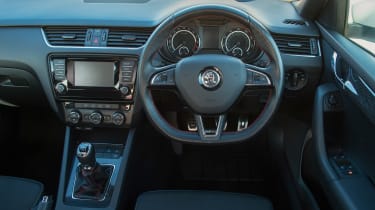
Posher versions of the Octavia feel considerably more upmarket than entry-level cars, but all models have a spacious cabin that’s generously equipped and well screwed together. There’s plenty of adjustment for the seats and steering wheel, plus the boot has a good capacity; the hatch can stow 590 litres and the estate up to 1,740 litres.
Running costs
The Mk3 has fixed or variable servicing; the latter has check-ups every two years or 18,000 miles, while the fixed schedule is every 10,000 miles or annually. Once the car is three, servicing work alternates between minor and major.
Air-con is recharged every two years; brake fluid is replaced at three years, then bi-annually. All diesels have a cambelt, as do many petrols; replacement is required every five years or 140,000 miles.
Recalls
There have been two recalls for the Mk3 Octavia. The first was in July 2016, for cars built between November 2015 and April 2016. Child locks on the rear doors could disengage, allowing doors to be opened from inside.
In November 2017, some Octavias manufactured that same year were called back. These were made with a poorly cast rear wheel hub, which could potentially lead to the wheel becoming detached.
Driver Power owner satisfaction
Coming 10th in the Driver Power 2018 survey is a decent result for a brand that’s no stranger to finishing in the top three. The only area in which Octavia owners don’t especially rate the car is its exterior design; everything else scores highly, including practicality, reliability, running costs and infotainment.
Skoda Octavia (2013 - 2020) review: What we said
Extracts from our 2020 in-depth review of the Mk3 Skoda Octavia...
The Skoda Octavia is a brilliantly packaged variation on its Volkswagen Group bedfellows, the VW Golf and SEAT Leon. It offers more boot space than either, as well as a hugely practical interior with enough room for five. In terms of driving, the Skoda Octavia feels competent, but it isn’t as much fun behind the wheel as some of its rivals, such as the Ford Focus or even the aforementioned Golf.
The Skoda Octavia Estate won the Auto Express 'Best Estate Car of 2013' award as a result of its attractive price, spacious interior and understated looks, and it should still be on any compact estate car buyer's shortlist. You wouldn’t call the latest Octavia (updated in 2017) racy, unless you’re lucky enough to be in the market for a hot vRS version. But for solidity, reliability and all-round practicality, the Octavia is hard to beat for family or business drivers.
There's more to the Skoda Octavia than meets the eye. It used to be a sensible budget family car, but today there's plenty of variety on offer, with practical hatchback and estate models, both including rapid vRS versions. There really is something for everyone if you're looking for a car that's practical and a bit different in the family car class.
Under the skin, the Skoda Octavia shares its platform, engines and much of its on-board tech with the Volkswagen Golf. The big difference is the Octavia's size in relation to the Golf. The Octavia is longer overall and has a longer wheelbase, too, so it offers more space than the Golf and a lot of its rivals, too. Those include cars such as the Honda Civic, Kia Ceed, Vauxhall Astra, Ford Focus and Toyota Corolla. But that's not all, as there's also the Peugeot 308, Renault Megane, Hyundai i30, SEAT Leon and Mazda 3 to consider.
While the Octavia isn't the budget option it once was, it does offer relatively good value for money. List prices start from around £18,600, which is a little lower than for the Golf, while top-spec cars such as the vRS and vRS Challenge come in at around £30,000. That's similar to the Golf, but the Octavia offers more space and a bit of extra kit for the money.
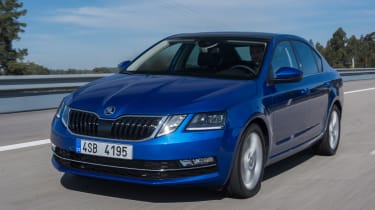
The current Octavia arrived in 2013, while an update in 2017 added a new grille and headlights, although the look wasn't universally well received.
Trim levels start with the Octavia S, then progress through SE, SE Drive, SE L and SportLine, with the vRS and vRS Challenge versions at the top of the range.
Even the entry-level Octavia S gets alloy wheels, automatic post-collision braking and a DAB radio as standard. SE L trim is designed to compete with sister company VW on the luxury front, offering comparable comforts at a more affordable price point, while SportLine is the equivalent of VW's R-Line, as it offers sporty looks like the vRS, but without the performance or higher running costs.
At the top of the line-up is the Octavia vRS, which is Skoda’s flagship performance car in this range. It’s a car that has a strong following, having received a high-profile launch at the World Rally Championship way back in 1999.
The vRS combines GTI-esque performance with all of the real-world practical qualities that Octavia owners have grown to love. There's also the vRS Challenge which adds bigger alloys, electrically-adjustable heated front seats and Dynamic Chassis Control, which offers three driving modes: Comfort, Normal and Sport.
There's a broad range of turbocharged engines to choose from. Petrol options include a 1.0 TSI turbo three-cylinder producing 113bhp, a 1.5 TSI with 148bhp and cylinder deactivation to help fuel economy, a 2.0 TSI with 187bhp, or 242bhp in the vRS. The diesels comprise a 1.6 TDI producing 113bhp, or a 2.0-litre TDI, which produces 148bhp, or 181bhp in the vRS.
Most Octavias feature a six-speed manual gearbox, although the DSG auto is offered as standard with 2.0 TDI versions and the 1.5 and 2.0-litre TSI-powered cars. On top of that, Skoda's 4x4 four-wheel drive is available on selected estate models, and the vRS in either body style.
Engines, performance and drive
Behind the wheel, the conservative appearance of non-vRS Skoda Octavia models matches their handling. While the Octavia shares many components with the Volkswagen Golf and SEAT Leon, the Skoda isn't quite as good to drive as either of them - or the Ford Focus, for that matter.
There's very little body roll in the Octavia; and, although there's less sound deadening, which means you hear bumps in the road more than in the VW, it's far from uncomfortable. The 4x4 estate is unique in offering a more sophisticated multi-link rear suspension, and this noticeably improves both ride and handling.
The Skoda Octavia vRS gets the 2.0-litre turbocharged engine from the Volkswagen Golf GTI. It manages 0-62mph in just 6.8 seconds with a 154mph maximum, it handles rather well, and it will suit keen drivers who are also on the look-out for practicality and economy.
Engines
The engine range on the Skoda Octavia yields plenty of choice. It’s comprised of 1.6 and 2.0 TDI diesels and 1.0, 1.5 and 2.0 TSI petrols, many of which are available with Skoda's excellent automatic DSG gearbox.
The entry level engines aren't particularly thrilling, but they get the job done and all blend performance and economy very well. The petrol-powered vRS tops the performance table, and while there have been different versions available in the past with 217bhp and 227bhp, the current model has 242bhp. Add in the car's lowered suspension and an electronically-controlled diff that distributes torque across the front axle to give better traction out of corners, and it's a pretty handy hot hatch (or estate). It manages 0-62mph in 6.6 secs and a 155mph maximum speed. The diesel vRS hits 0-62mph in 8.1 seconds (or 7.6 seconds for the 4x4 version), but has a welcome extra wallop of low-end grunt, which makes its performance very usable in daily driving.
At the other end of the range, the 113bhp 1.0-litre TSI is surprisingly perky, with a 0-62mph time of 9.9 seconds and a 128mph maximum. If you need a little more grunt, the 1.5 TSI from the VW Group will oblige. This is called EcoTSI elsewhere in the company, and it features cylinder deactivation to boost economy. It has 148bhp and 250Nm outputs, and it represents a compelling package for family motoring – it's punchy and makes the most of the generous torque on offer to deliver reliable and linear performance. That means it’s well suited to overtaking and motorway driving. It's impressively refined, too, as well as being hooked up to a snappy six-speed manual gearbox or quick-shifting DSG auto.
The turbocharged petrol engines in the Skoda Octavia are definitely worth considering if you're not doing many long journeys, but if you're planning on covering big miles, then go for a diesel engine – the 148bhp provided by the 2.0 TDI engine offers 0-62mph in 8.4 seconds and is a great choice. The diesels are slightly more raucous than their equivalents in the Audi A3 or Volkswagen Golf, but the economy will be worth it.
Overall, it's a diesel model that's our pick of the bunch. Powered by a 113bhp 1.6 TDI engine, it isn't the quickest, but it is by far the most economical, and there's precious little penalty in terms of cornering ability and refinement compared to less frugal versions.
MPG, CO2 and Running Costs
None of the engines in the Skoda Octavia range are particularly thirsty, although the 1.6 TDI diesel is the most efficient, and the Octavia's 2.0 TDI diesel also returns good economy figures. They're not quite as good as they once were under the latest WLTP test procedure, but that won't have any negative effect on everyday fuel economy, it just means you're more likely to achieve the claimed MPG figure in everyday driving.
New WLTP economy testing results for the 1.6 TDI come in at up to 57.7mpg and emissions of 128g/km. These figures deteriorate if you add the DSG gearbox or move up a trim level, with the extra weight and larger wheel combinations having a negative impact on fuel economy.
The sporty Skoda Octavia vRS is also available with a diesel engine, which is far from a gas-guzzler, and like the rest of the 2.0 TDI diesels, only comes with a DSG auto gearbox. With standard four-wheel-drive, it manages 47.9mpg and emits 156g/km of CO2. Even the petrol version of the Skoda Octavia vRS is impressive with 37.7mpg and CO2 emissions of 169g/km (36.7mpg and 174g/km for the estate version).
The 2.0 TSI (190PS) engine is only offered as an estate, in combination with DSG auto transmission and SE L trim, returning 35.8mpg and 178g/km emissions, while the 148bhp 1.5 TSI is still quite punchy and provides good numbers. With the DSG gearbox, it manages 46.3mpg, plus 137g/km of CO2. With the manual, 51.4mpg, and CO2 emissions of 124g/km.
The 1.0 TSI also makes for an efficient, tempting alternative to the diesels. It manages 52.3mpg with a manual box and emissions of 122g/km.
Overall, the Skoda Octavia is good value to buy thanks to a high level of standard equipment and low servicing costs - this means it's not an expensive car to keep on the road.
Interior, design and technology
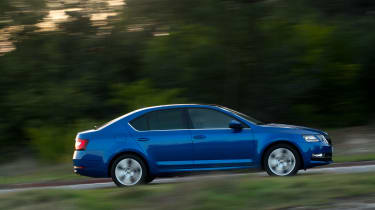
The Octavia isn’t going to win any beauty contests, but the Skoda’s upright lines and straight edges are handsome and well defined. The nose features a rectangular main grille and headlights, while the second grille under the bumper stretches the full width of the front end. This makes the Octavia look wide and low.
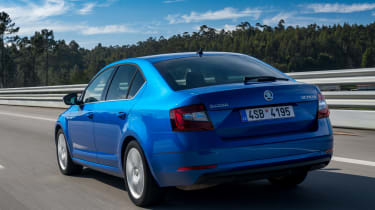
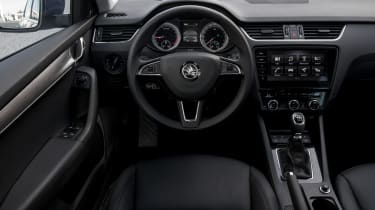
From the side, the Skoda looks long, while the rear windscreen’s shallow angle and the lengthy rear overhang are saloon-like. As standard, the Octavia doesn’t look particularly racy, and inside, the Skoda is restrained and sensible, with a conventional dashboard and centre console layout. The dash features a lot of dark grey plastic, and some of it has a hard finish, but the silver trim around the gearlever and the gloss black trim on the centre console and steering wheel give the cabin a lift.
This means it doesn’t feel like a dreary place in which to spend time. The dials and trip computer are simple to read, while the touchscreen sat-nav is a breeze to use, with a logical layout and straightforward controls allowing you to input destinations with ease. The optional 9.2-inch ‘Columbus’ touchscreen display is better still, but does away with too many buttons. We'd prefer to keep as much functionality as possible accessible via a button rather than a touchscreen.
Elsewhere, there’s dark grey cloth upholstery and more dark grey plastic throughout. However, this is countered by a light grey roof lining, which helps the Octavia’s cabin feel more spacious. Overall, the Skoda is functional rather than flashy, but it’s arguably all the better for it, while build quality is excellent.
Skoda offers the Octavia in a range of trim levels, which are available in either a hatch or estate body style. Mainstream models are the entry level S, mid-range SE and SE Drive, while SE L, SportLine and the hot Skoda Octavia vRS offer more kit and performance.
Skoda's reputation for good value is well deserved and standard equipment on the Octavia is excellent, with alloy wheels, DAB radio, a touchscreen system and Bluetooth connectivity all coming as standard on the entry-level S model.
The racy Skoda Octavia vRS adopts a sporty appearance, with a boot spoiler, 18-inch alloy wheels, a red strip across the rear bumper and a more aggressive bodykit. It’s also available in a bright range of colours. The interior of the Skoda Octavia vRS is also given some much needed flair thanks to sports seats, which are available in black and white alcantara, aluminium dash-inlays, aluminium pedals and a sports steering wheel.
Sat-nav, stereo and infotainment
The infotainment systems on the Octavia are bang up to date, with full connectivity, touch screens with motion sensors that call up menus, and the option of advanced navigation systems offering intuitive controls and clear mapping. However, for an extra £450, customers may want to upgrade the standard instrument dials to Skoda's Virtual Cockpit, which includes a 10.25-inch digital display.
You can connect your smartphone using MirrorLink, Apple CarPlay and Android Auto interfaces, while SmartGate tech allows you to send vehicle driving and performance data to a connected device.
There’s a decent 8-speaker sound system as standard, but you can also upgrade to a Canton system for around £500, which adds a central dash speaker and a boot-mounted sub-woofer.
Practicality, comfort and boot space
The current generation Skoda Octavia is much bigger than the previous model, and the ‘Simply Clever’ marketing line attached to the car is not just spin, it actually rings true.
Skoda has been sensible with the interior of the Octavia, and there are plenty of storage spaces and cubbies. There are cup holders, boot holders, a reversible boot floor, umbrellas in the front doors, a litter bin and even an ice scraper hidden inside the fuel filler flap – these little touches all add to the Skoda Octavia's sensible and practical appeal.
But it’s comfortable too. All models have a steering wheel that’s adjustable for height and reach, and the driver’s seat has plenty of adjustment. Forward visibility is good, but you are likely to rely on the parking sensors at the rear, as there’s quite an overhang to contend with. If you’re opting for the estate version, you’ll be in load-lugging heaven – its interior is cavernous.
Size
The Skoda Octavia boasts more interior space than a Volkswagen Golf or Ford Focus. In fact, it can match larger cars such as the Ford Mondeo and Volkswagen Passat for practicality. It's a real selling point for the Octavia, and one that attracts a lot of potential buyers
So how do they actually measure up? Well the 4,670mm long Octavia five-door hatch gives only 20cms away to the Ford Mondeo five-door, but is 40cms longer than the five-door VW Golf. Switch to the estate and the numbers are the same for the Octavia and Mondeo, but VW hits back by giving its Golf estate a longer body than the hatch – it’s almost identical to the Octavia at 4,657mm.
Leg room, head room & passenger space
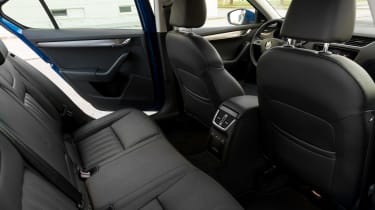
The Octavia’s interior is cavernous, offering the sort of leg and headroom for passengers that you’d expect in the class above. No wonder the model has been a perennial favourite with mini-cabbers. The rear doors open wide too, and SE L spec cars even get cupholders in the back.
Boot
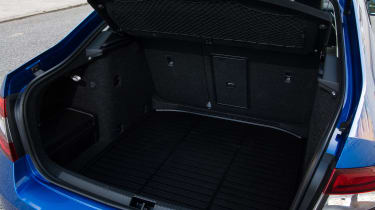
The Octavia hatch has a huge 590-litre boot that expands to 1,580 litres with the rear seats folded flat. The estate can handle 610 litres with the seats still in place, but really comes into its own with the 60:40 split rear bench folded flat – suddenly you’re in the removals business, with a remarkable 1,740-litres.
But it’s not just the space that impresses. The ‘Simply Clever’ thinking means the boots of both hatch and estate feature shopping bag hooks, a 12 volt power supply and a pair of bright load bay lights – just the thing when you need to unpack the boot to change a flat tyre in the dark (it's worth noting that a space-saver spare wheel is an option, though). The estate also features a secure storage area under a removable deck, there’s a ski flap in the rear bench and you can also spend extra on a powered tailgate.
Towing
The versatile Octavia will tow up to 2,000kg, but if that far exceeds your towing needs, there are alternatives limited to as little as 1,500kg. If you do need the maximum amount, then the you need to opt for either the 148bhp or 181bhp 2.0-litre diesels, with four-wheel drive and DSG gearbox.
How much is your car worth? Find out with our free car valuation tool...