Smart #5 review
The Smart #5 offers a lot of kit and premium quality at a competitive price, we just wish it was more efficient

Our opinion on the Smart #5
In the busy compact electric SUV class, the Smart #5 stands out thanks to its premium finish, spacious cabin, strong equipment list and refined drive. It’s competitively priced when compared with the likes of the Tesla Model Y and Volkswagen ID.4, while the higher-spec cars, especially the Brabus version, are ridiculously fast. There are two glaring flaws that pin the #5 back, though. The main issue is poor efficiency when compared with rivals, but we also think Smart’s established image as a manufacturer of small cars will stop buyers even considering the #5 in the first place. That’s a shame, because this quirkily designed electric family SUV has a lot going for it.
About the Smart #5
At 4.7 metres long, the Smart #5 is only 30cm short of being the same length as a pair of Smart ForTwos. It’s the biggest car the company has ever produced, but it’s still packed with plenty of distinctive design touches and clever features. It’s based on a variation of the platform used by the #1 and #3, but at 4.7 metres long and 1.7 metres tall, it’s bigger than both of them and matches rivals in the compact electric SUV class.
There’s space for five people on board, while a choice of rear or four-wheel drive powertrains is offered, with latter models coming with a dual-motor set-up. There are two battery sizes, too, although the smaller 76kWh pack is only available in the entry-level #5, the rest of the line-up being powered by a 100kWh battery.
Used - available now

2023 Peugeot
208
12,174 milesManualPetrol1.2L
Cash £12,660
2023 Land Rover
Range Rover Evoque
36,833 milesAutomaticDiesel2.0L
Cash £18,220
2021 Ford
Fiesta
32,964 milesManualPetrol1.0L
Cash £9,197
2022 Nissan
Qashqai
39,474 milesManualPetrol1.3L
Cash £13,697The model line-up comprises Pro, Pro+, Premium, Pulse and Brabus models, but even the entry-level variant has a generous amount of standard equipment and a premium finish inside. Each trim level features a different powertrain, but all versions are powerful, with the top-spec Brabus version delivering searingly quick acceleration. In addition to these trims, the Summit Edition is a limited-run edition based on Pulse spec.
Smart #5 prices and latest deals
The entry point to the range is the £39,800 Pro model, although this is still generously equipped. It’s the only version of the #5 that comes with the smaller 76kWh battery – there’s a £4,000 premium to upgrade to the Pro+ model with a 100kWh pack. The Pulse version is £3,500 more than that, while the Brabus comes in at around £52,000, which sounds a lot, but undercuts the similarly quick Tesla Model Y Performance. If you’re looking for a deal, there aren’t many around at the moment, but the Auto Express Buy a Car service will have the best offers available on the #5.
Performance & driving experience
Pros |
|
Cons |
|
The Smart #5 uses a development of the platform used by the #1 and #3 that allows for greater use of autonomous driving technology. As with those models, a kerbweight in excess of two tonnes means that the #5 feels weighty in corners, but it also helps to iron out bumpy roads so that the car delivers excellent comfort at all speeds.
| Model | Power | 0-62mph | Top speed |
| #5 Pro | 335bhp | 6.9 seconds | 124mph |
| #5 Pro+ | 358bhp | 6.5 seconds | 124mph |
| #5 Pulse | 579bhp | 4.9 seconds | 124mph |
| #5 Brabus | 637bhp | 3.8 seconds | 130mph |
Electric motors, 0-60mph acceleration and top speed
Smart offers a choice of four power outputs in the #5, and what you get depends on which version you choose. However, no model will feel particularly slow. The electric motors deliver strong performance from a standstill, while the rear-drive configuration on the lower-spec models means there’s instant thrust if you need it.
If you apply the power with even a slight amount of steering lock wound on, you’ll find the traction control light blinking as the electronics attempt to rein in the power. It’s quite a soft intervention, though, and just makes the rear-drive Smart feel a little more hesitant to accelerate than when you’re pointing straight ahead.
The Brabus model turns things up to 11. It features a dual-motor powertrain that produces a combined 637bhp and 710Nm of torque, and makes this 2.4-tonne family SUV an absolute rocket ship. Brabus mode offers full power, while Smart includes a synthesiser that offers different sounds when accelerating if you’d rather not sprint away in silence.
Town driving, visibility and parking
At lower speeds, occupants can revel in the comfort that the #5 offers. The soft suspension easily soaks up bumps, even on models fitted with the largest 21-inch wheels that are available.
A relatively tight 11.2-metre turning circle helps with low-speed manoeuvres. While the #5 is no ForTwo in terms of urban agility, that’s a tighter circle than in a Tesla Model Y (12.1 metres), plus there’s good visibility on the whole. The Smart’s front end is set quite high, though, leaving you to rely on the parking sensors and camera system to know where the front bumper is.
Country road driving and handling
The Smart remains comfortable at higher speeds, and there isn’t an increase in wind noise to accompany an increase in pace. The suspension remains composed, too, although the soft edge to the ride means that this isn’t a car with focused cornering as a top priority.
Switching to Sport mode sharpens the throttle response and adds a little more weight to the steering, but adaptive dampers aren’t fitted, so the ride remains on the soft side. In reality, the car’s 2.2-tonne kerbweight discourages you from pushing any harder than necessary.
While it’s nearly as powerful as the sensational Hyundai Ioniq 5 N, the Smart #5 Brabus doesn’t get any suspension, brake or chassis upgrades over the standard model.
Motorway driving and long-distance comfort
At higher speeds the #5 remains resolutely quiet and comfortable. There’s a very light rustling from around the base of the windscreen, but overall the car remains refined for all occupants. Even the base model has plenty of torque to get up to the national limit quickly and safely, while mid-range power is usefully snappy.
"There are some quirks to the #5 that need getting used to. When parking, 360-degree cameras offer multiple viewing angles, while front, rear and side-mounted parking sensors help you avoid low-speed scrapes.
"However, there’s one aspect of the sensors that could be changed to make the risk of collision even lower. While the frequency of the Smart’s beeps increases as you get closer to an object, there’s no final ‘flatline’ as you’ll find in many other cars. At least the system projects an object’s distance from the car on the screen." - Dean Gibson, Senior test editor
Range, charging & running costs
Pros |
|
Cons |
|
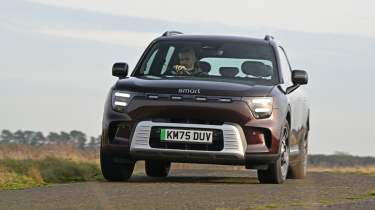
Despite a 100kWh battery being offered, the #5 struggles to match the class best for efficiency.
Electric range, battery life and charge time
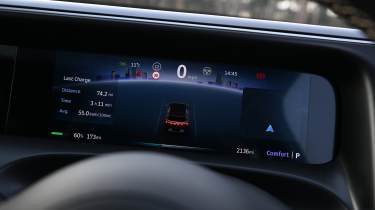
The entry-level Smart only has a 76kWh battery that delivers an official range of 288 miles, but when we tested this model (admittedly in cold winter conditions) a return of 2.4 miles per kWh meant a potential range of only 179 miles was possible. That was well behind the 3.1mi/kWh we achieved in the Kia EV5 on the same roads in matching conditions, while the base Tesla Model Y managed 3.6mi/kWh, so has a longer range with a smaller battery.
Upgrade to the 100kWh model for £4,000 and you’ll benefit from an extra 78 miles of range in Pro+ guise, while a heat pump should help to mitigate against any cold-weather losses. Achieve the same efficiency figure as we did in the 76kWh car, and you can expect a range of around 225 miles, which is similar to that possible in the base Model Y.
You’ll also see the maximum DC charging rate increase from 150kW to a whopping 400kW. So while the 76kWh pack takes 30 minutes to charge from 10-80 per cent, the 100kWh battery can be charged to the same capacity in just 18 minutes.
| Model | Battery size | Range | Insurance group |
| #5 Pro | 76kWh | 288 miles | 41 |
| #5 Pro+ | 100kWh | 366 miles | 42 |
| #5 Pulse | 100kWh | 335 miles | 44 |
| #5 Brabus | 100kWh | 335 miles | 46 |
Insurance groups
Group ratings are at the higher end of the spectrum, starting at Group 41 out of 50 and rising to 46 for the Brabus model. The Tesla Model Y is in similarly high categories, but rivals such as the Kia EV5 and Renault Scenic are around 10 groups lower.
Tax
With the luxury-car tax threshold for EVs now increased to £50,000, only the highest-spec versions of the Smart #5 have to add the supplement to their road tax for years two to six. And company-car buyers are likely to be attracted by the long list of kit that the #5 offers for a competitive P11D price that will attract annual bills of less than £240 for 20 per cent earners looking at the entry level variant.
Depreciation
We don’t have predicted values for the #5 just yet, but hopefully they will be closer to the #3 than they are for the #1. The former is in the 51-52 per cent bracket, while the latter is lower, but has a wider range from 41-47 per cent after three years and 36,000 miles of ownership.
How much is your car worth? Find out with our free car valuation tool...
Interior, design & technology
Pros |
|
Cons |
|
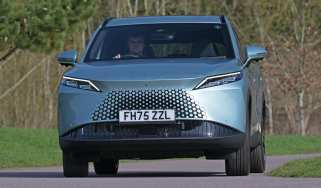
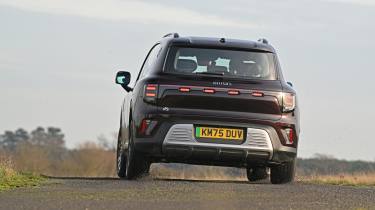
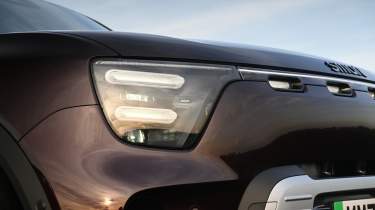
There’s no doubt that the Smart #5 stands out in the electric SUV market. Where rivals have fairly generic styling, the Smart offers a boxy shape reminiscent of the US market Ford Bronco Sport, but with a smooth nose and distinctive four-part light bars front and rear. There are frameless windows and pop-out handles for the doors, while wheel sizes range from 19-21 inches and the option of a black contrast roof is available.
Interior and dashboard design
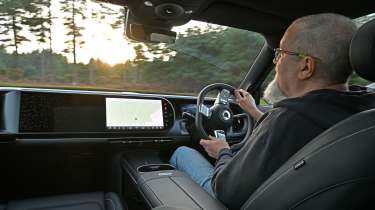
The quirky exterior design is a precursor to the cabin, which also has a distinctive look. There are hints of Mercedes in the design of the high-set centre console and door-mounted seat controls, but the cross-shaped air vent adjusters and large, flat touchscreen housing offer a unique style.
Materials and build quality
One aspect of Mercedes’ input that is hard to ignore is the quality of the fit and finish in the Smart. There are plenty of soft-touch plastics and upmarket metal-effect trim used throughout, while the soft artificial leather feels good, too. Everything seems solidly built and the #5 feels more expensive than it actually is.
Infotainment, sat-nav and stereo
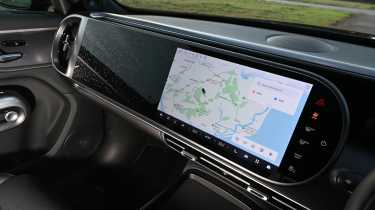
All versions of the Smart #5 come with a large, upright 13-inch infotainment touchscreen that is used to control nearly all the on-board functions. Fortunately the climate controls are fixed across the bottom of the display for ease of use, while a drop-down menu at the top of the screen allows you to access specific functions. The menu system itself is a little more complicated than necessary, because you need to scroll down long lists in places to access certain options. The system is fast to respond, though, and has a lot of personalisation options, including colour schemes, brightness and audio settings.
Wireless Apple CarPlay and Android Auto are fitted, so you can bypass the on-board system if you want, although we found that when using CarPlay, the shortcut buttons were arranged on the left-hand side of the screen, so were easier for the passenger to use than the driver.
Base models have a single screen, but Pulse and Brabus cars add a second display for the passenger. It seems a bit OTT when the main screen is so large, but does mean the navigation and entertainment functions can be shown at the same time. There is a lockout function on offer to stop the driver looking at the second screen, although the system didn’t interject once when we tried to provoke it. We were warned the car’s software is still being fine-tuned, and hopefully this function will have been improved by the time deliveries begin.
"There are plenty of upmarket touches in the cabin. The cross-shaped air vent controls look neat, although they leave us wondering whether this and the four-bar LED lights front and rear mean the car should be called the Smart #4, rather than #5.
"We like the aircraft-style reading lights and electric seat reclining in the rear, but less successful are the push-button door releases. They can confuse the unfamiliar, and as with any car with a similar set-up, a manual release is necessary anyway, so it just seems like excess tech for the sake of it." - Dean Gibson, Senior test editor
Boot space & practicality
Pros |
|
Cons |
|
The #5 is the biggest car that Smart has ever produced, and it blows away any preconceptions that the company specialises in smaller models. It’s tall and wide, which creates plenty of space for passengers and luggage.
Dimensions comparison | |||
| Model | Smart #5 | Tesla Model Y | Kia EV5 |
| Length | 4,695mm | 4,797mm | 4,610mm |
| Width | 1,920mm | 1,982mm | 1,875mm |
| Height | 1,705mm | 1,624mm | 1,680mm |
| Wheelbase | 2,900mm | 2,890mm | 2,750mm |
| Boot space | 630-1,530 litres (plus 72 litres in nose) | 845 (to roof)-2,118 litres (plus 88 litres in nose) | 566-1,650 litres (plus 44 litres in nose) |
The Smart #5 is 30cm short of being the same length as two Smart ForTwos parked end to end, and it’s one of the larger compact electric SUVs on the market. Its boxy shape means it fills out its dimensions, while a long wheelbase boosts cabin access and passenger space.
Seats & passenger space
The front cabin is cleanly divided in two by the high-set centre console, which has an armrest bin with a split lid, just as you’d find in any Mercedes. The space below is deep, but features a shallow tray so you don’t lose smaller items. Ahead of that are a pair of cup-holders and two trays for smartphones; lower-spec cars have a single wireless charging pad, high-spec models have two.
The big screen means the glovebox is set low ahead of the passenger, but it’s a decent size, while the door bins are deep, but the extended armrest with door release button means it’s harder to stow tall bottles here than in some rivals.
The front seats are comfortable and there’s plenty of room, while electric adjustment makes it easy to find a comfortable position.
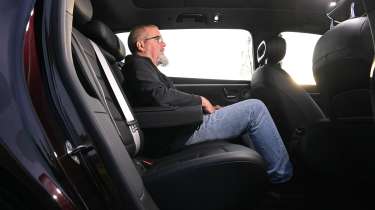
Access to the back is easy courtesy of the wide-opening doors and frameless windows, and once on board you’ll find plenty of head and shoulder room, while legroom is excellent even when the front seats are pushed all the way back. You can adjust the seat backs electrically via the controls on the doors if you want to stretch out further, while the front passenger seat can be moved forward using the controls for the seat behind.
Amenities in the back include air vents and twin USB sockets, while the aircraft-style cabin lights and panoramic glass roof add the upmarket and spacious feel in the back.
Boot space
All versions of the Smart #5 feature a powered tailgate, and it opens to reveal a 630-litre cargo space. That’s a good size for a car of this type, although there is a bit of a high load lip to negotiate if you’re lifting heavier items. A false floor hides extra storage space, while the seat backs have an offset split and are completely flat when folded. A rolling load cover is included, and this can be stowed under the boot floor when removed.
If you want to keep the charging cables out of the load bay, there’s storage under the bonnet. There’s a capacity of 72 litres in rear-wheel drive cars, but the addition of an electric motor up front cuts the space to 47 litres, but that’s still plenty for a charging cable and the tyre repair kit.
Reliability & safety
Pros |
|
Cons |
|
The Smart #5 was awarded a five-star Euro NCAP rating in 2025, so it’s going to be a safe car in the event of a collision. In fact, the car will do its utmost to prevent that in the first place, with a comprehensive suite of sensors and cameras monitoring the #5’s surroundings at all times.
Of course, a lot of people want to turn off their cars’ driver-assistance tech, and this is relatively simple process in the #5. Much like in the Renault Scenic, drivers can set up a unique profile with their preferred settings for the ADAS suite, and activate it quickly using the customisable button on the steering wheel and confirming it on the touchscreen.
| Euro NCAP safety ratings | |
| Euro NCAP safety rating | Five stars (2025) |
| Adult occupant protection | 88 per cent |
| Child occupant protection | 93 per cent |
| Vulnerable road user protection | 84 per cent |
| Safety assist | 92 per cent |
Warranty cover for the #5 is slightly above the basic, with an unlimited mileage limit for the three years that Smart’s new-car cover runs for. You also get roadside assistance for the same period, while the drive battery is covered for the obligatory eight years, but with an upper distance limit of 125,000 miles.
Even better, service costs are included in the purchase price, too, so the first three years of maintenance, including wear and tear items such as brake pads, wiper blades, brake fluid and pollen filter, are replaced free of charge, as long as you service at a Smart dealer.
Buying and owning
- Best buy: Smart #5 Pro+
The entry-level model is very well equipped and powerful enough, so we don’t think it’s worth paying extra for a higher-spec car that offers less range in exchange for even sharper responses. Having said that, the extra £4,000 for the Pro+ model is worth paying to benefit from a longer range.
Smart #5 alternatives
The Smart #5 is a mid-size electric SUV, which means it competes primarily against the Tesla Model Y, which now comes with a lower price courtesy of the latest entry-level variant. Of course, there are plenty of other rivals, including the Skoda Enyaq, Hyundai Ioniq 5 and Renault Scenic, plus there’s the Kia EV5 and Citroen e-C5 Aircross to consider.
Frequently Asked Questions
The Smart #5 is comfortable, incredibly spacious and packed with technology, plus it handles remarkably well for a big family SUV. We like it, and hope that buyers appreciate its plus points, too.
Did you know you can sell your car through Auto Express? We’ll help you get a great price and find a great deal on a new car, too.