Volkswagen ID. Polo review
Practical, well built and with decent driving dynamics, the ID. Polo feels like an electric equivalent to the ICE Polo in all the best ways


Our opinion on the Volkswagen ID. Polo
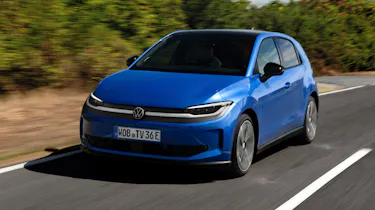
The Volkswagen ID. Polo offers understated style, plenty of practicality and excellent driving dynamics, making it a seriously impressive small electric car – and it’s good to see VW sticking to its promise of better ergonomics in its cars’ cabins. The larger-battery model seems like the best option because it offers greater usability, even if the range and charging capability are only average for the class.
About the Volkswagen ID. Polo
After Volkswagen’s initial batch of ID-branded EVs, the ID. Polo is the first to take the plunge and wear a nameplate already used by a combustion-engined model. That shows plenty of confidence from VW in its new electric supermini. Considering it uses the same MEB Entry architecture as the Cupra Raval (our 2026 Supermini of the Year) and the excellent Skoda Epiq, that confidence isn’t misplaced.
Performance & driving experience
Pros |
|
Cons |
|
The most crucial difference between these new MEB+ cars (including the ID. Polo and Raval) and older MEB cars such as the ID.3 Neo, is that MEB+ is primarily front-wheel drive. The result is a different kind of driving experience and better packaging. If you want a seriously sporty drive, then the Cupra Raval VZ or Alpine A290 GTS are great choices, but Volkswagen is working on a hot GTI variant of its ID. Polo too.
Performance, 0-60mph acceleration and top speed
The ID. Polo line-up kicks off with a 37kWh battery (from £23,945 in Life trim) and either a 114bhp or 134bhp electric motor on the front axle. The other option is the 52kWh battery, which is combined with a much more potent 208bhp electric motor, cutting the 0-62mph sprint time from 9.5 seconds to 7.1 seconds. Both times are identical to those of their Cupra Raval equivalents, as are their respective 99mph top speeds.
Used - available now

2018 Ford
Galaxy
76,036 milesAutomaticDiesel2.0L
Cash £10,100
2020 Vauxhall
Crossland X
34,375 milesManualPetrol1.2L
Cash £7,950
2022 Nissan
Qashqai
15,776 milesAutomaticPetrol1.5L
Cash £19,250
2023 BMW
5 Series Touring
59,441 milesAutomaticDiesel3.0L
Cash £25,700The 208bhp ID. Polo is also nearly a second quicker than the 148bhp Renault 5 from 0-62mph and almost two seconds faster than the 144bhp version of the Kia EV2, although it can’t quite match the 6.7-second 0-62mph sprint of the 218bhp MINI Cooper Electric.
| Model | Power | 0-62mph | Top speed |
| Volkswagen ID. Polo 52kWh 208bhp | 208bhp | 7.1 seconds | 99mph |
| Volkswagen ID. Polo 37kWh 114bhp | 114bhp | 10.6 seconds | 99mph |
Town driving, visibility and parking
The ID. Polo is a little taller than the existing petrol-engined Polo, but takes up almost exactly the same space on the road. As a result, the EV feels no more of a chore to drive in town than its petrol counterpart, even if the turning circle is slightly larger at 10.9 metres.
All-round visibility is great, and despite the ID. Polo being VW’s entry-level EV, the top-spec Style Launch Edition we drove comes with the brand’s self-parking Park Assist Pro system with a 360-degree view, which almost feels like overkill in a car that’s so easy to manoeuvre. However, we found the new steering wheel, which is shared with the ID.3 Neo and designed to enable better visibility of the driver’s screen, a little on the bulky side.
On the move, especially on rougher urban streets, the ID. Polo’s ride is on the firm side – something we felt was caused by more than our car’s 19-inch wheels (a £440 option even on the £31,495 Style Launch Edition). On consistently uneven roads, the ID. Polo struggled to settle, not being able to isolate bumps and drain covers as well as a Renault 5.
Country road driving and handling
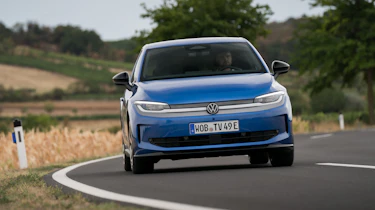
On a twisty bit of road, the ID. Polo feels typically VW, which is not something that we’ve said of recent all-electric cars from the brand. By this we mean that it’s refined, easygoing and very neutral in its handling set-up, just as you’d expect from a regular, combustion-engined Polo.
Although there’s a GTI version coming soon, the ID. Polo already feels like a hot hatch in some ways – especially with the more potent motor. There’s effortless shove, with a throttle response that doesn’t feel artificially reined in if you’re in Eco or Normal mode. Switch to Sport and the pedal responds much more eagerly, yet is no harder to modulate.
Despite the Style Launch Edition’s hefty 1,576kg kerbweight, which is only 6kg more than the smaller-battery car, there’s little body roll to speak of. That’s thanks in part to what VW calls a “comparatively rigid anti-roll bar”, plus ID. Polo-specific suspension that features a combination of MacPherson struts at the front and a torsion beam set-up at the rear for “precise and predictable handling”.
The torque delivery on the front axle is so immediate that you can rely on it to bring the ID. Polo back in line if you’re particularly exuberant. Couple this with quick, responsive steering that never feels overactive (which the sportier Raval’s can occasionally be) and the ID. Polo is a real joy to chuck around. In fact, perhaps the best compliment we can pay is that the GTI will have to be something special to stand out.
The brake regeneration system is well judged in its standard form, almost replicating traditional engine braking, and coming in smoothly once you’re off the throttle. There’s only one extra ‘B’ setting that you can engage via the same gear selector and this gives you a bit more regen, but isn’t enough for one-pedal driving, despite VW’s claims.
Motorway driving and long-distance comfort
At higher speeds, the ID. Polo feels very sure-footed, stable and never overly uncomfortable, but if you’re expecting a noticeably more compliant ride than the sportier Cupra Raval, then the VW might disappoint. On the motorway, the ID. Polo’s suspension – which is completely new for this model – calms down, and apart from a little bit of road noise creeping in from the front wheels, it is extremely refined for a supermini.
Adding to the easygoing nature of the ID. Polo are the assistance systems – or the seeming lack of them. The VW has Driver Attention and Lane Keep Assist as standard along with a suite of other tech, but we found them to be refreshingly unobtrusive.
“The front end of the ID. Polo feels pointy and direct, but it’s also a capable long-distance cruiser. Compared to the Cupra Raval, Volkswagen appears to have created the better all-rounder.” - Alastair Crooks, senior news reporter.
Range, charging & running costs
Pros |
|
Cons |
|
The Volkswagen ID. Polo is a little bit more expensive to buy than the £21,495 Renault 5, but it’s cheaper than the base Vauxhall Corsa Electric (£26,780). Trim levels and battery options do give the ID. Polo a broader spectrum of appeal - but pricing tops out well above the £30,000 mark.
Electric range, battery life and charge time
During our drive of the ID. Polo, it achieved only 3.5 miles per kWh on a cruise down the motorway, well down on the claimed figure of 4.5 miles per kWh. Around town and on country roads, however, the figure quickly rose to more than 4.0 miles per kWh. But in the real world, on a mix of roads, it seems unlikely many drivers will hit the claimed 281-mile maximum. It’s also a shame a heat pump is a £935 optional extra when the Renault 5 and the Vauxhall Corsa Electric get it as standard.
Charging speeds are identical to those of the Cupra Raval. The 37kWh models are capped at 88kW, allowing a 10-80 per cent charge in 23 minutes. The same benchmark only takes a minute longer for the larger battery, because it can be recharged at up to 105kW.
| Model | Battery size | Range | Insurance group |
| Volkswagen ID. Polo 52kWh | 52kWh | 281 miles | 20 |
| Volkswagen ID. Polo 37kWh 114bhp | 37kWh | 200 miles | 14 |
| Volkswagen ID. Polo 37kWh 135bhp | 37kWh | 205 miles | 14 |
Insurance groups
Volkswagen ID. Polos fitted with the larger battery sit in a higher insurance group because they’re pricier to buy and much more powerful. That matches the Cupra Raval, while the Renault 5 sits between group 18 and 22.
Tax
Annual Benefit-in-Kind (BiK) costs are very low for the Volkswagen ID. Polo thanks to its zero-emissions status. However, it’s worth remembering that pay-per-mile eVED is scheduled to come into effect in 2028.
Depreciation
According to data from our experts, after 36,000 miles and three years, on average the ID. Polo will on to 48 per cent of its value. This is slightly better than the Renault 5, which holds on to 45 per cent on average, while the Hyundai Ioniq 3 fares much better, better 49 and 56 per cent.
Interior, design & technology
Pros |
|
Cons |
|
The development of the ID. Polo has been led by Cupra, VW’s more stylish and hip sister company, which explains why the Spanish brand got priority on launching its car. However, as we’ve seen with the Volkswagen Passat and its Skoda Superb sibling, VW taking the back seat for development isn’t necessarily a bad thing.
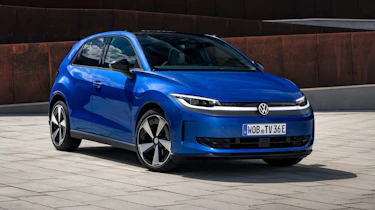
Closely following the ID.2all concept’s design inside and out, the ID. Polo is much more rounded, friendly and altogether more VW-like than its aggressive, angular Cupra sibling. That was a decision made by VW’s design boss Andy Mindt, who originally described the concept as “an homage to the Beetle, Golf and Polo”.
Interior and dashboard design
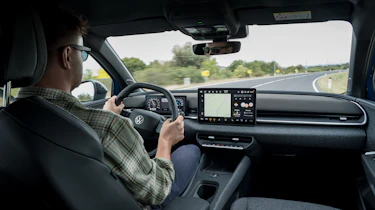
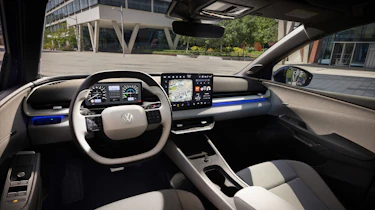
Step inside and you immediately notice the old-school sensibility. While there’s a clean, minimalist theme, there’s still a real user-friendliness that’s been disappointingly lacking in VWs of late. That new steering wheel bids goodbye to the brand’s awful touch-sensitive buttons in favour of some proper, tactile physical buttons. However, we also found out that if you tap the heated steering wheel button on models in lesser Life trim, you get a pop-up asking you if you want to buy that feature.
While most of the ID. Polo’s functions are operated on the fresh 12.9-inch touchscreen that dominates the dash, there’s a new bank of physical switches for climate controls below. They look similar to the toggles in the Renault 5 and they work just as effectively – which is not something we could say about VW’s awkward touch-sliders.
Materials and build quality
In terms of interior quality the ID. Polo is as good as any of its rivals. The fabric material across the dash is also used on the doors and centre console and it’s a refreshing change from the scratchy plastics you usually get in these areas on most other superminis. The new interior door handles that you pull backwards take a little time to get used to, though.
Infotainment, sat-nav and stereo
The 10-inch driver’s display doesn’t really move the game on in terms of layout, but one element we enjoyed was the ‘retro’ option. Slide down on the main touchscreen, choose the retro menu, and that screen transitions to a more traditional design complemented by twin dials on the driver’s display mimicking a Mk1 Volkswagen Golf’s (although the ‘rev counter’ here reflects power output).
Boot space & practicality

Pros |
|
Cons |
|
Part of the Polo’s success over the decades has come from its practicality, being only slightly less roomy than the Golf. The ID. Polo sticks to this and in some areas beats cars from the segment above for space.
Dimensions and size
The compact dimensions of the ID. Polo only make its interior package all the more impressive - though it’s near enough identical to the Cupra Raval.
| Dimensions comparison | |||
| Model | Volkswagen ID. Polo | Renault 5 | Hyundai Ioniq 3 |
| Length | 4,053mm | 3,922mm | 4,155mm |
| Width | 1,816mm | 1,774mm | 1,800mm |
| Height | 1,530mm | 1,498mm | 1,505mm |
| Wheelbase | 2,592mm | 2,540mm | 2,680mm |
| Boot space | 441 litres | 277 litres | 441 litres |
Seats & passenger space
Interior space up front is fine, but we found the ID. Polo more cramped in the rear than the Renault 5, with a high central seating position and narrow door openings – a result of those very cool, but bulky, rear wheel haunches. There’s not much rear under thigh support either.
Despite housing a battery in the chassis, the ID. Polo’s tall side profile means headroom is very generous.
Boot space
As we found with the Cupra Raval, which has a huge 441-litre boot courtesy of the electric motor mounted at the front and a compact torsion beam on the rear axle, boot space in the ID. Polo is enormous given that it’s a supermini. It matches its Cupra sister, meaning that it has 60 litres more luggage capacity than a Golf.
Towing
With the same battery and electric motor options, it’s not surprising that the ID. Polo matches the Cupra Raval and the larger Skoda Epiq when it comes to towing. You can haul up to 1,200kg, which is pretty good for a car of this size, but you’ll likely see a steep drop-off in range.
“The stand-out figure for the ID. Polo is that boot capacity - though it’s roomy enough elsewhere to really work as a family car.” - Alastair Crooks, senior news reporter.
Reliability & safety
Pros |
|
Cons |
|
While the ID. Polo is yet to be tested by the safety experts at Euro NCAP, the mechanically identical Cupra Raval earned a four-star rating in its base trim. The Cupra did receive a maximum five stars when equipped with the Safety Pack, though.
The ID. Polo should replicate the Raval’s scores and in particular it should perform well for ‘Crash Avoidance’, considering that its standard safety technology includes oncoming vehicle braking, advanced driver attention and drowsiness monitor, autonomous emergency braking, lane-keeping assist and rear traffic alert and dynamic road sign display.
There’s a three-year or 60,000-mile total warranty period for the ID. Polo, which doesn’t match the Cupra Raval’s five-year or 90,000-miles cover. There’s an industry-standard eight-year or 100,000-mile warranty for the VW’s battery, though.
Buying, prices and deals
Best buy: Volkswagen ID. Polo 52kWh Life
If you want a sporty electric supermini, the Cupra Raval VZ would be our choice over the ID. Polo - but even with that in mind, we’d still recommend that buyers of the VW opt for the more powerful, longer-range version. The refinement of the drive matched with the dynamic ability means it’s a joy to rack up the miles in, so you’ll want the big battery. However, we wish VW would offer the big battery with the less powerful electric motor, because that could potentially bring even greater efficiency at a lower price.
Standard equipment in Life trim is decent too. There’s a 10-inch digital driver’s display as well as that 12.9-inch touchscreen with wireless Apple CarPlay and Android Auto, while you also get LED headlights, fabric upholstery, a reversing camera, adaptive cruise control and plenty of safety features. With the large battery, Life models start at £25,055.
The £31,495 (after the Government’s Electric Car Grant is deducted) Style Launch Edition adds neat extras including ambient lighting, heated front seats, a heated steering wheel and matrix LED headlights.
For the smaller-battery ID. Polo, pricing starts at £23,945 in Life trim, rising to £28,470 for the Style model.
You can save by building your new Volkswagen ID. Polo right now with the Auto Express Buy A Car service. We also have a selection of ID. Polo leasing deals, and can even help you to sell your car.
Volkswagen ID. Polo alternatives
The most obvious rival to the ID. Polo is its cousin from Cupra, the Raval. The Spanish car looks sportier, but its ergonomics inside are as good as the VW’s. There’s not much to choose between them in terms of price, but undercutting both significantly is the stylish Renault 5, which starts at £21,495.
Style connoisseurs will also like the MINI Cooper Electric (from £26,905), which drives as well as any of its rivals, plus there’s the more spacious Volkswagen ID. Cross (based on the same platform as the ID. Polo) and the slightly raised-up Skoda Epiq, too.
Volkswagen ID. Polo pictures
Frequently Asked Questions
The Volkswagen ID. Polo is a great option in the small EV market as it drives well, looks good and is surprisingly spacious.
Deals on the ID. Polo and alternatives
More reviews
Which Is Best