Alpine A110 review
The two-seater Alpine A110 offers a real sense of occasion as well as great dynamics

Is the Alpine A110 a good car?
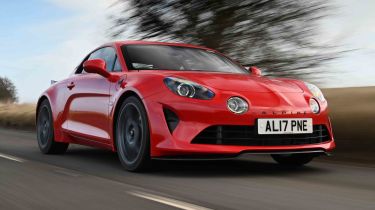
The relaunch of Alpine as a brand was always going to be exciting. Reviving a manufacturer steeped in motorsport excellence and known for producing lightweight sports cars was a stroke of genius by Renault, and it sure didn’t disappoint.
The A110 instantly won us over with its fabulous driving experience; that motorsport-like double-wishbone suspension mated to a lightweight chassis makes it feel like it was designed specifically for UK roads. Over the years, the formula has been mildly tweaked and new variants have been launched – as has an endless stream of special editions – but the original formula has been maintained.
| Key specs | |
| Fuel type | Petrol |
| Body style | Two-door coupe |
| Powertrain | 1.8-litre turbo, seven-speed auto, rear-wheel drive |
| Safety | Untested by Euro NCAP |
| Warranty | Three years/60,000 miles |
About the Alpine A110
No Alpine A110 variant can be described as cheap to buy, but you’re getting a very pretty two-seater coupe for the money, while the lightweight motorsport-inspired underpinnings mean the A110 delivers engaging handling, whichever model you choose.
Power for all versions comes from a 1.8-litre turbocharged four-cylinder engine, which might not sound very big, but it’s sourced from the last Renaultsport Megane and combined with a very low kerbweight. All A110s feature a seven-speed twin-clutch auto with steering wheel paddleshifters, and rear-wheel drive is the only configuration on offer.
The standard line-up now consists of the regular A110 alongside the fancier GTS and hardcore R variant. Alpine has also produced a number of special editions with different paint, wheels and specifications over the years.
Used - available now


We’ve tested the A110 in a number of ways over the years, including a twin test with its muscular rival, the Ford Mustang. Due to its agility, performance and immense driver engagement, the Alpine took the win here.
How much does the Alpine A110 cost?
When it was originally launched in 2018, the Alpine A110 started from a little under £47,000, but today the line-up kicks off at around £57,000. That gets you behind the wheel of the standard A110, while the fancier A110 GTS starts from closer to £70,500, the harcore A110 R is by far the priciest model at nearly £107,000.
If you’re tempted by this fiery French sports car, there are a range of Alpine A110 deals available right now through the Auto Express Buy a Car service.
Engines, performance & drive
Pros |
|
Cons |
|
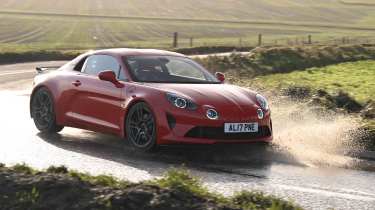
The Alpine A110 is a very quick car, but it’s the way in which it delivers that power that adds to the excitement. With so little weight to move around, the Alpine always feels eager to surge forward with even a gentle tickle of the throttle. As the engine reaches its boost, the car flies towards the horizon in a way that feels every bit as dramatic as its rivals.
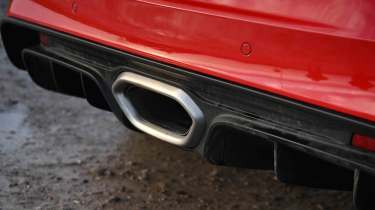
While the noise from a four-cylinder turbo is never going to be as exciting as a Porsche Cayman’s flat six or a Ford Mustang’s V8, it’s among the better examples of the breed – suitably rorty on acceleration without going over the top with childish pops and bangs from the exhaust, offering just a little turbo whoosh to add more character.
When the A110 was announced, we were disappointed to discover that there would be no manual gearbox option. However, we’ve long dismissed that as an issue, because the dual-clutch transmission used here is superb. Shifts are responsive both up and down the ratios, and it’s also very smooth and easy to live with at parking speeds, with no unnecessary sharpness or jerkiness.
Few cars deliver the purity and precision of the Alpine A110, whether the road is challenging or not. It’s a truly superb driver’s car, yet remains one that’s approachable, too. Around town it takes barely 100 metres of driving this sports car to understand its strengths. The car moves off from a standstill feeling like there’s no inertia whatsoever, and the steering, which is light, feels wonderfully precise. Its compact dimensions make it easy to place on the road, and the turning circle is good which makes the A110 perfectly fine to potter around town in.
Driving the A110 solely on urban trips would be missing out on what it’s truly capable of, however – it’s on a twisty B-road where it really shows its mettle. There are few cars better suited to a UK back road; those compact dimensions once again come into play, but it’s the suspension’s ability to soak up bumps that steals the show. This enables the Alpine to flow along a tricky section of tarmac better than any of its closest rivals, remaining unfazed by mid-corner bumps.
The lack of mass has allowed Alpine’s engineers to soften the suspension just enough to allow a touch of body roll – a useful indicator for the driver as to how much the car is loading up through the turns – while keeping things neatly under control when the road really gets challenging.
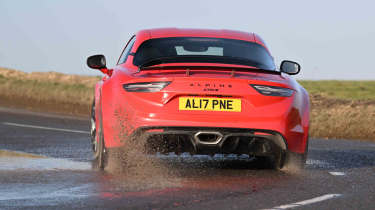
If anything, it’s the base A110 that feels best suited to UK roads; the firmer GTS and R variants stiffen things up, which makes them more focused on smooth surfaces or tracks, but prevents them from riding quite so sweetly as the entry-level version elsewhere.
That light steering is also loaded with feedback, and can point the car towards an apex with barely a flick of the wrist. The balance is wonderful, grip is strong and the brakes manage to give plenty of confidence even after repeated, heavy use.
One of the small compromises of the A110’s light weight is that certain creature comforts are used more sparingly. Soundproofing is one such luxury that you’ll struggle to find. Compared with a Ford Mustang or a BMW M2, the A110 isn’t as peaceful inside at motorway speeds, but road and wind noise aren’t much worse than you get in a Porsche Cayman. That composed ride also comes into its own here, because this is an impressively comfortable cruiser.
At the top of the range sits the A110 R. Think of it as the GT3 to the standard Porsche 911 range; it removes weight, largely through the use of carbon-fibre parts extending as far as even the wheels, to add more focus.
While it’s firmer-riding than the base A110, there’s an extra layer of sophistication built in. So while it’s a bit firmer to use every day, once it’s on the right road, it’s transformed into a mind-blowingly sharp performance car. It’s expensive, but if you can afford it, it’s definitely worth the extra.
0-62mph acceleration and top speed
On paper, some buyers might look at the 1.8-litre capacity of the Alpine’s four-cylinder engine and be left underwhelmed. But it comes from good stock, because it’s essentially the same unit that was fitted to the final-generation Renaultsport Megane – a car that was never criticised for lacking straight-line speed. In base spec, there’s 249bhp on tap, climbing to 296bhp for the rest of the range.
With that engine bolted behind the driver in a car that weighs just 1,102kg, performance isn’t in short supply. The base A110 can dash from 0-62mph in 4.5 seconds, the GTS 4.2 seconds, and the more potent (and lighter) R model in a mere 3.9 seconds.
| Model | Power | 0-62mph | Top speed |
| A110 | 249bhp | 4.5 seconds | 155mph |
| A110 GTS | 296bhp | 4.2 seconds | 161mph |
| A110 R | 296bhp | 3.9 seconds | 177mph |
MPG, emissions & running costs
Pros |
|
Cons |
|
With so little weight to lug around, the engine really doesn’t need to work very hard in everyday driving. As a result, the Alpine A110 is impressively kind on your wallet at the fuel pumps – especially by the usual standards of a high-performance car.
When we ran an A110 on our long-term test fleet, we averaged 34.8mpg over the course of 12,000 miles. We did see that figure climb beyond 40mpg on lengthy motorway journeys, though.
If you consider taking your A110 on a track day, that light weight has its benefits here, too, because compared with a heavier rival like a BMW M2, the Alpine will be much kinder on its tyres and brakes.
| Model | MPG | CO2 | Insurance group |
| A110 | 42.2mpg | 153g/km | 47 |
| A110 GTS | 40.4mpg | 158g/km | 49 |
| A110 R | 41.5mpg | 155g/km | 50 |
Tax
Every A110 sits above the £40,000 combustion luxury car tax threshold, so you’ll be faced with an additional £440 on top of your annual VED road tax bill between the second and sixth of ownership. Although this car’s fuel consumption and CO2 emissions are fairly modest compared to several of its performance car rivals, the lack of electrification also means a lack of tax savings.
Insurance groups
This is a low-slung, performance-focused sports car, so it should come as no surprise that the A110 will be pricey to insure. The base model sits in insurance group 47 (out of 50), while the GTS finds itself in group 49. The A110 R, meanwhile, predictably resides in group 50.
One thing that might come as a surprise, though, is that the entry-level Porsche Cayman actually sits slightly lower on the insurance scale than the Alpine, in group 44.
Depreciation
The Alpine A110’s desirability helps to make it a decent investment, one that’s reasonably financially sound as well as fun to drive. Our market data shows that this car should retain between 51 and 55 per cent of its original value after a period of 36,000 miles or three years. The Porsche Cayman is stronger still, though, at 52 to 65 per cent.
Design, interior & technology
Pros |
|
Cons |
|
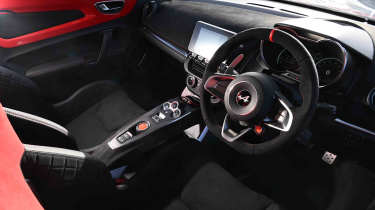
It’s a little more sparse inside than some of its rivals, but that’s one very small compromise you have to pay for the Alpine A110’s light weight, which forms such a significant part of the driving experience.
Those stepping out of a BMW M2 or even a Porsche Cayman will no doubt find the A110’s cabin a little spartan – but that’s kind of the point when you consider the seventies rally car it pays tribute to.
It has all of the features you need, with just one or two small luxuries thrown in. There are plenty of examples of Renault parts bin sharing here; the climate control panel is lifted from a Mk1 Renault Captur and there are lots of other buttons familiar to the brand’s cheaper models. But at least all of those controls are operated with physical switches, so they’re rather easier to use than touchscreens. The neat bank of toggle switches below the screen and array of buttons for the gear selector add design flair.
You won’t find many soft-touch plastics inside the A110’s cabin, but it manages to make the most of its lightweight approach without feeling cheap and nasty. The steering wheel is nice to hold and the wheel-mounted gear paddles feel solid and have a more pleasing action than in most rivals.
Sat-nav, stereo and infotainment
In a car where simplicity is one of its key selling points, the A110 isn’t loaded with tech. However, Alpine’s Telemetrics system can help to coach its owner to help them get the most out of the car. Standard on the S and the R and optional on the entry-level model, Alpine-Telemetrics allows the driver to monitor the car’s vital statistics in real time.
It’s fair to say that the seven-inch display in the A110 isn’t exactly the most advanced of its type – indeed, the basic interface is similar to that seen on much older generations of Renault’s small cars.
Don’t expect glitzy graphics and instantaneous loading times here, then, because everything feels a bit clunky. Fortunately, it’s possible to hook up a smartphone via Android Auto or Apple CarPlay, so things are much better if you leave your own device to take care of navigation and music.
Boot space, comfort & practicality
Pros |
|
Cons |
|
A two-seat performance car is never going to deliver limo-like cabin space, but the Alpine’s compact luggage areas are just about adequate for a few bags of soft luggage – that’s as good as it gets.
The seats are height-adjustable, but not via a lever – you’ll need to remove and refit a couple of bolts to relocate the seat into a higher or lower position, so it’s not something you can do quickly between drivers.
Regardless of where it’s positioned, your brain is initially tricked into thinking that you’re sitting a little high; but this is because the base of the windscreen sits so low. It’s a feeling that the A110 has in common with modern McLarens and the original Honda NSX, and the benefit is that you get a brilliant view of the road ahead. Storage is very limited, however, with a small net and shallow door pockets about the full extent of the options for holding items in the cabin.
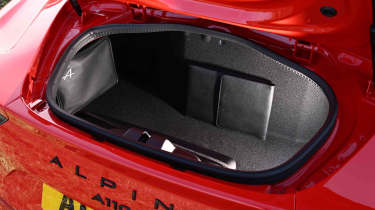
Long weekends away in the Alpine will need some investment in soft luggage and fairly light packing, because the 90-litre boot isn’t just small, the opening is tiny, too. Fortunately there’s a second boot up front, which at 100 litres is a little larger. The front boot is the place to store the weekly shop, while the back is for takeaway meals; due to the exhaust’s proximity to the rear compartment, it tends to warm up once the engine is fully up to temperature.
| Dimensions | |
| Length | 4,510mm |
| Width | 1,865mm |
| Height | 1,650mm |
| Number of seats | Two |
| Boot space | 100 litres front, 90 litres rear |
Safety & reliability
Pros |
| Renault (Alpine’s parent company) has a strong Driver Power reputation… |
Cons |
|
Alpine didn’t feature in the most recent Driver Power owner satisfaction survey, but Renault itself landed in an admirable sixth place out of 31 brands in the best manufacturer results. However, at the other side of the Renault Group pricing scale, Dacia finished in a disastrous 29th place, only managing to outperform BYD and MG.
Due to it not being a particularly mainstream model, Euro NCAP hasn’t put the Alpine A110 through its stringent testing .There isn’t a huge amount of safety tech on offer, either, but you do get stability control, emergency brake assist, hill-start assist and a couple of airbags. The A110 is also offered with a three-year/60,000-mile warranty, which is pretty mediocre when brands like Kia offer seven years and 100,000 miles.
Alpine’s dealer network isn’t as widespread as those of Ford, BMW or Porsche, so keeping up scheduled maintenance could be more of a hassle than rivals, depending on how close you live to one of the brand’s UK locations.
Alpine A110 alternatives
The sports car market isn’t anywhere near as big as it once was, but there are still a few talented options to pick from. The most obvious alternatives are the Porsche 718 Cayman and Lotus Emira, both of which are also low-slung and lightweight cars that are unashamedly driver-focused.
However, a more left-field and brutish choice is the Ford Mustang. It’s still a four-seat coupe with a big V8 up front, as it has been for decades, but nowadays this muscle car is appealingly priced and surprisingly agile in its handling. Finally, the BMW M2 offers sweet rear-drive handling at a similar price point, but with a touch of added practicality.
Alpine A110 GT long-term test

Our contributing editor, Steve Sutcliffe, certainly enjoyed the driving experience during his seven months behind the wheel of a GT trim Alpine A110, but it certainly wasn’t trouble-free.
Steve experienced some niggles during his ownership, these included the sat-nav screen going blank just at the end of his journey when he needed directions, some interior rattles and squeaks, and some erratic behaviour from the gearbox as the car approached its 12,000-mile service. Happily, all the mechanical and interior trim issues were taken care of, at which point, Steve seriously considered buying an A110. You can read the full long term test here…
Key updates of the Alpine A110 review
18 May 2026: Latest driving impressions, pricing and taxation data.
Frequently Asked Questions
While Alpine quotes fuel economy in the low 40s for all models in the range, when we ran an A110 on our long-term fleet, we saw figures closer to 35mpg. That’s still pretty impressive for a sports car that delivers entertaining handling that urges you to press on when you can.
Deals on the A110 and alternatives