Death of the convertible car: Have we fallen out of love with soft-tops?
As SUV sales soar, is the sun setting on the once-popular drop-top?

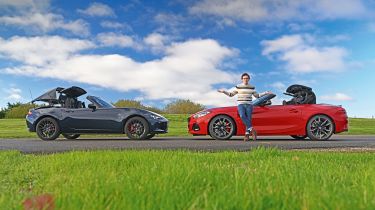
Convertibles are becoming a critically endangered species, with sales of drop-top cars plunging over the past decade-and-a-half as buyers are instead tempted by more fashionable high-riding SUVs. While cars such as the Mazda MX-5 seem to boast enduring longevity, it’s very much the exception as other cabriolets, such as the BMW Z4, end production due to sagging demand.
According to data from the Society of Motor Manufacturers and Traders (SMMT), just 12,173 new convertible models were registered in the UK in 2024. That’s a substantial 66 per cent decrease from the 36,193 examples that found homes in 2019. Wind the clock back even further to 2010 and there were just over 60,000 new drop-top vehicles registered, accounting for roughly three per cent of all new cars, compared with just 0.6 per cent in 2024.
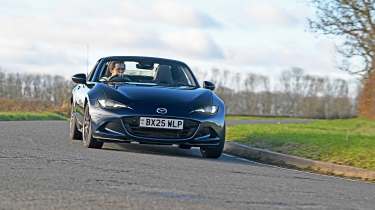
Such a staggering slump in sales might be surprising given the undying appeal and benefits of a retractable roof; the Auto Express Convertible of the Year, the Mazda MX-5, remains an absolute thrill even more than a decade after the current model’s release. Yet the roadster perseveres as one of the very few affordable convertibles still on sale today.
Convertibles are getting more expensive
In 2025 we said goodbye to a handful of drop-top models, including the BMW Z4 and its sibling, the larger 8 Series Convertible. The Z4 in particular is emblematic of the seeming demise of the affordable convertible; while it’s hard to call a forty-odd-thousand-pound roadster from a premium German manufacturer ‘affordable’, most drop-tops nowadays are even more costly.
Convertibles and cabriolets have historically demanded a premium over their fixed-roof counterparts, given their added complexity; insight director at analytics firm Cox Automotive, Philip Nothard, points out how, for example "convertibles require a different bodyshell – it’s not just a case of taking off the roof”.
The cost of these structural differences and the intricacies of the folding mechanisms are then passed onto the consumer, with the individual customer taking much of the financial burden given the comparatively few sales these types of model achieve in contrast to more mainstream bodystyles.

Of course, that’s not to say that more affordable convertible options never existed; cars such as the Volkswagen Golf Cabriolet, Peugeot 206 CC or even the more recently cancelled Audi TT Roadster, were all proof that making a mainstream convertible model isn’t out of the realm of possibility.
Go back to around 2010 and affordable folding hard-top convertibles were big news thanks to the Peugeot 207 and 308, Ford Focus, Renault Megane and Nissan Micra, as well as bespoke nameplates such as the Vauxhall Cascada and Volkswagen Eos, all of which died out by 2016. The Audi A3 Cabriolet was discontinued in 2020 and the BMW 2 Series Convertible followed a year later, while the radical and slightly oddball drop-top SUV will soon be extinct following the Range Rover Evoque’s departure several years ago and the imminent demise VW T-Roc Cabriolet following the arrival of the all-new T-Roc.
That said, we took a look at all of the new convertibles that remain on the market today costing less than £150,000. Excluding low-production kit cars and stripped-down track-day weapons such as the Caterham Seven, buyers now only have a choice of 16 distinct models – six of which are derivatives of the BMW 4 Series, Mazda MX-5 and Porsche 911.
In fact, only two – the MX-5 and MINI Cooper Convertible – cost less than £30,000. This, alongside the fact that the average price of all drop-tops under £150,000 is a wallet-wrenching £68,500 and the median is just shy of £55,000, it appears as if owning a convertible car is slowly and sadly becoming the preserve of the wealthy.
Such a shift upmarket largely comes down to profit margins; more expensive cars typically operate with wider margins and thus make more sense in such a narrow market. With this in mind, most manufacturers have decided to either make their convertible offerings more premium, or cancel them altogether.
“Over the last five years, brands have been streamlining their production line-ups as they attempt to transition into a new-energy world,” Nothard explains. “Doing this while fulfilling all these segments – superminis, city cars, convertibles, SUVs etc – becomes massively complex and expensive.”
Yet while the selection at the lower end of the market has diminished significantly, those with cash to splash still have plenty of options; almost every sports and supercar out there now has a convertible variant. This means that while sales have taken a nosedive overall, the actual number of convertibles on-sale, according to the SMMT, hasn’t shifted quite as much (59 in 2010 vs 46 in 2024). Although it’s important to remember that a large portion of these models are high-end luxury cars selling in very small quantities.
Consumers prefer SUVs
The already-restricted market for convertibles appears to be shrinking even further, however, as a survey by Auto Express and partner site, Carwow, found that the most common reason many people avoid convertibles (40 per cent of respondents cited this) is the bodystyle’s inherent impracticality.
This might not come as a surprise because, while driving a convertible can be a truly exhilarating experience – the MX-5 delivers thrills that can rival even the most high-end supercars, despite only producing 184bhp – the lack of boot space, fabric roof and often two-seat configuration adopted by many drop-tops means these models simply won’t fit all buyers’ needs.
“The cost of living is certainly playing into [reduced convertible sales],” Nothard adds. “Many people are having to watch what they spend and owning a weekend car like a convertible in addition to a family or business car is a luxury for most.”
So with consumers now having to buy with both their head and heart, the apparent fall in popularity of convertibles has coincided with the stratospheric rise of the SUV and crossover. In 2024, one third of new cars sold in the UK were SUVs, up from one quarter in 2019, with a vast majority of new models being of this bodystyle.
Will convertibles become extinct?
Why has the MX-5 survived when others haven’t? Mazda’s European project manager for product planning, Moritz Oswald, told us: “It's probably one of the best roadsters that was ever built. I think it's the most distinctive product out there and we have a huge, loyal customer base.”
Oswald explains how Mazda is “a small brand, so we need a halo car that attracts audiences”. This philosophy extends to MG, which introduced the Cyberster in 2023. This electric drop-top recalls the firm’s sports cars that existed prior to its Chinese buyout and defined its future design direction.
The Cyberster is one of the first convertible EVs on sale, excluding fabric-roofed hatchbacks such as the Fiat 500e Convertible. However, more could be on the way to keep the bodystyle alive, because Mazda looks to be developing a future electric version of the MX-5, utilising a unique stacked battery configuration in order to maintain the current model’s low centre of gravity.
In line with the ongoing scepticism surrounding the transition to electric vehicles, it likely won’t be electric only, though. “I'm not sure if it has to be an EV, because we have multiple solutions,” says Oswald. “I'm a bit old-fashioned. I do like the engine sound. But I can also imagine if it's electric, the advantages could be really interesting.”
All of this remains a few years away, according to Oswald, who says electric powertrains are “a bit too heavy”. It also remains to be seen whether consumer appetite for electric convertibles will be strong enough to counterbalance the research and development costs; manufacturers are already forking out billions on developing EV technology and a low-volume, low-margin convertible won’t exactly look like the most appealing option.
Nevertheless, with China’s Leapmotor having just revealed a new electric convertible concept and a zero-emissions version of the Porsche Boxster being officially on the horizon, the rag-top may not be heading for extinction just yet.
However, given the high cost associated with development of cabriolets, most of us will be forced to turn to the used market if we want the wind in our hair, as the models available continue to push further and further upmarket.
What are the best convertibles that you can still buy?
While the market is dwindling, there are still some top-notch drop-tops to choose from, ranging from sporty two-seaters to prestigious luxury cruisers. Our expert road testers have driven every convertible, cabriolet and roadster that you can buy in the UK, whatever the weather, and have rounded the up to top ten best convertible cars that you can buy right now. This list is compiled using the results of our thorough real-world testing.
- Mazda MX-5 - from £28,500
- MINI Cooper Convertible - from £29,000
- Mercedes CLE Cabriolet - from £55,000
- Porsche 911 Cabriolet - from £114,000
- Fiat 500e Convertible - from £31,000
- BMW 4 Series Convertible - from £55,000
- Ford Mustang Convertible - from £61,000
- McLaren Artura Spider - from £221,500
- Ferrari 296 GTS - from £280,000
- MG Cyberster - from £55,000
To read more about the very best convertible cars on sale, click here...