Genesis Electrified G80 review
The Electrified G80 is an executive saloon that’s as luxurious as it is left-field

Our opinion on the Genesis Electrified G80
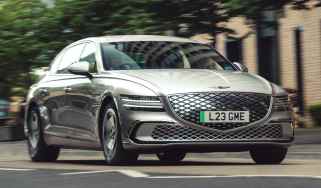
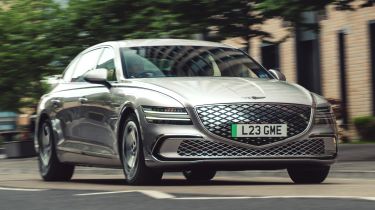
The Genesis Electrified G80 is an executive saloon that immediately grabs your attention. It’s an intriguing combination of an unshamedly traditional full-size saloon body with a thoroughly modern EV powertrain.
The fit and finish of the G80 certainly passes muster in this hard-fought sector, and its electric car credentials – namely range and charging capabilities – are strong. However, this is a market where badge appeal rules the roost, and we’d have hoped that this car’s sheer length would’ve resulted in a more spacious rear cabin.
About the Genesis Electrified G80
Taking on the likes of the BMW and Mercedes is no easy task, but Genesis has struck an impressive balance with the Electrified G80. This is a car that, at least at first glance, possesses a lot of the key features needed to succeed in the electric executive car sector.
In terms of appearance, it’s not uncommon for passers-by to mistake our Genesis test cars for Bentleys. We don’t have many concerns about the G80’s EV powertrain, either, as the firm’s parent company, Hyundai, has a strong track record in this field.
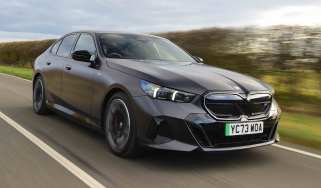
However, Genesis is still an overlooked brand on the UK market, and the fact this car costs several thousands of pounds more than a BMW i5 or Mercedes EQE could go some way towards explaining why that’s the case.
Used - available now


To see how the Electrified G80 performs against its rivals from the big German exec brands, we drove it alongside a Mercedes EQE in a twin test. Despite its rival’s slick tech and exquisite refinement, though, the Genesis was the winner due to its impressive performance and running costs.
Performance & driving experience
Pros |
|
Cons |
|
Compared with the class leaders from Mercedes and BMW, the Electrified G80 leans far more towards comfort as opposed to driver engagement. This won’t necessarily be a bad thing for some buyers, but it does mean a slightly less enjoyable experience in some driving scenarios.
| Model | Power | 0-62mph | Top speed |
| Electrified G80 (all variants) | 365bhp | 5.1 seconds | 139mph |
Electric motors, 0-60mph acceleration and top speed
With 365bhp on tap, plus a meaty 700Nm of torque from the two electric motors, the G80 feels more than quick enough for a model of this type. Perhaps most impressive is the instant, in-gear shove, with the car able to accelerate keenly even at motorway speeds. From a standstill, 0-62mph officially takes 5.1 seconds, and that number feels perfectly achievable in the real world.
Town driving, visibility and parking
The steering is well weighted, and we love the Hyundai-Kia Group’s paddle-activated regenerative braking system, which can be adjusted on the fly. There are four settings – the strongest of which offers one-pedal driving, and is perfect for use around town.
One function we particularly like is ‘Chauffeur Mode’, which softens the throttle map and removes the initial sharpness in the brake pedal. It’s designed to make the car more relaxing for those in the back, but if you’re just pootling around, it’s a perfectly likeable default driving mode.
However, when it comes to parking, the rear windscreen is rather small so visibility is limited. This car’s size also means that you’ll be extra wary when navigating into a tight space. Thankfully, an array of standard-fit cameras makes life just that bit easier.
Country road driving and handling
This is a very large saloon that’s firmly skewed towards wafting around in comfort rather than blasting around a corner. However, the Electrified G80 will just about maintain its composure if you’re driving in a spirited fashion, though we’re not sure that you’ll ever want to. If you want more of the fun factor from your electric exec, we’d steer you towards the BMW i5.
If comfort is key — and it should be — the Genesis’s camera-controlled damping does a pretty decent job of smoothing out lumps and bumps in the road.
Motorway driving and long-distance comfort
The Genesis is at its best when cruising along on the motorway, where the quiet electric powertrain, clever noise-cancelling tech, acoustic glass and road-reading adaptive suspension make it a compelling long-distance companion. Driving with a little more urgency doesn’t really suit the G80, although it’d be unfair to suggest it was anything other than perfectly capable when you’re in more of a hurry.
Our biggest complaint centres around the often distracting driver-assistance systems. The lane-departure and speed-limit warning systems are annoyingly sensitive, and the attention monitor seems to sound its alarm all too often – even when glancing to change the temperature on the climate control. You can turn these warnings off, of course, but the likes of BMW and Audi seem better able to integrate these systems without reducing their functionality.
Range, charging & running costs
Pros |
|
Cons |
|
Genesis initially offered the G80 with either a petrol or diesel engine, but the range now comprises a single all-electric model. This means business users, in particular, may wish to take a longer look at this impressive executive saloon.
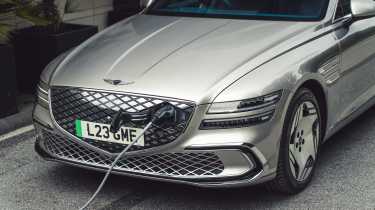
As well as axing combustion, Genesis also treated the EV to a larger 94.5kWh battery as part of a facelift in 2025. This saw the official WLTP Combined range bumped up to an impressive 354 miles, which is up from 323 miles previously.
During testing we saw a very reasonable 3.4-3.5 miles per kWh, which should ensure a range of close to 300 miles is achievable in normal driving conditions. Our test took place on a warm summer’s day, but the standard-fit heat pump will help maintain efficiency in the colder months. The G80 can also disconnect its front axle at a cruise, further boosting range.
Based on the same 800-volt electrical architecture as the Genesis GV60 SUV, as well as the Hyundai Ioniq 5 and Kia EV6, the G80 can charge at up to 187kW, taking the battery from 10 to 80 per cent in just 25 minutes. A BMW i5, despite claiming a higher peak speed of 205kW, takes longer to charge its slightly smaller battery to 80 per cent.
| Model | Battery size | Range | Insurance group |
| Electrified G80 (all variants) | 94.5kWh | 354 miles | 50 |
Insurance groups
If you’re in the market for an executive saloon then you probably won’t be surprised to hear that insurance premiums will be steep. The Genesis Electrified G80 sits in the top insurance group 50, whereas the BMW i5 dips as low as group 43.
Tax
The standard rate of VED road tax applies here, as does the lowest applicable rate of company car tax. However, the G80’s premium positioning means it sails past the £50,000 luxury car tax threshold for EVs. Because of this, you’ll need to account for an additional £440 being added to your annual tax bill between the second and sixth year after the car is registered.
Depreciation
The Genesis Electrified G80 isn’t a cheap car, and our market data makes for grim reading in the eyes of buyers and owners. After a period of three years or 36,000 miles, this executive saloon is only set to retain 37 per cent of its original value.
However, the BMW i5 fares even worse at a mere 34 to 37 per cent, and it’s an even bleaker story with the Mercedes EQE at 29 to 35 per cent.
Interior, design & technology
Pros |
|
Cons |
|
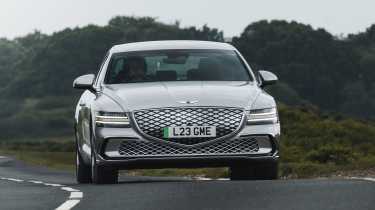
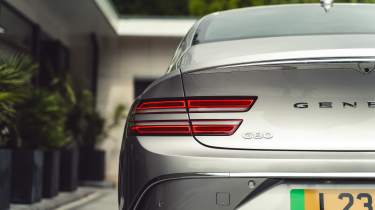
A premium executive car has to offer the right balance of style and sophistication that will win over customers seeking to make a particular impression. The G80 looks suitably purposeful with its huge wheelbase, coupe-like lines, long bonnet and oversized grille providing a little individuality and helping it to literally stick out from the office car park crowd.
Since the car was facelifted, there’s just one specification on offer. It’s technically labelled ‘Dynamic’, but has been designed to replace the old ‘Luxury’ trim. Despite its name, the G80’s styling doesn’t offer the racy edge you’ll find with M Sport BMWs or AMG Line Mercs – this is a car that’s unashamedly aimed at business users and the chauffeur-car market, and has been designed to shout more about its premium aspirations, than its sporting prowess.
At the front, you’ll immediately notice the huge grille, which subtly hides the (heated, no less) charge port on one side. Some of the trim, plus the headlights and bumpers were updated as part of the facelift, alongside the wheels and windowline. Apparently, everything from the B-pillar backwards is new to the revamped cars – chiefly to accommodate that 130mm-longer wheelbase.
Interior and dashboard design
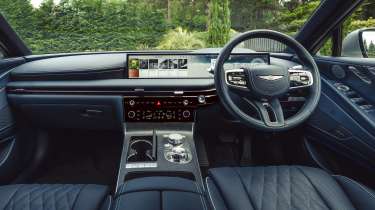
If the exterior appeals, then a glance inside the cabin will possibly seal the deal, because the G80 serves up a serious slice of luxury. It’s not just the areas in frequent use that make a good impression, the fit and finish everywhere is first class and we think the G80 can hold its head high alongside the Mercedes EQE on this score.
Materials and build quality
Inside, all cars get lovely leather trim (upgradable to a Nappa alternative for an additional charge) and the build quality is first rate. We’d like a bit more adjustment in the seat – the big battery means you sit quite high – but we didn’t find the driving position particularly uncomfortable.
Infotainment, sat-nav and stereo
Facelifted cars are fitted with a 27-inch, single-piece screen on the dashboard, spanning the infotainment system and digital instrument cluster. This setup looks very smart, doesn’t distract from driving and is easy to glance at for quick directions.
We also found the menus easy to navigate, either via touch, or by using the rotary dial on the centre console, while the digital instruments are clear and easy to read. The blind-spot monitor, which pops up with a camera view when you indicate to change lanes, is particularly well integrated.
Boot space & practicality
Pros |
|
Cons |
|
The G80’s cabin is a quality affair and full of luxurious touches; the seats are extremely comfortable and there is the option of specifying the Comfort Pack and Second Row Comfort Pack if you want to take things up a notch.
Dimensions and size
The G80 is something of a behemoth – particularly since the car was facelifted and an extra 130mm was added to the wheelbase. At 5,135mm long, it sits in between the BMW i5 and BMW i7.
| Dimensions comparison | |||
| Model | Genesis Electrified G80 | BMW i5 | Mercedes EQE |
| Length | 5,135mm | 5,060mm | 4,964mm |
| Width | 1,925mm | 1,900mm | 1,961mm |
| Height | 1,480mm | 1,515mm | 1,510mm |
| Wheelbase | 3,010mm | 3,000mm | 3,120mm |
| Boot space | 334 litres | 490 litres | 430 litres |
Seats & passenger space
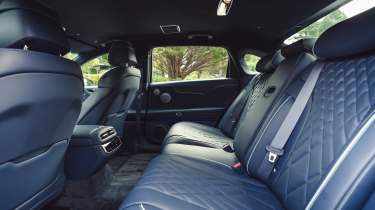
However, the G80 is a little lacking when it comes to rear-seat practicality, which is a shame given it’s so specifically targeted at the executive chauffeur-car market. The long wheelbase gives you loads of legroom, but thanks to the chunky battery, foot space under the front seats is limited. There’s not enough headroom for taller adults, either, forcing you to slouch a bit if you want to avoid rubbing your head on the roof.
Boot space
The old, petrol-powered G80 offered a reasonable 424-litre boot, which while not big enough to challenge the class leaders, did at least mean you could fit a couple of large suitcases in without much trouble.
The Electrified G80, however, has lost a big chunk of that due to the packaging of the electric motor. At 334 litres, it is smaller than a Volkswagen Golf’s, and the compromised shape and step in the floor means you can’t push things to the very back. Both the Mercedes EQE and BMW i5 boast more than 400 litres apiece, and the latter is also offered as a Touring estate should you need the extra room. We’d recommend trying the G80 before you buy, because it could be a dealbreaker.
Reliability & safety
Pros |
|
Cons |
|
Genesis didn't appear in the most recent Driver Power owner satisfaction survey, although being the luxury arm of parent company Hyundai should inspire some confidence as this brand generally performs strongly.
Industry crash-test body Euro NCAP awarded the pre-facelift G80 a full five-star rating, with a 91 per cent score for adult safety, 87 per cent for child protection and a reassuring 91 per cent mark for on-board safety assist technology. However, it hasn’t yet tested the facelifted car, nor do we expect an updated score any time soon.
All models include Smart Cruise Control (SCC) and a range of driver ‘Assist’ features: blind-spot collision-avoidance, lane-keeping assist, forward collision-avoidance, intelligent speed limit, lane following and highway driving are all standard.
While Genesis is boosting its dealer presence, it is still looking to differentiate itself with a concierge-style offering that can arrange delivery to your home address, plus offer ongoing support via its ‘Personal Assistant’ service.
Genesis offers a Care Plan for all of its model ranges that brings together warranty cover and servicing under one banner. When your car is due for an inspection, Genesis will arrange to collect your vehicle, perform any necessary work and return it to an agreed location. A courtesy car will also be made available while your vehicle is off the road.
| Euro NCAP safety ratings | |
| Euro NCAP safety rating | Five stars (2021, pre-facelift) |
| Adult occupant protection | 91% |
| Child occupant protection | 87% |
| Vulnerable road user protection | 77% |
| Safety assist | 91% |
Buying, prices and deals
- Best buy: Genesis Electrified G80 Dynamic
You’ll be spending a pretty penny on this car, but it comes with more than enough luxuries and kit in its entry-level Dynamic trim that we’d question the need to fork out any more on the Luxury trim. The Dynamic starts from around £76,500, while the Luxury commands at least another £8,000 on top of that. Both cars have exactly the same powertrain, so you won’t be making any sacrifices in terms of performance or efficiency.
Genesis Electrified G80 alternatives
If you’re in the market for a posh electric executive car, the most obvious alternatives come from the big German brands. The Mercedes EQE errs on the side of comfort, much like the Genesis, while the BMW i5 adds in much more sporting flair. If budget isn’t an issue and you fancy a particularly large saloon car, the even fancier Mercedes EQS and BMW i7 should also be on your radar.
Key updates of the Genesis Electrified G80 review
22 June 2026: Latest driving impressions and depreciation data.
Frequently Asked Questions
The Genesis Care Plan includes a five-year warranty and free servicing with a limited mileage of up to 50,000 miles.
Deals on the Electrified G80 and alternatives