Used Mazda 3 (Mk3, 2014 - 2019) review
A full used review on the Mazda 3 covering the Mazda 3 Mk3 that was on sale from 2014 to 2019

Verdict
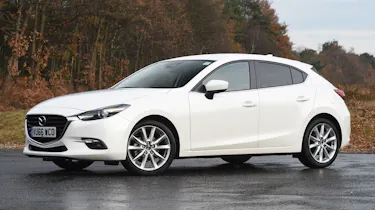
Although the Mk3 Mazda 3 has been obsolete for a few years, there’s plenty to like about it – and this is a car that we loved when it was new. We ran a 2.0 Skyactiv-G 120 model on our fleet for a year and clocked up almost 32,000 miles in that time. The verdict? A brilliant all-rounder that was frugal, a joy to drive, comfortable and eminently practical. No wonder the Mazda 3 saw off the Hyundai i30 in a twin test, and the Volkswagen Jetta was also beaten by a Mazda 3 fastback in another test. Every time we reviewed a Mazda 3 we were impressed, whether it was the entry-level 1.5 Skyactiv-G or the hotter 2.2 diesel – and we reckon that you’ll love the Mazda 3 too.
Compared with many of its rivals, Mazda is a relative newcomer to car manufacturing. It didn’t produce its first passenger car until 1960, but since then the company has built a reputation for making high-quality cars that are reliable and great to drive, plus they tend to look great, too.
All of this is true of the Mazda 3, and although the small family car segment is hotly contested, the Mazda manages to stand out from its rivals in many ways. Entry-level models feature a rather ordinary cabin, but posher editions feel much more premium. Whatever you buy, you’ll revel in the brilliant driving experience, impressive reliability and low running costs. And while the Mazda 3 was costly when new, prices are much keener on the used market.
Used - available now


Model covered
- Mazda 3 Mk3 (2014-2019) - Good-to-drive and sharp-looking Mazda offers used buyers a tempting package.
History
The Mazda 3 Mk3 arrived in January 2014, with 99bhp 1.5-litre or 119bhp/163bhp 2.0-litre petrol engines (badged Skyactiv-G); diesel fans could buy a 148bhp 2.2-litre Skyactiv-D diesel engine. The Sport Black special edition arrived in April 2016, with red or white paint, a 118bhp 2.0-litre petrol engine, 18-inch alloy wheels, leather and suede interior trim, plus a bodykit.
A 1.5-litre diesel engine joined the range in May 2016, then in October 2017 a revised Mazda 3 went on sale, with styling tweaks, updated suspension, improved refinement, better connectivity and optional adaptive LED headlights. From April 2018 there was another Sport Black limited edition, with blue, red or white paint, 18-inch alloys and extra equipment including a heated steering wheel, navigation and a Bose hi-fi. The Mk4 Mazda 3 launched in 2019 to replace this model.
Which one should I buy?
The smaller engines have to be worked hard to make progress, but they’re free-revving and enjoyable to use. The 2.2-litre diesel engine offers a fabulous blend of economy and performance, with even early cars Euro 6-compliant.
The entry-level SE is well equipped, with 16-inch alloy wheels, air-con, a seven-inch touchscreen, multifunction steering wheel, Bluetooth, and powered windows all round. Opting for SE Nav brings navigation, too.
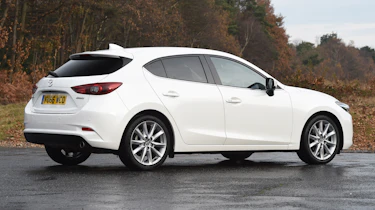
Moving up to the SE-L brings bi-xenon headlights, dual-zone climate control, privacy glass, automatic headlights and wipers, rear parking sensors, plus cruise control and a speed limiter; once again there’s an SE-L Nav option. The top Sport Nav model has 18-inch alloys, adaptive headlights, a premium Bose hi-fi, digital speedometer and front parking sensors.
Alternatives to the Mazda 3
The Mazda’s toughest adversary is the Volkswagen Golf, which features a very wide model range with some excellent engines. It also has a superb interior, and is good to drive. The SEAT Leon is closely related to the Golf and while it looks sharper, it’s more affordable. It’s also plentiful, equally practical and just as capable dynamically.
Another pair that are closely related are the Kia Ceed and Hyundai i30, which are reliable, well equipped and excellent value, while the Ford Focus is extremely likeable thanks to its ready availability, brilliant dynamics and impressive value. The Vauxhall Astra is also in plentiful supply and great value – traits it shares with the Peugeot 308, as well as the slightly bigger Skoda Octavia and Honda Civic.
What to look for
Driver assist
The earliest Mazda 3s are getting old, but they still have standard hill hold assist, speed limiter and auto emergency braking.
Codes
The first Mazda 3 was codenamed BK. The second was the BL and the Mk3 was known as the BM, or BN for facelifted cars (from 2016).
Spare wheel
The 3 didn’t come with a spare wheel, but you can buy a space saver. You’ll also need a foam mould to make it fit under the boot floor.
Problems
Reliability is generally excellent. Most problems stem from poor maintenance, but diesel particulate filters can clog up on cars used only for short trips.
Common faults
Mazda has a strong reputation for reliability and the 3 is no exception. We have seen the odd report of minor glitches with the infotainment system and sat-nav, but generally all is well as long as any necessary recall work has been done.
Interior
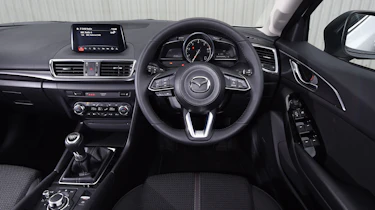
There’s a lot to like about the Mazda 3’s interior, because the dashboard is really well designed, so it’s both interesting to look at and user-friendly, while the quality is excellent. Although the saloon is 12cm longer than the hatch, cabin space is exactly the same because the extra length is all behind the back wheels. Every seat is comfortable and supportive, with lots of legroom in the back.
Boot space in the hatch is also rather good at 364 litres (1,263 litres with the back seats down). The fastback has an even more impressive 419-litre boot, but there’s no seat-folding option, which limits overall practicality compared with the hatch.
Running costs
The maintenance interval for all Mazda 3s, whether they’re fitted with a petrol engine or a diesel, is 12,500 miles or 12 months. Services alternate between minor and major, which are priced at £180-£220 (depending on which engine is fitted) and £276 respectively.
However, a really big service is required every six years, priced at £465; it’s when the spark plugs are changed as well as all of the fluids and filters. The brake fluid needs to be replaced every two years and this is accounted for in the standard service costs, but if it’s done on its own, you can expect to pay £40. All Mazda 3 engines are chain-driven, so there are no cambelts to replace, but the coolant should be renewed every 10 years or 125,000 miles. The cost of this is included within the general maintenance, however.
Driver Power owner satisfaction
The Mazda 3 Mk3 featured regularly in Driver Power surveys. It made its debut in our 2015 new-car survey, in 39th place out of 200 entries; the following year it climbed to 36th out of 150. In 2017 the Mazda came 31st from 75 entries, and its final new-car appearance was 28th out of 75 in 2018. The Mazda 3 also came 45th out of 100 entries in our 2019 used-car survey, with its best scores for driving enjoyment.
Mazda 3 (2014-2019) review: what we said
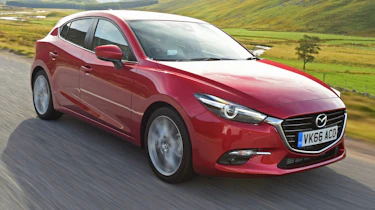
The Mazda 3 is a bit of an unsung hero in the compact hatchback market. While newer models like the Ford Focus and Kia Ceed take the plaudits, the Mazda 3 is still an enjoyable car to drive with sharp looks, plenty of kit and low running costs. Despite an all-new model due later in 2019, the current car is still a great all-rounder in the competitive family hatchback sector.
Improvements made to the Mazda 3 at the end of 2016 were small but worthwhile, and keen drivers will revel in the car’s engaging handling. The updates gave the car a step up in refinement, so it's one of the quieter cars in the class. However, the car's firm ride is the price you pay for its involving handling, although that will be a small matter for enthusiastic drivers.
Under the bonnet, the range of frugal and responsive petrol and diesel engines deliver great running costs, and we'd happily recommend the 3 to anybody who is looking for a change from the hatchback norm.
The Mazda 3 hatchback is a sleek looking five-door that sits between the Mazda 2 supermini and Mazda 6 family car in the Japanese maker’s UK line-up. The Mazda 3 for sale currently is the third generation, which first launched in 2013 and was facelifted in 2016.
That recent upgrade brought fresher looks, an upgraded and improved interior, and some mechanical tweaks, all of which were intended to cement the car’s position as one of the class leaders.
It’s a tough class, and there’s a huge range of rivals in the Mazda 3 price range. As well as the obvious trio of Ford Focus, Vauxhall Astra and VW Golf, there’s stiff competition from other Japanese rivals including the Honda Civic and Toyota Auris, and more cost-effective Korean contenders such as the Kia Ceed and Hyundai i30. You might also be looking at Renault Megane, SEAT Leon and Peugeot 308, or if you want to spend a bit more there’s the premium sector which includes the BMW 1 Series, Audi A3 and Mercedes A-Class.
The line-up consists of just three models, kicking off with the Mazda 3 SE - L Nav and the stylish Sport Black, before topping out with the Mazda 3 Sport Nav flagship. All of them are well kitted out, and the Sport Nav is laden with toys and luxuries including heated electric leather seats, a high end audio system and a head-up display.
There are four engines variants to choose from too, including a pair of 2.0-litre petrols with 119bhp or 163bhp. If you are more inspired by diesel, there’s a 1.5-litre four with 104bhp, and a 2.2-litre with 148bhp. You can chop and change engines and trims to some extent, but the 163bhp petrol is only available as a Sport Nav.
While some car makers promote low-emissions eco specials, there's no such option with the Mazda 3, although the 1.5D does dip below 100g/km. There’s a straightforward choice of two gearboxes: a six-speed manual or a six-speed automatic, although you can't get the auto with the 1.5-litre diesel.
Unfortunately, there's no high-performance version to take advantage of the car's inherent sharp handling. The Mazda 3 MPS hot hatchback is no more, and there no plans for a high-performance version of the current car.
Mazda has offered a four-door saloon version of the Mazda 3 in the past, and it's no different for the current model. Buyers who demand more carrying capacity from their 3 should definitely take a look at the Mazda 3 Fastback. It’s essentially the same as the hatchback, but its elongated rear end means you get a larger 419-litre boot. It's a rival for models such as the Hyundai i30 Fastback and Audi A3 Saloon. There's no price premium for the Fastback, while it also has slightly lower emissions than the hatchback.
The Mazda 3 also benefits from Mazda's ‘SkyActiv’ weight saving technology. This focuses on fitting the right engine for the car's size, instead of turbocharging a smaller unit. The 3 went on a diet to save weight and help economy and emissions, too, and the fringe benefit is that the 3, like all of Mazda's cars, delivers nimble handling. In fact, the 3 is one of the best handling hatchbacks on sale.
Engines, performance and drive
Mazda has a reputation for producing cars that are good fun to drive. Much of this comes from its incredibly successful MX-5 roadster, which is the world’s best-selling sports car and widely renowned as one of the best cars to drive at any price.
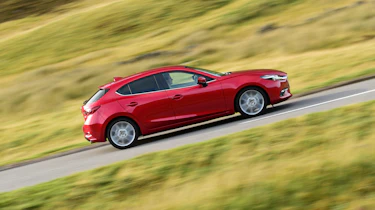
Even better is that a lot of the components and characteristics that make the MX-5 sports car so much fun tend to find their way into more conventional models, and the Mazda 3 is no exception. Thanks to its agile handling and rev-happy engine, the 3 has a surprising amount to offer for keen drivers, and it's a front-runner for driving fun in the hatchback sector.
Point the Mazda through a series of corners, and it’s immediately obvious that it has been developed by the same firm that makes the MX-5 roadster. The steering is quick and naturally weighted, while the car gives the impression that all four tyres are sharing the cornering loads equally, helping to create a feeling of near-perfect balance. Body control is also excellent, and the poised Mazda comfortably shrugs off mid-corner bumps.
Yet this agility on twisting roads doesn’t come at the expense of comfort, as the 3 rides bumps with surprising suppleness. Even potholes and sharp ridges fail to upset the car’s composure, especially in SE models on their modest 16-inch wheels wearing high-profile tyres.
2016 updates did little to change the driving experience, despite Mazda making a song and dance about its new 'G-Vectoring' technology. Essentially, the system subtly adjusts torque delivery according to steering angle, with the intention of making weight transfer through corners smoother. It's said to improve stability and comfort on longer journeys, but we didn't really notice the difference.
Engines
The Mazda 3 is also fast, especially the 2.2-litre diesel, which packs 148bhp and has a 0-62mph time of 8.0 seconds in the Fastback saloon and 8.1 seconds in the hatchback. The diesel engine also has a lot of mid range pulling power and it’s really responsive, so you can make the most of the engine simply by leaving it in gear – great for overtaking or on the motorway. However, Mazda’s six-speed manual gearbox delivers an unrivalled shift action. Snappy, positive and benefiting from a relatively short throw, it adds an extra layer of driver involvement to the 3.
The diesel is also extremely smooth, so much so that you wouldn’t really know it’s a diesel either on the move or when the engine is just ticking over. Even so Mazda felt the need to add a new sound deadening device in the engine to reduce vibration for the 2016 facelift, while further tweaks subtly improved throttle response.
The 2.0-litre 118bhp petrol engine is expected to be the biggest seller in the Mazda 3. It lacks the mid-range punch of the diesel but it isn’t far behind it in terms of acceleration – you’re looking at 0-62mph in 8.9 seconds for the hatchback and 8.8 seconds from the Fastback. You have to drive it a fair bit harder than the diesel to get the most out of it, though, and it can get unpleasantly noisy at high revs.
There’s also the option of a more powerful 163bhp version of the 2.0-litre petrol engine, which is almost as sprightly as the diesel with 0-62mph in 8.2 seconds, though it’s only available with the hatchback.
The 1.5-litre diesel is a tax-efficient engine designed for fleet use. It didn't feel very quick in the smaller Mazda 2 supermini where it debuted, and it feels lethargic at times in the heavier 3.
All the engines use Mazda’s SkyActiv technology, which aims to make the cars more efficient through saving weight. Those savings translate into both stronger performance and better fuel economy: the current 3 is much lighter on its feet and far more economical than its predecessor – and even that didn’t handle badly.
Surprisingly, Mazda hasn’t sacrificed refinement for performance and handling, as is often the case with sportier cars. The 2.2-litre diesel is extremely quiet for such an engine and the 2.0-litre petrol is similarly hushed and smooth.
Wind noise is also very low, but there is a bit of tyre and road noise, especially if you opt for a Sport Nav model with larger wheels. As impressive as the Mazda 3 is in this area, it’s got a way to go to have the Volkswagen Golf and the Audi A3 licked on refinement.
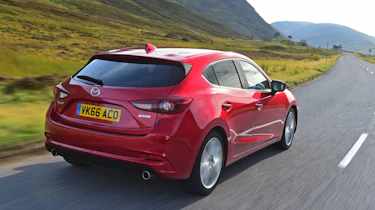
MPG, CO2 and Running Costs
It isn’t hard to find rival family hatchbacks that do better than the Mazda 3 in terms of fuel economy and emissions, but when you consider the size of the 2.2-litre diesel and how fast it is, the 3 does extremely well for itself. The most economical version is the 1.5-litre diesel, which returns claimed economy of 74.3mpg and emits 99g/km of CO2.
One thing to bear in mind is that the automatic gearbox really takes the edge off efficiency. The 2.2-litre diesel hatchback with an automatic transmission drops to 58.9mpg with CO2 levels rising to 129g/km, while the 1.5D breaks the 100g/km mark, which reduces its economy benefits. There are similar reductions for the petrol engines.
The 2.0-litre petrol returns a claimed 55.4mpg and emissions of 129g/km CO2. There is also a 162bhp version of the 2.0-litre petrol engine, but the combined cycle drops to 48.7mpg with CO2 emissions of 129g/km.
Interior, design and technology
Mixing eye-catching style with agile handling and impressive efficiency, the Mazda 3 Mk3 was an instant class contender when it debuted in 2013. Fast forward to 2016, and the hatch was treated to a mid-life update in an effort to keep pace with newer rivals.
You’re unlikely to spot the changes to the exterior unless you look closely. However, careful inspection will reveal the more prominent front grille, revised door mirrors and a reprofiled rear bumper. Range-topping Sport Nav models are identified by adaptive LED headlamps, while all versions are available with a trio of new metallic paints.
All versions get alloy wheels, colour-coded door handles and mirrors as standard. Sport Black cars get exclusive black detailing around the car plus dark 18-inch alloy wheels and privacy glass. Sport Nav cars get silver 18-inch alloys and distinctive LED running lights. Even without these eye-catching additions though, the entry-level 3 looks smart and upmarket, particularly if you go for the optional Soul Red signature metallic paint, which costs around £670.
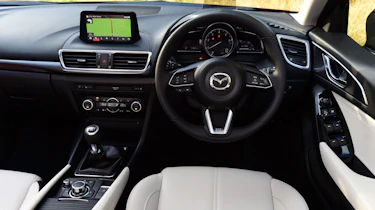
Inside, the upmarket theme continues, with the mix of tight build quality and decent materials lifting the ambience. Flashes of silver trim help brighten the otherwise dark interior, while the tablet-style touchscreen mounted is easy to see and use.
Eagle-eyed fans will spot the MX-5-style three-spoke steering wheel and the electric parking brake in which frees up extra storage in the centre console. Prod and poke the cabin and you’ll discover high-quality materials and switchgear.
Mounted on top of the dash is Mazda’s familiar seven-inch touchscreen, which can also be accessed via a rotary controller on the transmission tunnel. Other standard kit on the Sport Nav includes a full-colour head-up display, keyless entry, heated seats and a reversing camera.
The low-slung seating position gives the car a sporty feel, which is backed up by the large circular speedo set ahead of the driver. A centre console-mounted rotary controller operates the infotainment system, and it's straightforward to operate. Sport Nav models also benefit from a head-up display that shows speed and sat-nav directions on the windscreen in front of the driver.
While the Mazda can't quite match Volkswagen, BMW or Audi for upmarket appeal, the cabin still features plenty of soft-touch materials and it feels robust – more so than the old Mazda 3 and a lot of other Japanese cars, which have been known for slightly cheap feeling interiors.
Sat-nav, stereo and infotainment
The Mazda 3 has a decent standard kit list, which includes Bluetooth, USB and aux inputs and a seven-inch colour touchscreen display on the top of the dashboard. There are also a pair apps called Aha and Stitcher that allow you to sync up internet radio and social media accounts through a smartphone.
The infotainment system is very easy to use most of the time - it's likely you'll hardly bother using the touch interface often as the rotary dial is quick and intuitive. Sometimes, however, you'll find it lags and stutters between menus.
Practicality, comfort and boot space
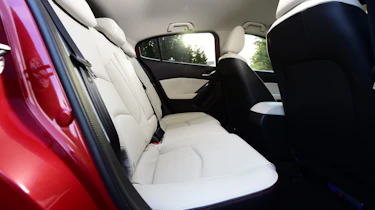
The price you pay for the Mazda’s sleek exterior is a cabin that can’t match the space in the Peugeot 308. Rear passengers don’t get quite as much leg or headroom, while the small side windows add to the slightly claustrophobic feel, and the shape of the hatchback’s rear window means visibility isn’t great. Both the hatchback and the Fastback saloon are five-seaters but it’s worth noting that the saloon has a marginally bigger boot.
On the plus side, there’s lots of storage elsewhere in the Mazda, including deep door bins, a lidded cubby between the front seats and a large, air-conditioned glovebox.
Size
The Mazda 3 hatchback is 4,465mm long and 1,795mm wide, while the Fastback saloon is a little longer at 4585mm, but an equal 1,795mm wide. The former is slightly longer than a Ford Focus – though the Ford is not renowned for its generous boot – and also longer than a Volkswagen Golf and Vauxhall Astra.
The Mazda’s shapely bumpers add a bit of exterior length, but the car as a whole could be more spacious given its longer proportions compared to rivals. At 1,465mm tall, the 3 sits lower than the Focus, the Astra and standard Golfs, which isn’t surprising given its sporty stance. However, it’s still taller than eco-friendly Bluemotion spec Golfs, which have a lower ride height to improve their aerodynamics and subsequently fuel economy.
Leg room, head room & passenger space
Though both leg and headroom have been improved over the old Mazda 3 by mounting the seats lower, neither are best in class and it’s quite easy to find rival family hatchbacks with more spacious interiors, such as the Peugeot 308 or the Nissan Pulsar.
Boot
The Mazda 3’s 364-litre boot is OK but it’s by no means the best in the class. It’s 106 litres behind the Peugeot 308’s boot and also lags behind the Volkswagen Golf’s 380-litres and the Vauxhall Astra's 370 litres. The Mazda does have more room in its boot than the Ford Focus though, which musters a mere 316 litres. However, the 3 doesn’t have any useful shopping bag hooks or even a 12-volt power supply. There’s a total of 1,263 litres available when the rear seats are folded flat.
The saving grace is the Fastback saloon, which has much more spacious 419-litre boot and there's a wide opening to make loading big items easy.